Utilization of Routine Health Information for Pharmaceutical Procurement and Associated Factors at Health Facilities in, Amhara Region, Northwest Ethiopia
Abstract
Background: Procurement of pharmaceutical drugs
plays a crucial role in the management of health. It takes a large part of the
country's budget to provide quality healthcare services from primary to
tertiary healthcare levels. The primary challenges are quality, quantity
and delivery time (lead time). There may be different associated factors with
poor routine information utilization but there is limited empirical evidence
found on routine information utilization for pharmaceutical procurement. In
Ethiopia, there are limited studies conducted on routine information
utilization for pharmaceutical procurement. Therefore, this study aimed to
assess the utilization of routine health information for pharmaceutical
procurement and associated factors at health facilities in Bahir Dar and West
Gojjam zone, Northwest Ethiopia.
Methods: An institution-based cross-sectional
study was conducted among pharmaceutical procurement committees at healthcare
facilities found in northwest Ethiopia from March 15 to May 5, 2023. The total
sample was 533. A stratified and simple random sampling technique was applied
to select health institutions and study units, respectively. Data were
collected by structured self-administered questionnaires after giving training
for data collectors. The collected data were entered into Epi Data 4.6 and
exported to SPSS version 25 for analysis. Descriptive statistics, bi-variable
and multivariable logistic regression analyses were done to identify the
associated factors.
Result: Of all 492 respondents, 296 (60.2%)
[CI 95%, 55.7, 64.4] used routine health information for pharmaceutical
procurement. Training [AOR=2.33; 95% CI; 1.218, 4.472] organizational culture
of information use [AOR=2.401; 95% CI; 1.076, 5.356] and user-friendly report
format [AOR=2.555; 95% CI; 1.333, 4.899] were found positively associated with
utilization of routine health information for pharmaceutical procurement.
Conclusion: Overall, this study finding showed
that more than half of respondents had a good level of utilization of routine
health information for pharmaceutical procurement. Trainning for data use,
user-friendly system design and organizational culture of information use were
significant factors for pharmaceutical procurement. The provision of training
on data use, developing an organizational culture of information use and
designing a user-friendly system could improve the utilization of routine
health information for pharmaceutical procurement.
Keywords: Ethiopia, RHIS, utilization, pharmaceutical procurement.
1. Introduction
Pharmaceutical is
drugs and medical supplies/equipment which are used to provide healthcare
services in different types of health facilities. Pharmaceuticals play a
critical role in the improvement of healthcare services as well as trust in
healthcare facilities when the pharmaceutical procurement process is based on
routine health information which is generated within the health facilities1,2. Pharmaceutical
procurement takes a large part of the country's budget to provide quality
healthcare service from primary to tertiary healthcare level though the
quality, quantity and time of delivery (lead time) are the main challenges3.
A routine health
information system is a system whereby health data are recorded, stored,
retrieved and processed to improve decision-making about health. It is vital
for the day-to-day patient management, disease prioritization, drug
procurement, health education, resource allocation and decision making as well
as for the planning, monitoring and evaluation of health care service
activities4,5. Pharmaceutical procurement is a
multi-disciplinary process requiring medical, pharmaceutical, managerial,
financial and often political expertise. An effective pharmaceutical
procurement process should ensure the availability of the right drugs in the
right quantities, at the right time, for the right patients at reasonable
prices and at recognizable standards of quality6. It is important for continuous
availabilities of medicines in resource-limited countries but without routine
health information, the underpinnings for evidence-based decision-making and
scientifically sound health information system is not only used for efficient
and effective clinical service but also for nonclinical (administrative)
service7.
Proper information
utilization is considered the foundation for effective health system
performance and a strategy to attain health-related targets in the Sustainable
Development Goal (SDG) era. The government of Ethiopia has considered
strengthening the health information system as a mechanism to enable effective
monitoring and evaluation of health policies, programs, projects and strategies
since 20068. In Africa health information utilization among
health professionals at healthcare facilities for decision-making is low, it
ranges from 27% to 699-11. Studies conducted in Addis Ababa,
Western Amahara, East Gojjam Zone and Hadya Zone revealed that the Routine
health information utilization rate was 37.3%, 38.4%, 45.8% and 69.3%
respectively5,12-14. It indicates utilization of health
information is lower than the national expectation which is 90%15. Another study
conducted in Gamo and Gofa Zone revealed that the utilization of RHI for
pharmaceutical procurement was 69.9%1. It leads to gaps
in essential drug availability and the procurement of poor-quality medicines at
unnecessarily high prices16.
Procurement
practice without evidence contributes to non-availability, unaffordability and
poor stock management of drugs, which leads clients forced to buy drugs with
high prices and affected by financial crisis1. Availability of
generic medicines in public sectors is less than 60% across WHO regions,
especially in Africa region17. Even though significant human and
financial resources have been invested to improve routine health information
systems globally and in Ethiopia, the use of information for evidence-based
decision-making for pharmaceutical procurement is still very weak. Especially
for data produced by health facilities. As a result, many health systems fail
to make evidence-based decisions and responed to priority health needs,
including pharmaceuticals.
In consideration of
this fact, Ethiopia has been intensely dedicated to reinforcing its national
HIS by taking different actions. Several studies have been conducted on routine
health information utilization for general decision-making; however, there is
limited evidence specifically for pharmaceutical procurement. The factors that
affect routine health information for pharmaceutical procurement are technical
organizational, behavioral and the integration of the health information unit
and pharmacy unit5,13,18,19. Therefore, this study assessed the
utilization of routine health information for pharmaceutical procurement in
selected health facilities at Bahir Dar City Administration and West Gojjam
health facilities.
2. Methods and Materials
2.1. Study setting and period
The study was
conducted in the Amhara region, Northwest Ethiopia, particularly at Bahir Dar
City and West Gojjam Zone, from March 15 to May 5, 2023. Bahir Dar city is the
capital city of the Amhara Region. West Gojjam is one of the 11 admenistrative
zones in the Amhara region. Finote Selam is the administrative town of
the West Gojjam Zone, which is 100 km from Bahir Dar city administration and
Bahir Dar is 491.4 km away from Addis Ababa, the capital city of Ethiopia.
2.2. Study design
Institution-based
cross-sectional study design was conducted since the study assessed both the
outcome and the factors simultaneously at a single point in time in the health
institution.
2.3. Source population
All health
professionals who were engaged in the pharmaceutical procurement committee in
health facilities at Bahir Dar city administration and West Gojjam zone were
source populations.
2.4. Study population
All health workers
who were engaged in the pharmaceutical procurement committee in randomly
selected health facilities at Bahir Dar city administration and West Gojjam
zone.
2.5. Inclusion and exclusion criteria
2.5.1. Inclusion
criteria: Those health professionals who were engaged in the pharmaceutical
procurement committee were included.
2.5.2. Exclusion
criteria: Selected respondents who were recruited less than six months in the
health facility were excluded.
2.6. Sample size
The total sample
size determined was 355, using a single population proportion formula from the
prevalence of utilization of routine health information for pharmaceutical
procurement (69.9%), with a confidence interval of 95% and a margin of error of
5%.
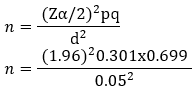
n = 323.
With 10% none response rate and design effect of 1.5, n= 533.
Where, n =sample size, d= margin of error,
p=proportion of RHIS for pharmaceutical procurement, q=1-p.
2.7. Sampling
technique and sampling procedure
A stratified sampling method was employed to select health facilities. Health facilities were stratified as hospitals and health centers by considering the presence of a difference between health facilities' utilization of RHI for PP and the calculated sample size for respondent’s self-administered questionnaire was proportionally allocated to each health center and Hospital and then health professionals were selected by using lottery method. A total of 6 hospitals and 51 health centers were selected from 11 hospitals and 101 health centers respectively. From each selected health facility 18 respondents were at specialized hospitals, 14 at General hospitals, 12 at primary hospitals and 10 at HC committees. Among them by simple random 75 and 458 respondents were selected from hospitals and health centers respectively.
3. Variables of the
Study
3.1. Dependent variable
The outcome variable is the utilization of routine
health information for pharmaceutical procurement. Pharmaceutical procurement is procuring or purchasing drugs,
supplies and diagnostic reagents other than receiving them through donation. In
this study, respondents who respond to more than half of the procurement
questions understand the pharmaceutical procurement process/procedure. Routine health information utilization for
pharmaceutical procurement refere uses of generated health information
from healthcare facilities at regular intervals for pharmaceutical procurement.
Measured by computing ten ‘yes’ or ‘no’ questions adapted from literature
conducted in Gamo and Gofa Zone. The assessment tool has a ‘yes’ or ‘no,’ and
categorical part, recodes the categorical part into ‘yes’ or ‘no’. The data
distribution was skewed, so median scores are used for health information
utilization for pharmaceutical procurement as having good routine health
information utilization for pharmaceutical procurement when they scored above
and equal to the median value or poor routine health information utilization
when they scored below the median value20.
3.2. Independent variables
Socio-demographic factors: age of respondents,
level of education, gender and profession. Technical factors: routine health
information system report formats, computer and data analysis skills. Organizational
factors: training on routine health information utilization, supervising
lower-level staff, availability of resources (human, financial and material)
and feedback from higher levels. Behavioral factors: motivation on using
routine health information, knowledge and attitude about routine health
information utilization.
3.3. Data
collection procedure
A structured self-administered questionnaire was
adapted and modified using information from the literature. Pre-tests were done
in Awi General Hospital to check reliability before the conduct of the actual
data collection. The data were collected by five trained data collectors guided
by two supervisors. The two-day training was given to conduct the research's
objective properly. The consistency and accuracy of the data have been checked
by the data collector and supervisor. Finally, the investigator made the
overall supervision. The questionnaire was developed in English and then
translated to Amharic to create smooth and clear communication.
3.4. Data quality
assurance
A modified and pretested questionnaire was used
with appropriate training for the data collectors and the data was collected
with a clear understanding by the support of the collector for respondents.
Then it was entered using statistical software to reduce data entry errors.
Finally, missing values, noisy data and incompleteness were validated. Based on
the suggestion of respondents during the pretest, some words were modified for
easy understanding; Cronbach's alpha was computed to determine the internal consistency
of the assessment tools.
3.5. Data
processing and analysis
The data was checked for its completeness and
cleaned, edited and coded by using Epi data version 4.6 and then exported to
SPSS version 25. Cronbach's Alpha was used to check the reliability test for
those associated factors of routine health information utilization for
pharmaceutical procurement; technical factors reliability test (Cronbach’s
alpha 0.766) organizational factors reliability test (Cronbach's Alpha 0.920)
and 26 behavioral factors (Cronbach's Alpha 0.897) which means it has strong
internal consistency among Likert items in technical factors organizational
factors and behavioral factors of utilization of routine health information and
associated factors in health facilities.
Descriptive statistics (mean, standard deviation,
median, frequency and percentages) were computed depending on the nature of the
variables and results were presented as graphs and tables. The association
between the dependent and independent variables was checked by using
bi-variable and multivariable logistic regression analysis. Odds Ratio with a
95% confidence interval and p-values <0.05 were used to measure the strength
of association and identify statistical significance. The goodness of model
fitness was tested by the Hosmer and Lemeshow test with a p-value of 0.064.
These data were checked for multi-collinearity through variance inflation
factor with a mean value of 1.79.
3.6. Ethical
consideration and consent to participate
Ethical approval was obtained from the
Institutional Review Board (IRB) of the College of Medicine and Health Science,
Bahir Dar University with protocol number 675/2023. Informed consent was
secured from each study participant. Confidentiality was assured through
collecting anonymous information and by informing the participants that
personal identifiers would not be revealed to a third party during data
collection, analysis and reporting of the findings.
4. Results
4.1. Socio-demographic
characteristics of the respondents
From 533 study subjects, 492 participated in the
study with a response rate of 92.3%. Among a total of 492 respondents, 225 (45.7%)
were female and more than half of the respondents, 296 (60.%), were above 30
years old, with a mean age of 33 ±5.817 (Table 1).
Table 1: Socio-demographic characteristics of
the respondents among health facilities in Bahir Dar city and West Gojjam Zone,
2023.
|
Variables |
Category |
Frequency |
Percentage (%) |
|
|
Sex |
Male |
267 |
54.3% |
|
|
Female |
225 |
45.7% |
||
|
Age |
Below and equal
to 30 years |
196 |
39.8% |
|
|
Above 30 years |
296 |
60.2% |
||
|
Religion |
Orthodox |
342 |
69.5% |
|
|
Islam |
63 |
12.8% |
||
|
Other |
87 |
17.7% |
||
|
Level of education |
Certificate |
24 |
4.9% |
|
|
Diploma |
78 |
15.9% |
||
|
Degree |
291 |
59.1% |
||
|
Masters and
Above |
99 |
20.1% |
||
|
Profession |
Pharmacy |
129 |
26.2% |
|
|
Doctor |
70 |
14.2% |
||
|
health officer |
75 |
15.2% |
||
|
Nurse (clinical/midwifery) |
63 |
12.8% |
||
|
Accountant/economics/marketing
management, etc. |
66 |
13.4% |
||
|
Health
information technician/health informatics |
46 |
9.3% |
||
|
environmental
health |
20 |
4.1% |
||
|
Other |
23 |
4.7% |
||
|
Work experience |
less than 5
years |
300 |
61.0% |
|
|
Greater than 5
years |
192 |
39.0% |
||
|
Procurement experience |
1-4 years |
197 |
40.0% |
|
|
Greater than 4
years |
295 |
60.0% |
||
|
Responsible department |
Pharmacy |
128 |
26.0% |
|
|
health
information technician/health informatics |
40 |
8.1% |
||
|
Accountant/economics/marketing
management, etc. |
54 |
11.0% |
||
|
Other |
270 |
54.9% |
||
4.2. Utilization of
routine health information for pharmaceutical procurement
Of the total respondents, 296 (60.2%) had good
utilization of routine health information for pharmaceutical procurement.
4.3. Behavioral
factors of the utilization of routine health information for pharmaceutical
procurement
From a total of participants, 263 (53.5%)
respondents did not get the motivation to use routine health information for
pharmaceutical procurement and 371 (75.4%) respondents did not have good
feelings about pharmaceutical procurement performance planning and monitoring.
The majority of respondents, 383 (77.8%), did not understand the roles and
responsibilities of uses of routine health information for pharmaceutical
procurement during decision-making (Table 2).
Table 2: Behavioral factors of utilization of
routine health information system for pharmaceutical procurement in health
facilities, 2023.
|
Variable |
Categories |
Frequency |
Percentage (%) |
|
Confidence on RHI |
Agree |
130 |
26.40% |
|
Disagree |
362 |
73.60% |
|
|
Confidence on
utilize RHI for PP |
Agree |
211 |
42.90% |
|
Disagree |
281 |
57.10% |
|
|
Motivating staff to
use RHI for PP |
Agree |
229 |
46.50% |
|
Disagree |
263 |
53.50% |
|
|
Enforce on RHI |
Agree |
189 |
38.40% |
|
Disagree |
303 |
61.60% |
|
|
Gives me feelings
for planning and monitoring pharmaceutical procurement performance |
Agree |
121 |
24.60% |
|
Disagree |
371 |
75.40% |
|
|
The committee uses
RHI |
Agree |
132 |
26.80% |
|
Disagree |
360 |
73.20% |
|
|
Understand the
roles and responsibilities of uses of RHI for PP during decision making |
Agree |
109 |
22.20% |
|
Disagree |
383 |
77.80% |
|
|
PP decisions are
made based on the annual pharmaceutical budget |
Agree |
206 |
41.90% |
|
Disagree |
286 |
58.10% |
|
|
Managerial
enforcement for PP based on RHI |
Agree |
145 |
29.50% |
|
Disagree |
347 |
70.50% |
4.4. Technical
factors of utilization of routine health information systems for pharmaceutical
procurement
From a total study of participants, 177 (31.9%)
respondents disagreed with the user-friendliness of system design to manage the
data. Among study subjects, 235 (52.8%) disagreed with the accessibility of
routine health information. 270 (54.9%) of respondents disagreed with the
orientation of staff on data collection tools (Table 3).
Table 3: Technical fators of utilization of RHIS for PP in health facilities,
2023.
|
Variables |
Categories |
frequency |
Percentage (%) |
|
|
Have
good knowledge to effectively use RHI |
Agree |
172 |
35.0% |
|
|
Disagree |
320 |
65.0% |
||
|
Have
good information technology skills to effectively use |
Agree |
155 |
31.5% |
|
|
Disagree |
337 |
68.5% |
||
|
Is the report format user-friendly |
Agree |
337 |
68.1% |
|
|
Disagree |
155 |
31.9% |
||
|
The
simplicity of RHIS makes it easy for health workers |
Agree |
257 |
52.2% |
|
|
Disagree |
235 |
47.8% |
||
|
The
pharmacy unit and other units have strong integration on RHI utilization |
Agree |
160 |
32.5% |
|
|
Disagree |
332 |
67.5% |
||
|
RHI
is easily accessible to health professionals |
Agree |
232 |
47.2% |
|
|
Disagree |
260 |
52.8% |
||
|
Have
feedback from facility managers/higher officials |
Agree |
190 |
38.6% |
|
|
Disagree |
302 |
61.4% |
||
|
Have
data analysis and use skills |
Agree |
160 |
32.5% |
|
|
Disagree |
332 |
67.5% |
||
|
Staff
are oriented on the use of data collection tools |
Agree |
222 |
45.1% |
|
|
Disagree |
270 |
54.9% |
||
4.5. Organizational
factors of utilization of routine health information for pharmaceutical
procurement
Of a total of participants, 54.3% disagree with
supportive supervision on routine health information uses and 276 (56.1%) of
respondents disagree with getting timely feedback from higher officials. Among
all study subjects, 235 (47.8%) of respondents disagree with getting training
on data management and use (Table 4).
Table 4: Organizational factors of
utilization of routine health information system for pharmaceutical procurement
in health facilities, 2023.
|
Variables |
Categories |
Frequency |
Percentage (%) |
|
|
|
Staffs
trained in data management and use |
Agree |
255 |
51.6% |
||
|
Disagree |
238 |
48.4% |
|||
|
Strong,
supportive supervision on routine health information uses. |
Agree |
225 |
45.7% |
||
|
Disagree |
267 |
54.3% |
|||
|
There
is reporting on RHI |
Agree |
125 |
25.4% |
||
|
Disagree |
367 |
74.6% |
|||
|
Timely
feedback on routine health information from higher officials |
Agree |
216 |
43.9% |
||
|
Disagree |
276 |
56.1% |
|||
|
Organization
culture of information use |
Agree |
250 |
50.8% |
||
|
Disagree |
242 |
49.2% |
|||
|
There
is quality report |
Agree |
210 |
42.7% |
||
|
Disagree |
282 |
57.3% |
|||
|
Enforced
to culture of information |
Agree |
155 |
31.5% |
||
|
Disagree |
337 |
68.5% |
|||
|
Conduct
data quality control |
Agree |
236 |
48.0% |
||
|
Disagree |
256 |
52.0% |
|||
|
Commite
has confidence to use RHI |
Agree |
138 |
28.0% |
||
|
Disagree |
354 |
72.0% |
|||
|
Hospital
officials gives regular feedback |
Agree |
222 |
45.1% |
||
|
Disagree |
270 |
54.9% |
|||
|
Based
on feedback |
Agree |
127 |
25.8% |
||
|
Disagree |
365 |
74.2% |
|||
|
Use
RHI for PP |
Agree |
233 |
47.4% |
||
|
Disagree |
259 |
52.6% |
|||
4.6. Factors associated with the utilization of
routine health information for pharmaceutical procurement
Bivariable and multivariable logistic regression
was undertaken to select significant factors associated with the utilization of
routine health information for pharmaceutical procurement. Bi-variable logistic
regression analysis revealed that training, supportive supervision, report
quality, motivation, regular feedback, user-friendly report format and
information culture of the organization were all significantly related to the
utilization of routine health information for pharmaceutical procurement.
Bi-variables with a p-value < 0.2 were candidates for multivariable
analysis. In the multivariable analysis of organizational culture of
information use, training for data management and use and user friendly of
report format were significant factors with a p-value of less than 0.05.
The odds of the utilization of routine health
information for pharmaceutical procurement among respondents who had training
were 2.33 times higher than those who didn’t have training (AOR=2.33; 95% CI;
1.218, 4.472). Organizations with a culture of information use were 2.4
(AOR=2.401; 95% CI; 1.076, 5.356) more likely to have good utilization of RHI
for PP compared to organizations that did not have an information use culture. A
user-friendly report format to manage data was 2.56 times more likely to utilize
routine health information for pharmaceutical procurement (AOR=2.555; 95% CI;
1.333, 4.899) (Table 5).
Table 5: Factors associated with utilization
of routine health information system for pharmaceutical procurement at health
facilities, 2023.
|
Variable |
Response |
Utilization of RHIS for PP |
COR (95% CI) |
AOR (95% CI) |
|
|
Good |
Poor |
||||
|
Training
in data management and use |
Trained
|
134 |
120 |
1.909
(1.322,2.756)* |
2.333
(1.218-4.472)** |
|
Not
trained |
162 |
76 |
|
|
|
|
Organization
culture of information use |
Good
culture |
129 |
121 |
2.089 (1.445-3.019)* |
2.401 (1.076-5.356)** |
|
Poor
culture |
167 |
75 |
1 |
1 |
|
|
User-friendly
format |
User-friendly |
231 |
106 |
0.33(0.224-0.491)* |
2.555(1.333-4.899)** |
|
Not
user-friendly |
65 |
90 |
1 |
1 |
|
5. Discussion
The prevalence of utilization of routine health information for
pharmaceutical procurement at health facilities was 60.2% [CI 95%, 55.7, 64.4].
This is almost in line with studies conducted in Northwest Ethiopia (64%)21, North Wolo Zone(58.4%)22, Hadiya Zone (62.7%)14 and South Region, Ethiopia (63.1%)18. However, the findings of this study
were higher than those of studies reported from Dire Dawa (53.1%)23, East Gojjam Zone (45.8%)13, Amhara region (46%)24 and Addis Ababa (37.3%)5. This difference might be due to the
variation in study periods, the differences in study participants and the
government's recent strong emphasis on using health information. Another
possible reason is health professionals’ attitudes toward health information
utilization and health information system policy. Similarly, cultural and
attitudinal change regarding the perceived value and practical use of health
information as a result of the implementation of the information revolution agenda
may have played a significant role19.
However, the findings of this study were lower than
the study conducted in the Northern Gondar Zone, 78.5 %20, the North Shewa Zone of the
Oromia regional state, 71.6%25
and the Gamo and Gofa Zone (69.9%). In the North Gondar Zone, the reason
for this variation may be due to good supervision, feedback and a large sample
size. Also, this study is specific and focused on the utilization of routine
health information for pharmaceutical procurements and participant variation,
since in this study the respondents were professionals who engaged in the
pharmaceutical procurement committee.
According to the multivariable logistic regression analysis, the higher
odds of utilization of routine health information for pharmaceutical
procurement were noted among professionals who had training on data management
and use compared to those who hadn’t had training. This is due to training and
data management guidelines that will improve users’ knowledge, attitude and
availability of inputs (HMIS registration formats, guidelines, paper and
markers), which will enable users to apply their knowledge and skills for data
processing and information use. The finding was supported by those of other
studies reported from East Gojjam and Western Amhara, Ethiopia13,26.
Another significant factor in this study was the organizational culture
of information use. The culture of information use is a subset of
organizational culture; it can be strengthened if all people within an
organization participate. Organizations that had a good culture of information
use had 2.4 (AOR=2.401; 95% CI; 1.076, 5.356) times more likely to utilize RHIS
for PP. The possible reason could be useful information can lead to the right
decision-making. This finding is supported by a study conducted by Yekatit 12
Hospital Addis Ababa27.
Those professionals who didn’t face difficulty
understanding the reporting format were 2.56 (AOR=2.555; 95% CI; 1.333, 4.899)
times more likely to have utilized routine health information for
pharmaceutical procurement than those professionals who faced difficulty
understanding the report format. The reason could be that understanding the
report format leads to easily retrieving and using information. This finding
was supported by studies conducted in East Gojjam Zone, Northwest Ethiopia,
Addis Ababa Health Bureau and Gamo and Gofa Zone.
Overall, this study
finding showed that more than half of respondents had a good level of
utilization of routine health information for pharmaceutical procurement.
Organizational culture of information use, user-friendly report format and
training for data use were significant factors in the utilization of RHIS for
PP. Developing an organizational culture of information use, designing a
user-friendly format and providing training for data use could improve the
utilization of RHIS for PP.
7. Lists of abbreviations
HIT: Health Information Technology; HMIS: Health
Information Management System; HO: Health Officer; HSTP: Health System
Transformation Plan; M&E: Monitoring and Evaluation; MOH: Ministry of
Health; PP: Pharmaceutical procurement; RHI: Routine Health Information; RHIS:
Routine Health Information System; SPSS: Statistical Package for Social
Science; WHO: World Health Organization.
8. Consent for
publication
Not applicable.
9. Competing
interests
The authors declare that they have no competing
interests.
10. Availability of
data and material
The datasets used and/or analyzed during the
current study are available from the corresponding author upon reasonable
request.
11. Funding
The authors have not received a specific grant for
this research from any funding agency in the public, commercial or
not-for-profit sectors.
12. Authors’
contributions
BGZ conceptualized the study, designed the study,
collected the data, analyzed and interpreted the data and drafted the
manuscript. NAM, AKTs, GG, BBA, EMA and YAM contributed to statistical analysis
and reviewed the manuscript. All authors contributed to critical revisions for
important intellectual content. They all read and approved the final
manuscript.
13. Acknowledgments
First of all, we would like to express our greatest
gratitude to Bahir Dar University, the College of Health Sciences and the
School of Public Health for giving us this golden opportunity to conduct this
research. Secondly, we would like to extend our heartfelt gratitude to study
participants for their helpful and valuable contributions.
14. References
- Bassa B. Assessment Of
Utilization Of Routine Health Information For Pharmaceutical Procurement And
Associated Factors In Public Hospitals In Gamo And Gofa Zone, SNNPR, Ethiopia.
IPHCE, 2020.
- Suleman S,
Woldemichael K, Tushune K, et al. A Critical Evaluation of Its Legal Basis and
Implementation Pharmaceutical Regulatory Framework. Ethiop J Health Sci,
2016;26.
- Ebrahim
AJ, Yimenu DK. Unused and Expired Medications in health facilities. J Prim Care
Community Heal, 2019;10.
- Nisingizwe MP, Iyer
HS, Gashayija M, et al. Toward utilization of data for program management and
evaluation: quality assessment of five years of health management information
system data in Rwanda. Global health action, 2014;7: 25829.
- Mengistu MTG,
Ayele W, Habtamu T, Biruk E. Assessment of routine health information
utilization and its associated factors among Health Professionals in Public
Health Centers of Addis Ababa, Ethiopia. Ethiop J Heal Dev, 2021;35.
- Shrestha
M, RM, Ranjit E, Chaar B. Medicine Procurement In Hospital Pharmacies Of Nepal.
PMC, 2018.
- Law
SMHE. Public procurement, 2015.
- Abdisa AB, Hajito KW, Daka DW, et
al. Health workers' use of routine health information and related
factors at public health institutions in Illubabor Zone, Western Ethiopia. BMC
Medical Informatics and Decision Making, 2022;22: 140.
- Garrib
A, McKenzie A, Stoops N, et al. An evaluation of the district health
information system in rural South Africa. S Afri Med J, 2008;9.
- Glèlè
Ahanhanzo Y, Ouedraogo LT, Kpozèhouen A, et al. Factors associated with data
quality in the routine health information system of Benin. Archives of Public
Health, 2014;72: 25.
- Nzomo
G. Use Of Routine Health Information For Decision Making Among Health Workers
At Coast General Hospital, Mombasa County, Kenya, 2017.
- Asemahagh
MA. Determinants of routine health information utilization at primary
healthcare facilities in Western Amhara, Ethiopia. Albert Lee (Reviewing
Editor) Cogent Medicine, 2017;4: 1.
- Shiferaw
AM, Zegeye DT, Assefa S, et al. Routine health information system utilization
and factors associated thereof among health workers at government health
institutions in East Gojjam Zone, Northwest Ethiopia. BMC Medical Informatics
and Decision Making, 2017;17: 116.
- Abera E, Daniel K, Leta TJ, Hibstu
DT. Utilization of health management information system and
associated factors in Hadiya zone health centers, Southern Ethiopia. Res Health
Sci, 2016;1: 98.
- Hinsta A,
Betebo B, Balcha B. Utilization of Community Health Information System and
Associated Factors in Health Posts of Hadiya Zone , Southern, 2020;63.
- WHO JD, Quick JR, Laing R, et al. Hartford, CT.
Kumarian Press. Operational principles for good pharmaceutical procurement,
1997.
- Cameron
A, Auton M. The world medicines situation 2011 medicines prices, availablity
and affordabilty. . BMC Health Services Research, 2017.
- Sako
S, Gilano G, Chisha Y, et al. Routine Health Information Utilization and
Associated Factors among Health Professionals Working in Public Health
Facilities of the South Region, Ethiopia. Ethiop J Health Sci, 2022;32:
433-444.
- Wude
H, Melese D, Lolaso T, Balacha B. Utilization of routine health information and
associated factors among health workers in Hadiya Zone, Southern Ethiopia.
- Dagnew
E, Woreta SA and Shiferaw AM. Routine health information utilization and
associated factors among health care professionals working at public health
institution in North Gondar, Northwest Ethiopia. BMC Health Services Research,
2018;18: 685.
- Chalachew Msganaw Yehula a, Agmasie Damtew Walle b,
Masresha Derese Tegegne a, Berhanu Fikadie Endehabtu a and S.M.W.a. ,
Mequannent Sharew Melaku a, Adina Demsie Bogale a, Biniyam Tilahun a, Health
information utilization and its associated factors among health professionals
in northwest Ethiopia: A crossectional study Informatics in Medicine Unlocked,
2023.
- Ngusie
HS, Kasaye MD, Kanfe SG. Utilisation of health management information and its
determinant factors among health professionals working at public health
facilities in North Wollo Zone, Northeast Ethiopia: a crosssectional study. BMJ
OPEN, 2022.
- Mekuria S, Adem HA,
Ayele BH, et al. Utilization of Routine Health Information System and
Associated Factors Among Health Professionals in Public Health Facilities in
Dire Dawa, Eastern Ethiopia: a Cross-sectional Study, 2021.
- Chanyalew
MA, Yitayal M, Atnafu A, et al. Routine health information system utilization
for evidence-based decision making in Amhara national regional state, northwest
Ethiopia: a multi-level analysis. BMC Medical Informatics and Decision Making,
2021;21: 28.
- Tulu
G, Demie T and Teshome T. Routine Health Information Use for Decision-making
and Associated Factors among Managers Working at Public Hospitals in North
Shewa Zone of Oromia Regional State, Ethiopia: A Mixed-Method Study, 2021.
- Asemahagn
MA. Determinants of routine health information utilization at primary
healthcare facilities in Western Amhara, Ethiopia. Cogent Medicine, 2017;4:
1387971.
- Bayisa
R. Assessment of health management information system (HMIS) data quality and
information use: The case of Yekatit 12 Hospital, Addis Ababa 2014.