Are Owners who have Predatory Animals in their Homes Mentally Healthy?
The article discusses the new trend of
having wild animals (big cats, foxes, ferrets, etc.) in some homes, and it
turns out that since they are raised from childhood, loved and cared for, they
behave like pets (dogs and cats) . The question is raised whether these animals
can still be considered domestic or not. To solve, characteristics (concepts)
are specified that allow one to distinguish between wild and domestic animals,
and the question is asked whether they can be applied to this case. To understand
this new class of animals, the concept of “anthropic living” is introduced and
it is shown that their psyche differs from the psyche of wild animals and is
closer to domestic ones. An explanation is offered for the experiments of
geneticist Dmitry Belyaev on the domestication of silver foxes. The author
argues that the evolution of foxes was influenced by two factors - not only
genetic selection, as Belyaev believed, but also the influence of the
environment created by man, an environment conducive to the formation of
anthropogenic creatures. At the end of the article, Belyaev’s hypothesis,
according to whichwe are “self-domesticated” apes, whose innate psychological
tendencies, behavior and social structure have radically changed under the
influence of selection for reduced aggressiveness towards relatives, is
compared with the author’s hypothesis about the role of signs in the origin of
man. It shows thatdomestication occurred as a result of the transition of
hominids to “paradoxical behavior,” which required the creation of a sign
system based on a signaling system. The latter allowed hominids to act contrary
to biological evidence at the command of the leader. A necessary condition for
this was the imagination conditioned by signs, which helped to invent the first
tools
Key words: Man; Wild animals; Domestic animals; Origin; Psyche; Behavior; Environment; Foxes; experiment; Genetics
For owners who have raised their pet
animals since childhood, feed and care for them every day, love and kiss them,
the question posed in the title is strange, well, of course, these are pets,
but what else? However, a question of this type has arisen in recent years for
biologists, psychologists who study animals, and philosophers of life in
connection with the creation of the unique Taigan Zoo, (Figure 1) where sick puppies or
abandoned wild animals are also often raised from childhood; in connection with
the appearance in families, along with dogs and cats (though not yet in large
numbers), of ferocious predators who turned out to be not ferocious at all, but
quite domestic and affectionate (Figure 2). They look like ferocious predators, but in their behavior they are
pets, pets (English: pet - pet, pet). However, the question is, are these still
domestic or wild animals, and can they, under some circumstances, attack their
owners?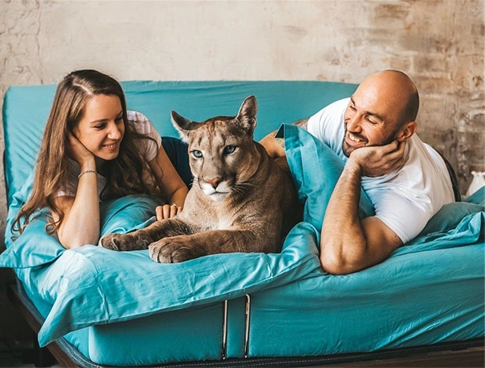
Figure
1. Maria
and Alexander Dmitriev with puma Messi1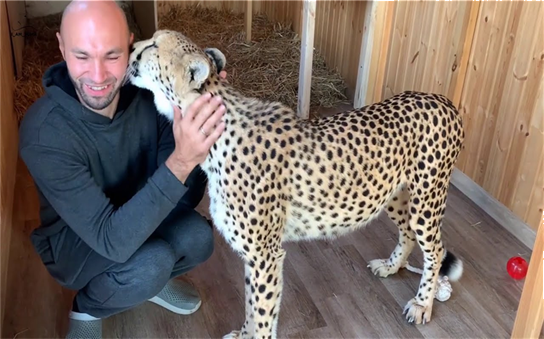
Figure 2. Alexander with the cheetah
Gerda
I remember one incident in connection
with this. In our family there was a beautiful big cat Timofey, but not
neutered (Figure
3).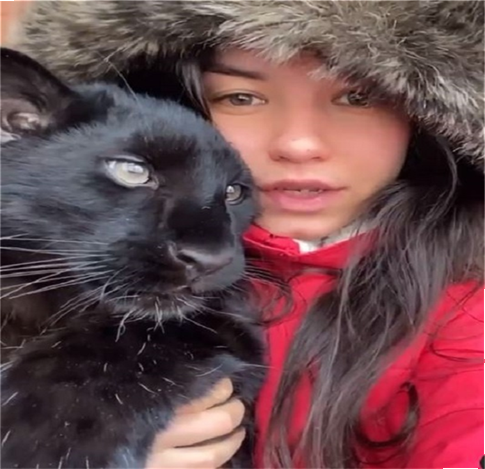
Figure 3. Victoria with the panther
Luna2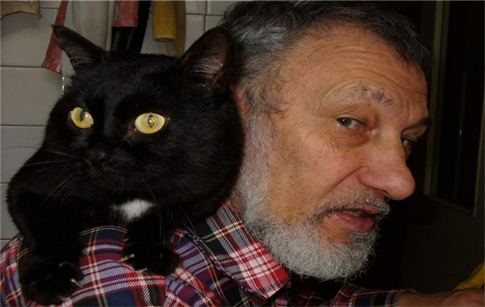
Figure 4. Author with cat Timofey
One day I walked out the door of my
apartment and decided to remove a cardboard box that for some reason was
standing there. Timofey ran out after me and began to sniff the box (the cat
had obviously urinated on it). I pushed my pet away from the box with my foot.
And suddenly Timofey rushed at me like lightning, tore my trousers and
seriously injured my leg; it took several weeks to heal. How can this be, a
domestic cat that often slept on me suddenly attacked its owner? And here is a
puma, a cheetah, a panther, a wolf! It’s time to pass a law prohibiting keeping
such animals at home (Figure
4).
And in general, are people mentally
healthy who have such predators in their homes, because they are putting their
lives at risk? In 99 cases out of a hundred, a “domestic predator” will remove
its claws and take into account the strength of its owner, but after all, it
can, if it gets too carried away, make a mistake. The mistake of our beloved
cat, in the worst case, threatens us with bloody scratches, and the mistake of
a panther can lead to what it’s scary to even think about.
I understand that for the owner of a
big cat, who raised it from a small kitten, this is indeed a beloved animal, a
member of the family, but he cannot help but understand the risk of such
communication. Or he still doesn’t understand, and if he does understand,
somewhere in the background of consciousness, he pushes this knowledge aside as
incredible. Is this understanding not schizophrenia? However, then we will have
to classify as schizophrenics the majority of modern humanity, which,
understanding the risks from cars, airplanes, nuclear power plants or, more
recently, from artificial intelligence, continues to go in the same direction (Figure 5).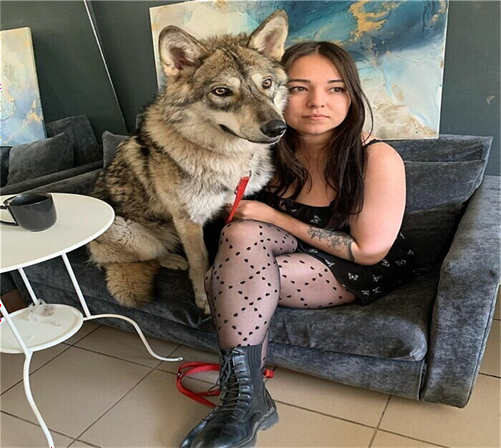
Figure 5. Alida with the she-wolf Kira3
But let’s leave the emotions to the
press and children and think scientifically.
Wild and domestic animals (distinctive characteristics).
I would highlight four such
characteristics.
1. Wild animals live on their own
in nature, regardless of humans, while domestic animals depend on the latter.
“Animals that live on their own in their natural habitat are called wild. They
take care of themselves, get food and build housing. The life of some animals
depends on humans. Animals that are specially bred by people are called
domestic animals. A person feeds them, protects them, takes care of their
offspring, creates all the necessary conditions for life4”.
2. The behavior and connections
between these two types of animals differ significantly, for example, in
relation to humans and within the population.
3. The issue of differences in
the psyche is also being discussed. One point of view is that the psyche of a
domestic and wild animal is essentially the same, the other is no, they are
significantly different.
4. The difference in the genesis (origin)
of wild and domestic animals. The former were formed without human influence in
accordance with Darwinian laws of natural selection, the latter in the process
of domestication (“domestication”) over about fifteen thousand years
(artificial selection).
What does it mean, from the point of
view of these distinctions, for a person to raise a wild animal in a family (we
will conditionally call such an animal “anthropo-living”, from “anthropo” -
attitude towards a person, “alive” - animal)? According to the first two
characteristics, an anthropologist is a domestic animal, according to the third
characteristic it is unclear which one, according to the fourth, it is partly
wild, partly domestic animal. Let us now take into account this circumstance:
the habitat of anthropogenic living is completely artificial, created by man.
The latter, on the one hand, blocks all anthropological instincts that are
dangerous to humans (to attack, threaten, bite, pursue, etc.), on the other
hand, it provides him with food and communication, primarily with himself and
with other anthropological creatures. For example, the panther Luna lives in a
family with a dog. "The owner's
dog, a Rottweiler named Venza, and Luna were wary of each other at first, but
after a long process of getting used to it, they got along and even became
friends. The owner notes that the panther and the dog are inseparable: they
play together, run together on walks and explore the world around them together2”.
But if all instincts
dangerous to a person are blocked and others are formed that ensure
communication with a person (communication not with the help of human language,
but “signals-signs” formed during the communication of a person with
anthropogenic life; for the difference between signals and signs, see[With. 94-98]), then we have to agree with those psychologists who claim
that the psyche of domestic animals (including anthropogenic animals) is
different from that of wild animals. In this regard, an anthropologist is
unlikely to attack and harm a person, unless by accident (such cases need to be
analyzed separately).
Multiple Acceleration of Evolution using Artificial Selection
We will talk about the famous
experiments of the Soviet geneticist Dmitry Belyaev, who was able to turn wild
silver foxes into domestic ones. He believed that the key to the mechanism of
domestication “lies in the principles of Mendelean inheritance”.Jason Goldman
of Scientific American said: “Belyaev hypothesized that the anatomical and
physiological changes observed in domesticated animals could be the result of
selection on the basis of behavioral traits. More specifically, he believed
that tameability was the decisive factor”… started with 30 male foxes
and 100 female foxes, most of them from a commercial fur farm in Estonia."
From the very beginning, Belyaev selected foxes solely for tameability,
allowing only a tiny percentage of male offspring and a slightly larger percentage
of females to breed. The foxes were not trained to be sure , that their
tameness was the result of genetic selection and not environmental influences.
For the same reason, they spent most of their lives in cages and were allowed only
short-term encounters with people. The only criterion for allowing them to
reproduce was their tolerance for human contact.
After more than 40 generations of
breeding, Belyaev produced "a group of friendly domesticated foxes.Many
domesticated foxes had floppy ears, short or curly tails, a long reproductive
season, changes in fur color and the shape of their skulls, jaws and teeth.
They also lost their "musk fox" smell5”. “Externally, the foxes also
differed from their wild relatives. Their color became more spotted and
lighter, and some foxes became almost completely white. At the moment, experts
in the domestication of foxes state that their charges may well live nearby.
with a person, but not in apartments or houses, but in farmsteads. Their pets
are unique: they get along with a person, but do not depend on him and are not
aggressive towards people and can be trained, but their cleanliness leaves much
to be desired. They live for about 10 years. , while their wild counterparts
are about 4. Foxes can be both hunting assistants and simply beautiful pets6.”
I'll comment. As a geneticist, Belyaev believed that the evolution
of animals is determined only by genetic selection, and not by environmental
factors. But where, one wonders, did he get the foxes for the experiment? From
fur farms, where foxes lived in an artificial environment (they were raised,
fed, cleaned, guarded, etc.), and they communicated with the people who looked
after them. That is, these were anthropogenic creatures in the initial stage of
development, and not purely wild animals (by the way,American biologists Elinor
Carlson and Catherine Lord also noted that “the experiment began with the
breeding of foxes that were not wild7”.Only those foxes were selected for
breeding that were not afraid of people and were drawn to them for
communication. It is not difficult to guess that the genes of these individuals
have undergone a mutation, which Belyaev, at the level of behavior, called a
sign of “tameability” (the desire to communicate with people and the absence of
aggression). It was the foxes from this population (a kind of “anthropological
philanthropists”) who were allowed to reproduce, which contributed, on the one
hand, to a certain direction of gene transformation (on humans), on the other-
further stages of the development of anthropological living. That is, the
evolution of foxes was influenced by two factors - not only genetic selection,
but also the influence of the environment created by man, an environment
conducive to the formation of anthropogenic creatures (Figure 6).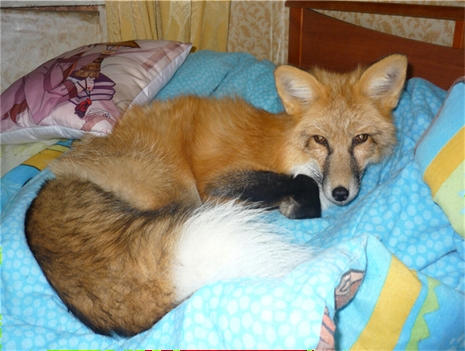
Figure 6. Domesticated male fox
The role of the anthropological
environment on the process of domestication of foxes is also evidenced by the
following episode given in the bookLee Alan Dugatkin and Lyudmila Trut “How to tame a fox (and turn it into
a dog). Siberian evolutionary experiment." "At that time, it was believed that the domestication of
animals took place slowly, over many millennia. What results can be achieved in
several decades? However, here she is, Pushinka, a tame fox, so similar to a
domestic dog. She responds to her nickname and follows the fur farm workers
around the nursery; she loves to walk with Lyudmila along the quiet country
roads in the vicinity of Novosibirsk, where the experiment is taking place.
(Lyudmila Trut was Belyaev’s main assistant; she was responsible for organizing
the experiment.- V.R.).Fluffy, we note, is
just one of hundreds of tame foxes that are bred here.
Having settled with
Pushinka in a house on the edge of the farm, Lyudmila began a new stage of
research. Fifteen years devoted to the selection of tame foxes were crowned
with complete success. Now it was necessary to find out whether Pushinka,
living side by side with Lyudmila, would be able to develop a special affection
for her, the same as domestic dogs feel for their owners. With the exception of
cats and dogs, domesticated animals generally do not show strong “emotional”
attachments to people. How and why did it arise in the first place? As a result
of a long life together with a person? Or, conversely, in a very short period
of time, what did our heroes observe in the example of tame foxes? And will
even such a domesticated fox as Pushinka feel comfortable under the same roof
with a person?
Lyudmila chose Pushinka
to be her companion at first sight, when she was still an adorable puppy of
three weeks old and frolicking in the company of her brothers and sisters.
Looking into Pushinka's eyes, Lyudmila felt a feeling of kinship that she had never
experienced before while working with other foxes. Fluffy was generally
unusually inclined to contact people. If Lyudmila or one of the farm workers
approached her, the fox began wagging her tail in excitement, whining and
looking at the person impatiently. This was unmistakably perceived as a
request: stop and stroke me. And then no one could resist.
A year later, when
Pushinka became an adult, acquired a partner and was expecting the birth of fox
cubs, Lyudmila decided to take her into the house. Now it was possible not only
to observe how the fox would adapt to a new way of life, but also to see how
the socialization of her offspring would go in comparison with other fox cubs
born on the farm. And so, ten days before giving birth, on March 28, 1974,
Pushinka was placed in a new place of residence.house with an area of just
over 60 sq. m consisted of three living rooms, a kitchen and a bathroom. The
room where Lyudmila placed a bed, a small sofa and a desk served her as both a
bedroom and an office. In the second room they built a shelter for Pushinka,
and the third became common. There were several chairs and a table there; it
was possible to have lunch and receive visitors. Fluffy was allowed to move
freely throughout the house.
Early in the morning, as
soon as she got into the house, Pushinka became excited. She ran nonstop from
room to room. This was very unusual, as pregnant foxes usually spend most of
their time lying quietly in their burrows. Finally, after rummaging through the
shavings that covered the floor of her shelter, Fluffy calmed down, but soon
jumped up again and began circling around the house. Every now and then she ran
up to Lyudmila so that she could caress her, but even after that Pushinka was
very excited. It was clear that the unusual new surroundings worried her
extremely. She hadn’t eaten anything all day, except for a piece of cheese and
an apple, which Lyudmila gave her from her breakfast.
Later, Lyudmila’s
daughter Marina and her friend Olga joined the new settlers, and they spent the
day of the great move together. But then it was eleven in the evening, and
Fluffy was still running restlessly from room to room. It was time to sleep,
and the girls, covered with blankets, lay down on the floor near Lyudmila’s
bed. When they dozed off, Fluffy silently slipped into the room and lay down
next to her. She finally calmed down and also fell asleep. Lyudmila was
relieved. Several months will pass, and she will finally be convinced that this
little fox not only lives well next to her, but has also become as loyal as the
most devoted of dogs8.”
If in about two or three decades it
was possible to domesticate wild foxes, then why is it impossible to
domesticate big cats (tigers, pumas, panthers, lions, cheetahs), as well as
wolves or crocodiles. For what? Well, at least for large zoos or individual
lovers of these animals who want to live with them.
All is not well in the Kingdom of Denmark.
It is a commonplace that people
continue to crowd out large wild animals, depriving them of their habitat and
hunting them. Many species have already disappeared, others are in danger of
extinction, and still others are forced to huddle in a shrinking territory.
People increasingly need land for goats, cows, horses, pigs, poultry, and
agricultural land. By the way, it’s a paradox - our anthropo-living big cats
are fed the meat of these domestic animals. Another paradox or, perhaps, a kind
of schizophrenia: an ever-increasing army of animal lovers calmly turns a blind
eye to the fact that their pets eat the meat of domestic animals, which are
raised and killed, including for feeding their beloved pets. I'm not even
talking about modern disputes like: do animals have a soul or the right to
life?
It is unlikely that vegetarianism and
some religions can solve all these problems, as long as everything goes in the
exact opposite direction of increasing the production of meat from domestic
animals. And it is unlikely that the trend of reduction in the habitat of large
wild animals and the disappearance of some species of these animals will be
stopped in the near future. Doesn’t this mean that, on the one hand, the number
of zoos will grow, in particular, such as “Taigan”, where the number of anthropogenic
animals will increase, on the other hand, the community of anthropological
animal lovers (such as big cats and other exotic animals) will gradually grow
), not excluding those people who want to raise such anthropologists from
childhood and live with them as with ordinary dogs and cats.
The ice will probably break only when
people realize that they are living incorrectly, have brought life on earth to
the brink of disaster, and come to the understanding that it is necessary to
comprehend modern life in order to change it. One aspect of such understanding
and change will also concern the relationship between man and nature and
animals. Since a person is also an animal, he will have to reconsider his
attitude towards himself. For example, does it look like a domesticated
predator, i.e. anthropoliving? Especially when it comes to the first stages of
its origin. Belyaev formulated roughly the same assumptions.
"One of Belyaev’s most daring and innovative ideas,-writes in the preface to the book “How to
Tame a Fox (and Turn It into a Dog). Siberian evolutionary experiment" Doctor of Biological
Sciences, Head. Department of Biological Evolution, Faculty of Biology, Moscow
State University A.V. Markov,-was that the patterns discovered during the experiment were partly
applicable to human evolution. Belyaev believed that in a certain sense we are
“self-domesticated” monkeys, whose innate psychological inclinations, behavior
and social structure have radically changed under the influence of selection
for reduced aggressiveness towards relatives (selection for social tolerance
and conformity, as experts say these days) .
It often happens that at
the end of their scientific career, distinguished scientists begin to put
forward too bold ideas, which are subsequently not confirmed. But this does not
apply to Belyaev’s ideas about anthropogenesis: they just sound surprisingly
modern and are confirmed over and over again by newly discovered facts of
paleoanthropology, genetics and neurochemistry. Today, on the basis of these
new facts (and sometimes, unfortunately, forgetting to refer to Belyaev, who
foresaw all this), many anthropologists have begun to lean towards the idea
that in the early stages of hominid evolution there actually was selection for
reduced intra-group aggression. It led to a whole range of consequences: from
an increase in dopamine levels and a decrease in acetylcholine levels in key
parts of the brain responsible for motivating behavior (this could promote
social conformity), to a reduction in secondary male sexual characteristics
associated with aggressive behavior (such as large fangs), reducing sexual dimorphism,
increasing male investment in offspring and strengthening emotional ties
between marriage partners. All this, in turn, created the preconditions for the
development of intra-group cooperation, giving our ancestors the opportunity to
develop complex and at the same time very profitable forms of behavior, such as
joint hunting of large game and the manufacture of stone tools8.”
CONCLUSION
This hypothesis of Belyaev that at
the early stages of the origin of man he wasself-domesticated
monkeycomplements my research on anthropogenesis well. I show that
domestication occurred as a result of the transition of hominids to
“paradoxical behavior”, which required the creation of a sign system based on a
signaling system. The latter allowed hominids to act contrary to biological
evidence at the command of the leader. A necessary condition for this was the
imagination conditioned by signs, which helped to invent the first tools9.
I would like to end the article on an
optimistic note. It seems to me that the process of revising man’s attitude not
only towards animals, but also towards himself is currently unfolding. We may
be experiencing one of the last outbursts of aggressive human behavior on
earth. In any case, I would like to believe so.
REFERENCES
1.
I_am_puma.
2.
A girl’s black pet panther from
Siberia has captivated the Internet.
3.
A girl from Ufa raised a she-wolf who
was not accepted by her mother 2022.
4.
Wild and domestic animals 2021.
5.
Domesticated
silver fox
6.
Instead of dogs: a successful Soviet
experiment in domesticating foxes. 2022.
7.
Jason Bittel. Tame foxes taught us about animal
domestication. But did we get the story wrong?(English). The
Washington Post
2020.
8. Dugatkin L, Trut L. How to tame a fox (and turn it into a
dog): A Siberian evolutionary experiment. Per. from English M: “Alpina
non-fiction” 2019;296.
9.
Rozin VM. Nature
and genesis of technology. M. De′Libri 2024;390.