Beyond Imagination: Evidence of Rigor Mortis and Cadaveric Spasm on the Shroud of Turin
Abstract
This paper will examine how inconspicuous details in the body images on the shroud of turin indicate that a crucified man is depicted who is in a state of cadaveric spasm and rigor mortis. Moreover, the precise positioning of the body indicates that death, cadaveric spasm and rigor mortis all occurred while the man was still nailed upright to a cross with his arms stretched outward and at an upward angle. Additionally, since the shroud is said to be the burial cloth of jesus of nazareth, evidence is presented that proves that, in general, rigor mortis and cadaveric spasm are capable of being sustained for 39 hours (the approximate maximum amount of time that jesus was dead according to the gospels) or longer.
Keywords: shroud of turin; jesus of nazareth; cadaveric spasm; rigor mortis; postmortem changes; crucifixion
While the body images on the shroud have historically been hailed by many as not being made by human hands, there are some who claim that the body images and bloodstains are the work of a clever medieval forger. So, the question arises: aside from the extensive chemical and physics-based tests which have been performed on the shroud, itself, as well as samples taken from the shroud and which point to the shroud’s not being a painting1,2 is there another reliable way to falsify the claim that the shroud’s body images are the result of a forger’s efforts?
Yes, there is.
Look for details that are so subtle and complex that it is unreasonable to think that even the most clever medieval forger could have ever imagined them. The very inconspicuous details which constitute evidence of rigor mortis and cadaveric spasm in the body images on the shroud are exactly this type of evidence.
Since there are many who think that the image formation mechanism for the body images on the shroud is due to energy from the resurrection of jesus and since the body images on the shroud point to a man in a state of rigor mortis and cadaveric spasm, if the man of the shroud is jesus, then it would be important to know whether or not scientific evidence supports rigor mortis and cadaveric spasm being visibly sustainable in a corpse up to 39 hours postmortem (which is approximately the maximum amount of time for jesus’ resurrection to occur according to multiple details from the gospels.) As such, the duration of rigor mortis and cadaveric spasm will be closely examined in this paper.
Curated highlights about the shroud of turin
Within the hallowed walls of the cathedral of st. John the baptist in turin, italy, there is a linen cloth that a very substantial body of credible evidence from science, forensics, medicine and history points to its being the authentic burial cloth that actually once wrapped the dead body of the historical jesus of nazareth. Many refer to this cloth as the “shroud of christ” or the “holy shroud,” but it is more commonly referred to as the “shroud of turin” or, more simply, the “shroud,” as it will be referred to hereinafter.
On this 4.36 m x 1.10 m (14’3” x 3’7”) burial cloth are life-sized, full-length, anatomically correct frontal and dorsal body images of a naked, well-formed, wellnourished and muscular adult human male. As even a simple visual inspection of the two body images reveals, neither is flat nor positioned in precisely the same way. However, when these two images are overlayed, they exhibit a remarkable anatomical correspondence and compatibility. The location and forensic details of bloodstains on this cloth are indicative that this cloth once wrapped an actual crucifixion victim.
To maximize the likelihood that one correctly interprets a reference to time, context is of vital importance. If someone says, “wait a ‘minute’,” this is not properly interpreted to mean “wait 60 seconds.” Moreover, sometimes people refer to a “day” without meaning a 24-hour period of time or just the “daylight hours” -which are sometimes referred to as “from dawn to dusk.” Cultural peculiarities are, also, quite relevant. For example, in 1st century palestine, an hour of time was not measured strictly as 60 minutes. Sometimes, it was more and sometimes it was less, depending upon the season3,4. Moreover, one day was not strictly measured as the passage of 24 hours. Instead, while a day was typically measured from sundown-to-sundown, a portion of a day could, also, be referred to as “a day.”
According to the gospels, jesus was resurrected on the “third day” -which can, as aforementioned, be very different from three 24-hour days. The breakdown of what constitute the “three days” is as follows: the “first day” of jesus’ death was a preparation day before the sabbath, the "second day” of jesus’ death was the sabbath/saturday and the “third day” of jesus’ death was considered to be the “start of the week” per matthew 28:1, mark 16:1-2, luke 24:1 and john 20:15-8. As such, the “first day” was a partial one on friday (from the time of jesus’ death at 3:00 p.m. Until sundown.) The “second day” of jesus’ death (the sabbath) was a full day starting at or immediately after, sundown on friday until sundown on saturday. And, the “third day” of jesus’ death, sunday, was a partial day that began at (or immediately after) the sundown that closed out the sabbath (which would be around 7:00 p.m. On what we consider to be saturday.) The women went to jesus’ grave on or around the break of dawn on sunday (which would be around 5:40 a.m. During april in jerusalem) and the tomb was already empty. Therefore, jesus’ resurrection could have occurred as early as soon after the close of the sabbath or as late as dawn on sunday. This would give a range of around 28-39 hours postmortem for when the resurrection occurred on the third day.
Cotton contamination has been detected within the shroud’s hand-spun linen fibers and it is thought that this is a result of contamination from the handloom that was used to manufacture this cloth9.
Founded by the late barrie schwortz, shroud.com is the largest repository of information (including peerreviewed scientific papers) about the shroud10.
The height of the man in the body image on the shroud is 72” as measured directly from the shroud (not from a photograph) during a private exposition in 1946 by anatomist dr. Luigi gedda11.
With the exception of just a few of the genuine bloodstains that went onto the cloth as a liquid [barbet, calvary12, the bloodstains on this cloth are transfers of blood clot exudates13. For confirmation of the presence of blood, see2.
The body images and bloodstains on the shroud contain numerous features which, independently, are often rather unexpected, strange and puzzling. Cumulatively, this linen cloth contains answers that are discoverable alongside mysteries that are endlessly explorable.
The following is a non-exhaustive listing of just some of the many curious features that the images on the shroud have: aged bloodstains that remain reddish in color instead of turning brownish in color an absence of capillary flow or cementation1 with the fibers in the pure body image areas of the cloth, the actual photographic negative of the shroud (e.g. Secondo pia’s photographic plate) reveals an image that appears more detailed and more like the natural face of a man to the naked eye compared to what is seen with the naked eye when viewing the image on the cloth.
When blood is exposed to air, the oxygen in the air oxidizes the blood and turns its red color into a brownish color14.
Capillary flow involves the flowing of liquid through narrow spaces (such as thin tubes or the voids in a porous substance) without the aid of any external forces such as gravity. An example is if one puts the tip of a linen napkin in a bowl of ink. The ink will slowly absorb into the porous fibers that comprise the threads in the cloth of the napkin until either the ink is fully drawn into the napkin or the napkin reaches its saturation point.
If an image were created on a linen cloth with a liquid (such as paint, stain or dye), the liquid would detectably flow along the threads of the cloth via capillary action. However, the shroud exhibits no evidence of such capillary flow where the body image is14. There is, however, detectable evidence of capillary flow where the bloodstains are (which is expected.) However, the degree of capillarity in the bloodstains is not as much as if the blood went on as a liquid; instead, there is a reduced capillary flow due to evidence that almost all of the bloodstains on the shroud are blood clots that were somehow transferred from a body to the cloth14.
While the pure body image areas remain on top of the crowns of the threads and there is nothing “cementing” the body image to the threads, the bloodstains penetrate the cloth and are “cemented” to its fibers14.
“pure” body image areas are straw-yellow in color and specifically exclude the reddish bloodstains as well as the clear-to-light yellow serum halos that can be found at the perimeter of most of the bloodstains on the shroud14.
Seen with the naked eye when viewing the image on the cloth, Itself (or a traditional positive photograph of the cloth, itself), the body image on the cloth is extremely superficial1 and is contained within the top 1-3 fibers of thread in the cloth22,23 with a thread being composed of approximately 100-20022 linen fibers, the straw-yellow color of the body image is strikingly uniform14,21 in color (as confirmed by a densitometric study of photographic images of the shroud) with less than 2%14 variation in the absorbance of the individual colored
Traditional (but not digital) photography produces an albedo image. Light from a scene is focused onto photosensitive paper or film that undergoes a chemical reaction in proportion to the quantity of light that has been focused onto it. This image that is created is actually a negative image of the actual scene in that the light areas in the scene and its subjects will be dark and the dark areas will be light. The photographic process evolved over time so that photographic prints could be made by shining light through the negative image onto a piece of photosensitive paper to reverse the negative image and produce a positive one15. Experimental results from analyzing albedo images (in the form of normal photographs) with the vp-8 image analyzer exclude the body image from the shroud as being an albedo image. Why? Because when albedo images are analyzed by the vp-8 image analyzer, they are are incapable of yielding an undistorted anatomical form of a human (such as a nose appearing in an unnatural position), whereas positive photographs of the shroud’s body images can achieve such a natural, undistorted anatomical form when examined via the vp-8 image analyzer16,14.
A positive image is a representation of a subject that matches its luminance and tones. A negative image inverts the lights and darks of a positive image. Ideally and in principle, a negative image contains the exact same information as its positive counterpart and it would seem like this should always yield two images that appear precisely the same, but in reverse. However, in reality, this is not always true. For example, in photography, film negatives possess a broader range of tones than what is typically seen in positive printed images and this broader range of tones results in an image that exhibits less contrast to the human eye. In order to make printed positive images easier to see with the human eye, the level of contrast in the image is typically enhanced via the printing process. Additionally, humans typically exhibit a very well-known impairment in their capacity to recognize faces (as opposed to other classes of objects) in photographic negatives17-19. The aforementioned low contrast in photographic negatives -as well as the broader range of tones that they exhibit- could be a possible explanation for this. However, the reversal of shadows from dark to light can also make the interpretation of the three-dimensional shapes of a face more challenging for the human eye to interpret. [phillips] moreover, data from behavioral studies on face representation under varying lighting conditions found that “the absolute magnitude of contrast across different regions of a face changes greatly under different imaging/lighting conditions, but the local polarity relationships between the eye regions and their neighborhood are maintained in all but the most unnatural lighting setups (such as lighting a face from below). Contrast negation of face images leads to the destruction of otherwise highly consistent polarity relations18.” As such, because two-dimensional ordinal relationships around the eyes are major determinants in facial recognition, when these ordinal relationships around the eyes are destroyed via a negative image of the face, this appears to account for the results from both behavioral studies and neuron-imaging data that demonstrate impairment in recognizing faces when in negative images18. As such, an actual negative image of a human face should appear less detailed to the human eye and less like an actual face that we would see in its positive state. This makes the greater perceived detail of the shroud’s photographic negative quite strange and outside of the natural order of things. How could a potential forger have even imagined to add details in the image on the shroud which, in their photonegative state, would yield a more natural-looking face to the human eye through a very particular area of the human brain -the lateral occipitotemporal gyrus (aka “fusiform gyrus”)- which is linked with neural pathways that pertain to the recognition of faces18. It strains credulity to think that a forger could have planned this out or that this detail could have happened purely by chance. It is a detail that is beyond imagination.
In a darkroom in 1898, lawyer and amateur photographer (but with many years of experience in taking and developing photographs) secondo pia was developing the photographs that had just taken of the shroud. Yet, what pia saw on that glass plate was so stunning to him that he almost dropped it. Why was pia so surprised? Because, as dr. Gilbert lavoie has aptly described, “the image on the photographic negative was not the negative image that he [pia] expected. Rather, it was the positive image of a man.”20; see, also1,21 and this, of course, meant that the image on the shroud’s cloth, when viewed with the naked eye, reads as a negative image of a man.
Giulio fanti has noted in a private correspondence with the author, dated november 3, 2024, that there is often confusion in the description of the fibers and microfibers. He specified that each thread is composed of about 100-200 fibers and each linen fiber is composed of hundreds of microfibers.
Body image fibers the image contains no brushstrokes21, has no sense of directionality and is neither a finger-painting21 nor a powder-rubbing21, the body image on the shroud is encoded with three-dimensional information24,25 (regarding actual depth or remoteness ) which (unlike an albedo image like a photograph) is capable of producing a three-dimensional effect of an undistorted anatomical human form on the screen of a vp-8 image analyzer digital analysis of the facial image on the shroud points to evidence of its “double superficiality” -in that the superficial body image from the facial area very strangely appears on both sides of the shroud, itself: the side that appears to have been in contact with a face from an actual body as well as the opposite side -that would seem to not have been in contact with the body22, no “snow-fencing” of pigment as exists with powder-rubbings/ finger-painting, no fluorescence of the body image under ultraviolet light (as would be the case if the body image were a scorch mark)26,1,27, the body image is not visually perceptible with any real sense of clarity unless one observes it from a distance of at least about 1 meter28 (3.28 feet), yet it fades from visibility at a distance
In areas of the body image that appear darker, this is not due to a variation of the degree of the yellowing of the fibrils but the presence of more yellowed fibrils per unit area1.
“directionality” refers to an observable direction from which light is coming from to either illuminate something or to cast shadows upon it.
Image analysis of numerous shroud photographs was performed by sturp team members don lynn and jean lorre who were both from the viking team of nasa’s jet propulsion laboratory (“jpl.”) Lynn was the supervisor for the space processing group at jpl16. Heller’s report references lynn’s finding that the directionless body images could not have been painted by human hand16.
Sturp team member dr. Alan adler explained that the vp-8 image analyzer “treats the intensity of the image at each pixel point as if it were a projection from a surface. The algorithm employs an inverse distance function analyzer such that darker pixels are translated into points closer to the receiving surface and pixels of lighter intensity are translated into points farther away. The shape of this distance projection surface is then displayed on a video screen”14. He further explained that the vp-8’s analysis of the photograph of the shroud’s body image yields “an excellent correlation of the image intensity to the 3-dimensional shape of a human body is revealed, i.e., true 3-d information is encoded into the shroud’s body images14.” And, this characteristic of the body image does not arise from a reflectance of an albedo image (e.g. A photograph) of its “source1.” Additionally, further data from the vp-8 analysis indicates that the distances encoded in the shroud’s body image are consistent with a cloth that was draped over a body (and not from the surface of a body to a cloth that is tightly stretched over it14.
Among its more common uses, the vp-8 image analyzer had been used since 1972 in the landsat program to instantaneously process images from satellites for the remote acquisition of spectral information about earth from space. These landsat satellite missions have been developed and managed through nasa and the department of the interior’s u.s. geological survey program.
The following is a non-exclusive list of artistic techniques that have been tested with the vp-8 image analyzer in an effort to see if they could produce a three-dimensional image without unnatural distortion to the human form when examined by the vp-8 image analyzer, however all of the following techniques failed this “vp-8 test”: traditional photographs of a person, statue or landscape16, albedo images as well as phosphorescent emission images from a bust of a bearded man, paintings and drawings (including drawings of the facial image on the shroud), chemical contact images, thermal imaging, diffusion images, electrostatic imaging, bas reliefs, dry powder contact images, scorching contact with an engraving and various hybrid mechanisms25,14.
if, in an attempt to avoid brushstrokes, a person used powdered pigment to create an image on linen, this creates the effect of “snow-fencing” (especially if something like a finger is used to draw/paint the image) which is where the pigment accumulates on the sides of the linen fibers that makes the cloth16. No evidence of snow-fencing14.
Of approximately 30 feet (9.14 meters)16, no outlines forming the body images14 and chemical tests evidence that the shroud was first stained with blood (through a contact process) before the body image was formed through a process that does not require contact1,31.
Historical details for context to forensic findings
A. Crucifixion in ancient rome: the historical evidence for when the romans began to use crucifixion as a method of execution appears to be during the time of the second punic war (218-201 bc)32. This extreme form of capital punishment was considered to be the “most pitiable of deaths”33, because it was “cruel and terrifying”34 due to the agony of death being slow and drawn out35,32. The romans used this extreme form of capital punishment extensively32 and the class of people who were typically the recipients of it were slaves, christians and non-roman citizens; however, sometimes freedmen, freed women and roman citizens and/or roman soldiers (usually for treason) could be subjected to the extreme penalty of crucifixion, as well32. In the 4th century, constantine the great -the first christian emperor of rome- abolished the practice of crucifixion within the roman empire.
B. Pre-crucifixion scourgings: pre-crucifixion beatings in general were commonly performed in ancient rome35-37. Among the various weapons that could be (and often were) used for precrucifixion beatings was Infrared thermographs of the shroud show no evidence of any outlines or underlying paint structures14,29.
The evidence points to the bloodstains staining the shroud before the body image appeared on the shroud, because when the blood is removed from body image areas, the cloth is the same uncolored in the same way that the background cloth is14. The “blood first, image second hypothesis” seems to indicate that the blood’s initial presence on the cloth shielded the cloth from becoming colored by whatever later formed the body image14.
There are some areas of the body image where there would not have been contact between a body and a cloth covering it, this points to the image formation process as not being due to direct contact with a body14.
For additional evidence that the bloodstains came to be on the shroud in a different type of process than the body image go to30.
Moreover, the author recently made a novel finding regarding a scourge that is placed outside of the frontal body image31.
From a private correspondence on november 7, 2024, between giulio fanti and the author concerning the body image formation process, fanti provided some important nuance to the popular claim that the body image was formed through a non-contact process: “while most of the hs [holy shroud] body image was formed in the areas where the fabric was in contact with the human body, in some fairly limited areas such as the area between the nose and cheeks and part of the belly area the body image was formed even though the fabric was certainly not in contact with the human body. Since the process of body image formation does not show differences (apart from the intensity) between the areas in contact and not in contact, it is usually said that this process of image formation has the characteristic of being a process that does not require contact.”
“crucifixion” is execution by way of suspension and is to be distinguished from “impalement” or “hanging32.”
Jews were typically considered to be non-citizen residents who could, however, under certain circumstances, attain full roman citizenship -such as was accomplished by the roman-jewish historian flavius josephus.
The dreaded scourge33,38,39,8,6,5. The 3rd century historian eusebius recorded the following description of the degree of damage that can be done to a body receiving a scourging:
For they say that the bystanders were struck with amazement when they saw them lacerated with scourges even to the innermost veins and arteries, so that the hidden inward parts of the body, both their bowels and their members, were exposed to view40.
Additionally, the roman-jewish historian josephus wrote that a man was “scourged until bones were laid bare.”33. However, pre-crucifixion scourgings (as opposed to a scourging being meted out as a stand-alone punishment ) required the scourger to attempt to navigate a delicate balance between (a) inflicting enough pain to weaken the condemned so that he cannot engage in much, if any, resistance when being affixed to the cross and (b) the avoidance of beating the condemned so severely that one of the main goals of crucifixion -protracted35,32 torture before the relief of death-is undermined.
C. Scourges with lead-tipped balls: the pagan historian zosimus (ad 460-ad 520) chronicled important events within the roman empire from the reign of augustus (beginning in 27 bc) to the reign of diocletian (ending in ad 305.) One such important event in 5.2.4 of his work “new history, zosimus refers to a man’s being ordered to be “beaten on the neck with leaden balls until he expired41.” Such leaden balls were likely attached to a scourge much in the same way that the romans had been attaching astragalus bones to the tips of scourges since 300 bc. Moreover, with the theodosian code, there are references to the beating and torturing of people with lead balls (plumbatarum)42.
When christians were still being persecuted prior to constantine’s issuance of the edict of milan in ad 313, the poet aurelius prudentius wrote a poem, circa ad 392, about roman and spanish christian martyrs being beaten with many “blows of the leaded lash43.” The lead being attached to a lash is mentioned by the poet aurelius about roman and spanish christian martyrs. In the tenth poem, he wrote: “let his back be beaten with many strokes and his shoulders swell up with the blows of the leaded lash43.”
There is evidence that there was, at minimum, at least some codification of the use of scourges in crucifixions during the reign of augustus that mandated the use of scourgers in the crucifixion of slaves at private expense in, at least, campania32.
In contrast to how roman citizens were not typically subjected to the long, torturous and humiliating penalty of crucifixion, roman citizens did not have such a general exemption by way of their citizenship from scourging as a singular punishment for such crimes as treason as well as certain forms of murder32.
The theodosian code was published in ad 438 and contained the laws of the roman empire spanning from ad 312 - ad 437. While this timespan begins at a later point from the crucifixion of jesus of nazareth, there is no reason to think that the plumbatarum was not in use by the romans prior to this time period since the romans had been attaching astragalus bones to scourges since around 300 bc.
D. Nails used in crucifixions: the romans were notorious for using nails to affix the condemned to the cross33,32 and, sometimes, they were known to even amuse themselves by crucifying the condemned in unconventional ways45. In having both observed suspension experiments and personally undergoing one, dr. Bucklin learned the vast importance of the feet being of the condemned being secured to the cross: if someone is just suspended by their wrists, death comes within a very short time46. Since the whole point of crucifixion is for it to be a long, drawn-out punishment, there would need to be some sort of support for the feet -most likely nailing- so that the torture does not end too quickly. Evidence of the feet being nailed during crucifixion to provide support to the body is seen with the excavated heel bone of a 1st century man named yehohanan which was found in an ossuary in an area known as giv’at ha-mivtar which is northeast of jerusalem. The heel bone contained an 11.5 cm (4.5”) nail with traces of wood at both ends47,48.
E. Crurifragium: in general, within the roman empire, jews were given relatively broad liberties to govern themselves with their own laws and customs, as even acknowledged by the first century jewish historian and military leader josephus49,33,50. A very pertinent jewish law that is relevant to crucifixions is deuteronomy 21:22-23 which required that those who have been condemned for a capital offense and are crucified must not remain suspended overnight and must be buried the same day so as to not desecrate the land51. Because crucifixion was designed to be a long, drawn-out punishment, crucifixion victims could often survive beyond the strictures of deuteronomy 21:22-23. As such, in order to accommodate this jewish law, romans had a “custom” of employing the practice of crurifragium (striking a blow to the legs of a crucified person so as to break and/or shatter their legs) so as to hasten death.
While quintilian wrote that the executioners would not forbid burial to crucifixion victims if they had been pierced or struck53,32, this does not appear to be a firm rule as there were times when a body might not be permitted to be released for burial, such as in some (or perhaps even “in roman times not only was it the rule to nail the victim by both hands and feet[.] . . . Binding the victim to the cross only with bonds remained the exception.”37
archeological evidence of a nailed foot from an apparent crucifixion44.
Lactantius (ad 240-320) mentions that jesus’ executioners did not think it necessary to break his bones, as was their prevailing custom. [lactantius, 4.26] the evidence seems unclear to the author as to how consistently the romans used crurifragium and under what conditions. Was it only in palestine and with jewish crucifixion victims and only when the jews were not in rebellion against the roman government or, perhaps, crurifragium was also used to expedite death when many people needed to be crucified in a short amount of time with a limited supply of crosses?
Dr. Frederick zugibe instructs that a single closed femoral (thigh bone) fracture can lead to 2 liters of blood being lost and up to 4 liters of blood being lost if both thigh bones are fractured. He states that breaking the legs would cause severe hypovolemia and that death would come from severe traumatic hemorrhagic shock or, in rarer cases, from a fatty embolism (where fat globules enter the bloodstream)10.
The key word in quintilian’s “declamations”53 for what has to be done for a body to be released for burial is “percussos” which can mean “beat,” “strike,” or “pierce.” As such, crurifragium or being lanced in a place like the chest -to ensure that death has come to the condemned- would be required before a body could be released for burial. All) cases of high treason32. Nonetheless, crucifixion victims were commonly left to rot32 on crosses and then unceremoniously dumped into a burial pit32 with other crucifixion victims.
F. Jesus of nazareth: supernatural powers, crowned, scourged, nailed, crucified, no crurifragium, lanced and buried in a shroud:
Supernatural powers: first century jewish historian flavius josephus wrote the following about jesus in his monumental 1st century work, “antiquities of the jews.”
There was, in those times, jesus, a wise man, if really it is right to call him a man. He was the doer of miraculous works and the teacher of men who gladly hear things that are true. He joined to him many of the jews and many of the gentiles. He was the christ. When pilate, upon an accusation of the most important men of our race, decreed him to be led to the cross, those who had loved him from the beginning did not desert him. He appeared to them on the third day, alive again, according to what the divinely inspired prophets had predicted-that both these and innumerable other wonders about him would occur. But even until today, both the name and descendants of the christians, who were called from him, have persevered49. [emphasis added.]
Matthew 12:22-24 reports how the pharisees believed that jesus had supernatural powers but demonically derived:
Then they brought to him a demon-possessed man who was
blind and mute. Jesus healed him so that he could speak and see. All the crowds
were amazed and said, “could this one be the son of david?” But when the
pharisees heard this they said, “he does not cast out demons except by the
power of beelzebul, the ruler of demons!”
In the babylonian talmud, jesus is said to have
practiced sorcery and enticed israel to apostasy54.
Crowned: john 19:2-3
reports how the soldiers mocked jesus as the “king of the jews” by putting a
crown of thorns on his head and putting him in a purple robe to signify royalty
as they then mocked him, over and over again saying, “hail, king of the jews!”
As they repeatedly struck him in the face.
The original latin used for the translated word
“miraculous” is “mirabilium” which, in latin, means “of miracles.” However,
there are translations on the internet which arbitrarily seek to eliminate the
supernatural description that josephus used and substitute words like
“surprising” for miraculous -which, rather obviously, changes the importance of
the word used in the text. It should, in fact, not be at all surprising that
josephus would use such a word as the jews who had observed or heard about
jesus’ “miraculous works” did not accuse him of fakery. Quite the contrary. The
jews understood jesus to have supernatural powers -they were just, however, of
the opinion that it was not derived from god but from satan (a.k.a.
“beelzebub”/ “beelzebul.”5,54.
Scourged: john 19:1 reports
that pilate took jesus and had him scourged8.
Additional reports of this are in mark 15:15 and matthew 27:26. Jesus’
pre-crucifixion scourging was, quite likely, far more severe than the two
criminals that were crucified with him, since jesus died after only about 6
hours on the cross, whereas the other two were still alive and required
crurifragium to hasten their death8.
Nailed: thomas the
apostle tells jesus’ other disciples that “[u]nless i see in his hands the
imprint of the nails and put my finger into the place of the nails and put my
hand into his side, i will not believe.” [john 20:25] jesus then told thomas,
“place your finger here and see my hands; and take your hand and put it into my
side; and do not continue in disbelief, but be a believer. Thomas answered and
said to him, “my lord and my god [8]!”
Crucified: in
the 1st century, the jewish josephus wrote about how the jews brought
accusations against jesus to pilate and that pilate had jesus crucified49. Additionally, tacitus, one of the most
renowned roman historians, wrote in “the annals” (circa ad 116) that jesus
suffered the “extreme penalty” at the hands of pontius pilate during the reign
of tiberius (ad 14 - ad 37)55.
No crurifragium, lanced: joseph of arimathea, a member
of the sanhedrin and a secret disciple of jesus, asked for and received
permission from pontius pilate to claim the body of jesus for burial5-8. However, in order for jesus’ body to be put
into private custody for a burial (so as to avoid the typically unceremonious
public disposal that crucified bodies received) the condemned’s body needed to
first be struck (crurifragium)32 or
pierced53.
John 19:31-34 reports the following:
Now it was the day of preparation and the next day was
to be a special sabbath. Because the jewish leaders did not want the bodies
left on the crosses during the sabbath, they asked pilate to have the legs
broken and the bodies taken down. The soldiers therefore came and broke the
legs of the first man who had been crucified with jesus and then those of the
other. But when they came to jesus and found that he was already dead, they did
not break his legs. Instead, one of the soldiers pierced jesus’ side with a
spear, bringing a sudden flow of blood and water8.
[emphasis added.]
Buried in a shroud:
Mark 15:46, matthew 27:59-61 and luke 23:53-56 report
that jesus was buried in a linen cloth (“sindon”) which is a “shroud” since it
is a cloth used to wrap a corpse for burial.
Within the roman empire, the sanhedrin was an official
jewish governing body that presided over judicial, religious and political
matters for the jewish people in palestine.
In john 19:40, a different word is used for what jesus
was buried in: “othoniois.” Some translations define this word as “linen
strips” which can cause confusion -as if jesus might have been wrapped in linen
strips like a mummy. However, the new english.
Translation “net,” which is widely acclaimed as having
probably the most exhaustive translator notes of any version of the bible and
is a favorite among scholars, has a very important translator note (number 117)56 concerning the word “othoniois” in john 19:40
which is as follows:
The fourth gospel uses ὀθονίοις (othoniois) to
describe the wrappings and this has caused a good deal of debate, since it
appears to contradict the synoptic accounts which mention a σινδών (sindōn), a
large single piece of linen cloth. If one understands ὀθονίοις to refer to
smaller strips of cloth, like bandages, there would be a difference, but
diminutive forms have often lost their diminutive force in koine greek (bdf
§111.3), so there may not be any difference. Also, luke uses both terms to
refer to the wrappings, which suggests they are interchangeable in some
contexts at least (luke 23:53; 24:12.)
Two types
of death
There
are two types of death that a body undergoes: “clinical death” and “cellular
death.” With clinical death, the brain, heart and lungs irreversibly cease to
function. As such, the oxygen supply -the primary and preferred energy source
for all cells- comes to an end. However, at this point in time, the cells in
the body are not dead and, in fact, many cells will remain alive after death
anywhere from several hours to even several days. Once all of the cells in a
cadaver have died, then molecular death has occurred.
Postmortem changes to
muscles
Rigor
mortis and cadaveric spasms are best understood within the overall context of
the several types of postmortem muscular changes that develop in a corpse which
are set forth, below:
Primary
muscular flaccidity: initially, there is an
automatic and total relaxation of the muscles that occurs immediately after
death and which is known as “primary muscular flaccidity57.” With primary muscular flaccidity, its
duration typically ranges from 1-3 hours postmortem57 and during this time, the muscles remain soft and the
joints are capable of being flexed58.
During this period of primary muscular flaccidity, the state of relaxation in
the corpse’s muscles is due to the presence of energy known as adenosine
triphosphate (“atp”) which continues to be generated
For
all 50 states within the united states, “death” is defined by the uniform
determination of death act as an irreversible cessation of the circulatory and
respiratory functions and/or an irreversible cessation of all functions of the
entire brain, including the brain stem.
In
the corpse for a finite length of time via anaerobic glycolysis. Once the
corpse becomes unable to resynthesizes atp, the level of atp in the body will
progressively diminish until it is depleted.
Rigor mortis: as all of the muscles -both
voluntary and involuntary- progressively lose their ability to remain relaxed
by way of receiving energy from atp, they, correspondingly, contract in a
systematic way so as to progressively induce stiffening throughout the body by
way of the process known as “rigor mortis”59,60.
Pattern of rigor mortis: rigor mortis’ pattern of
onset -known as the “march of rigor” is as follows from first to-last: the
involuntary heart muscles, the eyelid muscles, the muscles of the lower jaw,
the neck, the upper limbs, the muscles in the trunk, the lower limbs and,
lastly, the muscles in the fingers and toes61,57,62. Rigor mortis progressively
fades away from the body in the same order that it appeared so that the muscles
which first develop rigor mortis will typically be the first to lose it61.
Timeline
for rigor mortis: as the postmortem period of primary muscular flaccidity
comes to an end, the classic “rule of 12” holds that rigor mortis progresses
with the following timeline: 12 hours to progressively set in, 12 hours of
remaining constant at its peak and 12 hours to progressively subside.
Therefore, according to the rule of 12, from around 24-27 hours postmortem
(which includes an estimated 1-3 hours for the typical period of primary
muscular flaccidity), the effects of rigor mortis would start waning and be
gone by around 37-39 hours postmortem.
With
the window for jesus’ third-day resurrection ranging from around 28-39 hours
postmortem, supra, does this mean that a later resurrection time would preclude
any evidence on the shroud of rigor mortis? Let’s see.
The
classic rule of 12’s timeline -which can still be found being repeated in more
modern texts63- is, however, in
significant conflict with other reports for timelines regarding how long rigor
mortis can be sustained. For example, it is reported that under typical
circumstances, rigor mortis begins to fade away after approximately 36 hours of
being in effect57-as opposed to being gone by
36 hours per the rule of 12.
Additional
sources state that rigor mortis will not typically begin to disappear until the
even more expanded time period of around 36-48 hours57,61 postmortem and that there
still might even be some rigidity that persists in the lower limbs for up to
3-5 days (72-120 hours) 57,61. Other reports have the
onset of rigor mortis spanning from 2-6 hours postmortem64, the persistence of rigor mortis
spanning from 24-84 hours and the gradual relaxation of the muscles occurring
after the 24-84-hour time period64-67.
Lastly,
a meta-analysis was performed by h.j. mallach regarding the timing of rigor
mortis’ development in corpses by calculating the mean and standard deviation
of data concerning rigor mortis from 108 publications spanning from 1811-196068. He found that the mean for total
rigidity was 8 hours (with a standard deviation of 1 hour with the lower limit
at 6 hours and the upper limit at 10 hours post-mortem)69. Regarding the persistence of rigor
mortis, mallach found the mean to be 57 hours (with a standard deviation of 14
hours with a lower limit at 29 hours and an upper limit being at 85 hours post-
mortem)69. Regarding the resolution
of rigor mortis, he found the mean to be 76 hours (with a standard deviation of
32 hours with a lower limit at 12 hours and an upper limit at 140 hours [5.8
days] post-mortem69. See, also,70.
Factors
affecting onset and duration: both the onset and duration of rigor
mortis typically range from 2-6 hours postmortem66,65,71. This timing, however, can
range from one cadaver to the next because of varying internal and/or external
factors61, such as the ones set forth
below:
Early
onset: death between the ages of 18-5061; fatigued muscles61 at or near the time of death (which can
potentially induce almost immediate rigor mortis)10; a violent death61,10; dying in an open
environment57; muscle convulsions shortly
before death57,61; death in a warm and humid
environment61; high metabolic status
(caused by things such as fever, exercise or heat) which can also potentially
result in the atypical development of rigor mortis61,66.
Delayed
onset: sudden death to a healthy body61; a cold ambient temperature61; death by hanging61; severe hemorrhage immediately prior to
death61; and death from asphyxia61.
Shorter
duration: intense muscle spasms/convulsions just prior to death; death
occurring in a warm and humid environment and a violent death61.
Longer
duration: death between the ages of 18-50; a healthy and muscular body
just prior to death [61]; less clothing on a body; and a cold ambient
temperature61.
Additional
influences on the onset, degree and duration of rigor mortis are as follows:
the degree to which body was nourished (and hydrated) just prior to death73,61; the degree of acidity in
the muscle tissue just prior to death74; and whether or not the corpse was
moved prior to the onset of rigor mortis74.
While
the norm is for bodies to immediately start cooling after death, corpses have
been known to exhibit postmortem fevers. In a retrospective study of 744
violent deaths, it was found that the incidence rate of postmortem fever was at
10%72.
An
ambient temperature below 5°c/ 41°f will indefinitely impede the development of
rigor mortis in a corpse61.
When
assessing rigor mortis’ time of onset and/or duration, there might be factors
that compete with each other. It cannot be assumed that each factor carries the
same weight when attempting to assess which factor/s might be determinative61.
For example, if there are two factors which are in the category of triggering
the early onset of rigor mortis, but there are three factors that are in the
category for causing a delay in the onset of rigor mortis, it should not be
assumed that rigor mortis was delayed. Why? Because some factors (either alone
or in conjunction with other particular factors) might have a greater propensity
for either inducing or delaying rigor mortis. Moreover, one or more weaker
factors that are present to a higher degree might dominate over a stronger
factor that is present to a lesser degree. For these and other reasons, rigor
mortis is considered to be the least reliable of the post-mortem changes for
estimating a cadaver’s time of death.
Reversibility
of rigor mortis: in the early stages of rigor mortis -typically 6-8
hours postmortem75- stiffness can be
reversible due to there still being muscle fibers which have yet to contract;
however, while breaking this rigidity in muscle fibers can during this period
of time can be accomplished by, for example, bending a joint, doing so will
then induce rigidity in unyet stiffened muscle fibers located either above or
below the area where rigor was broken75. Once maximum rigidity is reached, the
corpse will become practically rock-hard and the rigidity will be fixed10 until it progressively diminishes and
then disappears. During this decline in rigidity, the muscles undergo a new and
different form of post-mortem relaxation known as “secondary muscular
flaccidity”57.
Secondary
muscular flaccidity: secondary muscular flaccidity causes the stiff muscles
of rigor mortis to progressively relax, however, it is completely unconnected
to atp which had initially enabled the muscles to remain relaxed during the
period of primary muscular flaccidity and which is now already completely
depleted from the corpse. Instead, the relaxation of the muscles during
secondary muscular flaccidity is due to the action of proteolytic enzymes as
well as the body’s overall process of cellular breakdown60,64,65 which corresponds to the
changes occurring to the cadaver due to the process of putrefaction59.
Is
the repositioning of a corpse detectable?
Prior
to rigor mortis, there is the aforementioned period of primary muscular
flaccidity. During this typically 1-3hour time period when the corpse’s muscles
are relaxed, the body can easily be repositioned. However, there still might be
a way to detect if a corpse has been repositioned at this point in time through
the tell-tale signs of livor mortis (a.k.a. “hypostasis.”) Although the
Drowning
deaths are an example of how the early onset of rigor mortis does not
necessarily compel the early cessation of rigor mortis. This is because while
the muscular fatigue from trying to not drown is a factor for the early onset
of rigor mortis, if the corpse is in cold water, the cold temperature of the
water could prolong rigor mortis’ effect on the body.
One
of the important signs of death is the irreversible cessation of a heartbeat in
a body. When this happens, the veins and arteries no longer receive blood flow
and the red blood cells (which are heavier than other components in blood)
settle in accordance with gravity to the lowest portions of the body in what is
known as “livor mortis” or “postmortem lividity.”
Timing
for livor mortis can vary rather substantially, its signs can begin to develop
as discolored spots on the skin as early as 30 minutes to 1hour postmortem63 and over time, these skin
discolorations become larger and turn into purplish-blue patches59. However, prior to livor mortis’
reaching its maximum effect, it is said to be in an “unfixed” state because the
blood has not yet coagulated; as such, this means that the aforementioned
discoloration can shift during this earlier postmortem time period if the body
is moved76. But, once maximum lividity
is reached, it becomes “fixed” that if the corpse is moved and/or repositioned,
the discoloration in the skin will not shift, but, instead, it will remain
where it is.
Livor
mortis can become fixed as early as 4 hours64 postmortem to as late as 15 hours61 postmortem. Moreover, once livor mortis
is fixed, it will not disappear but, instead, it will then just blend into the
rest of the body’s discoloration from the decomposition process. If a corpse is
found where it is positioned in a way that the discoloration of the skin from
livor mortis is not positioned at the lowest points of the body, this indicates
that the body has been moved/repositioned post-mortem.
If a
corpse is found in rigor mortis, its position is an indication of either how it
was positioned at the time of the onset of rigor mortis (which might -or might
not- be different from the position of the body at the time of death (because
the body might have been repositioned during the period of primary muscular
flaccidity) or the body might have been repositioned by external forces during
rigor mortis. A tell-tale sign that a corpse has been repositioned is if it is
still in substantial rigor mortis, but the body is positioned in a way that
defies gravity without some means of support78,73.
If a
body is repositioned by “breaking” rigor mortis through the forcible bending of
a limb at a joint10 while the body is still in
a state of rigor, rigidity will quickly become re-established in the new
position, albeit to a lesser degree79,64.
If a
corpse is repositioned after rigor mortis has passed, this means that the
corpse is now in the state of secondary muscular flaccidity where the muscles
will be relaxed again. The corpse can, once again, be moved without the
stiffness of rigor mortis. However, repositioning/movement of the corpse might
still be detectable if the skin discoloration from livor mortis is found in a
location that is inconsistent with gravity and if there is a detectable
contrast between the discoloration due to livor mortis and the particular state
of decomposition that the corpse is found in.
Cadaveric
spasm: cadaveric spasm -often thought of as an
“instantaneous rigor mortis”80- is a controversial postmortem
condition that is said to be extremely rare81 and it
is said to typically involve a Putrefactive
gases can cause bloating in a corpse as early as three days postmortem63 and this bloating can result in certain
body parts becoming distended in such a way that they defy gravity; however,
this is not actual rigor mortis77. Moreover, since there is no indication of post-mortem
bloating on the body images on the shroud, any appearance of stiffness or a
gravity-defying position cannot reasonably be attributed to bloating from
putrefactive gases.
Group
of muscles that are heavily used right before death, are immediately stiffened
at the moment of death82,83 or immediately after death80, remain stiff with the onset of rigor
mortis84 and remain stiff until
rigor mortis is resolved85.
Although
the stiffness brought on by a cadaveric spasm can appear the same as rigor
mortis, it is distinguishable from rigor mortis in that it presents with
stronger muscular stiffening than rigor mortis and it is more difficult to
“break” the stiffness from a cadaveric spasm than from rigor mortis86,87. Moreover, while it is
possible for a cadaveric spasm to affect the entire body (“cataleptic rigor
mortis”)82, it more typically involves
a particular part of the body that would have been under stress at the time of
death80. Additionally, the
immediacy of a cadaveric spasm at the time of death means that it can preserve
muscles in a stiffened, gravity-defying state that bypasses the
gravity-inducing influence of primary muscular flaccidity on the position a
body takes prior to its typically going into rigor mortis82,83.
Retired
chief medical examiner dr. Marcella f. Fierro has only seen three instances of
cadaveric spasms in her over 30 years of practice. In all three of these cases,
asphyxia was an important factor in the cause of death81.
An
example of a case evidencing a cadaveric spasm was with a murder victim who was
found with his mouth unusually positioned - the upper central teeth were
visible and biting down on the lower lip. [alfleesy] typically, cadavers are
found with an open mouth due to the jaw’s dropping during primary muscular
flaccidity, rigor mortis’ then preserving that open- mouthed position and then
the mouth continues to remain open during the period of secondary muscular
flaccidity [alfleesy] and the corresponding decomposition of the corpse.
Another
example of a case evidencing a cadaveric spasm was when a man was chasing his
wife with a straight razor and she shot him in self-defense (figure 1). The husband collapsed to
his knees and died instantly while still clutching the weapon (in defiance of
gravity) that he had been holding in the midst of his attack [dimaio].
It
is said that while rigor mortis provides information about the amount of time
since death, a cadaveric spasm provides a comment on the manner of death. [shedge]
Cadaveric
spasm captures the body’s final action prior to death that was preceded by
severe, highly stressful physical or emotional activity82,81.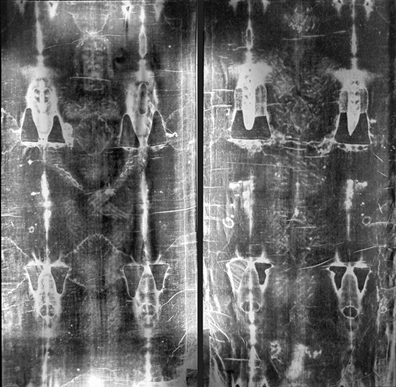
Figure
1: frontal and dorsal photonegative images of the shroud of
turin taken in 1931 by professional photographer giuseppe enrie. As he was
photographing the shroud, enrie was flanked by a french scientist, a priest and
secondo pia as witnesses. This was because pia -the first to ever photograph
the shroud in 1898- had been dogged by accusations that he had manipulated the
photonegative images due to the shocking detail that emerged in the frontal
facial image. As such, enrie proactively published details regarding the
lighting, lenses, filters, exposure times and camera settings that he used
while taking these photographs. Https://shroud.com/pdfs/ssi18part4.pdf with enrie’s photonegative
images matching pia’s, pia was exonerated.
Forensic findings regarding
rigor mortis, cadaveric spasm and crucifixion
The
findings of two renowned american forensic pathologists are presented below as
they pertain to evidence of rigor mortis, cadaveric spasm and crucifixion that
they detected during their close study of the details contained within
life-sized photographs of the full-sized frontal and dorsal body images on the
shroud. Their advanced training along with decades of experience in examining
forensic and anatomical details in order to determine both the cause and manner
of a cadaver’s death gave them precise skill that was needed to understand what
the body image reveals.
Dr.
Frederick zugibe, m.d., m.s. and phd in human anatomy (1928-2013), was the
chief medical examiner of rockland county, new york from 1969-2003. During his
tenure, he performed approximately 10,000 autopsies.
The
first of the 7 times that dr. Zugibe saw the shroud in-person was on october 7,
1978. Presumably the number is this high, because he stood in line more than
once during the time period that the shroud was on ostension in a given year,
although he specified that he once was given the special privilege of seeing
the shroud outside of its protective case10.
Dr.
Robert bucklin, m.d., j.d. (1916-2001) worked for over 50 years as a forensic
pathologist and he performed over 25,000 autopsies. During part of this time
and among just many of his accomplishments, dr. Bucklin was the chief of the
forensics division under chief medical examiner-coroner dr. Thomas noguchi in
los angeles county, california during a time when this county was widely
considered to be the “murder capital” of the united states -giving dr. Bucklin
and his division a vast amount of experience in performing autopsies where the
detailed evidence for a corpse’s cause and manner of death would often be of
pivotal importance in many murder trials. Dr. Bucklin was, also, a member of
the sturp team, however, approximately 20 years prior to joining the sturp
team, he had already published his medical and forensic findings regarding the
body images on the shroud. [bucklin 1958].
While
studying full-sized photographs of a body image cannot be said to be the
equivalent to performing an actual, full autopsy on a corpse -where the
forensic pathologist can touch, manipulate and cut into the body- nevertheless,
to the well trained and highly-experienced eyes of dr. Zugibe and dr. Bucklin,
many pertinent details about cause and manner of death were still noticeable
from such photographs which untrained, inexperienced eyes would never notice -much
less imagine.
Dr.
Zugibe Neck,
head and shoulders: with the frontal body image, there is an apparent
absence of neck space, whereas with the dorsal image there appears to be an
elongation of the neck. This can be explained by the head being bent forward in
rigor mortis.
Zugibe
explains that the head on the shroud is positioned as it is, because the
violence of jesus’ death triggered a cadaveric spasm which kept the neck
muscles solidly contracted (as opposed to becoming flaccid at the moment of
death due to primary muscular flaccidity) postmortem and that the positioning
of the head was maintained until rigor mortis was fully developed.
The
shoulders appear to be in a raised position and the head appears caught in
between the raised shoulders and, as aforementioned, bent forward. Moreover,
the right shoulder appears somewhat lower than the left.
When
working as the chief of the forensics division in los angeles county, dr.
Bucklin had 17 pathologists working under his charge88.
For
full details of bucklin’s professional experience performing over 25,000
autopsies see88.
While
acknowledging that rigor mortis in a corpse can be quite variable, zugibe’s
calculation for the timing of the typical onset and duration of rigor mortis
is: approximately 3 hours postmortem for the onset, rigor mortis is complete in
about 18-36 hours and rigor will usually remain for about 12 hours and
gradually leave the body in 12 or more hours10.
The
shoulders are made up of three bones: collarbone/clavicle), scapula/shoulder
blade (where all of the shoulder muscles interact), the humerus/upper arm bone
(which connects the upper arms to the torso.)
The
main bones used to raise one’s shoulders are the scapula (shoulder blade) and
clavicle (collarbone.)
Zugibe
performed suspension experiments with volunteers who weighed in the range of
174-204 pounds since the body image on the shroud appears to be that of a man
weighing approximately 175 pounds89. From these suspension experiments, zugibe discovered
that when they were put in the upright position of crucifixion their arms would
fall into formation at an angle in the range of 65°-68° and their head would
get caught between their shoulders and be capable of only a limited amount of
movement from side-to-side and from front-to-back. Zugibe’s suspension
experiments, therefore, confirmed his explanation for the appearance of the
neck and shoulders in the shroud’s two body images.
Arms:
but, what about the arms?
The
shroud contains no depiction whatsoever of outstretched arms -much less arms
outstretched to a 65°-68° angle. Instead, as zugibe points out, the hands in
the body image are crossed just below the umbilicus at the hip level with the
left hand over the right hand. Quite obviously, this is not the position of a
person who went into rigor mortis while still crucified to a cross. Yet, to the
well-trained and experienced eye, the matter is not closed. Zugibe’s expertise
in examining bloodstains and determining their origin enabled him to uncover
the full story behind the bloodstains on the arms so as to explain the
incongruence. With regard to the bloodstains on the arms, he made the following
observations:
It
is obvious that the blood flows on the arms occurred right after removal of the
nails (which had sealed the wounds during suspension) from the hand area,
causing the blood that contained fibrinolysins to flow down the back of the
arms from the nail exit wound while the arms were suspended above the head
still in rigor at the same angle in which they had been nailed to the
crosspiece. The [blood] flow patterns are consistent with the position of the
crucarius [sic] on the cros10.
Zugibe
further explained that while the image of the arms on the shroud exhibits the
stiffness of rigor mortis, their position was altered for the purpose of
entombment. Specifically, for them to be in the position that they are on the
shroud, rigor mortis had to be broken at the shoulder joint and also slightly
at the elbows. He referred to the shroud man’s body conforming to the position
of crucifixion during entombment with the exception of the arms -where the Zugibe
further notes that this is in sharp contrast to the many artistic depictions of
jesus on the cross where jesus’ head is in various positions (as depicted by
the imagination of artists but not factually accurate) such as “hanging way
over to the left or right, arched forward with and without the shoulders bent
forward, etc.10.” The
latin word for a person executed via crucifixion is “cruciarius.”
The
author notes that the postmortem repositioning of the arms was, also, likely
prompted by the desire to fully contain the corpse within the confines of the
burial cloth (without, for example, arms outstretched and sticking out of the
relatively narrow burial cloth) and to possibly place the corpse on a possible
built-in bench in a niche within a cave tomb in jerusalem.
The
term “breaking” rigor mortis is not about breaking bones; instead, it involves
the forcible bending of a limb at a joint10 so as to unstiffen the muscle fibers
that are responsible for the rigidity.
Rigor
had been broken and maintained (as in there was still rigor mortis in the arms
after they were repositioned.)
As
aforementioned, rigor mortis can be broken through the forced bending of a limb
at a joint. Moreover, if rigor mortis is still in a reversible, unfixed state,
rigidity can be reestablished in the new position —albeit to a lesser degree of
stiffness than prior to the repositioning [79], [64]. If, however, rigor mortis
is fully developed and, therefore, fixed, it is doubtful that even with the
exertion of great force that the body will be capable of being repositioned by
way of stretching or flexing a joint78,75; and, if it were
repositioned, there would be no stiffness in that area where rigor was broken78.
Since
the shroud is thought by many, including the author, to be the actual burial
cloth of jesus of nazareth, it is relevant to note that since jesus’ death was
reported to be at 3:00 pm7,6. His burial took place
within, at most, a couple of hours afterwards as it was preparation day with
sundown quickly approaching to mark the sabbath7. As such, in jesus’ particular case,
there is a strong likelihood that rigor mortis was not yet fixed, that the arms
were still repositionable into the very stylized and very dignified burial
position that is on the shroud’s body image and that after the arms were
repositioned, enough stiffness returned to the arms to give them the stiff
appearance that zugibe observed.
Zugibe
further noted that the repositioning of the arms by breaking rigor in the
shoulder joints and elbows would not have disturbed the raised position of the
shoulders with the head caught in between them.
Additionally,
concerning the amount of blood that is seen on the arms on the body image,
zugibe mentions that while it might seem like a lot, that it really is not and
the reason why is because there was not a beating heart when the nails were
removed and because the arms were in a suspended position. He further noted
that even prior to death that the nail wounds would not have caused bleeding
down the arm, because the large nails would have sealed the wounds and,
additionally, the arms were in an elevated position and the blood pressure
would have been very low.
Chest:
zugibe noted that the chest appears raised in a way that is
consistent with a cadaver’s experiencing rigor mortis while still suspended
from a cross.
Legs
and feet: zugibe observed the the right calf is denser than the left
calf and there is only a partial imprint of the left heel which suggests that
there is “either a very slight bend at the left knee with the
Zugibe
mentions that a major part of his work as a medical examiner is to estimate the
quantity of blood on various items during investigations for homicides,
suicides, etc.10.
Zugibe
notes that with someone crucified to a cross, for a significant amount of time
prior to death, there would be a decrease in the flow of blood from wounds due
to marked hypotension induced by shock10.
Foot
flexed slightly forward or a turning inward of the left foot over the right”
moreover, with the foot area showing an image of the right sole and heel, this
is further evidence that the knees in the body image are bent. Zugibe’s
suspension experiments confirmed what his predecessor dr. Pierre barbet
maintained: that when a crucifixion victim is nailed to a cross with the soles
of the feet nailed flat to the vertical beam of the cross, this will cause the
knees to bend forward to an angle of about 120° +/- 2°.
Zugibe
also pointed out that the calves exhibit a natural roundness in their
appearance which is in contrast and conflict with the expected flattened
appearance that a cadaver should exhibit if reclining flat with unbent knees. As
such, this is further evidence of bent knees being kept bent by the effect of
rigor mortis [as opposed to the flattening that occurs with primary or
secondary muscular flaccidity.
Regarding
the bent position of the legs, zugibe thought that the legs, also, experienced
a cadaveric spasm so as to maintain this bent position until rigor mortis
occurred (thereby avoiding the flaccidity of primary muscular flaccidity.) However,
while the author thinks that it is quite possible that the legs experienced
cadaveric spasm, she does not see this as definitive. Why? Because the position
of the soles of the feet being pressed flatly against the vertical beam of the
cross (stipes) would “mechanically” hold the knees in place in a bent position
regardless as to whether the muscles became flaccid or not through primary muscular
flaccidity at the moment of death.
The
left foot is slightly shorter than the right and the image of the tip of the
right foot has an unusual position which could be considered evidence that one
nail was used to secure both feet to the cross.
This
positioning of the leg and foot is evidence that a man’s body was in rigor
mortis at the time that he was placed in the shroud. Corroborating this is the
asymmetry of the legs in the body image, because if rigor mortis had not been
in effect at the time of image formation, the legs in the body image would be
symmetrical [due to primary muscular flaccidity.]
Buttocks:
zugibe noted that the right side of the buttocks is lower
than the left side which causes the buttocks to appear asymmetrical. This
asymmetry with the buttocks corresponds with zugibe’s observation of asymmetry
with the position of the legs.
Bucklin
Overall appearance : dr. Pierre barbet
(1884-1961) was a french battlefield surgeon during world war i and the chief
surgeon at st. Joseph’s hospital in paris. He was a prominent shroud researcher
and a pioneer in the area of performing experiments (with cadavers) to learn
more about important details regarding crucifixion and to apply that knowledge
to details that he was observing about the bloodstains and body images on the
shroud.
Bucklin
reported that the body image has an overall appearance of stiffness.
Legs
and feet: with regard to the lower extremities, bucklin noted that
“specific alterations in the appearance of the lower extremities from the
posterior aspect” are evidence of rigor mortis. The following are further
details with regard to this:
The
imprint of the right calf is much more distinct than that of the left
indicating that at the time of death the left leg was rotated in such a way
that the sole of the left foot rested on the ventral surface of the right foot
with resultant slight flexion [bending] of the left knee. That position was
maintained after rigor mortis had developed . . . Here is a reasonably clear
outline of the right foot made by the sole of that foot having been covered
with blood and leaving an imprint which reflects the heal as well as the toes. The
left foot imprint is less clear and it is also noticeable the left calf imprint
is unclear. This supports the opinion that the left leg had been rotated and
crossed over the right instep in such a way that an incomplete foot print was
formed. [emphasis added.]
Moreover,
the following is evidence that the man of the shroud was crucified and that his
feet were overlapped so that one nail could be used to affix them both to a
cross:
In
the center of the right foot imprint, a definite punctate defect can be noted.
This puncture is consistent with an object having penetrated the structures of
the feet and from the position of the feet the conclusion would be reasonable
that the same object penetrated both feet after the left foot had been placed
over the right. [emphasis added.]
Arms:
regarding evidence that the body was in the position of
crucifixion, bucklin noticed that the flow of the bloodstains on the wrist and
the two arms on the frontal image of the shroud could not have happened while
the arms and wrist were in the position that they are depicted in on the
shroud, because they would have flowed counter to the laws of gravity. In
reconstructing the position that the arms would have needed to have been in so
as to create blood flows on the wrist and arms like with what is seen on the
shroud, dr. Bucklin indicated that the arms would have needed to be
outstretched upward in a 65° degree angle with the horizontal.
Position
of the body at death: regarding the position that the man of the shroud was
in when he died, bucklin reported:
The
position of the puncture defects in the wrist, coupled with the blood flow
towards the elbows and also associated with the punctures of the feet, permit
the pathologist to conclude that the victim was in an upright position with his
arms extended when the blood flow took place. A crucifixion type posture would
be the most plausible explanation for these findings. [emphasis added.]
Chest:
the nature of the bloodstain from the chest area is
indicative of a dead body which corroborates the separate findings of rigor
mortis. Specifically, with the bloodstain from the chest bucklin stated the
following:
There
is distinct evidence of a gravitational effect on this stain with the blood
flowing downward and without spatter of other evidence of the projectile
activity which would be expected from blood issuing from a functional arterial
source. This wound has all of the characteristics of a postmortem type flow of
blood from a body cavity or from an organ such as the heart. [emphasis added.]
Bucklin
also found additional evidence of death in the upper plane of the bloodstain
from the chest where he detects “an ovoid skin defect which is characteristic
of a penetrating track produced by a sharp puncturing instrument.” [emphasis
added.]
Regarding
the chest, bucklin further noted that the appearance of “an increase in the
anteroposterior diameter of the chest due to bilateral expansion.”
This
increase in the anteroposterior diameter of the chest due to bilateral
expansion that bucklin described is precisely what occurs when one breathes in
or inhales. More specifically, the following occurs when a breath is drawn in:
During
inspiration, the anteroposterior diameter of the thorax is increased when the
ribs are raised. Because ribs slope downward, any elevation during inspiration
results in an upward movement of the sternum at the manubriosternal joint and
an increase in the anteroposterior diameter of the thorax90.
Although
bucklin does not state this, the author observes that bucklin’s report
concerning the appearance of the chest in the body image is evidence of a
cadaveric spasm in the chest that preserved the last inhaled breath of the man
of the shroud.
While
inhaling requires the use of muscles, exhaling is often a passive process
unless, for example, someone is exercising. But, with the primary muscular
flaccidity that occurs immediately after death, the chest muscles would relax
which would cause the passive process of exhalation91. However, a cadaveric spasm at the
moment of last inhalation at the time of See32 regarding nails used for crucifixions
in the 1st century. Also, corroborating the evidence that points to the man of
the shroud as a crucifixion victim are the patterned injuries all over the
frontal and dorsal area of the body image which are consistent with commonly
administered pre- crucifixion scourging33,36,39,8,6,5.
Death
would fix the muscles that were used to effectuate the bilateral expansion
(until the onset of secondary muscular flaccidity.)
Piczek experimentally
confirms bent knees
The
internationally acclaimed artist dame isabel piczek noticed that the knees in
the frontal and dorsal depictions of the body images on the shroud are bent. She
then sought to objectively prove her subjective observation through an
elegantly simple experiment: piczek had a live artist’s model lay in the supine
position with his body positioned in the same way as the body is positioned in
the frontal body image on the shroud. Then, she directed the model to take two
different poses while in this supine position so as to determine if the frontal
body image on the shroud can appear as it does if a real man’s knees are
unbent. The first pose had the model reclining with his back and legs
completely flat, while the second pose had him reclining flat on his back but
with his knees bent. In observing these two positions, piczek was able to
confirm that the knees in the frontal body image would have had to have been
bent if the body image on the shroud had somehow been imprinted from an actual
body. Why? Because the manner in which the arms and hands are positioned on the
shroud cover the man’s genitals and when the model was lying flat in the supine
position with unbent knees, his genitals were exposed due to the arms not being
long enough in this position to cover his genitals. However, piczek noticed
that when the model was in this same position but with his knees bent, his arms
were long enough so that his crossed hands could cover his genitals -just like
what is seen with the frontal body image on the shroud92.
Conclusion
The forensic findings of two preeminent forensic medical
examiners point to numerous details in the position of body parts on the
shroud’s frontal and dorsal body images which indicate a body in a state of
rigor mortis and cadaveric spasm. These findings were based on each of their
decades’ worth of experience in closely examining details in corpses in various
postmortem stages so as to determine both cause and manner of death and from
their observations from conducting and/or participating in suspension
experiments.
Specifically, they both found that the bloodstains and
various positions of body parts in the images body are indicative of a
crucifixion victim that died and went into a cadaveric spasm and rigor mortis
while still nailed to a cross in the upright position with arms in an upwardly
outstretched position and where one nail attached both feet to the cross. They
noticed further details that point to the arms being repositioned -after the
body was deposited from the cross while still in a state of cadaveric spasm and
rigor mortis- into the very stylized burial position that is seen in the
frontal image.
Additionally, the forensic finding of the bent knees in the
body images by both medical examiners was corroborated by a totally different
type of experiment that was conducted by an internationally acclaimed artist
with a live model being placed in the position of the body images on the
shroud.
Regarding whether or not rigor mortis and cadaveric spasm
could have been sustained to around the maximum time period (39 hours) that the
gospels indicate that jesus was resurrected on the “third day” after his
crucifixion, the findings from mallach’s metanalysis of data from 108
publications regarding the timing of the development of rigor mortis in
corpses, as well corroborating information from a number of independent
sources, conclusively indicate that the answer is “yes,” and that the overly
restrictive timeline that the classic “rule of 12” instructs is too broad and
too simplistic to be a reliable measure -particularly in a case where cause and
manner of death are far outside of the norm which most doctors will ever
encounter. However, in all situations, many factors can alter the timeline for
the onset and and attenuation of rigor mortis. As such, the best approach is to
examine the factors that are in play on a case-by-case basis.
In the particular case of jesus of nazareth’s death, as well
as the particular circumstances leading up to and following, his death, there
are competing factors with regard to the timing of both the onset and duration
of rigor mortis. Moreover, each of these factors has the capacity to weigh
significantly more or less in its effect on rigor mortis than other relevant
factors which adds to the complexity of things. Additionally, it is doubtful
that many (if any) forensic medical examiners have examined bodies which have
undergone the type and degree of torture that jesus underwent before dying. All-in-all,
we cannot really know with any high degree of confidence how quickly rigor
mortis set in and how long it lasted in jesus’ body. Understanding the factors
(as well as how long rigor mortis can be visibly sustained in a body), however,
does show us that there are many factors that could have caused cadaveric spasm
as well as a very early (if not nearly instantaneous) onset of rigor mortis and
that there are factors which could have caused jesus’ body to remain in rigor
mortis until just before the time that the empty tomb was discovered on the
“third day.”
As such, there is no conflict between rigor mortis and
cadaveric spasm being indicated on the frontal and dorsal body images on the
shroud and that jesus’ body was the one that created the body image.
While extraneous to the issue of rigor mortis and cadaveric
spasm, but relevant to the issue of the identity of the man of the shroud, the
bloodstains on the head are consistent with a crown of crown of thorns10,89. Since history knows of only one person -a crucifixion
victim- who had a crown of thorns placed on his head, this is compelling
evidence that the man of the shroud is none other than jesus of nazareth.
What is most compelling about the details pointing to rigor
mortis and cadaveric spasm on the frontal and dorsal body images on the shroud
is how inconspicuous they are -to undoubtedly all except those with both a very
trained eye and a very trained mind with regard to the various changes that a
body undergoes in relationship to its surroundings during the postmortem
process.
With regard to whether a forger put in these details to make
the body images on the shroud convincing to the public, one must not just ask
that question, but one must critically think through it.
The eyes cannot see what the mind does not know. As such, a
medieval forger cannot create that which he cannot conceive. The details with
regard to the head, neck, shoulders, arms, legs, bent knees, calves and feet
are so subtle that it would strain credulity to think that any forger (much
less a medieval one) could have even imagined the inclusion of such details. Moreover,
there is the question of why would a forger include details so subtle that they
would be meaningless to the public? How does the public become convinced of
something that they are not even aware of?
Adding to the complexity of things, even if we imagine the
unimaginable -that a forger imagined these detail —there is the additional
problem that no known person has ever managed to produce a body image that
exhibits all of the special features that the shroud’s body images possess.
Nonetheless, with the findings of these experts whose results
are discussed in this paper, our minds are now aware of these details -many of
which our own eyes can easily see to confirm.
Most importantly, these very important details point to the
authenticity of the body images and that the body that created these body
images in some still unknown way is none other than jesus of nazareth -a man
whose continued reputation for nearly 2,000 years is still intertwined with his
involvement with supernatural acts.
Dedication
This
paper is dedicated to the memory of my beloved uncle ted -aristotle theodore
pappas (september 15, 1928-october 30, 2022.) He was my wing-maker, my greatest
teacher and my biggest champion. And, to those who had the pleasure of knowing
him, they knew him to be the good man that he habitually was. His “mantra”
regarding work was always: "dedication, determination and persistence,”
and he drilled that into my brain on a regular basis for at least the first
three decades of my life. Those happen to be three of the most important
personality traits that one needs when deeply researching the shroud, so i am
profoundly grateful to him for that important life lesson among the many that
he taught me. You continue to be loved and missed by me beyond what words can
adequately express. Rest in peace, unc.
Acknowledgements
Endless
thanks to giulio fanti for his ongoing kindness and helpfulness to me in all of
the areas of shroud research that i have explored as well as for his very
useful advice on many issues in this paper. Many thanks, also, to peter
schumacher and janis winchester for their helpful comments concerning the vp-8
image analyzer, to randy hale, russell peterson and chris coleman for their
technical advice on some computer issues and to dr. Gilbert lavoie and gerardo
ballabio for their helpful comments regarding the issue of negative images.
Special
thanks to editor michael kowalski of the british society for the turin shroud
Newsletter
who published my first paper on rigor mortis in the summer 2024
Newsletter
and for his useful editorial help with that paper. Pappas, theodora a., “indicia
of reliability: evidence of rigor mortis and cadaveric spasm from the body
image on the shroud of turin,” british society for the turin shroud newsletter,
issue no. 99, summer 2024, https://www.bstsnewsletter.com/94.
Lastly,
deep thanks to barrie schwortz (september 12, 1946-june 21, 2024.) Barrie was a
very kind and generous teacher to me and many others and he was routinely a
very helpful source of information on countless matters regarding the shroud of
turin. Being regaled by barrie with wonderful first-hand stories about the
shroud was always the “cherry on top” of our many discussions. He is missed
very much by me and so many others, but he lives on through the great legacy
that he has left us with in the form of shroud.com and the many stories that we
share about him. Rest in peace, dear friend.
References
1. jumper ej, adler ad, jackson jp, pellicori sf, heller jh, drusik jr. A comprehensive examination of the various stains and images on the shroud of turin. American chemical society advances in chemistry. Archeological chemistry- iii 1984;205:447-476.
2. heller jh, adler ad. A chemical investigation of the shroud of turin. Canadian society of forensic sciences journal 1981;14(3).
3. https://www.agapebiblestudy.com/charts/jewishtimedivision.html
4. https://encyclopedia.pub/entry/30073
5. gospel of matthew, 27;57-60.
6. gospel of mark 15;42-47.
7. gospel of luke 23:50-124.
8. gospel of john 20:1-8.
9. shroud.com
10. zugibe ft. The crucifixion of jesus, 2nd ed 2005.
11. fanti g, marinelli e, cagnazzo a. Computerized anthropometric analysis of the man of the turin shroud 2000.
12. barbet p. A doctor at calvary 1953.
13. barbet p. Proof of the authenticity of the shroud in the bloodstains: part i. Shroud spectrum international 1987;1950(22).
14. adler ad. The orphaned manuscript: a gathering of publications on the shroud of turin. Shroud spectrum international special issue 2002;12.
15. https://chemart.rice.edu/photography.html
16. heller jh. Report on the shroud of turin 1983.
17. phillips rj. Why are faces hard to recognize in photographic negative? Perception and psychophysics 1972;12(5).
18. gilad s, meng m, sinha p. Role of ordinal contrast relationships in face encoding. Pnas 2009;106(13).
19. liu-shuang j, ales jm, rosin b, norcia am. The effect of contrast polarity reversal on face detection: evidence of perceptual asymmetry from sweep vep. Vision research 2015;108:8-19.
20. lavoie gr, the shroud of jesus 2023.
21 mccrone w. Judgment day for the shroud of turin 1999.
22. de caro l, fanti g. New insights on the turin shroud’s body image: face image at different wavelengths and its double superficiality. Scientia et fides 2024;12(2):151-84.
23. rogers rn. A chemist’s perspective on the shroud of turin 2008.
24. jackson jp, jumper, ej, ercoline, wr. Three-dimensional characteristic of the shroud image. Ieee 1982 proceedings of the international conference on cybernetics and society 1982.
25. jackson jp, jumper ej, ercoline wr. Correlation of image intensity on the turin shroud with the 3-d structure of a human body shape. Applied optics 23;1984;2244.
26. miller vd, pellicori sf. Ultraviolet fluorescence photography of the shroud of turin. J. Biol. Photogr. Assoc 1981;49:71.
27. pellicori sf. Spectral properties of the shroud of turin. Applied optics 1980;19:1913.
28. fanti g, malfi p. The shroud of turin: first century after christ! 2nd edition 2020.
29. accetta js, baumgart js. Infrared reflectance spectroscopy and thermographic investigations of the shroud of turin. Applied optics 1980;19(12):1921-1929.
30. lavoie gr, lavoie bb, adler ad. Blood on the shroud of turin part iii: the blood on the face. Shroud spectrum international 1986.
31. fanti g. New insights on blood evidence from the turin shroud consistent with jesus christ’s tortures. Arch hematol case rep rev 2024.
32. cook jg. Crucifixion in the mediterranean world, 2nd extended edition 2019.
33. josephus. Wars of the jews 2013.
34. cicero. Against verres, 2.5.165.
35. seneca. Moral letters to lucilius 10;10-14.
36. livy. History of rome, 22.13.9, 28.37.3, 33.36.1-3.
37. hengel m. Crucifixion. 1977.
38. philo of alexandria. In flaccum, 72.
39. dionysius of halicarnassus. Roman antiquities 5.51.3.
40. eusebius of caesarea. Ecclesiastical history, book 4, ch. 15.
41. zosimus. New history 5.2.4.
42. Theodosian codes, 9.35.2.1, 12.1.85.
43. prudentius a. Peristephanon, 10:116-125.
44. https://www.forbes.com/sites/kristinakillgrove/2019/12/23/heel-bone-fromitaly-is-only-second-example-of-crucifixion-ever-found/ .
45. seneca. Dialogues, 20.3.
46. bucklin r. The medical aspects of the crucifixion of our lord jesus christ: from a study of the shroud of turin. The linacre quarterly. 1958;25(1).
47. shanks h. Scholars’ corner: new analysis of the crucified man. Biblical archaeology review 1985;11:44-53.
48. zias j, sekeles e. 1985, the cruficified man from giv’at ha-mivtar: a reappraisal, israel exploration journal 1985;35:22-27.
49. josephus. Antiquities of the jews 16:160-173.
50. josephus. Against apion, 2.73 (jewish liberties.) 51. Deuteronomy 21:22-23.
51. Lactantius, 4.26.
52. quintilian. The major declamations, 6.9.
53. the babylonian talmud, sanhedrin 43a.
54. tacitus. The annals, 15.44
55. new english translation bible, john 19:40, translator note 117.
56. sugatha m, ramana v. Assessment of time since death using forensic autopsies based on the presence of rigor mortis- a cross-sectional study, international journal of contemporary medical research 2019.
57. janaway rc, percival sl, wilson as. Decomposition of human remains. 2009. 59. Almulhim am, menezes rg. Evaluation of postmortem changes 2024.
58. Rattenbury a. Forensic economics. 2018.
59. shivpoojan k, time since death from rigor mortis: forensic prospective, j forensic sci & criminal inves 2018.
60. shapiro ha. Rigor mortis, british medical journal 1950.
61. shrestha r, kanchan t, krishan k. Methods of estimation of time since death 2024.
62. hayman j, oxenham m. Human body decomposition 2016.
63. gill-king h. Chemical and ultrastructural aspects of decomposition, chapter 6, in: haglund wd, sorg mr, editors, forensic taphonomy: postmortem fate of human remains 1997.
64. Simmon t, cross pa. Late postmortem changes, encyclopedia of forensic sciences, 2nd ed 2013.
65. goff ml. Early post-mortem changes and stages of decomposition in exposed cadavers, exp appl acarol. October 2009.
66. Mallach h, zur frage der todeszeitbestimmung, berl. Med. 1964; 18
67. henssge c, madea b. Estimation of the time since death in the early post-mortem period, forensic science international. 2004;144(2-3).
70. demierre n, wyler d, zollinger u, bolliger s, plattner t. Elevated body core temperature in medico-legal investigation of violent death. The american journal of forensic medicine and pathology 2009;30:155-8.
71. d’souza dh, harish s, rajesh m, kiran j. Rigor mortis in an unusual position: forensic considerations, int j appl basic med res, 2011.
72. chemlab, https://www.chem.fsu.edu/chemlab/chm1020c/lecture 8/02.php
73. Madea bg, kernbach-wighton g. Encyclopedia of forensic sciences, 2nd ed 2013.
74. christensen am, passalacqua nv, bartelink ej. Chapter 5 - forensic taphonomy, forensic anthropology, academic press, 2014:119-147.
75. gill jr, landi k. Putrefactive rigor: apparent rigor mortis due to gas distension. The american journal of forensic medicine and pathology 2011.
76. tsokos m, board rw. Postmortem changes: overview, encyclopedia of forensic and legal medicine, 2nd ed 2016.
77. krompecher t, gilles a, brandt-casadevall c, mangin p, experimental evaluation of rigor mortis: vi. Effect of various causes of death on the evolution of rigor mortis, forensic sci. Int 2008.
78. shedge r, krishan k, warrier v, kanchan t. Postmortem changes. In: statpearls.
79. Treasure island (fl): statpearls 2023.
80. fierro mf. Cadaveric spasm. Forensic sci med pathol 2013;9:253.
81. madea b. Cadaveric spasm. Forensic sci med pathol 2013;9(2):249-250.
82. alfleesy, o. Cadveric spasm, int j forensic sci pathol 2016;4(6):252.
83. dundee. Postmortem changes and time of death
84. Emery km. New morbid terminology: cadaveric spasm 2013.
85. knusel c. Death, decay and ritual reconstruction: archaeological evidence of cadaveric spasm. Oxford journal of archaeology 1996.
86. journal of the american medical association editorial. Cadaveric spasm, jama 1898.
87. https://www.courttv.com/title/96-nv-v-murphy-tabish-dr-robert-bucklin/
88. bucklin r. An autopsy on the man of the shroud 1997.
89. https://hal.bim.msu.edu/cmeonline/ribcage/biomechanics/start.html
90. dezube r, control of breathing, merkmanuals.com
91. Piczek i, https://www.shroud.com/piczek.html
92. Rolfe d, https://whocanhebe.com/the_challenge_2024.html
93. Pappas ta. Indicia of reliability: evidence of rigor mortis and cadaveric spasm from the body image on the shroud of turin, british society for the turin shroud
94. newsletter, summer 99;2024.