CDR (CDR1, CDR2, CDR3) Complementary-Determining Region Invertebrate Primitive Antibody from; Sea Star Modelization 3D with Human IGK
Abstract
CDR1,
CDR2, CDR3 determining regions were discovered in the IPA (Invertebrate
Primitive Antibody) from sea star, for the first time, in an Invertebrate.
Further more a modelization in 3D of this primitive antibody was given; it
shares similar regions with IGKV1-5 human antibody.
Keywords: Invertebrates; sea star,
CDR regions; IGKV1-5 human antibody
Introduction
10
years ago, we tried to clone, for the first time, the Asterias rubens sea star
IGKappa gene by the use and the help of E. coli as amplificator1. It allowed, in a second time, to verify that
the Young Protein, or anti-HRP Protein recognizes the HRP antigen1,2.
In
the present work we research Complementary Determining Regions called more
briefly CDR1, CDR2, CDR3 or Complementary-Determining Regions3,4.
First,
anti-HRP sequence in nucleotids is given :
5’GGA TCC GGA GGA ATG
CGTGGCAACATGGCGTCTCTATGGATGTTCTTCTT
TGTCGTGGGGATAACTTTACAACGGAGTTTGGCGATTTACACGTTTCGCG
AGCAACCGTCGGACACTAGCGCGTTGCAGGGGAGCACAGTGGTGCTTCAC
TGCTCCGTTGAGCAGTACATAAACACCACGGCCATCGTTTGGTGGAGCCG
TGACTCGGTCATCAGCCACAACAAAGACCTGAAACTGTCCAGTCTAAACA
CCGACCAGCTCCAAAGGTACTCGATTTCAGGCGACGCATCTCGGGGGGAA
TTCAACCTTAAAATAGTGAACTTTACCGCCACAGACGCCGCCAGTTACCG
CTGTCAGATG TAA
GAA TTC3’
gga tcc gga gga atg cgt ggc aac atg gcg tct cta tgg atg ttc ttc ttt gtc gtg ggg
G S G G M R G N M A S L W M F F F V V G
ata act tta caa cgg agt ttg gcg att tac acg ttt cgc gag caa ccg tcg gac act agc
I T L Q R S L A I Y T F R E Q P S D T S
gcg ttg cag ggg agc aca gtg gtg ctt cac tgc tcc gtt gag cag tac ata aac acc acg
A L Q G S T V V L H C S V E Q Y I N T T
gcc atc gtt tgg tgg agc cgt gac tcg gtc atc agc cac aac aaa gac ctg aaa ctg tcc
A I V W W S R D S V I S H N K D L K L S
agt cta aac acc gac cag ctc caa agg tac tcg att tca ggc gac gca tct cgg ggg gaa
S L N T D Q L Q R Y S I S G D A S R G E
ttc aac ctt aaa ata gtg aac ttt acc gcc aca gac gcc gcc agt tac cgc tgt cag atg
F N L K I V N F T A T D A A S Y R C Q M
taa gaa ttc
- E F .
Or
in Another way:
MRGNMASLWMFFFVVGITLQRSLAIYTFREQPSDTSALQGSTVVLHCSVEQYINTTAIVWWSRDSVISHNKDLKLSSLNTDQLQRYSISGDASRGEFNLKIVNFTATDAASYRCQMFA
Results
2
Tables issued from IMGT resume the following analysis below : (Tables 1,2)
https://www.imgt.org/3Dstructure-DB/cgi/DomainGapAlign.cgi with
default settings, 17/01/2024
IMGT/DomainGapAlign version: 4.10.3 (2021-12-06).
Table
1: Closest Reference Gene and
Allele(s) from the IMGT V Domain Directory : (All Species)
Table
2: Alignments with the
Closest Reference Gene and Allele(s) from the IMGT V Domain Directory :
(All Species)
>starfish|IGKV1-5*01|33.3|||Pongo abelii
EQPSDTSALQGSTVVLHCSVEQYI.....NTTAIVWWSRDSVISHNKDL.KL.......SSLNTDQL.QRYSISGDASRGEFNLKIVNFTATDAASYRCQ.
The conserved amino acids (positions 23,
41, 89, 104) are found in the starfish sequence.
If it aligns with the Pongo IGKV1-5,
the percentage of alignment is 33%, so it is a sequence that seems to have
similarities to an IGKV gene when it comes to conserved amino acids.
It
appears clearly that CDR1 and CDR2 exist in the sea star primitive antibody and
less clearly for CDR3 (1 amino acid which is conserved).
Undoubtly :
These new parameters corroborate the existence of an
Invertebrate Primitive Antbody and NOT IG-LIKE as it is often said. We recall
also the discovery by us of T and B sea star lymphocytes5. Humoral specific response6, Genomic data7 with specially Invertebrate MHC
genes.
ALL these elements assess the existence of an
IPA : Invertebrate Primitive Antibody which shares strong sequence
alignments(at least for CDR1 and CDR2) with the Primate : Pongo
pygmaeuserences . More recently, in a work concerning Modelizations in 3D
of the sea star anti-HRP protein, we found a CDR3 region (see below this
modelization when compared to AlphaFold prediction of IGKV1-503 from Homo
sapiens (Figure 1).
Figure 1: Alpha Fold prediction of IGKV1-5*03 Homo sapiens
in black sea star CDR1, CDR2, CDR3(at the left) determining regions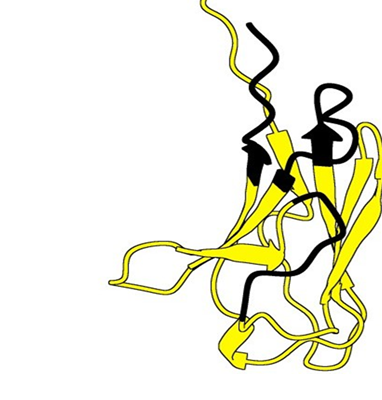
References
1. Leclerc
M, Otten P. Immune properties corroborated by A. Rubens sea star Igkappa gene.
SAJ Biotechnology 2014;1:104.
2. Leclerc
M. Recombinant protein (anti-HRP) issued from the sea star igkappa cloning by
the use of cho: its antibody specificity revealed by Elisa. J Stem Cell
Res Ther 2024;9(1):1.
3. Ehrenmann,F,
Kaas Q, Lefranc
MP. IMGT/3Dstructure-DB and IMGT/DomainGapAlign: a database and a tool for
immunoglobulins or antibodies, T cell receptors, MHC, IgSF and MhcSF. Nucleic
Acid Res 2010;38:D301-D307.
4. Ehrenmann
F. Cold Spring Harbor Protoc 2011;6:737-749.
5. Leclerc M, Arneodo VJ,
Legac E, Bajelan M, Vaugier GL. Identification of T-like and B-like lymphocyte
subsets in sea star Asterias rubens by monoclonal antibodies to human
leukocytes. Thymus 1993;21(3):133-139.
6. Brillouet
C, Leclerc M, Binaghi RA, Luquet G. Specific immune response in the sea star
Asterias rubens: Production of "antibody-like" factors. Cell Immunol
1984;84(1):138-144.
7. Vincent
N, Osteras M, Otten P, Leclerc M. A new gene in A. rubens: A sea star Ig kappa
gene. Meta Gene 2014;2:320-322.