Effect of heavy lifting on pelvic floor across the Menstrual cycle
Menstrual cycle is a gift in covering of a process to woman
by nature which enable woman to bring a new life in the world for which each
women goes through her life for around 450 cycles or 3500 days hence it is very
important for a woman to know about their menstrual cycle and health .
A normal physiological phase called menstruation starts
throughout adolescence when the progestational endometrium is torn, causing
blood loss and other hormonal changes. The hormones estrogen and progesterone
interact intricately during the typical menstrual cycle. Normal conditions call
for it to happen every 28 to 35 days, with blood flow lasting 3 to 5 days and
an average blood loss of 30 to 80 ml. It is determined by the girl's general
health as well as her social and dietary circumstances. The axis of the
hypothalamus, pituitary, and ovary is responsible for coordination.
When a woman is in her ovulatory menstrual cycle, her
hormones are constantly altering. It alters a number of bodily functions,
including the cardiovascular, respiratory, thermal, and metabolic, all of which
have an impact on the physiology of exercise. The early follicular phase,
ovulation phase, and mid-luteal phase are the three other major phases of a
menstrual cycle. Low estrogen and low progesterone levels are characteristics
of the early follicular phase. High estrogen and low progesterone levels define
the ovulatory period. High levels of progesterone and estrogen are present in
the mid-luteal phase. It is further divided into early, mid, and late
follicular phases as well as ovulation, early, mid, and late luteal phases.
Oestrogen, progesterone, follicle stimulating hormone (FSH),
and luteinizing hormone (LH) are the four hormonal indicators of the menstrual
cycle that fluctuate continually during the course of the cycle. The autonomic
nerve system and metabolic processes are impacted by these changes in female
steroid hormone levels. Consequently, several physiological factors and
physical performance may alter as the menstrual cycle progresses. It is
unknown, nevertheless, how the menstrual cycle phase affects exercise performance,
particularly muscular strength. Your uterus contracts during your menstrual
cycle to aid in the expulsion of its lining. The uterine muscles contract as a
result of hormone-like molecules (prostaglandins) involved in pain and
inflammation. More severe menstrual cramps are linked to higher prostaglandin
levels (Figure 1).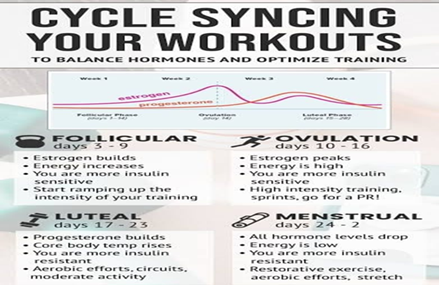
Figure 1. Exercise Regime
Heavy lifting
during menstrual cycle can actually cause what is called a uterine prolapse A
few people are more prone to uterine prolapse than others. However, have
particular risk factors that make them more vulnerable to prolapse, such as
women who are obese, have had multiple births or given birth to large infants,
have previously experienced uterine prolapse, are older or have already
experienced menopause. Some women will lift heavy objects for the majority of
their lives without experiencing uterine prolapse.
Bloating and water
retention are common in some females. You become more exhausted while lifting
weights during your period than you would during a typical workout. This occurs
as a result of energy loss. Your cramps may get worse if you lift weights while
on your period. This is due to the intense pressure that comes with hauling
weights. It's crucial not to strain oneself, though. a jog practice yoga, and
use light weights. If you feel comfortable using hormonal contraceptives, you
can take the recommended dosage. Weightlifting too hard while on your period
can make you feel uncomfortable and extremely painful in your lower abdomen.
Thus, hormonal contraceptives can aid you if you are experiencing severe
menstrual issues. A few people are more prone to uterine prolapse than others.
However, have particular risk factors that make them more vulnerable to
prolapse, such as women who are obese, have had multiple births or given birth
to large infants, have previously experienced uterine prolapse, are older or have
already experienced menopause. Some women will lift heavy objects for the
majority of their lives without experiencing uterine prolapse.
Exercise will
undoubtedly make you feel better because your body already has a hormonal
imbalance, but heavy lifting can be problematic because it increases the chance
of uterine prolapse and other concerns.