Indralupta (Alopecia areata): A Case Treated with Jalauka Karma
Abstract
Alopecia areata (aa), an autoimmune disease characterized by the appearance of non-scarring bald patches affecting the hair bearing areas of the body. Scalp is the most common site of involvement. Aa can affect any age group. The usual pattern of the hair loss is oval or round and can be co- related with indralupta in ayurveda. The pathophysiology of indralupta is the vitiated tridoshas and rakta affecting the scalp and also blockage of hair follicles with aggrevated rakta and kapha which further prevents regrowth of hairs is described as kapalgata roga by acharya vagbhata and as a kshudra roga by acharya susruta and madhava. When alopecia areata patchy develops, the body attacks its own hair follicles.
Aim: to evaluate the efficacy of leech therapy along with ayurvedic treatment in indralupta(alopecia areata). Material and methods: a hindu, unmarried 18 yrs. Old female patient suffering from a single patch of hair loss over the mid scalp region since three weeks was seen in shalya department of ayurveda teaching hospital, kirtipur opd no. 7901265. The patient was diagnosed as a case of alopecia areata patchy (khalitya) with clinical findings & examination done. Shodhana (raktamokshan) were done by leech (jalauka) along with internal medicine tablet amlaki, and local application of hairzone spray for 60 days with follow up at every one week.
Results/discussions: after 60 days of treatment, regrowth of hair was achieved remarkably.
Conclusion: the current case study demonstrated the effectiveness of ayurvedic treatment for indralupta/alopecia areata which includes jalauka karma along with some internal and external drugs. The single case report highlights that alopecia can be managed with an appropriate diet regimen, rakta-mokshana, and can be managed effectively with a minimum requirement of medicine.
Keywords: alopecia areata patchy; autoimmune; blood letting; hair loss; indralupta; jalauka; khalitya; leech therapy; panchakarma; raktamokshan; leech
1. Introduction
Alopecia aerata is an autoimmune disease
characterized by hair loss on body especially on scalp without any clinical
inflammatory signs. Its prevalence in general population was estimated at
0.1-0.2% with a lifetime risk of 1.7%1.
Male was reported to be more affected with the disease in comparison to
children and women and causes more emotional problems in woman and children due
to cosmetic concern2. Its main
treatment in modern science is corticosteroids which is having harmful side
effects so not advisable for long term use3.
Therefore world is expecting some remedies from alternative medical sciences.
Ayurveda offers different effective treatment modalities for the management of
different autoimmune diseases like psoriasis, eczema, etc4. Alopecia areata can be correlated with
indralupta disease described in ayurveda. Acharya charaka mentions that pitta
by involving vatadidosha when reaches the scalp, it results in khalitya
(indralupta)5. According to acharya
sushruta, pitta along with vata localize at the roots of hair (romakoopa)
causes fall of hair and thereafter kapha along with rakta obstructs the channel
of romakoopa leading to the stoppage of the regeneration of hair and this condition
is known as indralupta or khalitya6.
Thus vata, pitta and kapha dosha and rakta dushya are the main internal
causative factors of indralupta (figure 1).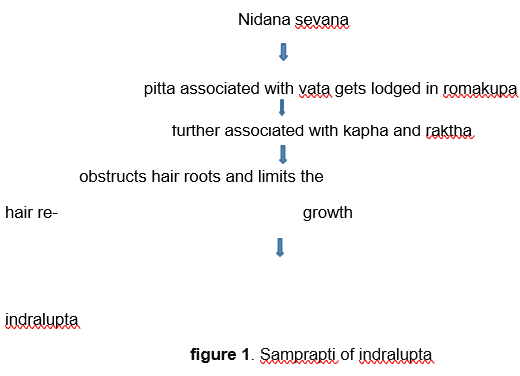
2.
Case
An 18 yrs old unmarried female which was
referred to the ayurvedic hospital by her doctor sister for ayurvedic
management, was presented in shalya department of tu ayurveda teaching hospital
kirtipur opd no. 7901265 with following chief complaints.
2.1
Chief complaints
A patchy hair loss for 3 weeks on the
scalp associated with mild itching.
History of present illness: according
to patient she was asymptomatic 3 weeks ago then she develops patchy hair loss
on scalp, with mild itching over
affected area and gradual increment since 3 weeks which was gradual in onset
and progressive in nature without any pain. There was patchy hair loss measuring about 4x4 cm on the mid scalp region. Patient didn’t notice
any exaggerating or relieving factors.
History of past illness:
there was no history of similar illness
in past and no
history of autoimmune disorders (like atopic
dermatitis, psoriasis, vitiligo,
asthma, urticaria, rheumatoid
arthritis, thyroiditis), no history of drug intake,
and no history of any systemic illness.
Family history:
- no any significant family history i.e. No member
of the family had history
of such illness.
Menstrual history: - regular with normal duration without any dysmenorrhea and clots.
Personal history
|
Diet |
Mixed |
|
Micturition |
4 - 5 times/day, 0 - 1/night |
|
Appetite |
Good |
|
Sleep |
Adequate,
rarely disturbed |
|
Bowel habit |
Irregular |
|
Addiction |
Nil |
Astavidha pariksha (eight folds of examinations)
|
Nadi(pulse) |
78/min, regular,normal In character |
|
Mala(stool) |
Constipation on /off |
|
Mutra(urine) |
Samyak (normal Frequency) |
|
Jihva(tongue) |
Normal shape and
size ,no cracked
present,slightly coated |
|
Sabda (speech) |
Clear |
|
Sparsa(touch) |
Mridu (soft) |
|
Drika (eyes) |
Normal |
|
Akruti (built) |
Madhyam |
General examinations
|
Pulse |
78/min |
|
Blood
pressure |
110/80 mm of hg |
|
Height |
130cm |
|
Weight |
50 |
|
Respiratory rate |
18/min |
|
Temperature |
Normal |
|
Tongue |
Slightly coated |
Dasvidha pariksha
(ten folds of examinations)
|
Prakriti (body Constitution) |
Vata-pitta |
|
Vikruti |
Tridoshaj |
|
Sara |
Mamsa sara |
|
Praman(body
proportion) |
Sama pramana(symmetrical) |
|
Samhanan(body built) |
Madhyam
(medium ) |
|
Satmya |
Sarwasatmya (homologation for all Taste) |
|
Satva(mental
strength) |
Madhyam |
|
Aahara skakti
(digestive Power ) |
Madhyam |
|
Vyayam shakti
(capability Of physical activity
) |
Madhyam |
|
Vaya (age) |
Yuva awastha |
Disease
specific examinations
Examination showed patchy hair loss measuring about 4x4 cm on mid scalp region and mild dryness over patch, no scarring or cicatrization, nor any other skin lesion over scalp, no tumor in localized area and abnormalities of hair in adjacent area. Length of hair of adjacent scalp was uniform and was not broken off. The patient was clinically diagnosed as case of indralupta (alopecia areata) and advised for leech therapy.
|
Site of involvement |
Mid scalp |
|
Pattern |
Round patch |
|
Skin color |
Slight reddish |
|
Discharge |
Absent |
|
Sensation |
Present |
Systemic
examination
On examination, patient was found to be
conscious and well oriented to time, place and person. Assessment of central
nervous system, cardiovascular system, respiratory system and musculoskeletal
system of patient was found within normal limits clinically. No clinical
abnormality was detected on per abdomen examination.
Blood
investigation
Blood investigations hb, tlc, dlc, esr,
blood sugar values were within normal limit.
Treatment
planned
The treatment was planned according to
the basic principles narrated in the context of indralupta disease.
Primary management of indra lupta
(alopecia areata patchy) is shodhan therapy (detoxification). As per ayurvedic
literature application of jalauka (leeches) on diseased area is a type of
raktamokshan (blood-letting) under panchakarma chikitsa. Blood vitiated by
pitta should be removed from the body (diseased part) by using jalauka. Leech
therapy (jalauka) was done once a week along with internal and local
medications up to 2 month.
(tables 1, 2). Application of jalauka (leech) was done as per methodology described by ayurved text with all aseptic precautions. The follow up was taken once in a week.
Table1. Leech therapy
(jalauka)
|
Raktamokshan |
Frequency |
Duration |
|
Application of Jalauka (leech)
1 at a time. |
Once a week |
Up to 2 months |
Table
2. Medicines
|
Medicines |
Dose |
Duration |
|
Tab. Amlaki |
2 tab x bd x po (500mg each ) |
2 months |
|
Hair zone spray |
Local application Hs |
2 months |
Advices
|
Do |
Don’t |
|
Washing of hair
with herbal Shampoo |
Avoid junk
foods |
|
Use coconut oil for
scalp |
Avoid use of bleaching agents |
|
Use cap when outside of Home |
Avoid direct sun
exposure |
|
Have adequate sleep |
Day sleep |
|
Pranayama for 15 min
in the Morning |
Awakening till late night |
|
|
Excessive use of salt |
3.
Observations and results
Before
treatment: there was patchy hair loss, no hair roots, slight
dryness at the site was present.
During
treatment: there was no any blister formation, etching or any
adverse reaction at site or all over body.
Follow
up: after 15 days of treatment small whitish grey hairs
grew on the lesion. Length and density increased; hair fall decreased. No
further complications were observed.
After
treatment: after 60 days length and density increased. Black
hairs easily observed over the affected site.
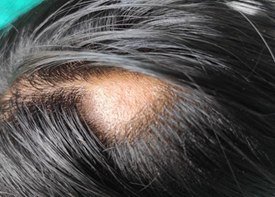
figure 1. Before treatment
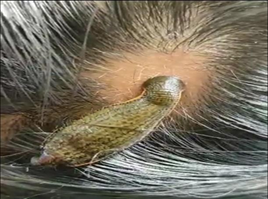
figure 2. After 15 days of treatment
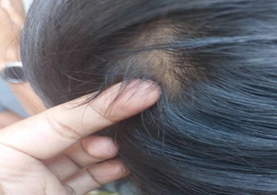
Figure 3. After 45 days of treatment
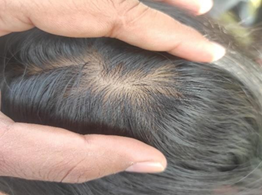
Figure 4. After 60 days of treatment
1. Discussion
As vata, pitta and kapha dosha and rakta dushya are the main internal causative factors of indralupta. In ayurveda, both shodhana (internal and external cleansing procedures) and shamana treatment (disease specific internal medications) are prescribed for indralupta. Charaka in vimanasthana, while describing the disorders occurring due to over indulgence in kshara, lavana and viruddha ahara has mentioned the occurrence of hair loss as a consequence. It has been mentioned that the viruddha ahara like, simultaneous intake of lavana (salt) with milk in the diet induces indralupta, as observed in the people of saurashtra and bahlika. Thus, it can be said that a person habituated to excessive lavana or kshara intake and taking viruddha ahara in routine is prone to have indralupta7. So nidana pariwarjana is advised here. Various localized treatment modalities like pracchan karma, lepa application, abhyanga8, swedanaa nd nasya9 along with rasayana therapy are advised in the context of indralupta. As vata, pitta and kapha dosha and rakta dushya are the main internal causative factors of indralupta. So the medications that balance out vata, pitta, kapha, and rakta and having action of keshaya (conducive to the growth of hair) and rasayana help promote the regrowth of hairs10. Amlaki is keshya, khalitya-palityahar, tridoshhar, deepan, pachan, rasayan which help in rejuvenation process. It promotes digestive fire, clears body channels for the nutrients to reach to the tissues, balances fats in the body and removes toxins by improving the digestive system. Hair zone spray which mainly contains plasha was topically used. According to bhavaprakash, palash is one of the drugs which are krimighana. Palash is katu, tikta, kashaya and katuvipaki, deepan, vrushya, snigdha, and used in krimi,varnadoshanashak, kapha-pitta, raktavikar, dahashamak and kusthaghna11. It has also proven that butea monosperma inhibits degeneration of hair follicles, extends the anagen phase of hair growth cycle and enhances proliferation and maturation of precursor epithelial cells of the final hair strand. It prevents the massive apoptosis in the proximal hair bulb and stimulates the multiplication of hair fiber cells with the stimulation of anagenic phase, and reduce the catagenic and telogenic phase12. In-vitro study of palasa (butea monosperma) seed oil also revealed considerable bactericidal and fungicidal effects13. In this way it acts and prevent further hair fall.
Raktamokashana
in this case performed with jalauka avacharan (blood-letting in which leech is
used) as, it is described as best method
to pacify the vitiated pitta and rakta14. Leech sucks the blood and improves local
blood circulation mainly by injecting histamine like substances that causes vasodilatation. After the evacuation of vitiated blood
from the affected
site, re-channelization of blood flow is stabilized. Many studies
have confirmed that leeches have more than hundred bioactive substances in its
saliva, which mainly have analgesic,
anticoagulant and anti-inflammatory effects. This is the reason for selecting
the combination of topical
application, systemic medications and leech therapy for treating this
particular case. The available treatment in modern medicine mainly based on steroid and minoxidil etc. Which have
their own side effects. Leech therapy works similar to minoxidil as it
improves the local blood circulation along with its anti-
inflammatory action.
2. Conclusion
From
this case report, we can conclude that shodhana therapy along with internal and
local medication helps in the management of indralupta. Nidanaparivarjana was
also a necessary part of the treatment. The patient suffering from alopecia
areata was successfully treated. This treatment protocol should be clinically
evaluated on large number of patients to confirm the efficacy.
References
3. Seetharam ka. Alopecia areata:
an update. Indian j dermatol
venereol leprol. 2013;79(5):563-575.
5. Trikamji ay. Sthana csc. Chaukhambha orientalia varanasi reprint
edition. 2004.
6. Trikamji ay, sthana
ssn. Chaukhambha krishanadas academy
varanasi reprint edition. 2004.
7. Trikamji ay, sthana csv. Chaukhambhaorientalia varanasi reprint
edition. 2004;672.
8. Acharya vyt, samhita s, nibandhasangraha d, sthana c,
adhyaya c. 2007.
9. Gaur bl, charaka a, samhita c, sthana c, adhyaya tc. 2014; 327.
10.
Sharma rk,
bhagwan d, caraka s. 2018.
11.
Brahmasankara
ms, bhavaprakasa sb, sansthan cs 1990;535.
14.
Srikantha murthy
kr, astanga hrdayam of vagbhata.
2005.