Knowledge and Perception of Health Care Undergraduate and Graduate Students Regarding Infection Control Practices
Abstract
Background: infection control measures are vital. It plays a major role in decreasing both morbidity and mortality. Infection control guidelines developed and continuously updated by cdc and who need to be appreciated and strictly followed.
Objectives: knowledge and perception of healthcare undergraduate and graduate students in byrdine f. Lewis college of nursing and health profession at georgia state university regarding infection control practices were explored.
Methods: this is a descriptive study of knowledge and perception of healthcare undergraduate and graduate students in in byrdine f. Lewis college of nursing and health profession at georgia state university, atlanta, georgia, usa in connection to infection control guidelines. Data was collected using a closed questionnaire which contained 27 questions. Data was analyzed using the statistical program of spss version 25.0.
Results: 68 (94.1% females) aged 19-55 years (mean: 30.7) participated. The most common specialty was nursing (44, 64.7%). The majority (>90%) were able to identify the correct answer for the specific knowledge questions. Perceptions of responders for hh and ppe were rated at 50-79.4% and 91.2-92.7% respectively. There was a significant association between the healthcare specialty and perceptions for ppe (p=0.031). There was no significant association between the healthcare’s gender, age, level of education and participation in a clinical program and perception.
Conclusion: despite the satisfactory responses obtained in this study reflecting a very good status of infection control policies applied in georgia state university, the need continues to achieve a better and continuously updated awareness of the current guidelines.
Keywords: infection control; knowledge; perception; healthcare workers; hand hygiene; personal protective equipment
Introduction
Infection
transmission is a very significant health issue. It may lead to significant
morbidities and mortalities1. Infection control guidelines have therefore been
established by cdc and who to present clear methods of prevention of disease
transmission2-4. These were based on the basic understanding of modes of
infection transmission which was also dependent on the nature of the organism
and the pathology it causes5,6. This has become obvious and more important during many
epidemics faced in the last few decades, last of which is the covid-19 pandemic7. Hcws knowledge and
perception of infection control guidelines is therefore highly required. This
study tried to explore the knowledge and perception of undergraduate and
graduate students among nursing, nutrition, respiratory therapy (rt),
physiotherapy (pt) and occupational therapy (ot) graduate and undergraduate
students in byrdine f. Lewis college of nursing and health profession at
georgia state university, atlanta, georgia, usa.
Background
Control
of infection transmission within healthcare facilities is a fundamental part of
any healthcare system. Application of this should be thorough and includes all
related factors. Hcws are perhaps the most important component. It is therefore
essential to assure that knowledge and perception of infection control guidelines
among hcws is optimal.
Methods
This study presents a
descriptive study done to explore knowledge and perception of healthcare
undergraduate and graduate students from byrdine f. Lewis college of nursing
and health professions at georgia state university, atlanta, georgia, usa, in
connection to infection control guidelines. Demographic data which also
included specialty and level of education, were collected and correlated to
knowledge and perception of these students towards hand hygiene (hh) and ppe.
Data was collected using a closed questionnaire modified from the literature8. The answers could
be ticked in preprinted boxes yes, no, and do not know, choosing one option and
true, false, and do not know style. The questionnaire contains 27 questions; 5
questions on demographic data, 17 questions on the background, and 5 questions
about knowledge and perception. The questionnaire was sent electronically to
the targeted population. Anonymous analysis of results was guaranteed. A
convenience sample was used in the study, as participants are chosen on the
basis of availability. The population was from undergraduate and graduate
students who were enrolled in nursing, rt, nutrition, pt, and ot programs in
this university (fall semester 2020). The study proposal was approved by
georgia state university institutional review board (irb). Study participation
was voluntary with a consent assumed on return of a completed survey. Data was
collected and analyzed using the statistical program of statistical package for
the social sciences (spss) version 25.0. Chi-square statistics and analysis of
variance were used. Scores of p=0.05 or above were considered as not
significant (ns). Anova and t-test were also used.
Results
The sample size of
this analysis was 68 responders, 64 (94.1%) were females and 4 (5.9%) were
males. The age range was from 19 to 55 years (mean: 30.27). Number of graduate
students (37, 54.4%) was slightly higher than the undergraduate students (31,
47.6%). Majority of responders’ specialty were nursing (44, 64.7%), followed by
nutritionists (8, 11.8%), ots (7, 10.3%), pts (6, 8.8%), and rts (3, 4.4%).
Thirty-six responders (52.9%) were enrolled in a clinical program (table 1).
Table 1. Demographic data

(figure
1) illustrates the general background knowledge and perception
of responders. Infection control guidelines were reported by 53 (77.9%) of the
responders to have been included in the university curriculum. Practical
sessions on infection control guidelines were offered to 36 (52.9%).
Instructions about the importance of infection control were provided for 59
(86.8%). More specific instructions about the hospital guidelines on infection
control was given to 40 (58.8%). Fifty (73.5%) see their infection control supervisors.
Forty-seven (69.1%) were given instruction to report symptoms and signs of an
infectious condition promptly to a supervisor or a hospital infection control
officer (figure 1).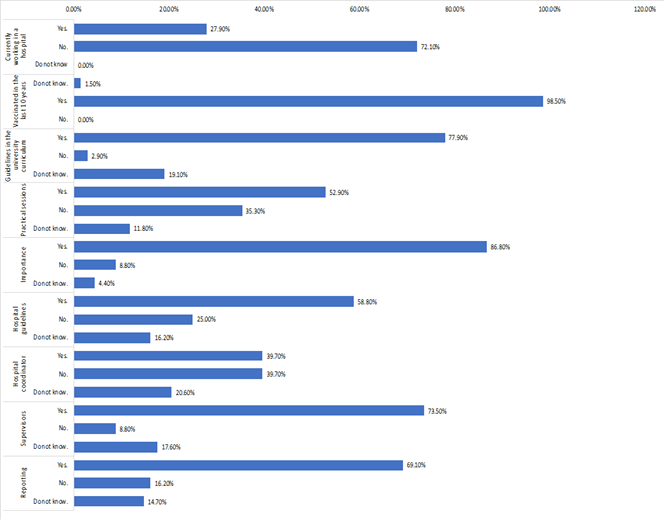
Figure 1. General background
The specific background of participants was done through 8 multiple choice questions with one correct answer out of the three. The correct answers were: standard precautions are recommended to protect patients and healthcare workers, standard precautions are applied for all patients, hh is recommended before or after a contact with a patient, use of gloves is recommended for each procedure, care of equipment should follow facility protocol in all instances, health workers once contaminated should contact their primary health care provider, respiratory isolation needs gown, mask and gloves, and n95 mask should be used for covid-19 patients.
As shown in (figure 2), the majority of responders
were able to identify the correct answers for the specific questions. As a
matter of fact, the response to the eight items was more than 90% for all
except for item 4 where 14 (20.6%) chose the inaccurate choice to make the range
between 54 and 68 (79.4% – 100%) (figure
2).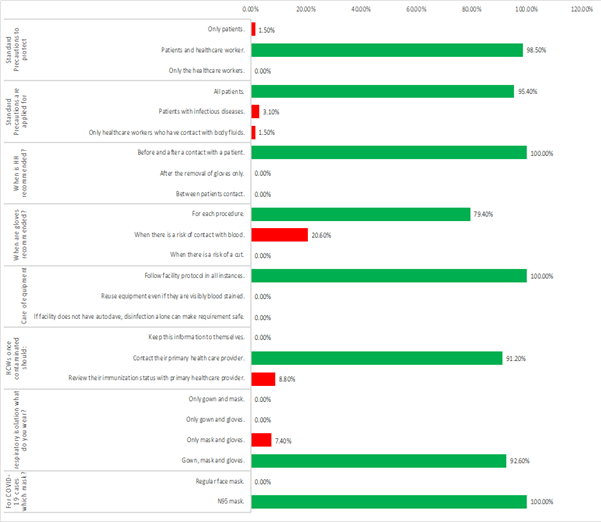
Figure 2. Specific background
In order to assess
knowledge and perception of the two main tools, hh and ppe in infection control
among responders, three statements were given for hh. “spreading of bacteria
in hospitals occurs mainly via the hands of personnel” was correctly considered
to be true by 54 (79.4%). Ten (14.7%) stated that they do not know and 4 (5.9%)
inappropriately labeled it to be false. For “infections are mainly
caused by bacteria brought into the hospital-by-hospital workers” only 34 (50%)
correctly labeled this to be false while 18 (26.5%) labeled it to be true and
the remaining 16 (23.5%) did not know. The statement that “hand jewelry makes a
good hand hygiene impossible” was correctly chosen to be true by 49 (72.1%).
Fifteen (22.1%) however labeled this statement to be false and 4 (5.9%) did not
know. For ppe, two statements were given. The first statement, “there is evidence that aprons, gowns and masks are effective
in preventing hospital-acquired infections” was appropriately chosen to be true
by 62 (91.2%). None disagreed with this statement, but 6 (8.8%) did not know.
The second statement “gloves reduce the
contamination of the hands, but do not prevent it completely” was appropriately
chosen to be true by 63 (92.7%) responders. Two (2.9%) considered it to be
false and 3 (4.4%) did not know (figure
3).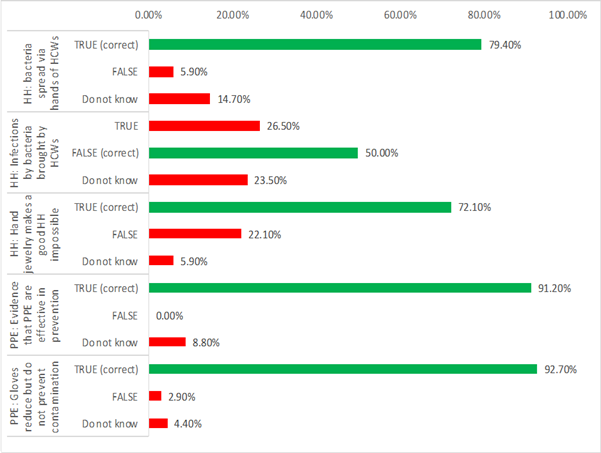
Figure 3. Perception
There was no
significant gender relationship with any of the specific background questions
(p > 0.05). Age was converted into a
categorical variable with four groups (15-24, 25-34, 35-44, 45+) to conduct the
chi-square tests. There was also no significant relationship of age, education
level, specialty, participation in clinical program (p > 0.05) (table 2 and table 3).
Table 2. Comparisons of
demographics and background questions

Note. Questions: when is hand hygiene recommended? What should healthcare worker do about care of equipment? And for covid-19 isolate cases which of the following masks is advisable? Were not computed because 100% of respondents chose only one option.
Table 3. Comparisons of
demographics and background questions

Note. Questions:
when is hand hygiene recommended? What should healthcare worker do about care
of equipment?, and for covid-19 isolate cases which of the following masks is
advisable?, were not computed because 100% of respondents chose only one
option.
(table 4) shows the descriptive statistics of gender, education level, and participation in a clinical program in relationship to knowledge and perception of hh and ppe. It was found that gender and education level had no significant impact on perception (p > 0.05). Participation in a clinical program was present in 21 out of 53 participants (39.6%) for both hh and ppe. Participation variable had no significant impact on perception (p > 0.05) (table 4).
Table 4. Perception for
hh and ppe measures by gender, education level, and participation in a clinical
program

There was no
significant association or impact of age on perception. However, there was a
significant correlation between specialty and perception of ppe (p < 0.05),
but there was no significant effect on perception of hh (p > 0.05) (table 5). A post hoc test was conducted
to identify which group differ from the other. According to that, nutrition (m
= 1.38) group had significantly lower perception of ppe scores compared to
nursing (m = 1.91,), rt (m = 2.00), pt (m = 1.83) and ot (m = 1.86)
specialties. This means nutrition group has poorer perception compared to other
specialties. (figure 4).
Table 5. Perception for
hh and ppe measures by age and specialty


Figure 4. Correlation of specialty and perception of ppe
Discussion
The
spotlight on infection control research and education initiatives has been
focused on and constantly updated by cdc and who to be consistent with the
current literature3,4. Understanding
modes of transmission by the hcws is an important element in infection control.
This strengthens compliance once the rationale of every tool used in infection
control is understood. Only 77.9% of responders in the present study stated that
these guidelines were included in the university curriculum. About half
received practical sessions. Almost 87% received instructions about the
guidelines’ importance, but only 58.8% received specific hospital guidelines.
The specific background of participants tried to look at some selected
important related issues needed as a basic knowledge and perception for all
hcws. The response was reassuring as the majority were able to identify the
correct answers. This may be taken as a good reflection of how good and
well-prepared hcws are in this university.
The two main tools used for infection control are hh and ppe. In this study, an attempt to obtain an insight on knowledge and perception of the responders towards hh and ppe was made. About 80% of responders considered that infection transmission occurs mainly via the hands of hcws. Three-quarters of the remaining 20% confessed that they do not know this fact. Contribution of hcws towards the etiology of infections inside the hospitals i.e., bringing it from outside was not clear in responders’ knowledge and perception as more than a quarter felt that this is the main source which of course is not true. It is well known that hand watches, rings and other hand jewelry are not encouraged in any hospital setting as hh becomes difficult to do. Only 72% agreed with this statement. Knowledge and perception of ppe among the study responders was slightly better as more than 90% agreed that using different ppe in general, like masks, aprons and gowns, is effective in infection control and that gloves have an important role in reducing infection transmission. In this study, there are limited but important and fundamental questions which may be sufficient to show a reflection of responders’ knowledge and perception of infection control measures. In a previous cross-sectional study on 243 nurses, only half demonstrated a good level of knowledge and positive perception of hh9. Responders in the present study, who were mostly nurses, therefore demonstrated better perception. Perception certainly needs continuous support in both basic education and training. This can be achieved by periodic revision of the university curriculum and regular refreshment of theoretical and practical courses. In a cross-sectional hospital-based study10, enrolled 293 nurses to fill up a questionnaire about standard precaution transmission of infections. Nurses’ knowledge was poor (97.9%). Up to 64.5% of the participating nurses had low knowledge about bloodborne pathogen transmissions. Over 58% used gowns and gloves and 72.7% practiced hand washing. Refresher training was beneficial (34.5%) as the major source of information10. Emphasis on this is even more needed during epidemics and pandemics. The world nowadays is living covid-19 pandemic and this has increased the awareness and perception of infection control. Despite this logical assumption, among 74 nurses and 14 rts in 175 surveyed hcws, only 50% and 30% identified the donning and the doffing order respectively. It was felt that ongoing training is very important to assure optimal perception11. This pandemic may have reflected on the responders’ answers in this study.
Responder’s distribution was almost equal in the number of undergraduate versus graduate students. More than half of responders were enrolled in clinical programs. Female gender dominated perhaps due to the nature of the specialties included. The majority of responders (64.7%) were nurses compared to other specialties. This may have an influence on the data analysis and comparisons. The present study is a descriptive study on describing and analyzing the findings as they are. It is felt that all findings are useful regardless of the significance of comparison or correlation made. Since this is perhaps the first study done in this university, it is hoped that the findings will formulate the base of many related studies and research in the future.
Despite the relatively small number of males in the study, there were no significant gender differences in answering the specific questions addressed. The age distribution was fair and for the sake of analysis responders were categorized into four age groups and even with that there was no significant age relationship to the way responders answered the specific questions12, showed that 64.2% of the 292 participants had formal training in hh for three years and 56.1% had correct knowledge. Correct knowledge in healthcare-related infections were present in 27.4% of the respondents. Females’ knowledge and perception were better12. Another descriptive study was performed on 198 nursing students, where a questionnaire was exploring hh attitudes, knowledge, and practice with some stress on the who questionnaire for hcws and its scales. The knowledge and attitudes were described to be moderate. Ensuring a positive attitude and improving awareness was emphasized13.
When
comparison addressing age, gender, level of education, specialty, participation
in a clinical program effect on knowledge and perception was made, important
findings were found. There were no significant relationship or correlation to
gender, age and level of education towards perception. The significant
relationships withdrawn from all responders in the present study were that specialty
has significant correlation with knowledge and perception of ppe. Nurses were
found to have better knowledge and perception in this and in other studies14-16. There was however no significant effect
or correlation with knowledge and perception of hh in the present study.
Innovation to sensitize hcws towards being able to defend themselves any time
has been found useful as it induces self-consciousness of being updated all the
time and be prepared for any challenge with a solution based on baseline
knowledge and perception17.
Limitations
This
study has several limitations. The small sample size may have given a response
bias. Response bias may be influenced by the high proportion of female and
nursing respondents in the study. Missing data analyses were not conducted to
determine the potential extent of the bias. Future studies should address these
limitations in their research.
This
study has explored a valuable data in connection to infection control practices
in undergraduate and graduate students in nursing and other health
professionals in the byrdine f. Lewis college of nursing and health professions
at georgia state university. This data is needed to be used as a baseline in
order to formulate an improvement plan based on modifications and enforcement
strategies towards infection control guidelines application which is reflected
on knowledge and perception of hcws. Despite the satisfactory responses
obtained in this study reflecting a very good status of infection control
policies applied in this university, the need continues to achieve a better and
continuously updated awareness of the current guidelines.
It is recommended that continuous research similar to the present study is performed periodically in addition to expansion on studying many of the listed variables. This certainly will add to the distinguished nature of this institution in a very vital health issue i.e., infection control.
Acknowledgements: the
help and guidance of dr. Rachel culbreth and dr. Douglas gardenhire in this
study is very much appreciated.
Research funding: no
funding involved.
Ethical approval: the study proposal was approved by georgia state university institutional review board (irb).
References
1.
Gold na, mirza tm, avva u. Alcohol sanitizer. In:
statpearls (edn). Treasure island, statpearls 2023.
2. Halboub
es, al-maweri sa, al-jamaei aa, tarakji b, al-soneidar wa. Knowledge,
attitudes, and practice of infection control among dental students at sana’a
university, yemen. J international oral health 2015;7(5):15-19.
3.
Guidance on personal protective equipment (ppe) in u.s.
healthcare settings during management of patients confirmed to have selected
viral hemorrhagic fevers or patients suspected to have selected viral
hemorrhagic fevers who are clinically unstable or have bleeding, vomiting, or
diarrhea.
4. A guide to the implementation of the who multimodal
hand hygiene improvement strategy. World health organization 2009.
5.
Stetzenbach ld, buttner mp, cruz p. Detection and
enumeration of airborne biocontaminants. Current opinion in biotechnology
2004;15(3):170-174.
6.
Wong kc, leung ks. Transmission and prevention of
occupational infections in orthopaedic surgeons. Jbjs 2004;86(5):1065-1076.
7.
Zhou f, yu t, du r, et al. Clinical course and risk
factors for mortality of adult inpatients with covid-19 in wuhan, china: a
retrospective cohort study. The lancet 2020;395(10229):1054-1062.
8.
Duerink d, hadi u, lestari e, et al. A tool to assess
knowledge, attitude and behavior of indonesian health care workers regarding
infection control. Acta med indones 2013;45(3):206-215.
9.
Al-mohaithef m, chandramohan s, hazazi a, elsayed eah.
Knowledge and perceptions on hand hygiene among nurses in the asir region,
kingdom of saudi arabia. Saudi journal for health sciences 2020;9(1):30-38.
10.
Acharya as, khandekar j, sharma a, tilak hr, kataria
a. Awareness and practices of standard precautions for infection control among
nurses in a tertiary care hospital. The nursing journal of india 2013;104(6):275-279.
11.
Piché-renaud pp, groves he, kitano t, et al.
Healthcare worker perception of a global outbreak of novel coronavirus
(covid-19) and personal protective equipment: survey of a pediatric
tertiary-care hospital. Infection control & hospital epidemiology 2021;42(3):261-267.
12.
Bakarman ma, baig m, malik aa, et al. Hand hygiene
knowledge and attitude of medical students in western saudi arabia. Peer j
2021;7:e6823.
13.
Cruz jp, bashtawi ma. Predictors of hand hygiene
practice among saudi nursing students: a cross-sectional self-reported study. J
infection and public health 2016;9(4):485-493.
14.
Ay p, teker ag, hidiroglu s, et al. A qualitative
study of hand hygiene compliance among health care workers in intensive care
units. Jidc 2021;13(02):111-117.
15.
Nair ss, hanumantappa r, hiremath sg, siraj ma,
raghunath p. Knowledge, attitude, and practice of hand hygiene among medical
and nursing students at a tertiary health care centre in
raichur, india. Isrn
preventive medicine 2014;2014:608927.
16.
Oluwagbemiga ao, akinsete sj, ana gr, ogunseye oo.
Knowledge, attitude and self-reported practice of healthcare workers on
infection control in a health facility in akure, nigeria. Int j infect control
2021;17: 20818.
17.
Arianpoor a, zarifian a, askari e, et al. “infection
prevention and control idea challenge” contest: a fresh view on medical
education and problem solving. Antimicrob resist infect control 2021;9(1):26.