Cytoreductive Surgery with HIPEC Treatment and Anaesthetic Management in a Case of Colo-Rectal Cancer with Pseudomyxoma Peritonei in Tertiary Care Centre of Nepal: A Case Report and Literature Review
Abstract
Hyperthermic Intraperitoneal Chemotherapy (HIPEC) and Cytoreductive
Surgery (CRS) represent an innovative approach to peritoneal surface
malignancies which are such as Pseudomyxoma Peritonei (PMP), in that they
simultaneously incorporate macroscopic tumour removal and ablation of
microscopic disease. The current case report presents a descriptive report of
the circumstance of perioperative and anaesthetic consideration in CRS/HIPEC as
a 33-year-old female presenting with colorectal cancer related PMP at a
tertiary care facility in Nepal. The patient had abdominal pain, distention and
ascites; characterised by comorbid problems like diabetes mellitus and
hypertension. An imaging study showed a rectal mass with peritoneal as well as
massive thickening of the omentum. Consensus of multidisciplinary stakeholders
later supported the use of CRS / HIPEC, due to its reported survival benefits
when compared to traditional chemotherapy. The goals of intraoperative
anaesthetic managements were the preservation of haemodynamic stability,
enabling thermoregulation and alleviation of toxicity associated with HIPEC
(complication of chemotherapy). The process involved careful administration of
fluids, long operative observation and critical care monitoring during the
postoperative period, hence attributing the necessity of specialised
infrastructure and expertise. CRS/HIPEC has been linked to 50-80% 5-year
survival rates in case of complete cytoreduction despite the logistical
shortcomings of resource-limited settings. So, this case explains once again
the need of coordinated, multi-disciplinary care in the complex oncological
surgery and is a few more contributions to very low level of literature on
CRS/HIPEC in low resource setting and supports the wisdom of strategically
introducing this procedure in a few tertiary centres this would significantly
enhance the treatment of peritoneal malignancies in Nepal.
Keywords: Cytoreductive
surgery, HIPEC, Onco-surgery, Anaesthesia, Critical care, Colo-rectal cancer,
Pseudomyxoma peritonei
Key Clinical Message
Hyperthermic intraperitoneal chemotherapy (HIPEC) and cytoreductive
surgery (CRS) offers significant survival benefits
(50-80% 5-year survival) for peritoneal malignancies like PMP but requires
specialized multidisciplinary care, meticulous perioperative management and
critical care support. This case demonstrates its feasibility in
resource-limited settings like Nepal, advocating for strategic implementation
in tertiary centres to improve oncological outcomes.
1. Introduction
The combination of Cytoreductive Surgery (CRS) and Hyperthermic
Intraperitoneal Chemotherapy (HIPEC) is a new frontier in treatment of
peritoneal surface malignancy such as Pseudomyxoma Peritonei (PMP), peritoneal
mesothelioma and metastatic abdominal tumor with colorectal, appendiceal,
gastric and ovarian cancers1. This hybrid therapy will pursue the
goal of absolute macroscopic resection of the tumor by exploiting aggressive
surgical debulking and then combine with intraoperative perfusion of heated
chemotherapy in order to lyse the microscopic residual disease2. The reason
HIPEC is used lies in the fact that it is helpful to increase the
chemotherapeutic drug penetration in the tumor tissues and reduce systemic
toxicity caused by the peritoneum-plasma barrier3.
Pseudomyxoma Peritonei (PMP) is an uncommon clinical phenomenon which is
described by progressive mucinous abscesses of the peritoneum and accretion of
ascites, generally related to the appendicular neoplasm, but other primities
have also been documented including ovarian and colorectal4. The
traditional systemic chemotherapy has a very poor efficacy because of its
sluggish but dogged behaviour and so CRS and HIPEC are the bottom line of treatment
in such patients who are eligible5. Research has indicated a better
survival result through this methodology where a 5-year survival percentage is
between 50 and 80 in those individuals who have undergone after complete
cytoreduction6.
CRS/HIPEC anesthetic care is complicated and details of perioperative
planning are needed to deal with hemodynamic variances, long surgery times,
fluid changes, thermoregulatory issues and even chemotherapy-related toxicity7. Surgical
oncologists, the anesthesiologists, intensivists and specialized nursing teams
should communicate in a multidisciplinary manner to ensure the best patient
outcomes are achieved8.
Although CRS and HIPEC is available in a few tertiary care hospitals in
Nepal, it is only available in selected secondary care institutions because
they require specialized infrastructure, professionals and facilities that can
support postoperative critical care. This case report would bring out some of
the perioperative and anesthetic challenges in the management of a patient with
ovarian tumor-related PMP that underwent CRS and HIPEC, as well as discussing
current literature on the efficacy and safety.
2. Case Presentation
2.1. Case History/ Examination
A 33 years old lady presented with the history of pain around the
umbilicus associated with abdominal distension for 1 week in the out-patient
department of onco-surgery. She was known case of colo-rectal cancer with
pseudomyxoma peritonei, which was diagnosed 7 months back with the help of computed
tomography of abdomen and thorax, raised CEA levels and histo-pathalogical
examination of the biopsied sample. For ovarian cancer, she received
chemotherapeutic agents which included paclitaxel and carboplatin every 3-4
weeks. She had other comorbidities which included type 2 Diabetes mellitus, for
which she took tablet metformin 500mg twice daily and systemic hypertension for
which she took tablet amlodipine 5mg once daily. On general physical
examination she was having pallor and moderate ascites. Her vitals revealed
pulse rate of 112 beats per minute, non-invasive blood pressure of 125/88 mm
Hg, respiratory rate of 20 beats per minute and room air saturation of 95%.
2.2. Methods (Differential Diagnosis,
Investigations and Treatment)
Routine blood examinations including complete blood count, renal function tests, liver function tests, CA-125 and coagulation profile, 12- leads electrocardiogram, 2-D echocardiography, chest X-ray and abdominal ultrasonography were done. Her recent imaging study which included contrast enhanced computed tomography of abdomen and thorax revealed mass measuring 6 X 4 X 8.5 cm in the anteroposterior, transverse and craniocaudal axes, arising from mid rectum involving peritoneum and moderate amount of pelviabdominal free fluid (Figure 1). Omental thickening was also present. However, there was not presence of any scalloping of liver margin. A multidisciplinary team, comprising of onco-surgeon, anaesthetist, intensivist, medical oncologist, gastro-intestinal surgeon, pathologist and radiologist in institutional tumour board meeting suggested to undergo CRS and HIPEC. Patient was explained about the condition of the disease and the risks associated with the procedure including bleeding, intraoperative adverse cardiac events like tachycardia, hypotension or arrythmia. Consent for post-operative mechanical ventilation and ICU admission was taken before-hand. Packed red blood cells and fresh frozen plasma were kept ready prior to the surgery.

Figure 1: CECT abdomen/pelvis shows cancer mass around colon area with omental thickening.
Patient was taken inside operating room and necessary monitoring’s like
electrocardiography, non-invasive blood pressure, pulse oximetry probe was
attached. Epidural catheter was inserted at the level of T9-T10 vertebrae level
and was fixed at 10 cm on skin. Patient was pre-oxygenated with 100% oxygen for
3 minutes and the case was induced using inj. Fentanyl 100 micrograms and
injection propofol 150mg intravenously and later injection rocuronium 50 mg was
given. Airway was secured with 7.5 mm cuffed endotracheal tube and fixed at
21cm at lips. Bilateral air entry in lungs was confirmed with auscultation
method and looking at the end tidal capnograph readings. Maintenance of the
general anaesthesia was done using isoflurane at minimum alveolar concentration
of 1.2. 7 French triple lumen central venous cannulation was done on right
internal jugular vein using ultrasound via Seldinger technique. In addition to
this, two 16 gauze cannulas were also secured in both upper limbs. Arterial
line was also secured with 20 gauze arterial cannula in right radial artery.
Nasopharyngeal temperature probe was inserted to monitor core body temperature
as temperature monitoring is crucial in this case. Urine output monitoring was
done using Foley’s catheterization. Goal directed fluid management was done.
Plasmalyte solution was infused as maintenance fluid throughout the procedure. Ambient
temperature was maintained inside operation theatre. Intraoperatively,
analgesia was maintained using epidural boluses comprising of injection
bupivacaine 0.25% 4-5 ml, every 45 minutes till the end of the surgery.
Surgeon started the surgery with midline laparotomy incision; all visible cancer mass was removed (Figure 2). Following cytoreductive surgery and adequate hemostasis, hyperthermic intraperitoneal chemotherapy which included cisplatin, was administered. HIPEC machine used in our institute was Novopec (Figure 3). The Inlet water temperature was kept 44 degree Celsius and outlet water temperature was kept at 41 degrees Celsius. The infusion solution comprised of normal saline 3 litre and 80 mg of cisplatin. Total HIPEC duration was 60 minutes. During this period the body temperature of patient was maintained using cold saline infusion and ice packs.

Figure 2: Laparotomy incision with arrow pointing towards bowel segment.
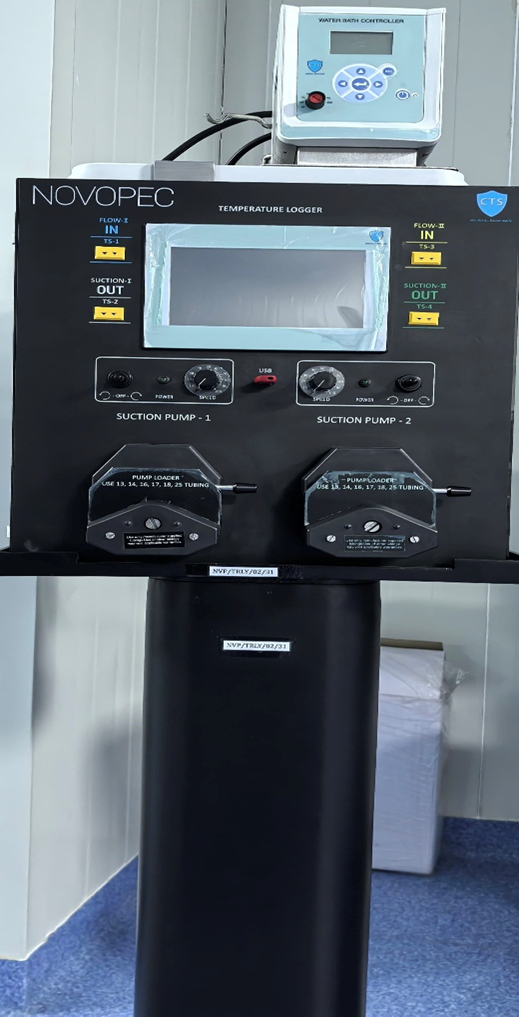
Figure 3: Novopec machine.
Intra-operative urine output was 800 ml and estimated blood loss was
about 1500 ml. 900 ml of packed red blood cells and 750 ml of fresh frozen
plasma and 4000 ml of plasmalyte solution was infused throughout the procedure.
Hypotension was treated with crystalloid, blood and blood products and
noradrenaline infusion in the range of 0.1-0.3 mcg/kg/min. Arterial blood gas
monitoring was done twice during the surgery which showed metabolic acidosis.
This was managed using pack red blood cells and fluid management.
2.3. Conclusion and Result (Outcome
and Follow-Up)
Post HIPEC, adequate hemostasis was re-checked again and closure of the
incision site was done and patient was shifted to intensive care unit. Patient
was kept in mechanical ventilation with sedation using dexmedetomidine in the
dose of 0.3 mcg/kg/hr for 2 days. Epidural infusion comprising of 0.125%
bupivacaine at 5ml/hr was administered to achieve analgesia. Extubation was
done after that and then patient was shifted to high dependency unit for a day
and subsequently to the onco surgery ward. By postoperative day 8, she was
ambulating and tolerating oral diet. At discharge, her abdominal symptoms had
resolved and advised for follow-up imaging at 3 months which showed no evidence
of residual disease or recurrence, with normalized tumor markers (CEA and CA-125). This case demonstrates that
CRS/HIPEC, despite its complexity, can achieve excellent oncological outcomes
in PMP when performed in a specialized centre with multidisciplinary
coordination, even in resource-constrained settings like Nepal.
3. Discussion
Combined With Hyperthermic Intraperitoneal Chemotherapy (HIPEC), Cytoreductive
Surgery (CRS) is at the heart of a new paradigm in the modern treatment of
malignancies that affect the surface of the peritoneum as Pseudomyxoma
Peritonei (PMP), peritoneal mesothelioma and metastatic abdominal disease of
colorectal, appendiceal, gastric and ovarian cancers. This cross-modal
treatment is the combination of aggressive surgical debulking with placement of
heated chemotherapy intraperitoneally as a means of treatment of macroscopic
tumor tissue, removed during surgery and microscopic persistence of residual
tumor disease. HIPEC justification is based on the ability of the therapy to
increase penetration of chemotherapeutic drugs into tumoring tissue as well as
preventing any systemic toxicity due to its mechanism (peritoneal plasma
barrier)1. The current
case report explains both perioperative and anaesthetic care of a 33-year-old
female patient with PMP complicated by colorectal cancer undergoing CRS/HIPEC
in a resource-limited tertiary care facility in Nepal explaining the fact that
multidisciplinary collaboration, the critical intraoperative monitoring and
recovery care support are important in these patients.
Showing abdominal pain, distension and ascites, the radiologic
assessment of the patient showed the presence of a rectal mass, peritoneum and
thickening of omens, which were in line with the diagnosis of PMP. Due to its
chronological upward direction and heavy opposition to systemic chemotherapies,
the best way of treatment was discovered in CRS/ HIPEC. This decision is backed
by the literature, according to which survival is 50% to 80% at five years
after complete cytoreduction, which is significantly higher than it is achieved
with traditional chemotherapy without reducing the level of cytoreductions1,2. However, it
must be remembered that the efficacy of CRS/HIPEC depends on teamwork and
patient selection, surgical skills and strict perioperative management,
especially in the settings of deprived resources involving poor infrastructure
and limited specialized staff.
Anesthesia management of combined CRS/HIPEC surgery is a complex venture
requiring finer attention to hemodynamics, thermoregulation, fluid balance and
avoidance of the toxicity of chemotherapy regimens. The long duration of the
surgery (usually over 8- 10 hours), the high levels of intravascular fluid
shifts and the hyperthermic physiological environment, which HIPEC allows,
cause a series of unique problems by themselves. As a result, invasive
monitoring, such as Central Venous Pressure (CVP) and arterial pressure turned
out to be essential. Epidural analgesia has been adopted to enhance pain
management and to reduce the exposure to opioids systemically, a practice which
sought the added advantage in preventing the postoperative ileus which comports
a notable problem as a sequel of major abdominal surgeries3.
The maintenance of normothermia even in a situation where peritoneal
temperatures reach 41- 43 degree Celsius is a particular critical problem
during HIPEC therapy. The systemic hyperthermia has a tendency to trigger
metabolic acidosis, coagulopathy and instability of the cardiovascular system.
Some of these effects were combated using temperature-control blankets, cold
I.V fluids and ice packs. In addition, the chemotherapeutic agent, cisplatin
has been linked to nephrotoxicity, thus requiring aggressive hydration and
close monitoring of whether the urine and the renal functions are functioning
properly. Goal-Directed Fluid Therapy (GDFT) was used to accomplish proper
tissue perfusion but prevented fluid overload, which is a crucial preventive
approach to avoid a pulmonary complication during post-operative stage.
It is also noted that postoperative care is also extremely important
since a patient is susceptible to sepsis, Acute Respiratory Distress Syndrome
(ARDS) and thromboembolic problems. The mechanical ventilation continued within
48 hours and the primary agent used to maintain sedation was alpha-2 agonist
that was dexmedetomidine, which provides effect of sedation without severe
respiratory depressions. The analgesia with epidural continuation was given to
promote early mobilization and reduce the pulmonary sequelae. The patient
experienced an uncomplicated recovery, resolution of abdominal symptoms and
signs of tumor control during follow-ups, thus demonstrating the central role
of a systematic postoperative management approach in the patients who have
undergone CRS/HIPEC operations.
There is a great potential in cytoreductive surgery with Hyperthermic
Intraperitoneal Chemotherapy (CRS/HIPEC) to treat peritoneal malignancies and
this option is limited to the institute readiness, which requires a special
surgical and anaesthetic group, a well-equipped intensive care unit and
dependable stock of chemotherapy agents in such settings like Nepal. Developed
countries are well equipped to follow well-established protocols, but the
centres in developing countries are often faced with logistic challenges:
limited access to HIPEC machines, heavy capital, investment and lack of
adequately trained personnel. As has been discussed in the current report,
CRS/HIPEC can effectively be performed even under such restrictions, when the
surgery is carefully and thoroughly planned and multidisciplinary coordinated.
The present literature confirms the growing field of CRS/HIPEC in
peritoneal cancers. Complete cytoreduction (CC-0/1) is the strongest prognostic
factor of survival in the long term due to the identification of data5. Moreover,
the interventions during perioperative care, i.e., Enhanced Recovery After
Surgery (ERAS) schemes, have demonstrated shortening of postoperative morbidity
and reduction of stay at the hospital6. Future
attacks include the continuation of research in the field of new
chemotherapeutic agents, targeted treatment and integration of immunotherapy
into HIPEC regimes in order to improve oncological results even more.
4. Conclusion
This case provides us with an example of a successfully applied CRS/HIPEC procedure in one of the tertiary centres in Nepal, with significant infrastructural deficiencies. The successful case of the patient with primary peritoneal malignancy confirms the possible positive effect of the treatment on survival in the cases of peritoneal surface diseases. However, broader distribution requires specific investment in specialised training, infrastructure and multidiscplinary cooperation. With more centres using CRS/HIPEC in low- and middle-income patients, research and reporting of cases will be needed to further streamline protocols and find the best ways to patient selection in terms of fit with therapy.
5. References
- Sugarbaker
PH. Cytoreductive surgery and hyperthermic intraperitoneal chemotherapy in the
management of gastrointestinal cancers with peritoneal metastases: Progress
toward a new standard of care. Cancer Treat Rev. 2016;48: 42-49.
- Van
Driel WJ, Koole SN, Sikorska K, et al. Hyperthermic intraperitoneal
chemotherapy in ovarian cancer. N Engl J Med. 2018;378(3): 230-240.
- Esquivel
J, Sticca R, Sugarbaker P, et al. Cytoreductive surgery and hyperthermic
intraperitoneal chemotherapy in the management of peritoneal surface
malignancies of colonic origin: A consensus statement. Ann Surg Oncol.
2007;14(1): 128-133.
- Smeenk
RM, van Velthuysen ML, Verwaal VJ, et al. Appendiceal neoplasms and
pseudomyxoma peritonei: A population-based study. Eur J Surg Oncol. 2008;34(2):
196-201.
- Chua
TC, Moran BJ, Sugarbaker PH, et al. Early- and long-term outcome data of
patients with pseudomyxoma peritonei from appendiceal origin treated by a
strategy of cytoreductive surgery and hyperthermic intraperitoneal
chemotherapy. J Clin Oncol. 2012;30(20): 2449-2456.
- Baratti
D, Kusamura S, Deraco M. Diffuse malignant peritoneal mesothelioma: Long-term
survival with complete cytoreductive surgery followed by hyperthermic
intraperitoneal chemotherapy (HIPEC). Eur J Cancer. 2013;49(15): 3140-3148.
- Schmidt C, Creutzenberg M, Piso P, et al. Perioperative anaesthetic management of cytoreductive surgery with hyperthermic intraperitoneal chemotherapy. Anaesthesia. 2008;63(4): 389-395.
- Raspe C, Piso P, Wiesenack C, et al. Anesthetic
management in patients undergoing hyperthermic chemotherapy. Curr Opin
Anaesthesiol. 2012;25(3): 348-355.