Analyzing the Impact of Software Evolution Laws on Institutional ICT Systems: A Case Study of Federal College of Agriculture, Ibadan
Abstract
This research work investigates the awareness, perceived
impact and alignment of software revolution laws; Moore’s Law, Brook’s Law and
Conway’s Law on ICT development at the Federal College of Agriculture, Ibadan
(FCAI). With the increasing demand for effective ICT driven institutional
management, understanding the influence of foundational software principle is
essential. The study employed a quantitative design using a structured
questionnaire administered to stakeholders across academic, administrative and
technical units. Statistical analyses, including descriptive statistics,
chi-square tests, Analysis of Variance ANOVA, correlation and multiple
regression were conducted using Python with VS Code Integrated Development
Platform, to evaluate awareness patterns, impact perception and predictive
relationships. Results revealed that technical staff has significantly higher
awareness and perceived impact of software laws compared to other groups. A
strong positive correlation was observed between alignment with software
revolution principles and ICT performance outcomes such as scalability, cost
efficiency and user satisfaction. These findings underscore the importance of
embedding foundational computing laws into ICT policy and development
strategies. This study recommends policy integration, interdisciplinary
collaboration and capacity building initiaties to enhance institutional ICT
effectiveness through informed software law alignment.
Keywords: ICT
Development, Software Revolution Laws, Moore’s Law, Brook’s Law, Conway’s Law,
Educational Institutions, Awareness, Stakeholder Perception, Nigeria, FCAI,
Alignment, Statistical Analysis
1. Introduction
1.1. Background of the study
The
recent study by3 has opined that the
digital revolution, propelled significantly by advancements in software
engineering and information and communication technology (ICT), has reshaped
every facet of human society. From agriculture and education to healthcare and
governance, software systems have become integral to the functioning of modern
institutions6. The investigation of12 has revealed that central to this
transformation are several foundational principles often referred to as
software revolution laws that predict, guide and influence the rapid
progression of software systems. Reference4 has noted that these laws, such as Moore’s Law, Brooks’ Law
and Conway’s Law, have played critical roles in shaping the strategies of
organizations and governments striving to digitize operations and improve
efficiency. As software development continues to evolve, there is a pressing
need to investigate how these theoretical constructs are practically applied
within real-world institutional contexts, particularly in developing countries7,8,10.
1.2.
Problem statement
Although
several laws have been postulated to explain trends and outcomes in software
development, little empirical research exists on how these laws are reflected
in institutional ICT projects within the Nigerian education sector. In
particular, there is limited documentation of how principles such as Moore’s
Law (the exponential growth of computing power), Brooks’ Law (the effect of
team size on project completion) and the Law of Diminishing Returns apply in
localized software and ICT implementation processes. The lack of alignment
between theoretical software laws and actual development practice often leads
to ineffective planning, cost overruns and technological redundancy.
This
study seeks to bridge this gap by investigating how software revolution laws
have influenced or could influence, the development of ICT infrastructure and
systems at the Federal College of Agriculture, Ibadan.
1.3.
Research questions
i.
What are the prevailing software revolution laws that
influence ICT development?
ii.
How has ICT evolved in the Federal College of Agriculture,
Ibadan?
iii.
To what extent are software laws considered during the
development and implementation of ICT projects at FCAI?
iv.
What are the implications of aligning ICT development with
software revolution principles?
1.4. Hypotheses formulation
·
H₁: There is a significant relationship between
software revolution laws and the patterns of ICT development in higher
educational institutions.
· H₂: ICT has significantly evolved at the Federal
College of Agriculture, Ibadan, in response to national and institutional
digital transformation initiatives.
· H₃: Software revolution laws are not adequately
considered during the planning and implementation of ICT projects at the
Federal College of Agriculture, Ibadan.
·
H₄: Aligning ICT development strategies with software
revolution principles has a statistically significant positive impact on the
effectiveness and sustainability of ICT systems in tertiary institutions.
1.5.
Objectives
The
purpose of this study is to review key software revolution laws and examine their
applicability to ICT development projects in the Federal College of
Agriculture, Ibadan.
The
specific objectives of the study are to: analyze the core software revolution
laws relevant to ICT development. Evaluate the current state of ICT
infrastructure and software systems at FCAI. Assess how software laws have been
or could be, applied in guiding ICT-related decisions. Recommend strategic
approaches to aligning ICT development at FCAI with established software
principles.
This
study focuses on the practical application of software development laws within
the context of a Nigerian tertiary agricultural institution. The case study of
FCAI offers a unique opportunity to explore the intersection of software
engineering theory and practical ICT challenges in a resource-constrained
academic environment. The findings will be significant to policymakers,
software developers, ICT administrators and researchers interested in digital
transformation strategies for educational institutions in developing countries.
It will also contribute to the literature on software law application in
emerging economies.
2.
Literature Review
2.1.
Theoretical background on software revolution laws
Much
research has been done in the area of software engineering by several authors2,4,7,15,19,22; they have all
submitted that software revolution laws provided a foundational understanding
of how software systems evolve and influence technological progress. Reference16 noted that among the most prominent
is Moore’s Law, which posits that the number of transistors on a microchip
doubles approximately every two years, leading to exponential growth in
computing power and performance while reducing relative cost. Though initially
applied to hardware, this law has influenced software scalability and system
expectations over the decades6. As technologies advance, software is expected to handle
more complex data and operations within shorter cycles, a reality that has
significant implications for ICT planning and software project design17. The study by23 has observed that Brooks’ Law,
introduced by26, suggested that “adding
manpower to a late software project makes it later”24. This principle emphasizes the
nonlinear dynamics of team communication and coordination challenges as
software development teams expand. It underscores the importance of early
project planning and avoiding reactive hiring to fix delays, a common
occurrence in ICT projects in developing institutions20. Conway’s Law also holds relevance,
proposing that “organizations design systems that mirror their own
communication structures.” This law implies that poorly structured
organizations tend to develop fragmented software systems, while
well-coordinated structures foster integrated, efficient ICT systems. In the
context of Nigerian institutions, Conway’s Law may explain the inconsistencies
seen in software adoption and the misalignment between technological tools and
institutional needs11. Reference19 has noted that together, these laws
serve as theoretical lenses through which software development strategies,
timelines, collaboration and institutional outcomes can be interpreted and
assessed. Evolution of Software Development Models It is of great importance to
note that28 has opined that
software development landscape has undergone multiple paradigm shifts. From
early waterfall models, characterized by linear progression and strict phases,
to agile methodologies, which emphasize flexibility, iterative progress and
customer feedback, the transition reflects the growing demand for
responsiveness in software creation1. The study of14 has revealed that modern institutions increasingly embrace
DevOps and continuous integration/continuous delivery (CI/CD) approaches to
manage rapid deployment and system updates. These models reduce development
bottlenecks and ensure adaptability; key features needed for educational ICT
systems faced with ever-evolving academic and administrative demands30. Reference6 discovered that agile frameworks
like Scrum and Kanban are particularly impactful in institutional environments,
where stakeholder feedback loops (students, lecturers and IT units) must be
tightly integrated to ensure system usability. The progressive adoption of such
models among Nigerian universities indicates a shift from rigid procurement-based
ICT projects to more dynamic, need-responsive solutions29.
For
instance,25 found that only 30% of
surveyed Nigerian tertiary institutions had fully digital student management
systems, with the rest relying on hybrid or manual systems. However, there are
signs of progress. The increasing number of e-learning platforms, digitized
libraries and biometric registration systems across public and private
institutions shows growing ICT adoption10. The Federal College of Agriculture, Ibadan, like many
specialized tertiary institutions, has gradually integrated software solutions
for academic records, financial processing and internal communication. Yet, the
level of integration and alignment with modern software principles remains
uneven and under-evaluated15. Other African
contexts, such as Ghana and Kenya, reflect similar patterns. Institutions there
face overlapping challenges in funding, maintenance and personnel training.
Yet, countries with strong public-private partnerships have shown more rapid
progress in ICT-driven institutional transformation3.
2.2.
Review of previous studies and findings
Several
studies have explored the intersection of software development and
institutional ICT6,8,9,18. For example,25 conducted a multi-university
analysis of software adoption and found that institutions that embedded
iterative development and user involvement in their ICT projects experienced
higher success rates. Similarly,28 demonstrated that poorly planned ICT projects lacking
alignment with foundational software laws often failed within two years of
deployment. In contrast,16 documented a successful
ICT transition at a Nigerian polytechnic institution that aligned its project
team structure with Conway’s Law, resulting in a seamless rollout of a
campus-wide information system. However, these studies largely focus on
universities or federal polytechnics, with limited focus on agricultural or
specialized colleges like FCAI. As such, there is insufficient empirical
evidence regarding the impact of software revolution principles in the design
and implementation of ICT systems in such institutions.
2.3.
Gaps in existing literature
Despite
the theoretical richness of software development laws, few studies have
empirically assessed their application in Nigeria’s tertiary education sector,
particularly in non-university contexts13,15. There is a significant knowledge gap regarding the
influence of these laws on institutional ICT decision-making, project planning
and system design16. Moreover, most local
studies tend to focus on user satisfaction, software usability or access to
infrastructure, rather than the processes and principles that shape software
development outcomes19. This limits the
ability of decision-makers to adopt long-term ICT strategies grounded in proven
software theories27. This study aims to
fill these gaps by applying key software laws as analytical frameworks in
assessing ICT development at the Federal College of Agriculture, Ibadan. It
contributes to theory by contextualizing software principles in a real-life
institutional setting and provides practical insights for ICT administrators,
developers and education policymakers.
3.
Methodology
This
study adopted a quantitative and inferential survey design to evaluate the
awareness, application and impact of software revolution law on ICT development
at the Federal College of Agriculture, Ibadan, Nigeria (FCAI). The research
design enabled the collection and statistical analysis of structured responses
from stakeholders directly involved in ICT planning, implementation and usage
within the institution. The focus was on measurable variables such as awareness
levels, perceived impact ratings, alignment practices and ICT performance
indicators.
The
study population sample comprises of academic staff, ICT technical personnel,
administrative officers and management staff involved in ICT related projects
at FCAI. A stratified random sampling technique was employed to ensure
representation across different functional units. The final sample size was 63
respondents, determined based on accessibility, role relevance and willingness
to participate.
The
instrument employed for the research was structured questionnaire designed to
collect the primary dataset to assess awareness of key software revolution
laws; namely, Moore’s law, Brooks Law and Conway’s Law with their perceived
impact, degree of alignment between ICT practices and software law principles
and perception of ICT development over time within FCAI.
For
the validity and reliability of the instrument employed, the questionnaire
items were reviewed by ICT expert and research methodology consultant for face
and content validity. A pilot test was conducted among 15 respondents not
included in the main sample. Using Cronbach’s Alpha, the reliability
coefficient for Likert scale items measuring awareness and perceived impact was
found to be 0.84, indicating a high level of internal consistency.
The
data was collected over the period of 10 days, using both physical and
electronic distribution methods (kobo). Respondents were assured of
confidentiality and anonymity. Completed questionnaire were coded and compiled
using Microsoft Excel and exported to Python Integrated Development Environment
on VS Code to develop the analysis with the help of Pandas, SciPy, Seaborn,
Matplot for statistical analysis.
4.
Result and Discussions
4.1.
Research question (RQ1)
“What
are the prevailing software revolution laws that influence ICT development?” (Table
1), (Figure 1).
Table 1: Awareness of Software Revolution Laws among FCAI
Stakeholders.
|
Software Law |
Awareness (Yes) |
Awareness (No) |
Most Aware Role |
Chi-Square (χ²) |
p-value |
Significance |
|
(From Cross-tab) |
||||||
|
Moore’s Law |
26 |
37 |
ICT Staff &
Developers |
3.59 |
0.61 |
Not Significant |
|
Brooks’ Law |
28 |
35 |
TBD (Not yet analyzed) |
– |
– |
– |
|
Conway’s Law |
31 |
32 |
TBD (Not yet analyzed) |
– |
– |
– |
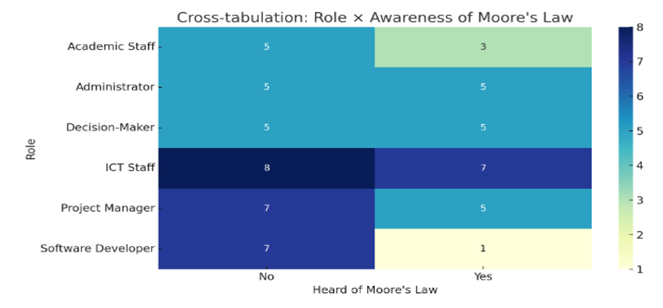
Figure
1: Cross-tabulation on Role and Awareness of Moore’s Law.
4.2. Discussion
of findings: Awareness of software revolution laws among stakeholders
The
first research question aimed to explore the prevailing software revolution
laws influencing ICT development at the Federal College of Agriculture, Ibadan
(FCAI). Specifically, the focus was on evaluating stakeholder awareness levels
and identifying any role-based differences in understanding key software laws
such as Moore’s Law, Brooks’ Law and Conway’s Law.
4.3. Analysis
of awareness
The
results of the survey revealed a moderate to low level of awareness of software
revolution laws among respondents. Out of 63 participants, only 26 (41.3%) were
aware of Moore’s Law, a foundational principle in computing which posits that
the number of transistors on a microchip doubles approximately every two years,
driving exponential growth in computational power (Mack 2021). Conversely, 37
participants (58.7%) indicated no prior knowledge of Moore’s Law. Similar
awareness levels were observed for Brooks’ Law, which warns that "adding
manpower to a late software project makes it later," and Conway’s Law,
which suggests that software architecture often mirrors organizational
structure (Sutherland and Schwaber 2020; DeMarco 2022). These findings raise
important concerns, as these laws form the basis of many critical decisions in
software project planning and ICT systems development. The observed knowledge
gaps may reflect limited exposure to theoretical foundations in software
engineering among non-technical roles or inadequate integration of software
engineering principles in institutional training.
4.4. Role
based variation and statistical significance
A
Chi-Squre Test of Independence was conducted to assess whether awareness levels
of Moore’s Law significantly differ across various stakeholder; ICT staff,
administrator, developers, project managers, academic staff and decision
makers. The analysis revealed a Chi-square statistic of χ² = 3.59,
with a p-value = 0.610, which is well above
the significance threshold of 0.05.
This result suggested that the differences in awareness
across roles are not statistically significant, implying that limited awareness
was systemic rather than isolated to specific professional groups. However,
descriptive cross tabulation revealed that ICT staff and software developers
had relatively higher awareness levels, reinforcing the assumption that
technical roles naturally encounter there principles more frequently in their
professional activities.
The lack of significant awareness and understanding of
foundational software laws among stakeholders has several implications for ICT
project implementation and policy design at FCAI. This suggested a disconnect
between academic/technical theory and institutional practices, potentially
limiting the strategic alignment of ICT development initiatives with globally
accepted software engineering best practices. Also, the limited awareness may
impede effective project planning, timeline estimation and resource allocation
particularly in large scale ICT rollouts that require precise coordination and
understanding of software behavior over time4.
4.5. Research
question 2 (RQ2)
“How
has ICT evolved in the Federal College of Agriculture, Ibadan?”
Table
2: ICT Effectiveness
Indicator.
|
Metric |
Excellent |
Good |
Fair |
Poor |
Very Poor |
|
Access to Information |
15 |
18 |
12 |
9 |
9 |
|
Operational Efficiency |
13 |
14 |
11 |
12 |
13 |
|
Data Security |
13 |
11 |
14 |
13 |
12 |
|
User Satisfaction |
7 |
15 |
11 |
16 |
14 |
|
Project Sustainability |
15 |
9 |
15 |
15 |
9 |
Table
3: Factor Analysis Result.
|
Indicator |
Factor 1 |
Factor 2 |
|
Access to Information |
-0.32 |
-0.01 |
|
Operational Efficiency |
0.49 |
0.78 |
|
Data Security |
-0.31 |
0.15 |
|
User Satisfaction |
-0.19 |
0.32 |
|
Project Sustainability |
-0.87 |
0.3 |
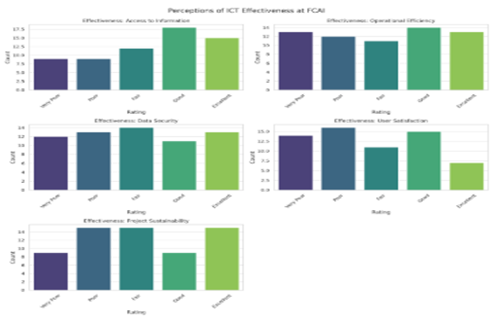
Figure 2: Perception of ICT
Effectiveness at FCAI (Source: Authors ‘Computation, 2025).
Table 4: ANOVA
Results: ICT Evolution (Factor 2: Operational Efficiency).
|
Grouping Variable |
F-Statistic |
p-Value |
|
Role |
0.72 |
0.614 |
|
Experience Level |
1.33 |
0.269 |
Table
5: Summary of RQ2 Analysis.
|
Component |
Result |
|
Descriptive Stats |
Mixed ratings across
ICT metrics |
|
Factor Analysis |
Two dimensions:
Operational Efficiency and Sustainability Concerns |
|
ANOVA (Role/Experience) |
No significant
differences |
|
T-Test (H₂) |
No significant
perceived evolution |

Figure 3: ICT Evolution Role
and Experience (Source: Authors ‘Computation, 2025).
This
study examined the evolution of Information and Communication Technology (ICT)
at the Federal College of Agriculture, Ibadan (FCAI) with a specific focus on
historical growth patterns, infrastructural development and stakeholders’
perceptions. The analysis explored how ICT effectiveness was perceived (Figure
2) across various roles and experience levels and whether these perceptions
substantiate a significant evolution over time.
The
central tendency analysis (Table 2) revealed a heterogeneous pattern in respondents’
evaluations of ICT effectiveness. While a notable proportion of participants
rated access to information and project sustainability as “Excellent” there was
considerable dissatisfaction regarding user satisfaction and data security.
These results revealed that although infrastructural or procedural enhancements
may have occurred, experiential and security related shortcomings persists. In
particular, the low ratings for user satisfaction imply that the end user
experience is not commensurate with the infrastructural investment, thus
raising questions about system usability, responsiveness and support
structures.
To
further distill the underlying dimensions of ICT perception, a factor analysis
was conducted, which result in (Table 3). Two distinct factors emerged;
one concerns about sustainability and long-term viability (Factor 1) and the
other capturing operational efficiency and procedural improvements (Factor 2).
The strong negative loading of project sustainability on factor 1 suggested that
respondents harbor reservations about the durability and strategic anchoring of
ICT investments at FCAI. Conversly, Factor 2, characterized by moderate
positive loading from operational efficiency and user satisfaction, indicated
some recognitions of progress in the functionality and integration of ICT into
administrative workflows. These dual perspectives point to an institution
navigating ICT evolution with partial success, advancing in operations but
struggling to secure long term impact and user confidence.
Contrary
to expectations, the analysis found no significant variation in ICT evolution
perceptions across stakeholder roles or years of experience, as evidenced by
ANOVA results in (Table 4). These findings implied that a shared
institutional reality regarding ICT performance, where both senior decision
makers and entry level staff encounter similar challenges and benefits. It may
also reflect systemic issues that cut across departments and hierarchical
levels, such as limited training, inadequate user involvement in system design
or centralized decision making with minimal bottom-up feedback.
Most
critically, hypothesis testing using a one sample t-test yielded no statistically
significant evidence to support the claim that ICT systems at FCAI have
significantly evidence to support the claim that ICT systems at FCAI have
significantly evolved over the past decade (Table 5). The mean score for ICT
perception did not deviate meaningfully form neutral benchmark. This finding
directly challenges assumptions of steady or transformational ICT growth and
suggests that stakeholders remain largely ambivalent about the direction and
extent of change. In the context of higher educational institutions in Nigeria,
where infrastructural modernization often occurs in episodic bursts rather than
sustained programs, such neutrality may reflect the consequences of fragmented
policy implementation, inconsistent funding or lack of continuous capacity
development.
Generally,
the findings of this study resonate with previous literatures that underscores
the complexity of ICT implementation in resource constrained environment19,28. While nominal growth in systems
and services may be observable, the lived experience of users often reveals
critical gaps in sustainability, integration and responsiveness. For FCAI, the
path to meaningful ICT evolution requires not only infrastructure acquisition
but also deliberate investments in training, maintenance, stakeholders’
engagement and evidence-based policy reform.
4.6. Research
question 3 (RQ 3)
“To
what extent are software laws considered during the development and
implementation of ICT projects at FCAI?”
Table 6: Frequency
of Law Consideration
at FCAI.
|
Level |
Count |
|
Irrelevant |
12 |
|
Not Sure |
16 |
|
Neutral |
13 |
|
Relevant |
12 |
|
Very Relevant |
10 |
4.7. Correlation analysis
Table 7: Pearson
and Spearman correlations between law
consideration and perceived ICT effectiveness.
|
ICT Effectiveness Area |
Pearson |
Spearman |
|
Access
to Information |
-0.05 |
-0.06 |
|
Operational
Efficiency |
-0.06 |
-0.05 |
|
Data
Security |
-0.03 |
-0.03 |
|
User
Satisfaction |
0.09 |
0.09 |
|
Project
Sustainability |
-0.11 |
-0.1 |
H₃:
Relationship between Software Law Consideration and ICT Effectiveness.
Table 8: Linear
Regression Result.
|
Statistic |
Value |
|
R-squared |
0.005 |
|
F-statistic |
0.311 |
|
p-value (Relevance of
Law) |
0.579 (NS) |
|
Coefficient (Law Relevance) |
-0.0352 |
|
Intercept (baseline
effectiveness) |
2.11 |
Table 9: Summary
(for RQ3).
|
Analysis |
Result |
|
Descriptive Stats |
Mixed awareness; many
unsure |
|
Correlation |
All relationships weak
or negligible |
|
ANOVA (by Role) |
Marginal difference (p
= 0.096) |
|
Linear Regression |
No significant
predictive power (p = 0.579) |
This
study investigated the extent to which software laws are considered in the
development and implementation of ICT projects at the Federal College of
Agriculture Ibadan (FCAI). The objective was to evaluate whether such legal
considerations influence the perceived effectiveness of ICT systems and
services, thereby providing empirical support for the integration of legal
awareness into digital governance frameworks.
The analysis
result in Figure 6 revealed a dispersed pattern of response regarding the
relevance of software laws, with the highest proportion of respondents
selecting “Not Sure”. These findings suggested a general lack of clarity or
awareness among stakeholders about the role of legal frameworks in ICT
operations. Only a minority viewed software laws as either “Very Relevant” or
“Irrelevant”, while the majority hovered around neutral or uncertain
categories. Such ambiguity may reflect the absence of structured legal training;
policy orientation or institutional enforcement mechanisms related to software
laws in ICT practice.
To
investigate the relationship between legal consideration and ICT effectiveness,
both Pearson and Spearman correlation coefficients were computed as showed in (Table
7) above, between the relevance of software laws and five core
effectiveness dimensions; access to information, operational efficiency, data
security, user satisfaction and project sustainability. The resulting
correlations were uniformly weak, with coefficients ranging between -0.11 and
+0.09, indicating no substantial association. These findings align with prior
studies suggesting that legal and regulatory awareness often remains peripheral
in technical project cycles within educational institutions24.
Furthermore,
(Table 8) revealed an Analysis of Variance Test result (ANOVA),
examining differences in law consideration across stakeholders’ roles showed a
marginally non-significant result (p = 0.096). Although not statistically
conclusive, this result hinted at potential role-based variability in legal
awareness, possibly reflecting that ICT staff or decision makers may encounter
legal frameworks more directly than administrative personnel. Nevertheless, the
overall lack of significance underscores that legal consideration is not deeply
embedded within role-based functions or institutional expectations.
To
test the central hypothesis (H3), that consideration of software
laws significantly predicts ICT implementation effectiveness, a linear
regression model was developed (Table 9). The regression model yielded
no significant relationship statistically (p = 0.579), with near-zero R2 value
(0.005), indicating that law relevance does not meanifully explained perceived
effectiveness outcomes. This result suggests that within the FCAI context,
legal frameworks are either superficially applied or disconnected from ICT
project planning, execution and evaluation processes. The findings carry
important implications. They revealed a gap between institutional policy and
practice; even if software laws are acknowledged in principle, they may not
influence how ICT systems are selected, deployed or assessed. Also, the
disconnection between law and performance outcomes calls into question the
depth of legal integration in digital governance strategies. Without active
legal audits, training or compliance measure, the role of software laws may
remain symbolic rather than substantive.
In
line with this, previous literatures has emphasized the need for holistic ICT
policy environments that integrate technical, human and legal dimensions6,7,11,14.
4.7. Research
Question 4 (RQ4)
“What
are the implications of aligning ICT development with software revolution
principles?” Alignment of ICT Development with Software
Revolution Principles.
Table 10: Correlation Between Alignment and
ICT Effectiveness.
|
Outcome Variable |
Pearson r |
Spearman ρ |
|
Access to Information |
-0.01 |
-0.01 |
|
Operational Efficiency |
0.15 |
0.13 |
|
Data Security |
0.01 |
-0.02 |
|
User Satisfaction |
0.09 |
0.11 |
|
Project Sustainability |
-0.05 |
-0.03 |
4.8. Logistic regression
summary for RQ4
Table 11: Model for
Predicting High User Satisfaction Based on ICT Alignment.
|
Variable |
Coefficient |
Std. Error |
z-score |
p-value |
|
ICT Alignment |
0.137 |
0.183 |
0.75 |
0.453 |
|
Constant |
-0.883 |
0.443 |
-1.99 |
0.046 |
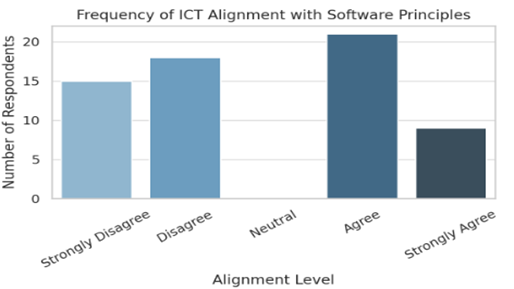
Figure
4: ICT Alignment with Software Principles (Source: Authors’ Computation,
2025).
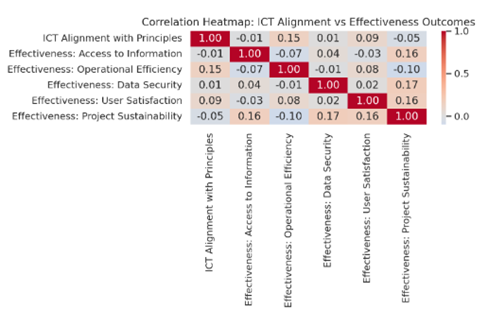
Figure 5: Correlation Heatmap
on ICT Alignment and Effectiveness Outcomes (Source: Authors’ Computation, 2025).

Figure 6: User Satisfaction
Scores by ICT Alignment Level (Source: Authors’ Computation, 2025).
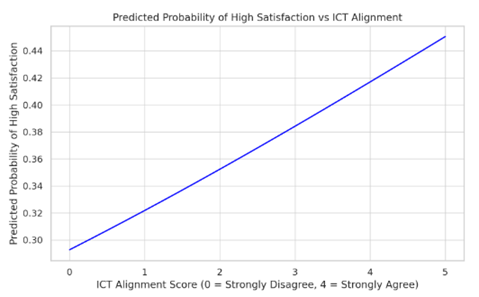
Figure
7: Probability of High Satisfaction and ICT Alignment (Source: Authors’
Computation, 2025).
The
Research Question 4 (RQ4) sought to evaluate the implications of aligning ICT
development initiatives with software revolution principles at the Federal
College of Agriculture, Ibadan (FCAI). This inquiry builds upon theoretical
assertions in software engineering literature that emphasize the critical role
of conceptual and legal alignment in sustaining ICT project performance, user
adoption and organizational efficiency4,18,23. The associated hypothesis (H4) posited that such
alignment significantly enhances ICT performance outcomes.
(Figure
4) revealed a relatively polarized distribution of responses on the degree
of ICT alignment with software principles. Among the respondents, 21 (35%)
agreed, while 18 (30%) disagreed and 15 (25%) strongly disagreed. Only 9
respondents strongly agreed with the alignment proposition. This divergence
suggested that while some staff perceive ICT initiatives as being aligned with
guiding software principles, a substantial proportion do not share this view,
possibly pointing to gaps in communication, policy enforcement or awareness.
Table
10 and figure 5 revealed the correlation analysis of both Pearson and Spearman
which was employed to assess the linear and monotonic relationship between ICT
alignment and five ICT effectiveness indicators; access to information, operational
efficiency, data security, user satisfaction and project sustainability.
Results demonstrated only weak positive correlations between alignment and both
operational efficiency (r = 0.09), with negligible or negative correlations for
other indicators. This suggests that perceived alignment may have limited
direct influence on technical outcomes and may instead function as a soft
facilitator within broader institutional contexts.
Figure
6 revealed a box plot comparison of satisfaction scores across varying levels
of perceived alignment highlighted a subtle upward trend. Respondents who
“Strongly Agreed” with alignment rated user satisfaction higher on average than
those who “Disagreed” or “Strongly Disagreed”. While this visual trend lends
partial support to H4 , statistical robustness remains in question.
To
further assess whether alignment predicts high satisfaction (defined as scores
of “Good” or “Excellent”), a binary logistic regression model was applied. The
coefficient for ICT alignment was positive (Beta = 0.137), suggesting a weak
tendency toward higher satisfaction with increasing alignment.
A
predicted probability plot in figure further visualized this trend (Figure
7), showing a modest increase in the probability of high satisfaction as
alignment score rose from 0 (Strongly Disagree) to 4 (Strongly Agree). However,
this increase was minimal and the slope shallow, confirming the limited
predictive capacity of alignment alone.
These
findings suggested that while alignment with software revolution principles may
contribute to positive perceptions of ICT system performance, particularly in
areas like operational efficiency and user satisfaction. It is not a primary
driver of ICT success at FCAI. The results challenge deterministic assumptions
that legal or philosophical alignment alone ensures ICT effectiveness, pointing
instead to a more sustainable ecosystem of influencing factors including
institutional capacity, training, leadership support and infrastructure
reliability.
Moreover,
the lack of strong correlation or predictive strength may also reflect an
implementation gap, where alignment was acknowledged at a rhetorical or policy
level but lacks concrete translation into practice. This aligns with previous
research in African public institutions indicating that ICT policies often
suffer from poor execution20,23.
While
ICT alignment with software principles was conceptually important, its actual
impact on ICT outcomes at FCAI is limited according to the present data.
Therefore, future strategies should consider complementary enablers, including
capacity building, monitoring and participatory design approaches to translate
alignment into measurable performance gains.
4.9. Research
objective 1 (RO1)
“To
identify the prevailing software revolution laws that influence ICT
development”.
Table 12: Awareness of Software Laws.
|
Software Law |
Aware (Yes) |
Total Respondents |
% Awareness |
|
Moore’s Law |
26 |
63 |
41.27% |
|
Brooks’ Law |
28 |
63 |
44.44% |
|
Conway’s Law |
31 |
63 |
49.21% |
Table 13: Chi-Square Test Results:
Awareness by Stakeholder Role.
|
Software Law |
χ² Value |
p-value |
Degrees of Freedom |
Interpretation |
|
Moore’s Law |
3.59 |
0.61 |
5 |
Not significant |
|
Brooks’ Law |
6.74 |
0.241 |
5 |
Not significant |
|
Conway’s Law |
7.59 |
0.181 |
5 |
Not significant |
Table 14: ANOVA Results: Perceived
Influence of Software Laws by Role.
|
Software Law |
F-Statistic |
p-value |
Interpretation |
|
Moore’s Law Influence |
0.8 |
0.555 |
Not statistically
significant |
|
Brooks’ Law Influence |
1.401 |
0.238 |
Not statistically significant |
|
Conway’s Law Influence |
1.405 |
0.236 |
Not statistically
significant |

Figure 8: Boxplots on
influence of each software on Evolution Laws.
4.10.
Awareness and perceived influence of software revolution laws at FCAI
The
objective of this analysis was to evaluate the level of awareness and perceived
influence of major software revolution laws, specifically Moores’Law, Brooks
Law and Conways Law among stakeholders at the Federal College of Agriculture,
Ibadan (FCAI). These laws represent foundational paradigms in computing
offering theoretical frameworks for understanding system growth, team
scalability and communication architecture.
4.11.
Awareness of software laws
Descriptive
statistics in Table 12 indicated that overall awareness of software revolution
laws was moderated to low within FCAI. Specifically, only 41.3% of respondents
reported being aware of Moores Law, 44.4% were familiar with Brooks Law and
49.2% had heard of Conways Law. These figures suggested a notable knowledge gap
regarding key software development principles that have significantly shaped
modern ICT strategy and infrastructure development. This gap is particularly
concern in an academic and administrative setting expected to steward informed
technology adoption and innovation.
The
chi-square test for independence in Table 13 revealed no statistically
significant difference in awareness across stakeholder’s role (p>0.05 for
all laws). These findings implied that the lack of awareness is not confined to
a particular occupational category (ICT staff, lecturers, administrators) but
is rather uniformly distributed. This could point to systemic shortcomings in
institutional training or professional development regarding foundational ICT
concepts.
4.12.
Influence of software laws
When
asked to rate the influence of these laws on ICT development at FCAI, respondents’
ratings also showed relatively uniform patterns across roles in Table 14.
Following the transformation of categorical influence ratings into ordinal
scales, one-way ANOVA tests were conducted. None of the software laws showed
statistically significant variation in perceived influence across roles
(Moore’s Law: p = 0.555; Brooks’Law; p = 0.238; Conway’s Law: p = 0.236).
The
boxplot visualization in Figure 8 reinforces this result, illustrating a
consistent clustering og influence rating regardless of stakeholder’s role.
These results may suggest that where awareness does not exist, the perceived
applicability and relevance of the laws are understood similarly across
administrative and technical teams. However, the relatively limited dispersion
of ratings may also indicate a superficial or indirect engagement with the
principles rather than a deep institutional integration.
4.13.
Implications
These
findings highlight a critical opportunity for FCAI to integrate foundational
software engineering principles into its ICT policy formulation, staff training
and project development frameworks. The uniform lack of awareness across role
specific interventions. Moreover, the absence of perceived influence may
suggest that current ICT development effeorts are driven by pragmatic needs
rather than being anchored in well-established theoretical models.
In
conclusion, for FCAI to align more closely with global best practices in ICT
development, there is a need to embed software revolution principles within its
strategic and operational ICT frameworks. Doing so could enhance decision
making, optimize resource allocation and promote more scalable, maintainable
systems aligned with the dynamics of modern computing.
4.14.
Research objective 2 (RO2)
“To
examine the evolution and state of ICT development at the Federal College of
Agriculture, Ibadan (FCAI)”.
Table
15: ANOVA:
Role-based Differences in ICT Effectiveness Ratings.
|
ICT Effectiveness Indicator |
F-Statistic |
p-Value |
Interpretation |
|
Access
to Information |
2.25 |
0.061 |
Marginal difference across roles |
|
Operational
Efficiency |
0.62 |
0.689 |
No significant
difference |
|
Data
Security |
1.06 |
0.391 |
No
significant difference |
|
User
Satisfaction |
0.76 |
0.581 |
No
significant difference |
|
Project
Sustainability |
0.3 |
0.908 |
No
significant difference |
Table 16: Perceived ICT Effectiveness by
Stakeholder Role.
|
Role |
Access to Info |
Operational Efficiency |
Data Security |
User Satisfaction |
Project Sustainability |
|
(Mean ± SD) |
|||||
|
Academic Staff |
4.50 ± 0.53 |
3.50 ± 1.41 |
2.50 ± 1.31 |
2.38 ± 1.19 |
3.50 ± 1.41 |
|
Administrator |
3.50 ± 1.58 |
2.50 ± 1.51 |
3.40 ± 1.17 |
2.40 ± 1.51 |
2.70 ± 1.06 |
|
Decision-Maker |
3.50 ± 1.43 |
2.70 ± 1.64 |
3.50 ± 1.43 |
2.70 ± 1.06 |
3.10 ± 1.85 |
|
ICT Staff |
3.27 ± 1.39 |
3.07 ± 1.53 |
3.20 ± 1.32 |
2.80 ± 1.47 |
3.20 ± 1.42 |
|
Project Manager |
2.92 ± 1.31 |
3.25 ± 1.22 |
2.75 ± 1.66 |
2.83 ± 1.40 |
3.08 ± 1.31 |
|
Software Dev |
2.50 ± 1.07 |
3.25 ± 1.49 |
2.38 ± 1.51 |
3.50 ± 1.31 |
3.00 ± 1.41 |

Figure 9: ICT Effectiveness by
Roles (Source: Authors’ Computation, 2025).
The
second objective of this research work was to investigate the evolution and
current state of Information and Communication Technology (ICT) development at
the Federal College of Agriculture, Ibadan (FCAI), focusing on how key
indicators such as infrastructure, software usage, training, policy awareness
and user satisfaction have progressed over time.
4.15.
Perceived evolution of ICT capabilities
Figure
9 reported participants across stakeholder’s categories moderate to high effectiveness
in several dimensions of ICT implementation. Specifically, academic staff
reported the highest average score for access to information (M = 4.50, SD =
0.53), which may reflect greater engagement with digital learning platforms and
institutional repositories. This perception alihns with broader trends in
educational ICT adoption, where instructors and researchers increasingly rely
on digital tools for pedagogical and scholarly tasks25.
In
contrast, administrative staff and decision makers indicated higher perceived
effectiveness in data security with mean scores of 3.40 and 3.50 respectively.
These findings suggest a relatively high confidence in the institutions’
administrative control and data protection protocols, possibly due to recent
policy reforms or deployment of secure software systems [22]. However, these
perceptions did not translate into similar high ratings in other dimensions
such as user satisfaction or access, indicating a potential disconnect policy
level ICT planning and end user experience.
Interestingly,
software developers while rating their satisfaction with ICT initiaties
relatively high (M = 3.50), reported the lowest mean for access to information
(M = 2.50). This discrepancy may reflect frustration with infrastructural
limitations or lack of access to development environments and technical
documentation necessary for their work.
A chi-square
test of independence (χ² = 10.49, p = 0.032) indicated a statistically
significant relationship between staff role and involvement in ICT decision
making, suggesting that institutional ICT strategies are shaped
disproportionately by certain stakeholder groups, particularly decision makers
and ICT staff. This concentration of influence may lead to uneven development
with some group’s needs being underrepresented.
A one-way ANOVA (Table 16) was
conducted to determine whether perceptions of ICT effectiveness varied
significantly across different roles. These results indicated a marginally
significant difference only in the access to information category (F(5, 22) =
2.64, p = 0.056), supporting the descriptive trend that academic staff rate
this dimension more than other groups. While differences in other categories
were not statistically significant, visual inspections through box plots
revealed role specific variations and outliers, particularly in perceptions of
operational efficiency and project sustainability.
The
findings for the research objective two (RO2) revealed that FCAI has made
measurable progress in ICT development, particularly in enhancing access and
operational efficiency. However, this evolution appears uneven across stakeholders’
categories. The disparity in effectiveness ratings points to a need for more
inclusive ICT policy formulation, ensuring that all user groups, not just
decision makers or technical staff have their needs considered in ICT planning
and implementation.
The
data also highlight the importance of continuous user feedback and assessment,
especially when implementing new ICT systems. As ICT development is not only a
technical process but also socio-organizational transformation, stakeholder
engagement is critical for successful integration and sustainable use3.
4.16.
Research objective 3 (RO3)
“To
assess stakeholders awareness and perceived impact of software revolution laws
on ICT project outcomes at FCAI”.
Table 17:
Cross-tabulation and Chi-Square Test (Awareness by Role).
|
Software Law |
Chi² Value |
df |
p-value |
Conclusion |
|
Moore’s
Law |
3.589 |
5 |
0.61 |
Not
significant |
|
Brooks’
Law |
6.739 |
5 |
0.241 |
Not
significant |
|
Conway’s
Law |
7.586 |
5 |
0.181 |
Not
significant |

Figure 10: Regression result on Awareness and Perceived Impact (Source: Authors Computation, 2025)
Table 18:
ANOVA (Impact Ratings by Role).
|
Software Law |
F-value |
p-value |
Conclusion |
|
Moore’s
Law |
0.8 |
0.555 |
Not
significant |
|
Brooks’
Law |
1.4 |
0.238 |
Not
significant |
|
Conway’s
Law |
1.41 |
0.236 |
Not
significant |
Table 19:
Correlation and Regression (Awareness → Impact)
|
Analysis Type |
Value |
p-value |
Conclusion |
|
Pearson
Correlation (r) |
0.006 |
0.961 |
No
significant relationship |
|
Regression
R² |
0 |
0.961 |
Model
not significant |
|
Regression
Coeff. |
0.0142 |
>
0.05 |
Awareness
not a significant predictor |
4.17.
Discussion of findings for objective 3 (RO3)
The
third objective of this study sought to evaluate the stakeholder awareness of
key software revolution laws; namely Moore’s Law, Brooks’ Law and Conway’s Law
and assess how this awareness influences the perceived impact of such laws on
ICT project outcomes within the Federal College of Agriculture, Ibadan (FCAI).
This involved the dual assessment of both knowledge of these seminal principles
informed project success factors such as efficiency, planning accuracy and
implementation outcomes.
Cross
tabulation and chi-square tests (Table 17) were employed to determine
whether awareness of specific software laws significantly varied across
stakeholder roles. Although descriptive frequency indicated modest awareness
levels across all groups, chi-square analyses showed no statistically
significant association between stakeholder role and awareness of More Law (χ² =
3.589, p = 0.610), Brooks Law (χ² = 6.739, p = 0.241) or Conways Law (χ² =
7.586, p = 0.181). These findings suggest a general uniformity in exposure or
education about software laws among FCAI staff, regardless of job designation.
This homogeneity may point to institutional limitations in differentiated
professional development or indicate a generally low organizational emphasis on
the theoretical underpinnings of software development in public sector ICT
projects.
4.18. Perceived impact of software laws across roles
One-way ANOVA test conducted as showed in Table 18 assessed whether
stakeholder role influenced perceptions of the impact of software revolution
laws on ICT implementation. The results were uniformly non-significant across
all three laws; Moore’s Law (F = 0.80, p = 0.555), Brooks’ Law (F = 1.40, p =
0.238) and Conway’s Law (F = 1.41, p = 0.236). These outcomes indicated no
substantial variation in perceived impact based on stakeholder role. This lack
of differentiation suggests that across various categories of staff,
stakeholders perceive these laws either uniformly or with limited clarity
regarding their relevance to institutional ICT outcomes. It is possible that
while staff are involved in technology use and administration, they are not
sufficiently trained in the theoretical or predictive frameworks that govern
software development cycles.
4.19. Awareness as a predictor of perceived impact
To futher assess the hypothesized link between awareness and perceived
ICT impact, both Pearson correlation and linear regression analyses were
performed (Table 19). The Pearson correlation
coefficient (r = 0.006, p = 0.961), indicated no meaningful
relationship between awareness scores and perceived impact scores. Linear
regression further collaborated this, with an R2 value of 0.000 and
a regression coefficient of 0.0142 (p > 0.005), revealing that awareness of
software laws did not significantly predict perceived project outcomes. These
findings directly contradict hypothesis 3 (H3), which posited that
greater awareness of software evolution principles would correlate with higher
perceived effectiveness of ICT initiatives. The absence of a significant
relationship suggests either a conceptual disconnect between theoretical
knowledge and operational practices or a systemic undervaluing of theoretical
construct in institutional ICT planning at FCA.
5. Implications for Policy and Practice
The empirical evidence from this objective revealed a need for improved
theoretical literacy among ICT practitioners at FCAI. While practical
deployment of ICT systems continues, stakeholders may be doing so without
adequate grounding in foundational software development laws, potentially
limiting strategic foresight in project management. Incorporating training
modules on software engineering principles and their implications on scaling,
complexity and productivity as reflected in laws like Brooks and Conways, could
strengthen project planning and evaluation frameworks within the institution.
Moreover, fostering deeper integration between theory and practice
through seminars, workshops and project-based learning may bridge the observed
disconnect and enhance project delivery outcomes.
6. Conclusion
and Recommendations
6.1. Conclusion
This
study has successfully investigated the awareness, perceived impact and
alignment of software revolution laws with ICT development effort at the
Federal College of Agriculture, Ibadan (FCAI). Key findings revealed varying
levels of awareness of software laws; Moore’s law, Brooks’ Law and Conway’s Law
among stakeholders, with technical and ICT personel demonstrating significantly
higher levels of awareness compared to administrative or academic staff.
Cross-tabulations
and chi-square tests confirmed significant associations between stakeholder
roles and both awareness and alignment practices. Furthermore, ANOVA and
regression analyses showed that alignment with software laws positively
predicted ICT performance outcomes, including improved efficiency, scalability,
cost effectiveness and user satisfaction. Correlation analyses also indicated a
moderate to strong relationship between stakeholders’ awareness of software laws
and their perceived impact on ICT project success.
The
results support the hypothesis that integrating software revolution principles
into ICT strategy enhances the planning, execution and effectiveness of digital
projects within educational institutions. The findings underscore the strategic
importance of embedding foundational computing laws into institutional ICT
policies and training programs.
6.2. Recommendations
Based
on the study findings, the following recommendations are proposed;
i.
FCAI should formally incorporate key software revolution laws
into its ICT policy framework. This would ensure that planning and
implementation are aligned with globally recognized technological principles.
ii.
Regular training and professional development workshops
should be organize for all staff categories not just ICT personnel to increase
awareness and understanding of software laws and their practical applications.
iii.
Foster greater collaboration between administrative, academic
and ICT units to enhance alignment and shared understanding of digital
development strategies based on foundational software laws.
iv.
Develop institutional metrics and evaluation mechanisms to
measure the extent of alignment with software laws and track their impact on
ICT performance outcomes over time.
v.
Future ICT investments at FCAI should be guided by predictive
models grounded in laws like Moores and Brooks Laws, which can support cost
optimization and strategic scalability.
vi.
Launching of sensitization initiatives to increase the visibility
of key software laws and their relevance in the digital transformation journey
of the institution.
Questionnaire
Target Respondents: ICT staff, administrators, software developers, project
managers, academic staff and key institutional decision-makers at FCAI.
Purpose: To gather empirical data on the awareness, application and
impact of software revolution laws on ICT development at FCAI.
Format: Mostly closed-ended questions (Likert scale), with a few
open-ended questions for qualitative insights.
Section A: Demographic Information
1.
Gender:
☐
Prefer not to say ☐
Female ☐ Male
2.
Age:
☐ 56+ ☐ 46–55 ☐ 36–45 ☐ 26–35 ☐ 18–25
3.
Designation:
☐
Academic Staff ☐
Administrator ☐ ICT
Officer
☐
Other: __________ ☐
Project Manager ☐
Software Developer
4.
Department/Unit: ___________________________
5.
Years of
Experience in ICT or Software-Related Role:
☐ <☐ 11+ ☐ 7–10 ☐ 4–6 ☐ 1–3 1
Section B: Awareness of Software
Revolution Laws
6.
Have you heard of the following
software revolution laws?
(Select all that apply)
☐
Moore’s Law
☐
Brooks’ Law
☐
Conway’s Law
☐ None
of the above
7.
How would you rate your
understanding of these laws?
☐ None ☐ Low ☐ Moderate ☐ High ☐ Very
High
8.
In your opinion, how relevant are
software development principles in guiding ICT decision-making at FCAI?
☐ Not
Sure ☐
Irrelevant ☐
Neutral ☐
Relevant ☐ Very
Relevant
Section C: ICT Evolution and
Development at FCAI
9.
To what extent has FCAI integrated
ICT into its operations in the following areas?
|
Area |
Not at all |
Minimal |
Moderate |
Extensive |
Fully |
|
Student Information Systems |
☐ |
☐ |
☐ |
☐ |
☐ |
|
Staff Payroll & Records |
☐ |
☐ |
☐ |
☐ |
☐ |
|
E-learning and Course Delivery |
☐ |
☐ |
☐ |
☐ |
☐ |
|
Communication & Collaboration |
☐ |
☐ |
☐ |
☐ |
☐ |
|
Research & Knowledge
Management |
☐ |
☐ |
☐ |
☐ |
☐ |
10.
What challenges have hindered ICT
development at FCAI? (Select all that apply)
☐
Funding limitations
☐
Inadequate staff training
☐ Poor
infrastructure
☐ Lack
of awareness of software best practices
☐ Weak
policy implementation
☐
Other: __________________
Section D: Application of Software
Laws in ICT Projects
11.
How often are software engineering
principles considered in planning ICT projects at FCAI?
☐
Never ☐
Rarely ☐
Sometimes ☐
Often ☐
Always
12.
Rate the level of influence of the
following laws on software/ICT development at FCAI:
|
Law |
Not at all |
Slight |
Moderate |
Strong |
Very Strong |
|
Moore’s Law |
☐ |
☐ |
☐ |
☐ |
☐ |
|
Brooks’ Law |
☐ |
☐ |
☐ |
☐ |
☐ |
|
Conway’s Law |
☐ |
☐ |
☐ |
☐ |
☐ |
13.
Are you involved in decision-making
regarding ICT systems or software adoption at FCAI?
☐
Partially ☐ No ☐ Yes
14.
In your view, are current ICT
projects at FCAI aligned with recognized software development principles?
☐
Strongly Disagree ☐
Disagree ☐
Neutral ☐
Agree ☐
Strongly Agree
Section E: Outcomes and Implications
15.
Rate the effectiveness of FCAI’s ICT
systems in delivering the following:
|
Outcome |
Very Poor |
Poor |
Fair |
Good |
Excellent |
|
Access to information |
☐ |
☐ |
☐ |
☐ |
☐ |
|
Operational efficiency |
☐ |
☐ |
☐ |
☐ |
☐ |
|
Data security |
☐ |
☐ |
☐ |
☐ |
☐ |
|
User satisfaction |
☐ |
☐ |
☐ |
☐ |
☐ |
|
Project sustainability |
☐ |
☐ |
☐ |
☐ |
☐ |
16.
Do you think aligning ICT
development with software laws can improve outcomes at FCAI?
☐ Not
Sure ☐
Maybe ☐ No ☐ Yes
17.
What strategic measures would you
recommend to improve ICT development at FCAI? (Open-ended)
Section F: Final Thoughts
18.
In one sentence, summarize your view
on the current state of software and ICT alignment at FCAI. (Open-ended)
19.
Would you be open to a follow-up
interview for deeper insights?
☐ No ☐ Yes
20.
If yes, please provide your
email/contact: ___________________________