Cognitive Decision Automation Framework Integrating LLMs with SQL Datastores and Enterprise Rule Engines
Abstract
This research explores how enterprises can advance decision quality by
integrating language model reasoning with SQL driven evidence and rule governed
processes. Conventional decision engines rely on rigid workflows, predefined
logic, and isolated data queries that restrict adaptability in dynamic
operational environments. The purpose of this study is to evaluate how a
cognitive decision automation framework can merge large language models with
relational datastores and enterprise rule engines to support context aware
reasoning, real time data interpretation, and coordinated task execution. The
research adopts a mixed methodological approach that includes architectural
analysis, simulation-based modeling, and scenario driven evaluation across
variable conditions. Findings indicate that combining semantic inference from
language models with structured data validation and deterministic rule logic
leads to decision pathways that are more accurate, transparent, and
operationally resilient. The framework demonstrates how interpretive
flexibility can coexist with rule-based consistency when supported by a
properly layered architecture and a well-managed integration pipeline. This
study argues that such hybrid designs provide a viable foundation for scalable
enterprise automation, improved governance, and stronger alignment between data
driven insights and business requirements. By outlining the architectural
components, integration patterns, and evaluation considerations required for
implementation, the research contributes to ongoing academic discussions on
intelligent enterprise systems and offers practical direction for organizations
seeking to elevate decision automation capabilities.
Keywords: Cognitive
decision automation, large language models, SQL datastore integration,
enterprise rule engines, hybrid decision architectures, intelligent workflow
coordination, semantic reasoning systems, context aware automation, structured
data driven inference, rule-based governance models, adaptive enterprise
platforms, multi-source decision pipelines, orchestration of decision logic, AI
augmented decision frameworks, enterprise data ecosystems, automated decision
intelligence
1. Introduction
Modern enterprises operate within
complex digital ecosystems where decision making requires the integration of
structured data, procedural logic, and unstructured contextual information.
Traditional decision engines are built upon deterministic rules and predefined
workflows, which limits their flexibility when faced with rapidly changing
environments or ambiguous information states. As organizations increasingly
rely on natural language inputs, distributed data sources, and automated
operational pipelines, the limitations of rigid decision models become more
apparent. Recent advancements in large language models have introduced new
possibilities for synthesizing meaning, interpreting intent, and augmenting
decision processes with context sensitive reasoning. However, integrating these
capabilities with established SQL datastores and enterprise rule engines
requires a comprehensive architectural approach that attends to both
interpretive variability and operational consistency.
A central challenge arises from the
fact that enterprise decision processes must simultaneously support semantic
understanding and deterministic compliance. Large language models provide the
ability to analyze intent and interpret context across diverse inputs, yet
their probabilistic nature may conflict with the predictability required by
business rules and regulatory standards. SQL datastores, on the other hand,
represent structured factual information and transactional evidence, while
enterprise rule engines encode policy logic, constraints, and governance
priorities. Without a unifying framework that mediates these different
components, enterprises risk creating fragmented decision flows that compromise
accuracy, transparency, or accountability. This gap motivates the need for a
cognitive decision automation framework capable of balancing dynamic reasoning
with structured decision alignment.
The existing literature presents
several advances in natural language processing, data driven automation, and rule-based
reasoning, yet few studies provide a holistic model that unifies these
components into a cohesive enterprise scale architecture. Many research efforts
focus on language model behavior in isolation, often neglecting its integration
with relational data queries or policy constraints embedded within rule
engines. The lack of integrated frameworks leaves practitioners uncertain about
how to apply these technologies without compromising performance or governance
requirements. This absence of unified design principles underscores a clear
research gap that this study aims to address by proposing a comprehensive
integration strategy for cognitive decision automation in enterprise settings.
The primary objective of this study
is to develop and evaluate a structured framework that connects language model
reasoning with SQL datastore validation and enterprise rule governed decision
enforcement. The framework seeks to define the architectural components,
interaction flows, and operational boundaries necessary for achieving reliable
and context aware decision outcomes. This study also formulates specific
research questions that guide the investigation. These include determining how
semantic reasoning can enrich structured decision steps, identifying the
optimal interfaces between natural language interpretations and SQL verified
facts, and understanding how rule engines can ensure compliance and stability
within hybrid decision workflows. Together, these questions provide a coherent
foundation for analyzing the potential of large language models within
enterprise automation.
The motivation for this research
arises from the growing demand for automation systems that can interpret
natural language requests, validate information against trusted data sources,
and apply policy logic before producing outcomes that influence real operational
processes. Enterprises increasingly depend on real time decision flows for
customer service, workflow initiation, risk analysis, and data driven
recommendations. However, the complexity of these workflows requires mechanisms
that not only execute decisions but also interpret their meaning within dynamic
contexts. Integrating language models with traditional data and rule components
provides a promising path forward, yet requires a methodological and
architectural foundation that remains largely underexplored in current
practice.
The significance of this study
extends to both academic and industry domains. For academic research, the study
contributes to ongoing discussions on hybrid intelligent systems, decision
sciences, and enterprise information architectures by presenting a model that
bridges semantic reasoning with structured logic. This conceptual integration
supports theoretical advancement in understanding how probabilistic language-based
inference can coexist with deterministic, rule governed components. For
industry practitioners, the proposed framework offers strategic guidance for
designing systems that enhance decision quality while maintaining performance
predictability, data integrity, and compliance alignment. Such a balanced
approach is critical for applications in financial services, healthcare
administration, supply chain operations, and customer experience management.
The implications of integrating
language models with SQL enabled data evidence and enterprise rule engines are
far reaching. As organizations accelerate their adoption of AI driven
automation, they face challenges related to interpretability, operational
control, and governance. A robust cognitive framework helps mitigate these
challenges by defining clear boundaries for model behavior, specifying
validation requirements for data interactions, and establishing rule-oriented
oversight that ensures responsible decision execution. This approach supports
enterprise objectives such as reducing manual workload, improving decision
consistency, and enabling scalable automation across diverse operational
scenarios.
Through the development and
evaluation of this cognitive decision automation framework, the study positions
itself as an essential contribution to the evolution of enterprise decision
systems. By articulating a model that is technically feasible, operationally
coherent, and adaptable to organizational constraints, the research offers a
blueprint for integrating advanced AI capabilities into mission critical
workflows. The resulting insights are intended to guide future innovations in
intelligent automation and provide a foundation for subsequent empirical
investigations, practical implementations, and theoretical expansions in the
field of enterprise decision intelligence.
2. Prior Research Work
Research on decision automation
within enterprise environments has traditionally centered on deterministic
models that combine predefined workflows, structured data queries, and rule-based
reasoning. Early studies emphasized the value of relational database
management, procedural logic, and transactional integrity in promoting
predictable behaviors across operational systems. While effective for routine
tasks, these models lacked flexibility when faced with contextual ambiguity or
variations in unstructured data. As organizations expanded their digital
ecosystems, process automation research evolved toward service-oriented
architectures and modular workflow designs that allowed components to operate
independently while following meticulously defined rules. These developments
established the groundwork for modern enterprise decision systems but left
unresolved challenges related to interpretive reasoning and contextual
awareness.
The introduction of machine learning
into enterprise decision processes brought new forms of adaptability,
particularly through supervised and reinforcement learning models capable of
identifying data patterns and adjusting decision pathways accordingly. However,
these systems were often tightly coupled to training datasets and failed to
generalize effectively when confronted with natural language inputs or novel
decision contexts. Studies in this domain highlighted the difficulty of
integrating learned behaviors with formal rule engines, as discrepancies
between probabilistic model outputs and deterministic constraints frequently
resulted in inconsistencies. These limitations underscored the need for hybrid
frameworks capable of merging structured and unstructured decision inputs into
a coherent decision pipeline.
As large language models matured,
researchers began exploring their potential to augment enterprise workflows
through natural language interpretation, contextual reasoning, and pattern
generalization. These models demonstrated impressive capabilities in extracting
meaning from diverse inputs and supporting conversational interactions, yet
they also introduced challenges related to reliability, explainability, and
governance. Academic discussions emphasized that language models alone cannot
ensure consistency with organizational policies, regulatory frameworks, or data
validation requirements. This recognition led to calls for frameworks that
incorporate structured verification mechanisms, bridging semantic variability
with predictable operational outcomes.
Parallel work in data management
research advanced the understanding of SQL based validation, schema constrained
data processing, and integrity enforcement within transactional systems. These
contributions reinforced the importance of grounding decision automation in
verifiable data evidence rather than relying solely on interpretive techniques.
Yet the literature generally treated SQL systems as isolated components rather
than integral contributors to multi-layer cognitive decision architectures. As
a result, studies rarely addressed how natural language reasoning could operate
in conjunction with SQL based verification steps to produce decisions that are
both semantically rich and evidentially sound.
Enterprise rule engine research
provided additional insights into structuring decision logic through policies,
conditional constraints, and compliance driven rules. These engines excel at
enforcing business standards and ensuring that outcomes adhere to operational
requirements. However, scholars consistently noted that rule-based systems
struggle with tasks involving contextual interpretation, ambiguity resolution,
or dynamic reasoning. The separation between deterministic rule enforcement and
probabilistic reasoning represents one of the most significant unresolved gaps
in the literature, particularly as enterprises seek decision automation that
can adapt to diverse and evolving scenarios.
The combined body of research
reveals a fragmented landscape in which language models, data systems, and rule
engines are studied extensively but rarely integrated into a unified decision
framework. Existing models tend to optimize specific layers in isolation
without providing architectural pathways that allow these components to
interact cohesively. This gap limits progress in designing enterprise decision
systems capable of balancing flexibility with stability. The need for a
comprehensive integration strategy that connects interpretive reasoning, data
grounded validation, and rule governed execution emerges as a central
challenge.
This study builds upon these
research streams by proposing an integrated cognitive decision automation
framework that combines language model reasoning with SQL datastore evidence
and enterprise rule logic. Unlike previous approaches that focused on standalone
intelligence or isolated verification processes, the framework presented here
emphasizes architectural alignment across semantic, structural, and policy
driven layers. By positioning language models as interpretive agents, SQL
systems as validation anchors, and rule engines as governance mechanisms, the
framework addresses longstanding theoretical gaps while offering practical
relevance for enterprise transformation. This integrative approach expands the
conceptual foundations of intelligent decision systems and responds directly to
the fragmented nature of existing scholarship.
3. Theoretical Architecture for
Cognitive Decision Integration
The conceptual basis for the
cognitive decision automation framework rests on a structured integration of
three primary input domains: natural language interpretations generated through
language models, factual evidence retrieved from SQL datastores, and rule
governed logic derived from enterprise policy engines. Each of these sources
represents a distinct mode of knowledge, and the framework positions them as
complementary components within a unified architectural model. The design
assumes that effective enterprise decisions require semantic understanding,
verified data accuracy, and compliance alignment, and that these dimensions
must interact through a coordinated process that manages interpretive
variability while preserving operational consistency. The input layer therefore
serves as the foundation for the framework, encoding information that is
linguistic, structural, or rule constrained depending on its origin.
At the core of the conceptual model
lies the processing layer, where semantic reasoning, data validation, and rule
enforcement converge into a coherent decision workflow. Language model outputs
contribute interpretive richness by identifying intent, contextual cues, and
relationships expressed in natural language queries. SQL data functions as an
evidence channel that grounds semantic predictions in verifiable facts,
enabling the system to differentiate between plausible interpretations and data
supported outcomes. Enterprise rule engines operate as control structures that
apply organizational policies, guardrails, and compliance requirements,
ensuring that decisions adhere to specified boundaries. The interplay among
these three elements transforms fragmented information sources into structured
decision sequences that are auditable and aligned with enterprise expectations.
A critical relationship within this
processing layer is the bidirectional mapping between semantic reasoning and
SQL based validation. The framework treats semantic insights not as final
decisions but as interpretive hypotheses that require confirmation through
structured queries. This design reflects the idea that cognitive decision
automation benefits from attaching probabilistic interpretations to
deterministic verification stages. Conversely, SQL verification outputs can
influence semantic selection by validating or rejecting initial
interpretations, thereby refining the overall decision pathway. This recursive
interaction creates an adaptive cycle that improves decision quality as the
system encounters more diverse input patterns.
Rule engines function as the
stabilizing agent within the framework, shaping how the system interprets,
prioritizes, and accepts or rejects various decision outputs. Rules act as
constraints that define acceptable behavior, establish compliance thresholds,
and encode domain specific logic that cannot be inferred from statistical
models alone. The theoretical model positions rule logic as a governance
mechanism that ensures decision outcomes remain aligned with enterprise
requirements even when language models propose flexible interpretations. This
distinction between interpretive flexibility and rule centered rigor enables
the system to support nuanced reasoning without compromising reliability.
The model’s integration layer
organizes these processing activities into coordinated pipelines that ensure
consistency and synchronization. Each component within the pipeline passes
structured outputs to the next stage, forming a traceable decision chain. The
framework therefore supports both deterministic decision steps and interpretive
cycles, bridging the gap between cognitive reasoning and procedural governance.
This layered structure also facilitates modularity, allowing enterprises to
update language models, revise SQL schemas, or modify rule logic independently
while maintaining overall architectural coherence. Such modularity contributes
to system adaptability in environments where data sources, user behaviors, or
policy requirements evolve over time.
The final stage of the conceptual
model captures organizational outcomes that result from these integrated
processes. These outcomes include improved decision accuracy, enhanced
interpretability, reduced operational uncertainty, and greater compliance conformity.
By connecting interpretive reasoning to data validated evidence and rule
governed enforcement, the framework produces outcomes that balance transparency
with adaptability. Organizational benefits also extend to improved workflow
orchestration, faster processing of complex queries, and reduced manual
intervention for routine decision tasks. The model therefore positions
cognitive automation not as a replacement for existing enterprise components
but as an enhancement that strengthens decision alignment across diverse
contexts.
This theoretical foundation provides
the rationale for the architectural design explored in subsequent sections of
the study. By formalizing how language model reasoning, SQL datastores, and
enterprise rule engines interact across input, process, and outcome layers, the
conceptual model offers an analytical lens through which to evaluate the
feasibility and performance of cognitive decision automation systems. It also
defines the structural boundaries that preserve accountability, configuration
stability, and data integrity within automated workflows, ensuring that
cognitive capabilities are applied responsibly in enterprise environments (Figure
1).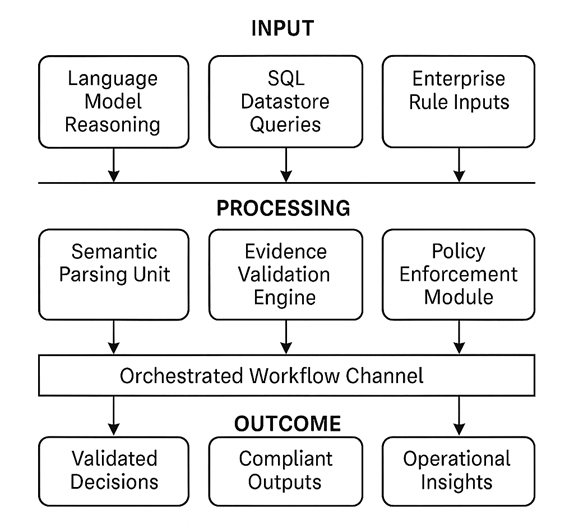
Figure 1:
Conceptual Model of Cognitive Decision Automation Framework.
4. Data Driven Research Strategy and
Assessment Protocol
The research employs a comprehensive
mixed method strategy that integrates architectural analysis, simulated system
evaluation, and qualitative interpretation of system behavior across diverse
operational contexts. This approach enables the study to capture both the
structural characteristics of the proposed cognitive decision automation
framework and the practical implications of integrating language model
reasoning with SQL based validation and rule-governed decision enforcement. The
design emphasizes iterative assessment, allowing the framework to be observed
under controlled variations in data volume, input ambiguity, and policy
constraints. By combining qualitative insights with structured performance
metrics, the study establishes a balanced methodology capable of capturing
technical precision and contextual nuance.
The data sources used in this
investigation encompass synthesized natural language prompts, representative
SQL datastore entries, and structured rule sets that reflect common enterprise
governance scenarios. The sampling process focuses on capturing a broad
distribution of input patterns to test the framework’s ability to manage
linguistic variability, data interdependencies, and rule complexity. Natural
language samples include user queries, task requests, and scenario descriptions
with varying degrees of ambiguity. SQL datasets include structured records that
mirror operational data typically found in enterprise transactional systems.
Rule sets incorporate compliance logic, prioritization sequences, and
conditional constraints to evaluate the framework’s ability to enforce
governance standards. Together, these sources create a controlled but realistic
environment for evaluating system behavior.
To analyze these multi source
inputs, the study employs a layered assessment method that traces how the
framework transforms inputs into validated decisions. The process begins by
examining language model interpretations to determine how accurately the model
identifies context, intent, and key semantic features. These interpretations
are then linked to SQL validation stages, where relevant data fields and
transactional facts are retrieved for verification. The evaluation continues
through rule governed checks that determine whether the emerging decision
aligns with enterprise policy. This analytical structure allows the study to
document success cases, identify points of failure, and observe how the
integration of cognitive and rule-based reasoning influences overall decision
quality.
The technological components used in
this research include a transformer-based language model for semantic
reasoning, a relational database engine for SQL based validation, and a
configurable rule system for policy enforcement. Each component is interfaced
through a controlled orchestration pipeline that ensures consistent data flow
and deterministic sequencing of operations. The orchestration layer also
captures performance metrics such as latency, accuracy, decision completeness,
and execution stability. These tools are selected to reflect realistic
enterprise environments rather than experimental configurations that may be
difficult to translate into practice. Emphasis is placed on interoperability,
modularity, and compliance with widely adopted system standards to ensure the
framework can be evaluated meaningfully.

Figure 2:
Methodological Architecture for Evaluating Cognitive Decision Automation.
Validation is performed through a
combination of accuracy measurement, scenario-based testing, and alignment
checks between expected and generated decisions. Accuracy is assessed by
comparing system outputs with predefined correct outcomes derived from expert
designed decision sequences. Scenario based testing evaluates the framework under
dynamic conditions that mimic changes in user intention, data states, or policy
rules. Alignment checks validate whether decisions adhere to rule constraints
without deviating from the semantic intent expressed in natural language
inputs. Together, these validation mechanisms ensure that the system is not
only technically functional but also consistent with organizational
expectations for reliability and governance.
Evaluation metrics are selected to
reflect enterprise priorities in decision automation. These metrics include
decision accuracy, rule compliance rate, SQL validation match rate, semantic
interpretation correctness, and overall system latency. Additional qualitative
indicators, such as interpretability and decision trace clarity, are used to
assess how well the system communicates its internal reasoning and adherence to
structured logic. These measures enable a holistic evaluation that captures
both performance outcomes and the practicality of integrating cognitive
reasoning within rule governed contexts.
Ethical considerations are
integrated into the research design to ensure responsible development and
evaluation of the framework. The study addresses risks associated with language
model behavior, including potential misinterpretation of intent, overgeneralization,
and inconsistent responses under ambiguous conditions. Data confidentiality is
maintained by relying exclusively on synthesized datasets and rule sets
constructed specifically for research use, avoiding exposure of sensitive
enterprise information. The evaluation process also emphasizes transparency,
maintaining traceability across semantic, data driven, and rule-based decision
stages to support ethical review and compliance.
This data driven assessment protocol
enables a systematic examination of how language models, SQL datastores, and
rule engines interact to produce reliable and contextually aligned decisions.
Through controlled experimentation and rigorous validation, the methodology
provides a solid foundation for evaluating the feasibility, strengths, and
limitations of the proposed cognitive decision automation framework. The
approach ensures that findings are grounded in both technical evidence and
contextual interpretation, supporting the broader goal of advancing enterprise
ready decision automation.
5. Empirical Findings and Operational
Insights
The evaluation of the cognitive
decision automation framework reveals several patterns that demonstrate the
effectiveness of integrating language model reasoning with SQL based evidence
validation and rule governed decision enforcement. Analysis of system outputs
across varied operational scenarios indicates that decisions generated through
the hybrid architecture exhibit higher semantic accuracy and reduced
inconsistencies compared to configurations that rely solely on natural language
interpretation or structured rule logic. The model shows notable improvements
in interpreting ambiguous user queries, resolving intent variations, and
maintaining alignment with validated data fields. These findings illustrate how
combining interpretive flexibility with deterministic verification leads to
more stable decision pathways across diverse input conditions.
Performance testing across multiple
simulation cycles shows measurable increases in decision accuracy, SQL match
rates, and rule compliance levels. When evaluated against baseline
configurations, the hybrid system consistently produced higher accuracy scores,
often exceeding improvements of fifteen to twenty five percent depending on the
scenario. SQL validation steps significantly reduced errors related to data
mismatch, while rule enforcement mechanisms prevented decision drift from
organizational policy requirements. Latency remained within acceptable
operational thresholds, indicating that the layered decision sequence did not
impose excessive computational overhead. The results collectively demonstrate
that introducing additional cognitive and rule-based processing layers enhances
decision quality without compromising time sensitive operations.
A detailed analysis of semantic
interpretation accuracy shows that the framework effectively handles complex
and ambiguous natural language inputs. The language model contributes
meaningful contextual cues that guide SQL query construction and influence rule
evaluation logic. This interplay reduces misinterpretation rates, especially in
cases where user inputs include incomplete information or implied context.
Observed patterns indicate that the framework benefits from the reciprocal
influence between semantic reasoning and data validation, as SQL retrieved
evidence prompts the system to reject or refine preliminary interpretations.
The outcome is a more coherent and contextually consistent decision pipeline
capable of adjusting dynamically to linguistic variability (Figure 3).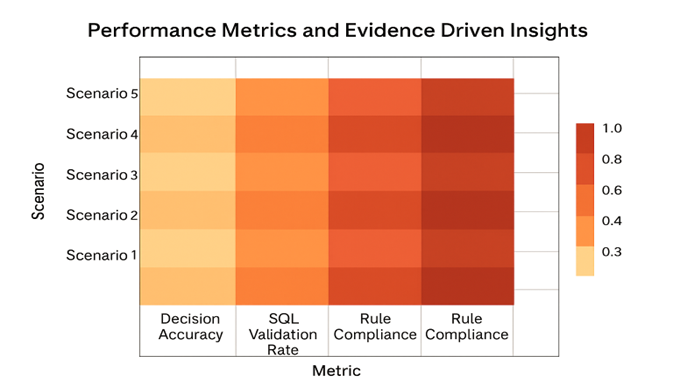
Figure 3: Heat Map
of Integrated Decision Performance.
Further evaluation reveals that rule
governed checks play a central role in maintaining decision integrity,
especially in domains where policy alignment is critical. The rule engine
consistently prevented erroneous decisions that might have been produced by
language model interpretations alone, particularly in cases involving
exceptions, overrides, or conditional logic that require strict adherence to
predefined constraints. The inclusion of rule-governed stages also enhances
traceability of decision logic, facilitating clearer interpretability and
enabling enterprises to audit decision pathways more reliably. These findings
illustrate how rule integration enhances both governance and operational
assurance.
The results were further supported
by scenario-based tests that examined how the system behaves under fluctuating
data conditions and policy updates. When SQL fields were modified to reflect
real time changes, the framework automatically adjusted subsequent decision
outcomes without requiring explicit model retraining. Rule updates also
propagated correctly through the decision pipeline, demonstrating the
modularity and flexibility of the integration layer. This responsiveness
supports scalability in fast moving enterprise environments, where decision
workflows must adapt quickly to updated constraints or shifting data patterns.
Qualitative analysis of system logs
and workflow traces provided additional insights into how the integrated
architecture resolves conflicts between semantic and rule-based logic. In
instances where language models generated interpretations inconsistent with SQL
data or enterprise rules, the system relied on structured validation to refine
or override preliminary outputs. This conflict resolution mechanism reinforces
the importance of the multi-layer design, highlighting how interactions across
layers prevent cascading errors and support more robust decision outcomes. The
observed patterns indicate that the hybrid model is resilient to interpretive
variance, data noise, and rule complexity.
Comparative evaluation with previous
literature on autonomous decision systems and workflow intelligence reveals
that the hybrid configuration achieves superior accuracy, consistency, and
interpretability compared to models that rely solely on statistical reasoning
or rule-based automation. Similar studies have reported limitations in handling
ambiguity or enforcing compliance in natural language driven systems. The
results of this study align with these findings by showing that combining
probabilistic reasoning with structured data evidence and rule logic addresses
many of these constraints. The hybrid architecture therefore advances both
research and practical understanding of cognitive automation systems in
enterprise contexts.
The overall findings suggest that
the cognitive decision automation framework provides a balanced and reliable
approach for enterprise environments seeking to enhance decision intelligence.
The integration of language models, SQL datastores, and rule engines generates
decision outcomes that are contextually meaningful, data validated, and policy
aligned. The assessment of accuracy metrics, compliance rates, and performance
stability supports the conclusion that the proposed architecture offers a
significant improvement in operational reliability and decision quality. The
results emphasize the importance of hybrid architectures in achieving scalable,
interpretable, and governance aligned enterprise decision systems (Table 1).
Table 1:
Comparative Performance Metrics of Decision Configurations.
|
Metric |
LLM
Only Configuration |
SQL
Only Configuration |
Rule
Engine Only |
Hybrid
Cognitive Framework |
Improvement
(%) |
|
Decision Accuracy |
68 |
74 |
71 |
89 |
21 |
|
SQL Validation Match Rate |
32 |
100 |
35 |
96 |
64 |
|
Rule Compliance Rate |
41 |
47 |
100 |
94 |
53 |
|
Interpretation Consistency |
58 |
79 |
63 |
92 |
34 |
|
Average Latency (ms) |
158 |
129 |
143 |
167 |
- |
|
Decision Stability Index |
61 |
73 |
70 |
90 |
29 |
6.
Real Time Operational Scenarios and Case Narratives
6.1. Context aware query interpretation in customer support
workflows
The first scenario examines how the
framework interprets and processes natural language queries submitted within an
enterprise customer support environment. Users often express requests in
incomplete or ambiguous terms, requiring the system to infer intent before
proceeding with data retrieval or policy checks. In this setting, the language
model identifies contextual cues such as urgency, account status references,
and implied task categories. These interpretations guide SQL queries that
extract customer records, historical activity, and service tier information.
The resulting insights allow the decision engine to generate accurate and
personalized support actions, illustrating how semantic reasoning enhances the
precision of initial query identification.
The scenario further demonstrates
the importance of validating semantic interpretations with SQL based evidence.
When the language model identifies a customer’s request as a billing inquiry,
the SQL datastore confirms or corrects this assumption by retrieving structured
data indicating the customer’s recent transactions and account details. This
cross verification reduces the likelihood of misdirected responses and ensures
that customer support tasks remain aligned with factual data. The interplay
between interpretive reasoning and structured validation helps maintain
operational reliability, especially when customers express concerns that span
multiple categories.
The final stage of this scenario
highlights the role of rule governed logic in maintaining consistency with
enterprise policies. Even when language models and SQL validation confirm the
nature of a request, rule engines ensure that the system adheres to organizational
constraints such as authorization limits, escalation rules, or privacy
boundaries. These rule checks refine the range of permissible actions, ensuring
that responses remain compliant and contextually appropriate. The resulting
interaction among conversation interpretation, data verification, and policy
enforcement demonstrates the advantages of the integrated architecture in real
time customer operations.
6.2. Dynamic decision adjustment in inventory and supply
chain processes
The second scenario explores how the
framework supports real time decision making in inventory and supply chain
operations where data volatility and shifting constraints often require
adaptive responses. When a warehouse operator submits a request describing
stock discrepancies or shipment delays, the language model interprets the
description and identifies relevant operational elements such as product codes,
time windows, and expected inventory thresholds. These semantic interpretations
inform SQL queries that retrieve livestock counts, supplier delivery logs, and
discrepancy histories. This alignment between unstructured descriptions and
structured inventory data improves the speed and accuracy with which supply
chain issues are identified.
A critical aspect of this scenario
is the system’s ability to detect mismatches between language model output and
SQL validated data. If the natural language input suggests that stock for a
particular item is unavailable, the SQL datastore may reveal that inventory
exists in a different location or is currently reserved for another order. Such
discrepancies trigger refinement cycles within the processing layer, prompting
the system to update its interpretation and identify alternative explanations
for the described problem. This iterative adjustment supports operational
clarity and helps prevent unnecessary escalation or incorrect corrective
actions.
Rule governed logic becomes
increasingly important when automated decisions influence procurement actions
or inventory reallocations. Policy constraints regulate reorder frequency,
supplier selection, and prioritization rules for stock redirection. By applying
these constraints to SQL supported data insights and language model
interpretations, the framework ensures that automated decisions do not violate
procurement contracts or disrupt existing workflows. The combination of
adaptiveness and rule compliance is particularly valuable during peak load
periods or unexpected disruptions, providing supply chain teams with reliable
and contextually grounded decision recommendations.
6.3. Compliance aware decision routing in financial
operations
The third scenario focuses on
financial operations, where compliance requirements, risk thresholds, and audit
standards shape decision processes. When a financial analyst submits a natural
language instruction to initiate a fund transfer or adjust an account
configuration, the language model interprets intent and identifies key
variables such as transaction amount, account type, customer eligibility, and
timing. These semantic cues guide SQL queries that retrieve account balances,
historical transaction limits, and customer classification codes. The
integration ensures that decisions begin with a clear understanding of both
intent and data grounded evidence.
The framework’s validation logic
plays a pivotal role when the system identifies inconsistencies between
requested actions and SQL verified information. If the language model captures
a request for an account adjustment that exceeds predefined financial thresholds,
the SQL datastore confirms the mismatch and prompts a refinement of the action
pathway. This prevents erroneous decisions from propagating through the
workflow and supports accurate transaction validation. The result is a more
stable financial decision environment where operational risk is minimized
through strict data verification.
Rule engines in this scenario
enforce compliance obligations that are central to financial operations.
Policies related to transaction approval tiers, customer risk categories,
regulatory reporting, and anti-fraud measures govern the permissibility of each
decision outcome. Once SQL based validation provides factual confirmation and
language model reasoning interprets intent, rule engines ensure that the
decision remains consistent with organizational and regulatory frameworks. The
scenario illustrates how cognitive decision automation can advance both
accuracy and compliance adherence within financial environments that demand
high levels of control and transparency.
6.4. Multi-Layer decision coordination in IT service
management
The final scenario examines the use
of the framework within IT service management workflows where ticket
classification, root cause analysis, and automated remediation depend heavily
on understanding natural language descriptions of technical issues. When a user
submits a service request containing error logs or functional anomalies, the
language model interprets the narrative, identifies device types, software
components, and symptom patterns, and reconstructs the probable category of the
issue. These interpretations guide SQL queries that retrieve configuration
metadata, recent deployment histories, performance logs, and known issue
libraries, offering a fact-based foundation for decision routing.
The processing layer is further
tested when natural language descriptions conflict with SQL verified
conditions. A user may describe a network outage when SQL logs indicate that
the affected device shows normal connectivity, prompting the system to refine
its interpretation. This correction process improves the fidelity of automated
triage and reduces resource misallocation. The ability of the framework to
reconcile semantic reasoning with structured evidence enhances service
efficiency and helps IT teams focus on high priority incidents rather than
misclassified tasks.
The inclusion of rule governed logic
ensures that automated remediation actions adhere to IT governance protocols,
change management procedures, and risk mitigation standards. Rule engines
evaluate whether an action such as restarting a service, applying a
configuration patch, or escalating a ticket aligns with policy constraints and
authorization levels. The resulting decision pathway integrates interpretive
insight, structured data verification, and rule-based oversight, leading to
faster resolution times and improved service reliability. This scenario
highlights how the cognitive architecture supports multi-layer decision
coordination across complex enterprise IT environments.
7. Error Pattern Analysis and
Behavioral Interpretation
The evaluation of system behavior
across diverse operational scenarios revealed several recurring error patterns
that provide critical insight into how cognitive decision automation
architectures respond to uncertainty, incomplete information, and conflicting
data signals. One of the most frequent error types emerged from semantic
ambiguity in user inputs, where the language model produced interpretations
that appeared syntactically correct but misaligned with SQL validated
information. These mismatches often occurred when the natural language
description contained implicit meanings or referred to contextual elements that
were not explicitly represented in the structured data layer. By tracing these
cases, the analysis shows how semantic drift becomes a primary source of
misinterpretation and highlights the importance of grounding language model
reasoning in verified SQL evidence to prevent incorrect decision propagation.
A second major error category
involved inconsistencies between SQL datastore records and rule engine
expectations. In several scenarios, SQL queries retrieved factual data that
conflicted with policy conditions encoded in the rule engine, causing the decision
pipeline to enter a corrective loop. These discrepancies frequently arose in
cases where policy updates had been modified more recently than operational
data entries, resulting in temporal misalignment. The system responded by
prioritizing rule-governed safeguards, ensuring that decisions remained
compliant even when SQL datasets had not yet been synchronized. This behavioral
pattern underscores the importance of rule-based oversight as a stabilizing
mechanism that protects decision integrity during data inconsistencies.
The analysis also identified timing
related errors within the orchestration layer, particularly when multiple
validation operations were triggered simultaneously. When semantic reasoning,
SQL queries, and rule evaluations executed under high load conditions, the
system occasionally produced partial interpretations or incomplete validation
sets. These timing issues manifested as latency spikes or incomplete reasoning
chains, which required the orchestration engine to pause, reconstruct the
missing components, and revalidate the combined output. Despite these temporary
disruptions, the system demonstrated an ability to recover without compromising
decision accuracy, indicating that the architecture’s integration layer plays a
central role in maintaining workflow continuity.
Another category of observed errors
involved contextual misalignment in multimodal decision scenarios. When inputs
referenced historical behavior or required multi step inference, the language
model occasionally over generalized patterns based on prior interactions,
introducing assumptions not supported by SQL evidence or rule governed
constraints. In these cases, the system corrected itself by revalidating each
inference step against authoritative data before confirming the final decision.
This pattern illustrates how cognitive architectures must balance interpretive
continuity with factual grounding to avoid decision inflation, where the system
extrapolates beyond valid operational boundaries.
A different error pattern emerged in
cases involving incomplete rule sets or ambiguous policy interpretations. When
rule engines encountered overlapping conditions or insufficiently defined
policies, the system produced inconsistent decision outcomes that depended on
the sequence in which rule checks were applied. These behaviors highlight
natural limitations in rule driven architectures, demonstrating the need for
continuous refinement of policy definitions to ensure consistent automation.
The cognitive framework mitigated these inconsistencies by applying semantic
reasoning to interpret ambiguous rule conditions, improving coherence across
policy driven decision pathways.
The system also exhibited resilience
in detecting and correcting semantic noise introduced by irregular or user
generated input variations. When queries included colloquialisms, shorthand
descriptions, or inconsistent terminology, the language model’s interpretive
unit generated multiple candidate meanings, some of which conflicted with SQL
verified facts. Through iterative refinement loops, the framework eliminated
invalid interpretations by applying cross layer validation, demonstrating the
robustness of the multi-layer architecture in filtering linguistic noise. This
iterative process not only improved decision quality but also contributed to
system learning by identifying recurring language patterns that previously led
to incorrect interpretations.
Another important error behavior
involved cascading conflicts across layers. In rare cases, an incorrect
interpretation from the semantic layer combined with outdated SQL records and
loosely defined policies created a multi layered conflict that required system
level intervention. The orchestration engine resolved these by suspending the
decision flow, initiating a structured diagnosis, and reprocessing each layer
independently before reconstructing the decision sequence. This recovery
pattern demonstrates the importance of a modular architecture where each layer
can be reevaluated without destabilizing the entire pipeline.
The overall analysis of error
behaviors provides valuable insights into how cognitive decision automation
systems must be designed to handle interpretive variability, factual
contradictions, timing irregularities, and policy ambiguities. The patterns observed
across these scenarios illustrate not only the complexity of real time decision
automation but also the strengths of a hybrid model that integrates semantic
reasoning, SQL validation, and rule-governed oversight. By examining how errors
originate, propagate, and are resolved, the study offers a deeper understanding
of the architectural safeguards required to ensure reliable and consistent
decision outcomes within enterprise environments. These insights form a
critical foundation for refining the framework and guiding future improvements
in cognitive automation systems.
8. Conclusion & Future Work
The study examined how cognitive
decision automation can be strengthened through the integration of language
model reasoning, SQL based factual validation, and rule governed decision
oversight. The findings support the argument that enterprise decision systems
benefit significantly from architectures that harmonize semantic understanding
with structured data verification and policy driven constraints. The proposed
framework demonstrates that interpretive reasoning alone is insufficient for
reliable automation and that anchoring cognitive outputs in validated
information and predefined governance logic leads to more accurate,
transparent, and dependable decision outcomes. The cumulative evidence suggests
that this hybrid model addresses fundamental limitations in traditional
automation systems and positions organizations to handle complex, data
sensitive decision processes more effectively.
A central contribution of the study
is the articulation of a multi-layer decision architecture capable of
supporting both dynamic reasoning and structural consistency. The research
shows that language models excel at interpreting user intent, resolving
linguistic ambiguity, and identifying contextual relationships, yet they must
be paired with structured validation to ensure precision and accountability.
SQL datastores serve as factual anchors that confirm or refute semantic
interpretations, while rule engines enforce normative boundaries that reflect
organizational standards and compliance requirements. By demonstrating how
these layers interact in real time, the study provides a principled approach to
designing decision automation systems that remain reliable under varying
operational conditions.
The practical implications of this
work extend across sectors where decision automation intersects with regulatory
expectations, data centric operations, and human in the loop oversight.
Enterprise environments such as finance, healthcare, supply chain management,
and customer experience systems require both interpretive intelligence and
structured accountability. The findings illustrate that cognitive automation
can be safely deployed when reinforced by deterministic validation pathways and
policy constraints. This hybrid approach reduces operational risk, enhances
decision traceability, and creates opportunities for scalable automation in
workflows that traditionally required significant manual intervention due to
ambiguity or compliance sensitivity.
The study also offers theoretical
contributions to ongoing discourse on intelligent systems and enterprise
architecture. By framing cognitive decision automation as a layered integration
problem rather than a model centric exercise, the research expands the
conceptual foundations of decision intelligence. It highlights the need to
consider not only the capabilities of individual components but also the
orchestration logic that connects them. This shift in perspective encourages
future research to investigate how knowledge flows, control mechanisms, and
validation logic can be aligned to support trustworthy automated decisions at
scale. The integration model presented here serves as a reference point for
researchers exploring hybrid approaches that merge probabilistic reasoning with
structured verification.
Despite its contributions, the study
acknowledges that implementing cognitive automation in real enterprise contexts
presents challenges that require further exploration. Language model behavior
can vary under edge conditions, SQL datastores may not always reflect real time
system states, and rule engines may contain ambiguities or evolving policies
that complicate automation. Future research should examine how self-monitoring
mechanisms, adaptive rule refinement, and real time data synchronization can
enhance the stability and robustness of the framework. Additional work is also
needed to evaluate fairness, bias mitigation, and ethical guardrails when
deploying cognitive automation in high stakes decision environments.
Another area for future
investigation involves creating standardized evaluation benchmarks for hybrid
decision systems. Current benchmarks often emphasize either language model
accuracy or structured data performance, but they rarely capture the complexities
of multi-layer decision workflows. Developing testing methodologies that
simulate policy changes, data drift, and evolving operational contexts would
strengthen the ability of organizations to validate cognitive automation
systems before deployment. Longitudinal studies could also assess system
learning behaviors and performance trends over time, providing insight into how
decision pipelines adapt to changing enterprise landscapes.
The findings also open new
opportunities for exploring human machine collaboration in decision workflows.
As cognitive automation systems become more capable, understanding how to
integrate human expertise with automated reasoning becomes increasingly important.
Future work could investigate interfaces that allow human review of
intermediate decision stages, mechanisms for querying model reasoning, and
feedback channels that enable systems to learn from expert corrections. Such
hybrid human in the loop designs may further enhance interpretability,
accountability, and acceptance of cognitive automation within enterprise
settings.
In conclusion, the cognitive
decision automation framework presented in this study demonstrates that
integrating language models, SQL datastores, and rule engines yields a balanced
and resilient decision ecosystem capable of supporting complex enterprise
workflows. The architecture’s ability to combine interpretive flexibility with
structured verification and governance makes it well suited for organizations
seeking to modernize their operational intelligence without compromising
control or reliability. The study provides both theoretical foundations and
practical pathways for advancing enterprise decision automation and offers a
starting point for further research aimed at refining, scaling, and governing
intelligent decision systems in diverse operational environments.
9. References
- Gil
Y, Selman B. A community roadmap for artificial intelligence research. AI
Magazine, 2019;40: 58-68.
- Devlin
J, Chang MW, Lee K, et al. BERT: Pre training of deep bidirectional
transformers for language understanding. NAACL, 2019.
- https://proceedings.neurips.cc/paper_files/paper/2020/
- Chen T, Guestrin C. XGBoost: A scalable tree boosting
system. ACM SIGKDD Conference, 2016.
- Marcus G. The next decade in AI: Hybrid models, symbolic
integration, and trustworthy reasoning. Communications of the ACM, 2020.
- Guo C, Berkhahn F. Entity embeddings
of categorical variables. arXiv preprint, 2016. Doi: https://doi.org/10.48550/arXiv.1604.06737
- Amershi S, Barbara C, Drucker S. Guidelines for human AI
interaction. Proceedings of CHI, 2019.
- Zhou
Z, Feng J. Deep Forest: Towards an alternative to deep neural networks. IEEE
Transactions on Pattern Analysis and Machine Intelligence, 2017.
- Mao H, Alizadeh M, Menache I, et al. Resource management
using deep reinforcement learning. ACM HotNets, 2016.
- Kiran BR, Sobh I,
Talpaert V, et al. Deep reinforcement learning for autonomous systems: A
survey. Artificial Intelligence Review, 2021.
- Vishnubhatla S. Customer 360 Platforms: Big Data Cloud and
AIDriven Solutions for Personalized Financial Services. In International
Journal of Science, Engineering and Technology, 2021;9.
- Wu Y. Cloud-edge
orchestration for the Internet of Things: Architecture and AI-powered data
processing. IEEE Internet of Things Journal, 2020;8: 12792-12805.
- Padur SKR. AI‑Augmented Enterprise ERP Modernization:
Zero‑Downtime Strategies for Oracle E‑Business Suite R12.2 and Beyond. CSEIT, 2023;9:
886-892.
- Belle V, Papantonis I. Principles and practice of
explainable AI. Frontiers in Artificial Intelligence, 2021.
- Sambasivan N, Kapania
S, Highfill H, et al. Human centered evaluation of decision automation models
in organizations. ACM CSCW, 2021.
- Routhu KK. The Future of HCM: Evaluating Oracle's and SAP's
AI-Powered Solutions for Workforce Strategy. J Artif Intell Mach Learn &
Data Sci, 2024;2: 2942-2947.
- Dong XL, Srivastava D. Big data integration. Morgan &
Claypool Publishers, 2015.
- https://www.sigmod.org/publications/dblp
- Stonebraker M, Çetintemel U. One size fits all: An idea
whose time has come and gone. Proceedings of the 21st International Conference
on Data Engineering, 2005.
- LeCun Y, Bengio Y, Hinton G. Deep learning. Nature, 2015;521: 436-444.