Research Article
Container Orchestration with Kubernetes
Authors: Venkat Soma
Publication Date: July 30, 2024
DOI:
https://doi.org/10.51219/JAIMLD/venkat-soma/247
Citation:
Citation: Venkat Soma. Container Orchestration with Kubernetes. J Artif Intell Mach Learn & Data Sci, 2024, 2(3): 1-7.
Copyright:Copyright: ©2024 Venkat Soma. This is an open-access article distributed under the terms of the Creative Commons Attribution License, which permits unrestricted use, distribution, and reproduction in any medium, provided the original author and source are credited.
View : PDF
Abstract
The research paper focuses on the effectiveness of Kubernetes in container orchestration. In this concern, it investigates the sports industry to assess the way Kubernetes can support this industry for its operational management. This system can be combined with Azure cloud and ML algorithms for better resource allocation and schedule management. This study found that Kubernetes can provide beneficial insight into resource operations by building data engineering.
Keywords: Kubernetes, Container orchestration, Server, Resource management, Sports industry, Security, Stakeholder communication
1. Introduction
Container orchestration is a beneficial tool that provides companies with a framework to manage the microservice architecture and containers at a data management scale. Container orchestration is used to automate and manage operational tasks. “Configuration and scheduling”, “Container availability”, “Load balancing and traffic routing”, “Configuring applications based on the container in which they will run”, “Monitoring container health”, “Keeping interactions between containers secure”, “Scaling or removing containers based on balancing workloads across organisational infrastructure”, “Resource allocation”, and “Provisioning and deployment” are those tasks.
1.1. Aim
To assess how the NY Mets can utilize Kubernetes for container orchestration to streamline the management of the micro-level services and preserve the confidentiality of the information.
1.2. Objectives
- To evaluate the effectiveness of Kubernetes automates and streamlines the micro aspect services and the management of the containers for the NY Mets.
- To scrutinize the overall efficacy of the Kubernetes in preserving authentic information from the inclusion of the third-party proforma.
- To examine the Kubernetes's responsibility in optimizing allocation of the resources, maintaining the equilibrium with the load, and measurement for effective data manipulation.
- To analyse the process through which Kubernetes exemplifies the employment and the scaling up of the processes, and mitigation of the manual interpretation.
1.3. Research questions
- How does Kubernetes streamline the overall reliability and resource management for the sports information at NY Mets?
- What are the potential positive aspects and the underlying challenges of amalgamating the Kubernetes with Azure for the manipulation and the analysis of the data processing?
- How can Kubernetes improve sports analytics and virtual reality applications for team performance and audience engagement?
- To what extent does Kubernetes container orchestrate the abilities to be capitalized to manipulate and scale the diversified sports data and application of the services?
1.4. Research rationale
The research analyses the Kubernetes's responsibilities regarding the orchestration of the containers to streamline the overall operational efficacy for the sports and management of the resources. With the rapid advancement of the sports sector, the extensive reliance on large volumes of data management systems. Kubernetes provides autonomous solutions for the microlevel and the management of the containers. It streamlines the autonomous solutions for the microservice and management of the containers.
2. Literature Review
2.1. Research background
Kubernetes automates the working process and lifecycle of stateless applications, for example, static web servers. This is a simple web server to retrieve files, as well as send on to the visitors’ browsers. Kubernetes works with several strategies and servers to complete a task. It increases operational reliability by managing the collection of computers, namely nodes. Kubernetes can manage its visitor’s site architecture through suitable production solutions; it allows the containers to deploy and interact among themselves and increase database management actions1. Figure 1 presents the way Kubernetes can provide suitable production solutions through visior sire architecture.
Figure 1: Visitors Site Architecture1.
Filtering and ranking are the activities for scheduling tasks and proper utilisation of resources to promote system performance. “The K8s Cluster Autoscaler” (CA) responds to workload fluctuation, which can look into managing nodes. It solves the issue. At that time, the clusters cannot be scheduled due to insufficient resources. Kubernetes includes rkt, OCI, CRI, and Docker as the container technology to manage all workloads and reschedule those2. It controls both virtual and physical infrastructure through both elastic and manual scaling.
The study of3 mentioned that Kubernetes can manage almost 332 thousand uniform data, while it can handle more than 285 thousand dynamic data. These are microservices, which Kubernetes can control by dedicating several resources. Resource allocation can be accomplished without any interruption. Rather, it can control the issues through high high-efficiency video coding system. In the sports industry, it can allocate the live encoders.
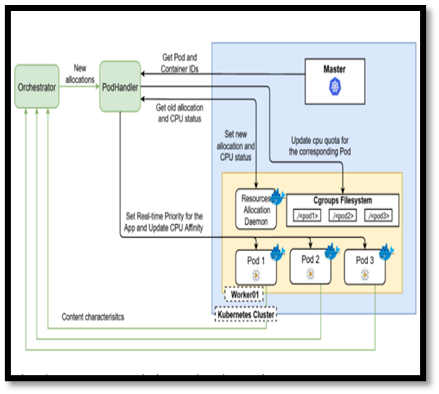
Figure 2: Updating resources and orchestration processes by Kubernetes3.
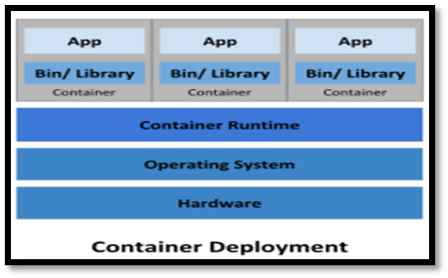
It updates the resource allocation process to a container; it stores resources in the government Pod; then, it starts and stops to promote a desired resource allocation. Linux system increases transparency to Kubernetes3. It can update the orchestration processes for proper resource management [mentioned in Figure 2]. This ideal platform can host cloud-native applications and clusters according to the criteria of public, private and hybrid cloud management. Figure 3 shows that the three containers can be stored in three different bins or libraries under three different applications. It manages hardware and operating systems based on container runtime4.
Figure 3: Steps of container deployment through Kubernetes4.
Figure 4: Position management of the players through active use of Kubernetes based on real-world situations5.
Hence, it is essential to understand the way organisations, especially sports organisations, such as the NY Mets can utilise Kubernetes for its efficient operational management.
2.3 Critical assessment
Kubernetes versions are crucial for internal resource management and increasing security services. The combination of Azure and Kubernetes can be effective in promoting solutions for performance management. The Azure Cloud platform can handle multi-cloud services and promote the services for the development of the business processes; it will be crucial for the slowing similar pattern in performance with all infrastructure. These provide companies with commercial solutions through cloud infrastructure6. This combination manipulated the benchmark related to the useful resources. Hence, this can be mentioned that Kubernetes will imitate the manual works or organisation, while Azure will maintain the cloud platforms and servers to continue the digital operations.
Edge-cloud continuum is associated with the development of business processes and cognitive management through decentralised container orchestration. The article7 mentioned the CODECO orchestration framework, which increases the reliability of a developing approach which connects data, computers, and networks. The K8s architecture stores configuration and data to increase key value through “K8s Custom Resource Definitions” (CRDs), “control manager”, “scheduler”, and “API server (K8s API or kube-apiserver)”. In this way, the cyber-physical system is managed, and a high-level perspective is developed.
Kubernetes can manage independent services in dynamic seamless resource allocation processes. This container orchestration tool conducts a live video compression to assess information on the athletes, their performances, playing strategies, and stats. Kubernetes can promote complex sports channels to deal with sports information8.
The study of9 mentioned that Kubernetes can promote the services of virtual reality in the sports industry. The container-based VR application can be promoted through several steps. It resides in the issues regarding resource utilisation and fault tolerance; in other words, Kubernetes (K8s) improves the performance of cloud-native VR applications.
Figure 5: Balance between the Control panel and Nodes in the Kubernetes cluster11.
This promotes web-based real-time communication among the stakeholders; here, “Application Programming Interfaces” (API) can establish a peer-to-peer connection between server and VR clients. This promotes high-quality streaming and enables low latency in streaming services. Hence, this is beneficial for the development of business processes through congestion and bitrate control mechanisms. Here, the integration of WebRTC and K8s improves real-time communication to deliver the immersive experiences of the customers. Furthermore, NY Mets conducts e-sports events as well, which also attracts a huge level of audience. The report of10 mentioned that by 2025, there will be almost 640 million people with high interest in e-sports events. Here, “a container orchestration platform” is crucial to manage the core features of the sports industry. The cloud-neutral API will manage all functionality with the API server; it can integrate all major cloud platforms within the “Kubernetes controller manager” (KCM) 11.
2.4. Linkage to aim
The sports industry can use these algorithms and cluster combined so that they can assess the performance of the team minutely12. Such analysis is essential for the development of the team's performance and for making necessary decisions. The stakeholders, such as coaches and athletes can assess the effectiveness of their performance and on-field strategies. This insight assists them in engaging in practices so that they can avoid unwanted incidents, such as accidents.
Cloud-based software, such as Kubernetes promotes efficient data management so that the sports industry can focus on the development of the business processes through monitoring-as-a-service system. This adjusts the function of memory and CPU for efficient network utilisation. Hence, the researchers of article13 mentioned that Kubernetes can increase the application of real-time sports analytics to reduce manual job management and increase platform-independent management of job workload among sports organisations.
2.5. Encapsulations for capsulations
According to the information from the article14, efficient use of the Kubernetes cluster will increase the use of virtual machines (VM) in the sports area. This will increase people’s attention and attraction to e-sports increasingly, which will promote a renaissance of the sports industry. People will not need to be involved in outdoor games, and they can indulge in only internet gaming activities. On the other hand, virtual machines increase the attention to online gaming activities and increase online stakeholder management. The web server performance improves the coaching solutions by deploying all the sports environments and efficient communication with the players and stakeholders. Furthermore, the use of VR technology provides customers, players, and other stakeholders with real-world experience; it improves data engineering activities. Scalability, resource utilisation, and responsiveness increase the effect of Kubernetes in improving resource allocation and promoting operational efficiency in the model of modern digital sports event management; web infrastructure is also improved.
The cloud computing model and its association with Kubernetes are beneficial for shaping online services. “CIS Kubernetes Benchmarks” provides a clear insight into the potential vulnerabilities such as budget constraints and change management. The sports industry fetches open-source solutions to its information management and resource allocation issues. Hence, it can be said that NY Mets will also be able to understand its issues in its resource management activities. In this concern, the Kubernetes CLI plugin will provide a deep insight into their resources and use of servers. Hence, this organisation will be able to understand the way it can use its cloud computing models15. NY Mets can understand the gaps in their available information; furthermore, this organisation can mimic the manual functions of its existing servers, so that it can serve implement automated services. It will increase safety and security measures as well.
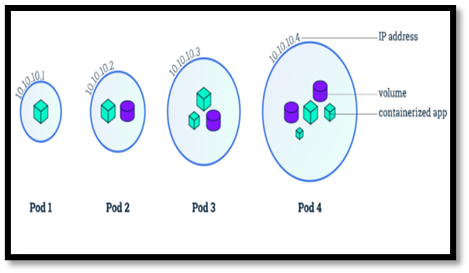
Figure 6: Kubernetes Pod16.
Video transmission is one of the most crucial services for the sports industry; “scalable Edge Cloud architecture” can be implemented through Kubernetes as this is one orchestration engine. It addresses the reasons for increasing features in video services; the Kubernetes Pod deals with IP address, volume and containerised applications to strengthen the cloud performance [Mentioned in Figure 6]. This is much better than the “traditional central cloud approach” as it improves crowdsourcing through edge architecture. Virtualisation of sports activities, monitoring activities, controlling media and networking activities are crucial for this service.
3. Methodology
3.1. Research philosophy
This research adheres to a deductive approach, determined towards the adoption of practical solutions and consequences. The approach puts focus on the implication of the meticulous theories and the proactive methodologies that provide extensive benefits and point out the specific complexities
3.2. Research approach
The research inclines a mixed procedures approach, amalgamating the qualitative approaches. The qualitative analysis of the data adheres to secondary sources of the data and aids in the analysis of the Kubernetes capabilities and its practical adoption for the organizations.
3.3. Research design
A case study crafted to capitalize, determining the specific scenarios regarding the sports organization. This configuration allows thorough evaluation and examination of the application of various perspectives regarding the sports sector and comprehends the underlying benefits and limitations, and the secondary sources of the data, which involves interviews, surveys, and the prevalent kinds of literature on container orchestration.
3.4. Data collection procedures
Data collection further considers multi-levelled approaches to ensure comprehensive understanding a comprehensiveness of Kubernetes and its potential impact the NY Mets. Through the performance of the analysis of the secondary sources of data from academic journals the participation of the IT professionals.
3.5. Results
a. Critical Analysis
The use of Kubernetes increases the scope of online operational functions which is beneficial for application development. In other words, it improves the IT operations in the sports industry. An application is typically designed to work in a particular type of computing environment, making it difficult to migrate or deploy to another environment. This is a constraint for both development and IT operations teams.
b. Findings and Discussions
1. Container Orchestration and Management of the Resources
Kubernetes offers an extensive range of configurations for the autonomous functioning of container management, which is considered a potential aspect of automating complicated applications.
2. Integration with the platform designed by Cloud management services
The integration of Kubernetes with cloud platforms such as Azure enhances its capabilities in resource management and security.
3. Prompt data processing and Analysis
The operation and the mechanisms posters the maintenance of the real scenario-based analysis of the data and the live monitoring of the vents. It aids in highly efficient coding of the visual implications of the organizations dealing with sports and game dynamics efficiently. Through the autonomous approaches, significant insights were gathered regarding the strategies of decision-making for the coaches and the managers. It aids in punctual alignment and enhancement of the game strategies.
4. Enhancing the Virtual and Augmented Reality of the entire applications
Kubernetes supports the deployment and management of virtual reality (VR) and augmented reality (AR) applications, which are increasingly relevant in the sports industry. Through the manipulation of the VR content and the escalation of the activities, which are surging authenticated in the sports segment.
Flexible and powerful features of this system will assist the internal management of an organisation18. This study provides further scope to future researchers and cloud managers in understanding the utility of Kubernetes.
4. Conclusion
This research paper highlighted the way Kubernetes is one of the most effective container orchestrations. This study mentioned that Kubernetes can secure information and maintain communication through different servers when its performance is combined with Azure Cloud.
5. Recommendations
This increases organisational efficiency by human-machine communication. Kubernetes controls Microservices, which are little bits of software that perform simple operations like opening or updating files.
6. Future Work
Containers eliminate these dependencies, allowing developers to create apps that work consistently when IT operations teams move them from one computer environment to another17. They address this issue further by using a microservices-based technique for application development.
7. References
1. https://books.google.com/books?hl=en&lr=&id=Kf3RDwAAQBAJ&oi=fnd&pg=PR4&dq=Container+Orchestration+with+Kubernetes&ots=qWmsWfEjOQ&sig=R7UTrTOuPPZ7wRh6hJLqf_9KnL8
2. https://doi.org/10.1145/3378447
3. https://dx.doi.org/10.18580/setep.2022.47.3
4. https://www.theseus.fi/bitstream/handle/10024/818922/Jakobsson_Jan.pdf?sequence=2
5. https://it-systems.su/wp-content/uploads/2022/03/nigel-poulton-the-kubernetes-book-2020.pdf
6. https://www.diva-portal.org/smash/get/diva2:1778399/FULLTEXT01.pdf
7. https://doi.org/10.1109/ACCESS.2024.3406861
8. https://ieeexplore.ieee.org/abstract/document/9772098/
9. https://backoffice.biblio.ugent.be/download/01J1F4XAFYN80MGKMW3S89TXAN/01J1F4ZWTCQ241K6HGVXC7TKZW
10. https://deadline.com/2023/10/new-yorks-citi-field-an-esports-arena-owner-steve-cohen-ponders-1235570840/
11. https://sgp1.vultrobjects.com/books/Infrastructure/Core%20Kubernetes.pdf
12. https://doi.org/10.1109/TNSM.2021.3052837
13. https://trepo.tuni.fi/bitstream/handle/10024/123555/KoskelaLauri.pdf?sequence=2
14. https://digitalcommons.georgiasouthern.edu/etd/2747?utm_source=digitalcommons.georgiasouthern.edu%2Fetd%2F2747&utm_medium=PDF&utm_campaign=PDFCoverPages
15. https://scholarworks.calstate.edu/downloads/4f16c823t
16. https://repositorio-aberto.up.pt/bitstream/10216/128597/2/412427.pdf
17. https://www.cisco.com/c/en/us/solutions/cloud/what-is-container-orchestration.html#~q-a
18. P. Kayal. Kubernetes in fog computing:
Feasibility demonstration, limitations and improvement scope. In 2020 IEEE 6th
World Forum on Internet of Things (WF-IoT), IEEE, 2020; 1-6.