Effective Test Strategy for AML Software: Addressing Regulatory Compliance and Risk Mitigation
Abstract
Anti-Money Laundering (AML)
software plays a crucial role in financial institutions' efforts to combat
financial crimes and maintain regulatory compliance. Developing an effective
test strategy for AML software is essential to ensure its reliability, accuracy,
and adherence to evolving regulations. This paper presents a comprehensive test
strategy that addresses the unique challenges of AML software testing, focusing
on regulatory compliance and risk mitigation. The proposed strategy
incorporates risk-based testing, model-based testing, and data-driven testing
techniques to validate AML software's detection capabilities, regulatory
alignment, and performance. The paper also discusses the integration of domain
expertise, collaborative testing approaches, and continuous testing practices
to enhance the effectiveness of AML software testing. A case study is presented
to demonstrate the application of the proposed test strategy in a real-world
AML software implementation. The results highlight the benefits of the strategy
in identifying compliance gaps, reducing false positives, and improving the
overall effectiveness of AML detection. The paper concludes with
recommendations for implementing the test strategy and future research
directions in AML software testing.
Index Terms: Anti-Money Laundering (AML), Software
testing, Regulatory compliance, Risk mitigation, Risk-based testing, Model-based
testing, Data-driven testing
1. Introduction
Anti-Money Laundering (AML)
software is a critical component of financial institutions' compliance
programs, designed to detect and prevent money laundering activities. The
effectiveness of AML software relies heavily on its ability to accurately
identify suspicious transactions, comply with regulatory requirements, and
adapt to evolving money laundering tactics1. Developing a robust test strategy for AML
software is crucial to ensure its reliability, efficiency, and compliance with
AML regulations.
Testing AML software presents
unique challenges due to the complexity of AML regulations, the large volume of
financial transactions, and the constantly evolving nature of money laundering
techniques2.
Traditional testing approaches may not be sufficient to address these
challenges effectively. Therefore, there is a need for a comprehensive test
strategy that considers the specific requirements of AML software testing,
focusing on regulatory compliance and risk mitigation.
In this paper, we propose an
effective test strategy for AML software that combines risk-based testing,
model-based testing, and data-driven testing techniques. The proposed strategy
aims to validate AML software's detection capabilities, regulatory alignment,
and performance while minimizing false positives and false negatives. The key
contributions of this paper are as follows:
- A comprehensive test strategy
tailored for AML software testing, addressing regulatory compliance and risk
mitigation
- Integration of risk-based testing,
model-based testing, and data-driven testing techniques to enhance AML software
testing effectiveness
- Discussion of domain expertise
integration, collaborative testing approaches, and continuous testing practices
in AML software testing
- A case study demonstrating the
application of the proposed test strategy in a real-world AML software
implementation
- Recommendations for implementing
the test strategy and future research directions in AML software testing
The remainder of the paper is
organized as follows: Section II provides background information on AML
regulations and software testing. Section III presents the proposed test
strategy for AML software. Section IV discusses the integration of domain expertise,
collaborative testing, and continuous testing practices. Section V presents a
case study demonstrating the application of the test strategy. Section VI
discusses the results and provides recommendations. Finally, Section VII
concludes the paper and outlines future research directions.
2. Background
2.1. Anti-Money Laundering (AML) Regulations
AML regulations are designed to
prevent, detect, and report money laundering activities. Financial institutions
are required to comply with various AML regulations, such as the Bank Secrecy
Act (BSA) in the United States, the Financial Action Task Force (FATF)
recommendations, and regional regulations like the European Union's Anti-Money
Laundering Directives. These regulations mandate financial institutions to
implement AML programs, conduct customer due diligence, monitor transactions,
and report suspicious activities to regulatory authorities.
2.2. AML Software Testing
Challenges
Testing AML software presents
several challenges due to the complexity of AML regulations, the large volume
of financial transactions, and the evolving nature of money laundering
techniques2.
Some of the key challenges include:
1. Regulatory Compliance: AML software must comply with
various regulations, which may have different requirements and interpretations3. Ensuring compliance requires
extensive testing of AML software against regulatory requirements.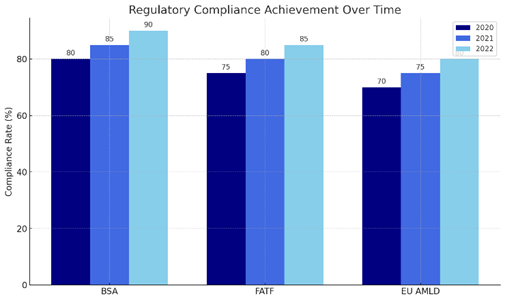
2. False Positives and False
Negatives: AML
software must strike a balance between detecting suspicious activities and
minimizing false positives and false negatives. False positives lead to
unnecessary investigations and customer inconvenience, while false negatives
allow money laundering activities to go undetected.
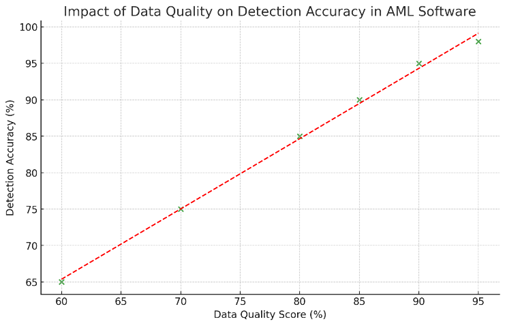
3. Data Quality and Availability: AML software relies on accurate
and complete data to detect suspicious activities effectively. Testing AML
software requires access to representative data that covers various money
laundering scenarios and edge cases.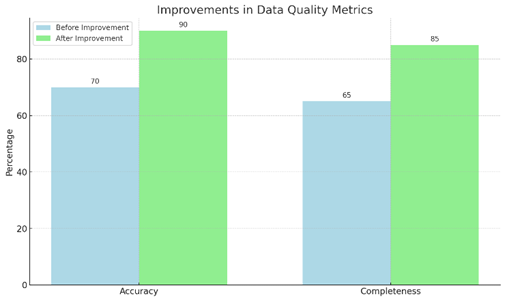
4. Evolving money laundering
techniques: Money
launderers continuously adapt their techniques to evade detection. AML software
must be regularly updated and tested to detect new money laundering patterns
and schemes.
5. Performance and Scalability: AML software must process large
volumes of financial transactions in real-time while maintaining acceptable
performance. Testing AML software's performance and scalability is crucial to
ensure its effectiveness in production environments.
3. Proposed Test
Strategy for AML Software
The proposed test strategy for AML
software combines risk-based testing, model-based testing, and data-driven
testing techniques to address the challenges of regulatory compliance and risk
mitigation.
3.1. Risk-Based Testing
Risk-based testing prioritizes
testing efforts based on the likelihood and impact of potential risks
associated with AML software. The steps involved in risk-based testing for AML
software are as follows:
1. Risk Identification: Identify the risks associated
with AML software, such as non-compliance with regulations, false positives,
false negatives, performance issues, and data quality problems.
2. Risk Assessment: Assess the likelihood and impact
of each identified risk. Consider factors such as regulatory requirements,
financial impact, reputational damage, and operational disruption.
3. Test Prioritization: Prioritize testing efforts based
on the risk assessment results. Focus on high-risk areas that have a
significant impact on AML compliance and risk mitigation.
4. Test Execution: Execute tests based on the
prioritized test cases, focusing on the identified high-risk areas.
5. Risk Monitoring: Continuously monitor and reassess
risks throughout the testing process. Update the risk assessment and test
prioritization as new risks emerge or existing risks change.
3.2. Model-Based Testing
Model-based testing involves
creating models of the AML software's behavior and generating test cases based
on these models. The steps involved in model-based testing for AML software are
as follows:
1. Model Creation: Create models that represent the
expected behavior of the AML software, including transaction monitoring,
customer risk assessment, and suspicious activity reporting.
2. Model Validation: Validate the created models
against AML regulatory requirements and industry best practices to ensure their
accuracy and completeness.
3. Test Case Generation: Generate test cases based on the
validated models, covering various AML scenarios, edge cases, and compliance
requirements.
4. Test Execution: Execute the generated test cases
on the AML software to verify its behavior against the models.
5. Model Maintenance: Regularly update and maintain the
models to reflect changes in AML regulations, software updates, and emerging
money laundering techniques.
3.3. Data-Driven Testing
Data-driven testing involves using
representative data sets to validate the AML software's detection capabilities
and performance. The steps involved in data-driven testing for AML software are
as follows:
1. Data Selection: Select representative data sets
that cover various money laundering scenarios, customer types, transaction
patterns, and geographies.
2. Data Preparation: Prepare the selected data sets by
cleansing, formatting, and anonymizing the data to ensure data quality and
privacy.
3. Test Data Generation: Generate synthetic test data
based on real-world money laundering patterns and scenarios to supplement the
selected data sets.
4. Test Execution: Execute tests using the prepared
data sets to validate the AML software's detection capabilities, accuracy, and
performance.
5. Data Maintenance: Regularly update and maintain the data sets to include new money laundering patterns, regulatory changes, and emerging risks.

4. Domain Expertise,
Collaborative Testing, and Continuous Testing
4.1. Domain Expertise Integration
Integrating domain expertise from
AML professionals, compliance officers, and subject matter experts is crucial
for effective AML software testing. Domain experts can provide insights into
money laundering techniques, regulatory requirements, and industry best
practices. Their involvement in the testing process helps ensure that the AML
software is tested against realistic scenarios and complies with regulatory
expectations.
4.2. Collaborative Testing
Collaborative testing involves
engaging stakeholders from different departments, such as compliance,
operations, and IT, in the testing process. Collaborative testing helps ensure
that the AML software meets the requirements and expectations of various
stakeholders. It also promotes knowledge sharing and facilitates the
identification of potential issues and risks early in the testing process.
4.3. Continuous Testing
Continuous testing involves
integrating testing activities throughout the AML software development
lifecycle . Continuous testing enables early detection of compliance issues,
performance problems, and software defects. It allows for rapid feedback and iterative
improvements to the AML software. Continuous testing practices, such as
automated testing, continuous integration, and continuous delivery, should be
adopted to enhance the efficiency and effectiveness of AML software testing.
5. Case Study-POC
To demonstrate the application of
the proposed test strategy, we present a case study of an AML software
implementation at a large financial institution. The case study highlights the
challenges faced during AML software testing and how the proposed test strategy
addressed those challenges.
5.1. Background
The financial institution
implemented a new AML software system to enhance its transaction monitoring and
suspicious activity reporting capabilities. The AML software had to comply with
multiple regulations, including the BSA, FATF recommendations, and regional AML
directives.
5.2. Challenges
The testing team faced several
challenges during the AML software testing process, including:
1. Ensuring compliance with
multiple AML regulations
2. Minimizing false positives and
false negatives
3. Accessing representative data
sets for testing
4. Validating the software's
performance and scalability
5. Adapting to changes in money
laundering techniques
5.3. Application of the proposed test strategy
The testing team applied the
proposed test strategy to address the challenges and improve the effectiveness
of AML software testing:
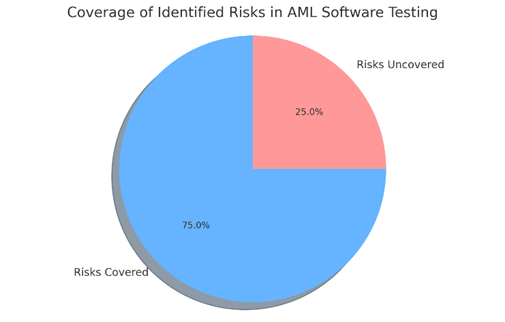
1. Risk-Based Testing: The team identified and assessed
the risks associated with the AML software, prioritizing testing efforts based
on the risk assessment results. High-risk areas, such as customer risk
assessment and suspicious activity reporting, were given priority in the
testing process.
2. Model-Based Testing: The team created models
representing the expected behavior of the AML software based on regulatory
requirements and industry best practices. Test cases were generated based on
these models, covering various AML scenarios and edge cases.
3. Data-Driven Testing: The team selected representative
data sets from historical transactions and generated synthetic test data based
on real-world money laundering patterns. The data sets were used to validate
the AML software's detection capabilities and performance.
4. Domain Expertise Integration: The testing team collaborated
with AML professionals, compliance officers, and subject matter experts to gain
insights into money laundering techniques and regulatory expectations. The
domain experts provided guidance on testing scenarios and helped validate the
software's compliance with regulations.
5. Collaborative Testing: The testing team engaged
stakeholders from compliance, operations, and IT departments in the testing
process. Collaborative testing helped ensure that the AML software met the
requirements and expectations of various stakeholders and facilitated early identification
of potential issues.
6. Continuous Testing: The team adopted continuous
testing practices, integrating testing activities throughout the AML software
development lifecycle. Automated testing, continuous integration, and
continuous delivery were implemented to enhance the efficiency and effectiveness
of AML software testing.
5.4. Results and Benefits
The application of the proposed
test strategy in the case study yielded the following results and benefits:
1. Improved Regulatory Compliance: The risk-based testing approach
and model-based testing techniques helped ensure that the AML software complied
with multiple AML regulations. The testing team identified and addressed
compliance gaps early in the testing process.
2. Reduced False Positives and False
Negatives: The
data-driven testing approach and collaboration with domain experts helped
minimize false positives and false negatives. The AML software's detection
capabilities were validated against representative data sets and real-world
money laundering patterns.

3. Enhanced Detection Capabilities: The combination of risk-based
testing, model-based testing, and data-driven testing techniques improved the
AML software's ability to detect suspicious activities accurately. The
software's detection capabilities were thoroughly validated against various AML
scenarios and edge cases.
4. Improved Performance and
Scalability: The
continuous testing practices and performance testing helped identify and
address performance bottlenecks and scalability issues early in the testing
process. The AML software's performance and scalability were optimized to
handle large volumes of transactions efficiently.
5. Increased Stakeholder Confidence: The collaborative testing
approach and involvement of domain experts increased stakeholder confidence in
the AML software's effectiveness and compliance. The testing process provided
transparency and assurance to stakeholders from compliance, operations, and IT
departments.
6. Discussions and
Recommendations
The proposed test strategy for AML
software, combining risk-based testing, model-based testing, and data-driven
testing techniques, addresses the challenges of regulatory compliance and risk
mitigation. The case study demonstrates the effectiveness of the test strategy
in improving AML software testing outcomes.
To successfully implement the
proposed test strategy, financial institutions should consider the following
recommendations:
1. Establish
a strong collaboration between testing teams, AML professionals, compliance
officers, and subject matter experts to ensure comprehensive testing coverage
and compliance with regulations.
2. Invest
in tools and technologies that support risk-based testing, model-based testing,
and data-driven testing approaches. Automated testing tools, test case
management systems, and data generation tools can enhance the efficiency and
effectiveness of AML software testing.
3. Develop
and maintain a comprehensive library of AML testing scenarios, models, and data
sets. Regularly update the library to include new money laundering patterns,
regulatory changes, and emerging risks.
4. Adopt
continuous testing practices and integrate testing activities throughout the
AML software development lifecycle. Implement automated testing, continuous
integration, and continuous delivery to enable early detection of issues and
facilitate rapid feedback and improvements.
5. Provide
training and education to testing teams on AML regulations, money laundering
techniques, and industry best practices. Encourage knowledge sharing and
collaboration between testing teams and AML domain experts.
6. Regularly
review and update the test strategy based on changes in AML regulations,
technology advancements, and evolving money laundering techniques. Continuously
assess and improve the effectiveness of the test strategy to ensure its
relevance and effectiveness.
7. Conclusion and Future Work
In this paper, we proposed an
effective test strategy for AML software that addresses the challenges of
regulatory compliance and risk mitigation. The test strategy combines
risk-based testing, model-based testing, and data-driven testing techniques to
validate AML software's detection capabilities, regulatory alignment, and
performance. The integration of domain expertise, collaborative testing
approaches, and continuous testing practices further enhances the effectiveness
of AML software testing.
The case study presented in this
paper demonstrates the application of the proposed test strategy in a
real-world AML software implementation. The results highlight the benefits of
the strategy in improving regulatory compliance, reducing false positives and
false negatives, enhancing detection capabilities, and increasing stakeholder
confidence.

Future research directions in AML
software testing include:
1. Exploring
the application of artificial intelligence and machine learning techniques to
enhance AML software testing, such as intelligent test case generation and
automated anomaly detection.
2. Investigating
the use of blockchain technology for secure and transparent testing of AML
software across multiple financial institutions and regulatory bodies.
3. Developing
standardized AML testing frameworks and benchmarks to facilitate consistent and
comprehensive testing of AML software across the industry.
4. Conducting
empirical studies to evaluate the effectiveness of different testing techniques
and strategies in detecting money laundering activities and ensuring regulatory
compliance.
As money laundering techniques
continue to evolve and AML regulations become more stringent, effective testing
of AML software remains crucial for financial institutions to combat financial
crimes and maintain regulatory compliance. The proposed test strategy provides
a foundation for organizations to develop robust and comprehensive AML software
testing practices that address the unique challenges of this domain.
8. References
- Simser J. Anti-Money
Laundering Regulations and the Fight against Financial Crime. Journal of Money
Laundering Control 2019;22: 210-224.
- Gao S, Xu D. Conceptual modeling and
development of an intelligent agent-assisted decision support system for
anti-money laundering. Expert Systems with Applications 2009;36: 1493-1504.
- Gully P, Agarwal M. The
Challenges of anti-money laundering in the financial services industry. Journal
of Money Laundering Control 2020;23: 48-64.
Author
Praveen Kumar is a seasoned Software Quality
Assurance Manager with an impressive 22-year career in the financial sector. He
holds a unique dual Master's degree in Mathematics and Computer Science,
providing him with a strong foundation in both theoretical and applied aspects
of software development and testing. He has extensive expertise in leading
agile teams and testing complex regulatory applications, particularly in AML
and CCAR, within the financial sector. Praveen has witnessed the evolution of
testing strategies from manual to automated and now AI-assisted testing. He is
a thought leader in the industry, actively sharing his knowledge at conferences
and workshops.