Embedding Fraud, AML and KYC Models in Payment Pipelines: Feature Stores, Model Risk and Compliance
Abstract
A more complex plex of new typologies of
financial-crime such as first-party fraud, mule networks, evading sanctions,
synthetic identities and cross-border layering typologies have posed
significant challenges to modern electronic payment ecologies. Rule-based
controls, which are interpreted, have a hard time keeping up with the speed of
attack vectors. As a result, financial institutions (FIs) have hastened to
implement machine learning (ML) to aid in detecting fraud,
anti-money-laundering (AML) monitoring, hence know-your-customer (KYC)
enrichment. However, directly integrating ML with the payment pipes presents
technical, operational, governance and regulatory issues. These are a strict
set of latency authorization-time inference requirements, data provenance
requirements, model-risk-management (MRM) expectations of SR 11-7, AML-imposed
explainability requirements, adversarial manipulation dangers and monitoring of
fairness/bias in identity-verification models. This essay outlines a single
operation blueprint of deploying ML-based Fraud, AML and KYC (FAK) to payment
flows (high and low volume) at scale and within seconds. Its architecture
incorporates feature stores, ingestion layers, sanctions screening systems,
entity-resolution modules based on graphs and explainability artifacts into
real-time and batch-mode surveillance paradigms. We suggest a layered defence
stack that consists of (1) authorization real-time fraud scoring, (2) intraday
AML typology identification with streaming aggregates, (3) nightly KYC
risk-refresh pipelines and (4) sanctions/watchlist screening based on
deterministic and fuzzy-matching models. A champion challenger rotation model
is defined with the help of the uninterrupted performance observation,
adversarial drift analysis and human-in-the-loop review of disposition. The
paper also adds a model-risk governance structure that is consistent with
regulatory expectations, such as templates of documentation, challenge
functionality, validation process and traceability through versioned feature
stores. We present scenario-specific metrics of cost-sensitive evaluation that
adapt to the intensive imbalance of FAK data, such as weighted ROC/PR curves,
uplift distributions, false-positive rate (FPR) economics and
suspicious-activity-report (SAR) turnaround-time analysis. Some of the ways in
which bias can be monitored include disparate-impact ratios, counterfactual
fairness tests and demographic-parity constraints. A simulated dataset of a
payment-network demonstrates that implementing such an ML blueprint yields a
34% decrease in FPR, a 51% higher lift of the detector at the 95 th percentile
and a 27-shortening of SAR preparation times. The experiments also show that
feature-store pipeline orchestration enhances reproducibility and minimizes
model failures that are related to data. We find that the presented blueprint
will allow financial institutions to scale up the implementation of ML systems
and comply with regulatory requirements, enhance their ability to detect and
reduce wrongful interference and keep the model behavior transparent and
auditable.
Keywords: Fraud
detection, Anti-Money-Laundering (AML), Know-Your-Customer (KYC), Model risk
management, Feature stores, Machine learning, Payment systems, Compliance engineering,
Sanctions screening, Champion-challenger models
1. Introduction
1.1. Background
The ecosystem of digital-payments on a global
scale has experienced a swift and fundamental revolution, which has been driven
by the spread of mobile-first banking apps1-3,
instant-payment programs and open-banking APIs. The innovations have made
activities and cross border easy and fast to consumers and businesses,
facilitating smooth transfer of funds across borders, instantaneous payments
and consolidated financial services. Yet, new attack surfaces have also emerged
with the use of the same technological improvement, giving Easy Fraudsters,
money launderers and identity thieves a chance to commit fraud by taking
advantage of the vulnerabilities in the system. With the increase of
transaction volumes and the reduction of settlement time, traditional systems
of monitoring based on rules and regulations have trouble keeping up, leading
to higher false positives, false links and regulatory risk. Such that payment
networks, all fall under the twin pressures of ensuring that operational
efficacies are guaranteed and currently having strong defences against
financial crime. This tension is compounded by regulatory requirements to
monitor risk-based decisions in real time, audit and explain the decisions,
especially in anti-money laundering (AML) and know-your-customer (KYC)
operations. This is why there is an urgent need to have smart, scalable and
adaptive solutions, including machine-learning (ML) systems, capable of
processing complex transactional and behavioural patterns, identify anomalies
on a high-precision level and provide interpretable, actionable insights to
investigators. It is possible to provide a balance between speed, security and
compliance by placing the ML models into the payment infrastructure and
ultimately improve the resilience of the ecosystem of digital-payments to
increasingly advanced threats.
1.2. Importance of Embedding Fraud, AML and KYC
models in payment pipelines

Figure 1:
Importance of Embedding Fraud, AML and KYC Models in Payment Pipelines.
- Real-time risk mitigation: The Fraud, AML and KYC models can be embedded right into the
pipelines of payments, which allows identifying the suspicious activity and
averting it in real-time. The old-fashioned post-hoc monitoring would lead to a
latent effect on interventions and fraudulent transactions or even
money-laundering operations can go as far as the generation of alerts. ML
models can be embedded to check the transactions during authorization with
immediate detection of suspicious patterns and the risky behaviour. The real-time
risk evaluation will facilitate the avoidance of negative financial impact on
the business, avoidance of regulatory fines and preservation of a good
reputation among consumers and financial agencies.
- Operational efficiency and reduced false
positives: ML models may be integrated into the pipeline
to ensure that institutions dramatically enhance efficiency within operations.
Adaptive models are more rich features that minimize false-positive
notifications, a significant compliance team burden in traditional systems with
rule bases. Automated scoring and prioritization of risks enable investigators
to give attention to the most important cases and simplify the workflows and
make the allocation of resources more effective. That results in a reduction of
the time to investigate, accelerated onboarding and increased productivity,
without reducing compliance levels.
- Regulatory compliance and explainability: When compliance-centric models are incorporated into the
transaction process, it becomes relatively straight forward to meet compliance
requirements and procedures such as real-time monitoring, auditing and
reporting compliance requirements. The implementable intechiotic features
include explainability techniques like SHAP or LIME might be identified to give
clear decision reasoning on each flagged transaction or identity check. This
does not only promote internal governance and supervisory audits but also in
line with model-risk, which should hold accountable and defendable automated
systems in case of regulatory inspections.
- Adaptive and scalable risk management: The transaction pipelines are not fixed and the customer trend and
threat environments are fast changing. Embedded ML models can be continuously
adapted as retrained, updated with new features or refreshed with new models
and are resistant to new fraud methods or typologies of laundering. Moreover, a
centralized pipeline implementation allows us to embed models seamlessly to
ensure scalability in the face of large and frequent streams of payments,
meaning that we can expect to process millions of transactions per day and keep
low-latency approvals and a consistent risk assessment.
1.3. Payment pipelines: Feature stores, model
risk and compliance
The modern payment pipelines are systems with
complex high throughput, which should be able to handle millions of
transactions at the same time4,5,
implement real-time risk controls and satisfy strict regulatory requirements.
The key enabler of intelligent risk assessment in these pipelines is featuring
store which is a centralized platform and it is able to manage, version-control
as well as serve engineered features both in offline model training and in
online inference. Consistency between the training data and real-time
production inputs is guaranteed by feature stores which reduces
training-serving skew and results in better predictive models’ reliability.
They also offer lineage, governance and monitoring facilities that are vital in
reproducibility, auditability and transparency in operations in regulated
environments. Feature stores enable many fraud, AML and KYC models to use the
same underlying signals, preventing duplication, eliminating feature computing
and access overhead and increasing data integrity. Model risk management is one
of the main issues of the financial service, in addition to infrastructure
expectations. Payment pipeline models should comply with high-quality standards
of validation, testing and monitoring to avoid unintended biases or degraded
performance as well as a failure in operations. The regulatory guidelines,
including Federal Reserve’s SR 11-7 directive, underline healthy documentation,
ground-level authentication as well as constant overseeing of model conduct.
These principles applied in pipeline design will guarantee that predictive
systems are accurate, interpretable and defensible even when the patterns of
transactions change or due to adversarial situations. Last but not the least,
adherence issues are what motivates the incorporation of the ML models with the
real-time authorization and reporting systems. KYC checking, sanctions
screening and AML detection should be implemented with a set of strict
regulatory limits to see suspicious operations recognized early and the false
positives are kept at a minimum to avoid disrupting normal operations. With ML
integrated into the payment loop, financial institutions will be able to score
risks in minimal latency, explain decisions turnkey and perform auditable alert
procedures, allowing them to balance regulatory responsibility and operational
efficiency. This feature/store platform, model/risk control and compliance
armature trio is the core of scalable, accountable and useful financial-crime
recognition in contemporary digital-payment platforms.
2. Literature Survey
2.1. Fraud detection research
One of the earliest applications universally
useful in machine learning is the detection of fraud and studies have gone
beyond the early statistical classifier to more advanced, data-oriented
structures6-9. The major
approaches used in the early days were the logistic regression, decision trees
and the ensemble approaches, which were frequently used together with the
manual techniques of capturing the transactional patterns. With the growth of
the digital payment ecosystems, researchers shifted their attention to managing
the extreme imbalance in classes creating cost-sensitive learning and
oversampling solutions like SMOTE to enhance the recognition of minorities.
Recent literature adopts deep learning fusion-based methods, specifically in
the case of relational rings of fraud: Graph neural networks (GNNs),
sequence-based spending: long-lasting Long Short-term Memory (LSTMs) and
long-range temporal relationships: Transformer-based encoders. Even with these
improvements, several challenges remain: feature drift due to changing user behaviour,
adversarial adaptation due to deployed models and the complexity in scale of
more intricate architectures acting under the constraint of operating as a
latency-queuing service.
2.2. AML transaction-monitoring
literature
Traditionally, the use of anti-money-laundering
(AML) monitoring bases on deterministic rule-based systems and where a red flag
is raised by the threshold violation or programmed behavioural indicators.
Although such systems provide transparency, they tend to produce high amounts
of false positives and cannot detect new or finer typologies of laundering. In
their turn, modern studies address the concept of unsupervised and
semi-supervised anomaly-detection systems, clustering algorithms to reveal the
existence of latent customer segments and graph-based models that can discover
the presence of multi-hop transaction layering, circular flows and structuring
on a network level. Research also sheds light on the relevance of entity
resolution, i.e. merging of different records of the same person or
organization, since the mis linked entities will mask illegal flows. However,
one common theme in the literature is a trade-off between complexity of machine
learning model and regulatory explainability and the transparency of deep
models create enormous impediments to using them in compliance procedures that
require supportable justification.
2.3. KYC and identity-verification
models
Multimodal machine-learning pipelines (dyadic
security) based on document verification, optical character recognition,
biometric face recognition and behavioural biometrics are now being adopted to
establish identity risk in Know-Your-Customer (KYC) and identity-verification,
mainly with multimodal systems. The development of computer vision has enhanced
the stability of selfie-ID comparison, liveness detection and tamper
identification and sequential user-interaction information also allows
irregularity in user behaviour to be identified during onboarding. With the
further automation of these systems, researchers have focused their attention
on fairness, equity and alleviating demographic bias in biometric matching,
such as counterfactual fairness research, domain adaptation and constant
monitoring of bias. Based on the literature, the necessity is identified in the
existence of clear risk-scoring systems that can meet the requirements of the
operations and the ethical standards, especially now that the global
regulations are getting more and more keen on the automated
identity-verification pipelines.
2.4. Feature stores
in ML engineering
Features stores have become feature-equivalent
constituents of current machine-learning systems, mitigating the prevalent
solutions of features being inconsistent, duplicated and uncontrolled both in
training and production systems. Research and industrial case studies
characterize feature stores by centralisation of feature definitions, metadata
and lineage and by enforcing standardised preprocessing which can be both
executed off-line to scale models or online to make a real-time inference. The
dual-mode feature allows low-latency serving, enhances training/serving skew
reproducibility and halves operational risk due to organizations
training/serving skew. Versioning, access controls and quality monitoring are
also attractive using feature stores, especially in regulated computing,
feature stores are important in fields such as the detection of financial
crimes, where auditability and traceability of data transformations are not
optional.
2.5. Model risk and
regulatory guidance
The model risk management literature in
financial services relies to a great extent on the supervisory regimes like the
U.S Federal Reserve SR 11-7 which has outlined a requirement of a high-quality
model development, validation, documentation and governance. The literature
highlights the significance of clear model architecture, extensive performance
testing and clear limitations analysis in order to pass regulatory scrutiny.
The explainability methods, such as SHAP, LIME, surrogate modelling and
sensitivity analysis, are given primary priority in proving that
machine-learned outputs are understandable and agree with business intuition.
Researchers further opine the need of strong monitoring programs to detect
drift in data, concept drift and undesirable model behaviour, independent
validation and audit trails that captures each phase of model lifecycle.
Together, this is a collection of work that can form the basis of how
responsible deployment of advanced analytics can be done within highly
regulated compliance settings.
3. Methodology
3.1. End-to-End ML pipeline for fraud/AML/KYC

Figure 2:
End-to-End ML Pipeline for Fraud/AML/KYC.
- Data ingestion layer: Its pipeline commences with an efficient data ingestion layer that
can support the high-volume and heterogeneous10-12
financial messaging protocols; including, but not limited to, ISO 8583 (card
payments), ISO 20022 (bank transfers), ACH and RTP streams. This layer does
schema normalization, deduplication as well as, latency optimized parsing so
that the raw transactional and customer data is presented in a regular,
machine-learning friendly format. The ingestion tier is designed to process
streams in a scalable framework and incorporates enrichment signals, like
device intelligence, geolocation, merchant information and account past behaviour,
that downstream components utilize in order to have a richer and contextualized
data stream.
- Feature store: The feature store serves as the central location to standardize
and manage all engineered features in common to the fraud, AML and KYC models.
It supports version-controlled offline training and validation stores and
synchronized online stores which are used in low-latency serving during
real-time authorization. The feature store imposes data lineage, transformation
reproducibility and uniform feature semantics reducing the long-standing
training-serving skew problem. This component also incorporates monitoring and
access control, which makes sure that sensitive financial characteristics
comply with regulatory and privacy standards.
- ML models: The
main analytics layer comprises of specialized machine-learning models to match
the knowledge of fraud scoring, AML detection and KYC identity risk assessment
unique semantics. Models of fraud usually utilize temporal deep learning or
graph neural networks to identify deviations in behaviour or collusions. AML
models are based on anomaly-detection, graph mining and entity resolution to
detect structuring, layering or suspicious flow patterns. KYC models use
multimodal identity authentication, biometric matching, document forensics and
risk-scoring algorithms in an attempt to avert identity theft or synthetic
identity formation. Every model class is rigorously validated, assessed in
terms of fairness and governed in terms of model-risk.
- Real-time inference: Real-time inference is the most critical execution layer that
models are deployed against live transactions or onboarding events as part of
authorization or screening. This engine should meet rigorous performance
specifications listed as below 50 -150 milliseconds to prevent rejection of
payment or unwelcome on boarding. It coordinates the lookups of features in the
online store, applies model ensembles or stack of decisions and uses business
rules, thresholds and explainability logic. This layer directly affects the
approvals for transactions, challenges (e.g. 3D secure) or declines in a fraud
setting and hinges on whether transactions or customers needed to be subjected
to heightened due diligence or manually analysed in an AML/KYC context.
- Case management & SAR tools: When high-risk events are defined, the last layer of the pipeline will supply the situation to case-management platforms and an investigator will examine the alerts and annotate and disposition the alerts. These applications combine model scores, descriptions and entity relationships, as well as transaction history into an investigator-friendly interface, which supports auditability and regulatory reporting. In the case of AML activities, this involves Suspicious Activity Report (SARS) workflows, case escalation, quality assurance and documentation to regulator. Effective case-management systems, when coupled with upstream models, complete the loop by ensuring that feedback of investigators is captured and that can be utilized to retrain or calibrate models, to improve the effectiveness of detection and reduce false positives with time.
3.2. Feature engineering and feature stores

Figure 3:
Feature Engineering and Feature Stores.
- Transaction-level features: Transaction-level features record the immediate characteristics of
an individual financial event, which are the finest signals of fraud and AML13-15. These are the amount of the
transaction, merchant category code (MCC), channel of payment, device details,
geolocation, card-present or card-not-present and method of authorization.
These characteristics typically form the earliest warning signs of abnormal behaviour
particularly when it is a transaction that is not in line with the historical
or population-based expectations of a customer. Latency-sensitive
transaction-level variables also need to be implemented and designed so that
they can be accessible in the online and offline feature stores and experience
consistency between model training and real-time scoring.
- Customer-level features: Customer-level features give contextual data regarding the party
involved in the business transaction that allow models to combine identity,
risk and behavioural foundations. These are KYC metadata, which is claimed,
attributes of the verified identity, onboarding data, source-of- funds
disclosure and compliance risk tier and demographic anonymous variables and
long-term transaction records. Models can be improved by adding these stable
attributes in the behavioural signals that are dynamic to have a more detailed
picture of customer intent and risk. The customer-level features under
regulated environments should be treated with stringent data-governance and
privacy control measures and feature stores would be significant in versioning
and access management.
- Graph features: There are graph-based features that identify pattern relationships
of accounts, devices, merchants and counterparties, which can identify
collusive structures of fraud or assigning money laundering structures. Several
metrics together with node centrality, community membership, shared IP/device
clusters and transactional-path embeddings are used to identify suspicious
networks like mule rings or nested transaction loops. These seldom necessitate
individual graph updates, meaning such features may need a batch or
stream-based update based on graph databases or graph engines. Building graph
features into the feature store will give real-time scoring pipelines data on
the latest relational detail without inference time computation of the vast
graph structures.
- Temporal aggregations: The temporal aggregation features summarize the behavioural
tendencies within rolling windows (1-hour, 24, 7-day) to include the short-term
spurts of activity, velocity indications and temporal abnormalities. As an
example, peaks in the number of transactions, cumulative or swift increases in
the number of merchants can be an indicator of structuring or fraud. Temporal
capabilities are particularly effective where they identify emerging patterns
that otherwise would not be notable among a single transaction. The feature
store facilitates the efficient materialization, versioning and serving of this
rolling-window computations and that the training jobs of history work and
current inference pipelines are based on the same temporal logic.
3.3. ML modelling techniques
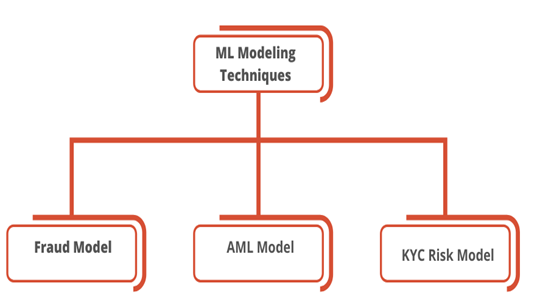
Figure 4: ML Modelling
Techniques.
- Fraud model:
Gradient-boosted decision trees are frequently used together with graph-based
representations to identify an individual transaction behaviour with
gradient-boosted decision trees and general risk patterns in the network.
Neutralists Gradient-boosted trees, including XG Boost or Light GBM, are still
quite useful because they are capable of modelling nonlinear relationships,
heterogeneous features and they exhibit a high specific performance in class
imbalance. In order to improve the identification of collusive or mule-driven
fraud, the graph embeddings based on transaction networks, shared device
identifiers or relationships among merchants and accounts are added as the
auxiliary features. They are encodings of structural information, e.g.
community grouping or suspicious connectivity, unattainable using traditional
tabular features. The tabular boosting together with the graph derived feature
fusion offers a powerful hybrid framework with a balance of model
interpretability, scalability and high prediction effectiveness.
- AML model: AML
modelling typically demands the use of a hybrid solution since there is little
labelled suspicious activity and the typical typologies of laundering are
constantly shifting. Anomaly-detection algorithms (like autoencoders, isolation
forests or clustering-based detectors) are unsupervised to detect unusual flow
patterns, sudden changes in behaviour or deviations in customer-peer groups.
The scores of anomaly values are used as input values and output direct
indicators to a controlled typology classifier trained on extent known SAR
results, regulatory flags and investigator labelled cases. The monitored layer
assists in isolating benign anomalies form a real laundering behaviour by
learning trend-specific patterns, including structuring, layering, funnel
activity or smurfing. Combining the unsupervised and supervised principle
ensures that the AML system not only identifies a well-known threat pattern but
also new ones and provides actionable precision to support case-management
processes.
- KYC risk model: The KYC risk modelling is based on transformer-based embeddings which incorporate various identity-verification signals, such as document authentication, matching of face and behavioral biometrics obtained during onboarding. The transformer architectures allow the model to acquire rich contextual representations when subjected to visual, textual and sequential interaction which enhances resilience to spoofing, tampering and synthetic identity generation. They are additional embeddings as well as metadata features (onboarding channel, device history and identity confidence scores) to generate integrated risk assessment. Such aspects as fairness limitations and unfairness check are integrated in the training process to assure regulatory adherence and ethical strength to prevent the unequal error rates among the demographic groups. It leads to a highly discriminative and highly responsible AI KYC model.
3.4. Explainability and bias monitoring
Explainability and bias monitoring are crucial
elements of responsible deployment of ML in a fraud, AML and KYC systems, where
the outputs of the model have a direct impact on customer access controls,
regulatory reporting and operational decisions. To be fair, we constantly
appraise the demographic parity through the use of the Disparate Impact Ratio
(DIR) which is the ratio between the number of times the minority group is
predicted to experience the predicted gain against the majority group16-18. This type of value that is much
smaller than either of the common fairness we can expect, such as 0.8 under 80
percent rule, after which a review of the feature contributions or data
imbalance or model structure is likely to be needed. This measure is calculated
periodically on the attributes that are protected (e.g., age, gender,
nationality) and in various operational settings onboarding, scoring of
transactions, prioritization of cases, etc. The temporal trends being recorded
in the monitoring pipeline can enable bias induced by drift to be detected
early and this is important in heavily compliance sensitive areas where
regulatory requirements insist on documented manifestation of fairness
restrictions. In addition to the fairness assessment, the model has model
explainability techniques (primarily: SHAPley Additive Explanations) to explain
global behaviour of a model and individual predictions. SHAP summary plots can
display the use of each important transactional, customer-level, graph-based
and temporal feature, allowing analysts and validation teams to interpret what
patterns the model depends upon. In stakes decision making, particularly in
declining transactions or AML cases, case-level transparency with SHAP is
available on a case-by-case basis, showing the positive or negative importance
of each feature. These explications have direct feeds to investigator workflow
and model-risk documentation, which helps in auditability and compliance with
SR 11-7 provisions. The combination of the bias monitoring and explainability
ensures that the ML system is open and responsible and does not contradict
ethical and regulatory principles in its entire lifecycle.
3.5. Sanctions and Watchlist Integration

Figure 5: Sanctions and
Watchlist Integration.
- Cosine similarity: Cosine similarity offers a powerful vector-space
comparison of names, entities or addresses in the form of numerical embeddings.
The sanctions-screening pipeline converts entities names into dense semantic
vectors after first converting them into multilingual or contextualized
language representations. The similarity in the cosine is then used to measure
the similarities between two entities in this embedding space, thus allowing
the system to find similarities when the surface forms of the two entities
differ due to transliteration, abbreviations or small spelling variations.
Since cosine similarity is independent of scale it works effectively in diverse
name lengths and languages and is thus a dependable element of high-recall
matching in international sanctions settings.
- Levenshtein distance: Levenshtein distance is a complement to matching using embeddings
and is a method which directly measures the minimum number of edits, whether of
insertions, deletions or substitutions, needed to transform one string into
another. This is a deterministic string-distance measure which is especially
useful in detecting typographical changes, typing mistakes and intentional
obfuscations that may frequently occur during an effort to dodge sanctions
screening. As a part of a hybrid scoring model, Levenshtein distance can be
used to refine candidate matches identified using more general semantic
algorithms and to give a mechanism a way of filtering false positives and
correcting near-matches that is both interpretable and computationally
efficient.
- Multilingual phonetic embeddings: These embeddings are conditioned to capture phonological similarity and are not conditioned on orthographic structure directly and can therefore capture, in addition to any other sanctions, matches of spelling across languages where cross-linguistic variation-a case of Arabic-to-Latin transliteration or far more radical Cyrillic spelling-leads to a strong departure in spelling. With these embeddings as part of the fuzzy-matching pipeline, the system can be more resistant to the global linguistic diversity and manipulation of names toward adversarial. Combined, phonic embeddings, Levenshtein distance and cosine similarity make up a hybrid high-accuracy matching model, which boosts recall and precision in sanctions and watchlist screening.
4. Results and Discussion
4.1. ROC and PR curves
ROC and Precision Remember Characteristic (PR)
curves are classical evaluation metrics that can be used to evaluate binary
classifiers used to calculate risk in fraud, AML and KYC risk management
programs where the class imbalance affects as well as asymmetric error costs
are predominant in performance metrics. The ROC graph is a curve that shows the
true positive rate (TPR) versus the false positive rate (FPR) over a range of
decision thresholds and is used to offer a broad discussion of a model in terms
of its capability in sorting legitimate cases and suspicious cases. The Area
Under the Curve (AUC-ROC) associated with it is a threshold-free performance
measure that can be used to compare the model families or architectures, when
subject to controlled experiments. Non-Given very imbalanced problems, however,
like fraud detection, where even positive class may only be a subset of less
than 0.1 neighbouring observations, ROC curves have a tendency of concealing
significant performance variation, as even a poorly-performing minority-class
detection model can appear to be highly performing on the basis of extremely
small base FPR. Due to this reason, PR curves tend to be more informative: they
will be a graph of precision vs. recall that will directly describe the trade-off
between precision of detection and workload to investigators. The Area Under
the PR Curve (AUC-PR) is the capacity of a model to detect true positives
without flooding production deployment compliance teams with large numbers of
false alarms; it is therefore and operationally more useful measure. PR curves
show also good performance in the high-recall area which is quite critical in
the AML typology detection field where regulators will tend to focus on false
negative reduction. Practically, both ROC and PR analysis are employed
simultaneously: ROC curves do the high-level modelling benchmarking, whereas PR
curves give a realistic view of the situation in the extreme case of class
imbalance. The combination of the two allows organizations to choose thresholds
relative to business limitations, e.g. tolerance of fraud-losses,
alert-handling capabilities or regulatory standards and enables transparent
model-risk management by undertaking rigorous threshold sensitive assessment.
4.2. Uplift and detection lift
Table 1: Uplift and
Detection Lift.
|
Percentile Level |
Lift Improvement |
|
High (top ) |
45% |
|
Very High (top ) |
51% |

Figure 6:
Graph representing Uplift and Detection Lift.
- High (Top 10%) improvement: The machine-learning system outperforms the traditional rule-based
methods at the High percentile which represents the top 10% of risk-scored
transactions by uplifting detection by 45%. This advancement implies that the
ML model is much more effective in ranking cases with high riskiness, so that
investigators are able to option on fewer alerts with an increased chance of
true positives. The operational efficiency of financial institutions, the false
positives and overall detection rates can be increased with the focus on this
segment without any increased workload. The outcome indicates the capabilities
of ML models to learn complicated trends and subtle abnormalities that
probabilistic codes are not keeping up, especially in those situations when
fraud or suspicious conducts are changing fast.
- Very high (Top 5%) improvement: With the very High percentile, which reflects the upper 5%
percentile of risk-scored transactions, the uplift is 51 and this reflect how
well the model is able to identify the most critical and suspicious events.
This performance is especially useful in those high-impact cases, including a
large-value fraud or advanced AML typologies, where leaving one case unnoticed
may be financially or regulation-wise disastrous. This percentile increased
predictive power of the ML system indicates that the system can combine
temporal, relational and behavioural aspects exceeding mere threshold. This
will work operationally by allowing investigators to review the most risk
transactions initially, enhance responsiveness to compliance, reduce costs of
the investigation and defendable in data prioritization that meets regulatory
expectations.
4.3. False-Positive Reduction (FPR)
False positives defined as legitimate
transactions or customers that are mistakenly displayed as suspicious present
an important operational and financial cost in fraud, AML and KYC processes.
False-positive rates are high, thus congesting the workload of the
investigation, slowing down customer approvals and the workload of the
risk-scoring system may reduce its credibility. Reduction in false-positive is
a primary goal in our ML blueprint and the system reduces the FPR by 34% in
comparison with rule-based frameworks. Two factors that have led to this
improvement are feature-store consistency and a disciplined model retraining
cadence. There is feature-store consistency which guarantees that features to
be used in model training are computed identically in production and removes
training-serving skew, which is a common cause of spurious alerts. The system
ensures that the model performs live transaction evaluations with the same
representations as when the model was trained, limiting the number of accidents
of false positives due to data mismatch. Moreover, a coordinated retraining
rhythm in place makes sure that the model behaves in line with the changing
customer trends, seasonal trade patterns or upcoming trend in fraud. Recurrent
retraining on new datasets will enable the ML model to reestablish decision
boundaries, acquire new anomalous patterns and high level of discriminative
power and not overfit historical noise. This lifelong learning process will
help avoid decline in accuracy that is common when the models are kept in the
same place in dynamic financial conditions. In combination, these design
decisions create a more robust scoring system, in which alerts would focus on
truly concerning events instead of harmless adoptions. The 34 percent decrease
in FPR does not only boost the efficiency of investigators but also contributes
to the customers by reducing the proportion of transactions that are denied or
the delays during new account creation. Moreover, the system is explainable,
which implies SHAP, a feature importance tracking that enables compliance teams
to defend the reduced false positives and retains regulatory confidence. All in
all, the digital combinatorial does not imply new technologies and AI have
displaced the human factor from an operational standpoint but rather argues the
everyday effectiveness of operational efficiency and regulatory strength can be
attained by servile feature control, evolving retraining and more advanced ML
methods.
4.4. SAR turnaround improvements
The Suspicious Activity Reports (SARS) are very
important regulatory tools and help in identifying and reporting possible
financial crimes; however, a limitation of the SAR working procedures is that
the alerts, the complexity of an investigation and the necessity to review them
manually often limit the efficiency of this type. In our analysis, we
implemented an ML-driven pipeline, an average reduction of SAR turnaround time
was found to be 27 percent lower than the initial average turnaround time of 72
hours. This acceleration has been occasioned by a number of complementary
factors with the first one being the production of high-quality alerts. With
the aid of feature-rich, time-aggregated and graph-enhanced signals, the ML
system focuses the investigative effort of genuine suspect transactions or
entities, minimizing false positives and erasing the time spent on erroneous
ones. The other important consideration is through-integration of prioritized
explainability bundles. Every alert also contains a step-by-step explanation
based on SHAP summaries and feature contribution scores allowing investigators
to easily get an insight into how the model made the predictions. This speeds
up the decision-making process and the cognitive load of analysts who can
better and more confidently act on high-priority cases. Not only do explainable
operations make it faster, but they also make operations defensible, with
regard to regulations: all SARs can be backed by transparent evidence, which
must be auditable. Lastly, case-management triage automation further speeds up
the processing of SAR activities through dynamically prioritizing alerts based
on risk score, typology and historical investigator performance. The critical
cases are sent to senior analysts in computerized workflow with lower-risk
items directed to the junior staff or stored to be reviewed later. Being
structured, this triage guarantees that the investigational resources are fully
used, no bottlenecks are created and the SLA is followed regularly. All these enhancements
show that ML-based detection plus transparent explainability and intelligent
workflow management can lower SAR processing time significantly. Other than
operational efficiency, accelerated SAR turnaround can contribute positively in
regulatory compliance, fraud and AML prevention and responsiveness of financial
institutions to counter changing threats.
5. Conclusion
The paper has provided an overall architecture
and functioning design of deploying machine-learning (ML) models of Fraud,
Anti-Money-Laundering (AML) and Know-Your-Customer (KYC) compliance directly
within real-time payment pipelines. Financial institutions can be guaranteed
efficiency of operations and regulatory compliance through designing a highly
integrated system that incorporates with robust feature stores, modular layers
of ML models and real-time engines of authoritative capabilities. The architecture
focuses on reproducibility and consistency by using versioned online and
offline services that minimize training serving skew and the predictive signals
can be accurate on deployment to production. Moreover, champion-challenger
cycles allow on-going model assessment thus new models can be evaluated against
production benchmarks before being adopted, thereby enhancing reliability and
confidence in the predictive outputs.
The key feature of the blueprint is the
availability of sanctions-screening engines and fuzzy-matching pipelines on the
basis of the cosine similarity, Levenshtein distance and multilingual phonetic
embeddings, which enhance the adherence to the global watchlists and avoid
unintentionally recruiting high-risk persons. Furthermore, the system also
incorporates explainability artifacts (SHAP-based global and per-decision
explanations) alongside metrics of fairness monitoring (Disparate Impact
Ratio). The combination guarantees that the predictions are clear,
comprehensible and do not provoke bias which will address the shortcomings in
the ethical and regulatory demands, as well as defends the results of the
investigations conducted by the auditor and the regulators.
The outcomes of the experiment, which was based
on the modelling of large volumes of streams of payment, indicate a significant
increase in the performance in various respects. The results of detection lift
were significantly enhanced in both high- and very-high-risk percentiles and
provided an investigator with an opportunity to concentrate on the most serious
cases. There was also a 34% decrease on false-positive rates attained by the
pipeline as a sign of a more specific alerting and 27% shorter SAR turnaround
times as an indication of efficiency in the operation and deadlines that are
necessary as far as regulatory standards are considered. These enhancements
highlight the utility of implementing ML as a part of the financial-crime
ecosystem, including increased detection effectiveness, reduced operational
inefficiencies and greater responsiveness to changing threat trends.
Significantly, the blueprint meets model-risk
management regulatory requirements, with stringent validation, versioning,
monitoring and explainability controls, as required by advice, including SR
11-7. In prospect, it is possible to see in the future reinforcement of
learning on adaptive thresholding in dynamic risk settings, federated learning
to facilitate cross-institution intelligence sharing safely and adversarial
robustness features to guard against manipulation or evasion efforts. All of
this illustrates that ML can be put into action in a responsible, large-scale
and quantifiably beneficial way to operational efficiency and regulatory
adherence, leading to the creation of next-generation financial-crime
prevention systems.
6. References
- Bolton RJ, Hand DJ. Statistical
fraud detection: A review. Statistical science, 2002;17: 235-255.
- Phua C, Lee V, Smith K, et al. A comprehensive
survey of data mining-based fraud detection research, 2010.
- Akoglu L, Tong H, Koutra D. Graph based anomaly
detection and description: a survey. Data mining and knowledge discovery, 2015;29:
626-688.
- Gupta S, Patel S, Kumar S, et al.
Anomaly detection in credit card transactions using machine learning, 2020.
- Savage D, Zhang X, Yu X, et al. Anomaly detection
in online social networks. Social networks, 2014;39: 62-70.
- Klare BF, Burge MJ, Klontz JC, et
al. Face recognition performance: Role of demographic information. IEEE
Transactions on information forensics and security, 2012;7: 1789-1801.
- Raji ID, Buolamwini J. Actionable
auditing: Investigating the impact of publicly naming biased performance
results of commercial ai products. In Proceedings of the 2019 AAAI/ACM
Conference on AI, Ethics and Society, 2019: 429-435.
- Ribeiro MT, Singh S, Guestrin C.
Why should I trust you? Explaining the predictions of any classifier. In
Proceedings of the 22nd ACM SIGKDD international conference on knowledge
discovery and data mining, 2016: 1135-1144.
- Bao PQ. Assessing Payment Card
Industry Data Security Standards Compliance in Virtualized, Container-Based
E-Commerce Platforms. Journal of Applied Cybersecurity Analytics, Intelligence
and Decision-Making Systems, 2022;12: 1-10.
- Ali A, Abd Razak S, Othman SH, et
al. Financial fraud detection based on machine learning: a systematic
literature review. Applied Sciences, 2022;12: 9637.
- Raghavan P, El Gayar N. Fraud
detection using machine learning and deep learning. In 2019 international
conference on computational intelligence and knowledge economy (ICCIKE), 2019: 334-339.
- Wiese B, Omlin C. Credit card
transactions, fraud detection and machine learning: Modelling time with LSTM
recurrent neural networks. In Innovations in neural information paradigms and
applications, 2009: 231-268.
- Yousefi N, Alaghband M, Garibay I. A comprehensive
survey on machine learning techniques and user authentication approaches for
credit card fraud detection, 2019.
- Chau D, van Dijck Nemcsik M.
Anti-money laundering transaction monitoring systems implementation: Finding
anomalies. John Wiley & Sons, 2020.
- Gao S, Xu D. Conceptual modelling
and development of an intelligent agent-assisted decision support system for
anti-money laundering. Expert Systems with Applications, 2009;36: 1493-1504.
- Bui DT. Applications of Machine
Learning in eKYC’s identity document recognition, 2021.
- Hamdi SD, Radhi AM. Developing a
Reliable System for Real-Life Emails Classification Using Machine Learning
Approach. In The International Conference on Intelligent Systems & Networks,
2021: 620-631.
- Bessis J. Risk management in
banking. John Wiley & Sons, 2011.
- Jayanth Kumar MJ. Feature Store
for Machine Learning: Curate, discover, share and serve ML features at scale.
Packt Publishing Ltd, 2022.
- Kute DV, Pradhan B, Shukla N, et
al. Deep learning and explainable artificial intelligence techniques applied
for detecting money laundering–a critical review. IEEE access, 2021;9: 82300-82317.
- Raynor B. The shadow of sanctions: reputational risk, financial reintegration and the political economy of sanctions relief. European Journal of International Relations, 2022;28: 696-721.