Fortifying Web and mobile applications with PKCE and state parameters in OAuth 2.0
Abstract
As the digital landscape rapidly expands, secure
authorization has become essential for safeguarding user data in apps and
online services, whether on mobile apps, websites or APIs. OAuth 2.0 has become
the standard framework for allowing third-party services to access user data
without needing to share passwords. However, OAuth 2.0 is not without its
security challenges, especially when used by public clients like mobile apps or
single-page web applications. This paper examines how OAuth 2.0’s security can
be enhanced by focusing on two key features: Proof Key for Code Exchange (PKCE)
and the State Parameter. It begins by explaining OAuth 2.0’s role and its
inherent vulnerabilities, especially when used by public clients. The paper
then explores how PKCE strengthens security by preventing authorization code
interception attacks, contrasting it with the traditional OAuth 2.0 flow and
the role of the State Parameter in mitigating Cross-Site Request Forgery (CSRF)
attacks. Furthermore, the review highlights essential security considerations,
best practices and the challenges developers face while implementing these
features. In conclusion, it emphasizes how these enhancements significantly
improve OAuth 2.0’s security and underscores the need for continued development
to address emerging threats.
Keywords: OAuth2.0,
Secure authorization, API security, OAuth flows, PKCE, OAuth 2.0 PKCE, OAuth
2.0 state parameter
1.
Introduction
As outlined in1
OAuth 2.0 relies on four key roles:
·Resource owner: The user who owns the data and grants access.
·Resource server: The server that hosts the protected data or resources.
·Client: The application requesting access to the resource server on behalf of
the resource owner.
·Authorization server: The server that authenticates the resource owner and issues access
tokens to the client.
While
OAuth 2.0 provides a strong foundation for authorization, it doesn't fully
address several critical security concerns, such as authorization code
interception, user impersonation and token leakage. These vulnerabilities are
particularly concerning public clients, like mobile apps and single-page web
applications, which are unable to securely store client secrets. Since these
clients often run on platforms such as browsers or mobile devices, where
secrets can be easily accessed or reverse-engineered, they are more vulnerable
to attacks. These risks can be mitigated by implementing PKCE (Proof Key for
Code Exchange) and the State parameter in OAuth 2.0.
2.
Authorization Code Interception Attack
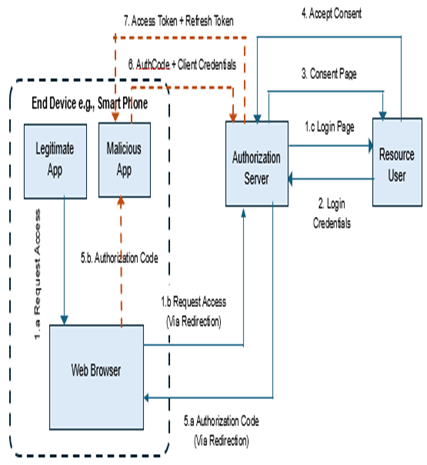
Figure
1: Authorization Code Interception Attack Flow.

Figure 2: OAuth PKCE Abstract Flow.
A. Flow overview
The client (Legitimate App)
directs the resource owner (user) to the authorization server's authorization
endpoint.
·The user authenticates
(e.g., via username and password).
·The authorization server
validates the credentials and requests consent to access specific resources.
·The user grants permission
to the authorization server to let the client (Legitimate App) access specific
resources.
·The authorization server
redirects the user back to the client, passing an authorization code as part of
the URL. This code represents the user's consent. Although the intent is to
redirect the user back to the client, it is important to note that a malicious
app can register itself as a handler for the same custom scheme as the
legitimate app. Once this occurs, the malicious app gains the ability to
intercept the authorization code.
·The malicious app then
exchanges the authorization code for an access token by making a request to the
authorization server's token endpoint, including the client credentials for
authentication.
·The authorization server
provides the malicious app the access token and refresh token to access the
resources. Since the malicious app now has access token and refresh token, it
can impersonate the legitimate app and access protected resources.
3. Proof Key
for Code Exchange (PKCE)
·The client generates a random value called the “code_verifier” and derives a transformed version, “t(code_verifier)”, known as the “code_challenge”, using a transformation method (or hashing algorithm) “t_m.” Both the “code_challenge” and the transformation method “t_m” are then included in the Authorization Request. t_m usually is SHA256. If the client can’t support SHA256, then the client can send the code_verifier itself where t_m then is assumed as plain.
oplain: code_challenge = code_verifier
oSHA256: code_challenge = BASE64URL-ENCODE(SHA256(ASCII(code_verifier)))
·The Authorization Endpoint validates the request, stores the "code_challenge" and the transformation method and then returns the authorization code.
·The client requests an Access Token from the Authorization Server by sending the "code_verifier," the random value generated during the Authorization Request.
·The authorization server transforms the 'code_verifier' into a 'code_challenge' using the 't_m' sent during the Authorization Request and compares the resulting value with the 'code_challenge' sent in the same request. If the values match, Access Token is returned.
oplain: code_verifier == code_challenge.
oSHA256: BASE64URL-ENCODE(SHA256(ASCII(code_verifier))) == code_challenge
·The client requests the protected resource from the resource server and authenticates by presenting the access token.
·The resource server validates the access token and, if valid, serves the request.
In this flow, PKCE adds an extra layer of security by requiring the code verifier to be sent during the token exchange. This ensures that even if an attacker intercepts the authorization code, they cannot use it to obtain an access token and ensures the entity requesting the access token is same as the one that initiated the authorization request. Additionally, PKCE eliminates the need to securely store client secrets for public clients, which are vulnerable to reverse engineering2.
A. OAuth 2.0 vs OAuth 2.0 PKCE Flow
Table 1: OAuth 2.0 And OAuth 2.0 PKCE
Comparison.
|
Flow |
OAuth 2.0 vs OAuth 2.0 PKCE |
|
|
OAuth 2.0 |
OAuth 2.0 PKCE |
|
|
Auth Request |
The
client sends the client_id, redirect_uri and client_secret. |
The
client sends code_challenge, transformation method (t_m) along with
client_id, redirect_uri. |
|
The Authorization
Server validates the request and returns the authorization code. |
Authorization
Server validates the request, stores code_challenge and t_m and returns the
authorization code. |
|
|
Token Request |
The
client sends the authorization code and client_secret to the Authorization
Server. |
The
client sends authorization code and code_verifier to the Authorization
Server. |
|
The
Authorization Server validates client_secret and authorization code and if
they are valid, it returns an access token. |
The
Authorization Server derives the code_challenge by applying t_m to the
code_verifier and validates it against the value sent in the Authorization
Request Flow. If they are valid, it validates the authorization code and
returns an access token. |
|
|
Resource Access
Request |
The
client uses the access token to access protected resources. |
The
client uses the access token to access protected resources. |
|
Overall Security |
OAuth
2.0 relies on client_secret, susceptible to interception attacks if not
protected well. |
Relies
on dynamic verification mechanism using code_verifier and code_challenge,
mitigating interception attacks, primarily in public clients. E.g., mobile or
browser apps. |
B. Security considerations and best practices
·Entropy
of code_verifier value: The code verifier must be
generated in a manner that ensures it is cryptographically random and has high
entropy, making it impractical for an attacker to guess1,4.
·Secure storage of the code verifier and
client secret:
Though
client_secret is not required in PKCE, when used client_secret should also be
securely stored2.
·Use of strong cryptographic methods: The SHA-256 code challenge
method or another cryptographically secure mechanism should be used. If the
code challenge is plain,alternative mechanisms, such as encrypting and
decrypting the code verifier may be employed than relying on transacting with just
the plain value2.
·Always Use TLS (https): Clients must always use TLS (https)
or equivalent transport security when making requests with tokens. Failing to
do so exposes the token to numerous attacks that could give attackers
unintended access3,4.
C. Challenges and limitations
Though
PKCE mitigates the risk of interception authorization code attacks, it does
come with challenges and limitations.
·Implementation complexity &
additional latency:
Technologists need to design, implement and
thoroughly test the creation, exchange and verification of code challenges.
This introduces additional complexity, including future enhancements,
compatibility with existing systems and other factors resulting in increased latency and response time.
·Secure storage of code verifiers: Code verifiers and details should be stored
securely to avoid leaks or misuse.
·Additional protection to tokens: PKCE helps secure the process until the access
and/or refresh token is obtained. However, once an attacker intercepts or
steals either token, they can impersonate the user and access protected
resources. This highlights the need for additional security measures, such as
using short-lived tokens, securely storing them, implementing token revocation
mechanisms and adding extra validations for both access and refresh tokens on
the server to further protect user data5,6.

Figure 3: OAuth Code Grant with State
Parameter.
4. Proof Key
for Code Exchange (PKCE)
The
state parameter mechanism plays a crucial role in preventing these types of
attacks by ensuring that the callback from the authorization server matches the
original request made by the client.
The
following section explains the authorization code grant flow, as outlined in1, including the use of the state parameter when
a client logs into a legitimate application. This process is a prerequisite for
the attacks discussed earlier. The client first registers with the
authorization server, providing redirect URLs where the authorization code can
be sent.
A. Flow overview
·The client directs the
resource owner (user) to the authorization server's authorization endpoint.
During this process, the client sends state param to the authorization server
along with the redirect url to which the authorization code should be sent upon
user consent. The redirect url sent in the request must be one of the urls
provided during the registration process.
·The user authenticates
(e.g., via username and password).
·The authorization server
validates the credentials and requests consent to access specific resources.
·The user grants permission
to the authorization server to let the client access specific resources.
·The authorization server
redirects the user back to the client, passing an authorization code and state
param as part of the redirect url. This code represents the user's consent.
·The client checks that the
state parameter matches the one sent in the original request. If it's valid,
the client then exchanges the authorization code for an access token by sending
a request to the authorization server's token endpoint, along with its client
credentials for authentication.
·The authorization server
provides the client with the access token and refresh token to access the
resources.
In
addition, the following sections outline the consequences of each CSRF attack
scenario and explain how the state parameter along with redirect url validation
can help address these issues. For both scenarios, its assumed that after the
client logs into the application and the session is still active, the attacker
sends them a malicious link that contains an authorization code request and the
client unknowingly clicks on the link and visits the page from where the
attacker takes the control.
Client
has not registered the redirect urls with authorization server: In
this scenario, it becomes much easier for an attacker to hijack the entire flow
once the user clicks on the malicious link. The malicious app can send an
authorization request with a redirect URL that’s different from the client’s,
allowing the attacker to capture the authorization code from the callback and
access the user’s resources. While we’ll dive deeper into the state parameter
later, this section highlights the importance of validating the redirect URL to
ensure the callback goes to the correct location2.
The next section will focus on the need for the state parameter.
Client
has registered the redirect urls with authorization server: The
authorization server will reject requests if the redirect URL provided by a
malicious application differs from the registered one. However, the malicious
app can provide a valid redirect url in the authorization request with
different client credentials that will result in a different, but a valid
authorization code sent to client. Additionally, without a secure transport
layer, the attacker could modify the response, say., authorization code. Both
these attacks can cause potential harm.
B. Security considerations and best practices
·Entropy
of code_verifier value: Make sure the
value of the state parameter has high entropy so that it’s difficult to predict
for attackers. To enforce high security, the state parameter value can be
encrypted at the client and decrypted at the authorization server so only these
two parties know how to interpret the value2.
·Register
and Validate redirect URLs: Make sure valid
redirect URLs are provided during registration process and authorization server
performs validations with the one sent during the authorization request
process. The authorization server should send the response only if the
validations are through.
·Always
use TLS (HTTPS): Usage of HTTPS
ensures the requests and responses can't be intercepted or altered, protecting applications
from potential attacks3,4.
·Limited
Time Usage of Auth Code: Restrict the usage of authorization code to obtain
access tokens to prevent brutal force attacks or unauthorized access attempts7.
C. Challenges and limitations
Additional logic, maintenance and testing are
required to ensure
·The
state param value is managed securely so that the correct state param value
(the one that came with the authorization request) is sent in the callback
along with authorization code.
·Encryption
keys should be properly managed, shared and rotated in case the state parameter
value is to be exchanged securely than just plain value.
PKCE
helps ensure that only authorized clients can exchange authorization codes for
tokens, while the State Parameter protects against cross-site request forgery
(CSRF) attacks that could steal tokens. Using both together helps mitigate the
risk of token leakage. As mentioned earlier, following best practices alongside
PKCE and the State Parameter is crucial to achieving the best results.
5.
Conclusion
While
these techniques significantly improve security, additional measures are still
needed to better protect user data. These include using short-lived tokens,
enabling token revocation, validating access and refresh tokens on the server,
checking redirect URLs and ensuring TLS/HTTPS is used. However, these added
protections come with trade-offs, like increased complexity, potential delays
and the need for secure storage of code verifiers.
In conclusion, PKCE and the State Parameter significantly strengthen OAuth 2.0's security. However, as attackers continuously seek out new vulnerabilities, it is essential to continually refine these mechanisms to stay ahead of emerging threats, all while ensuring they remain simple to implement.
6. References
- Hardt D. The OAUTH 2.0 Authorization Framework, 2012.
- Bradley J and Agarwal N. Proof key for code exchange
by OAuth public clients, 2015.
- Dierks T and Rescorla E. The Transport Layer Security
(TLS) Protocol Version 1.2, 2008.
- McGloin M and Hunt P. OAUTH 2.0 threat model and
security Considerations, 2013.
- Jones M and Hardt D. The OAUTH 2.0 Authorization
Framework: Bearer Token usage, 2012.
- Dronia S and Scurtescu M. OAUTh 2.0 token revocation,
2013.
- OAUth 2.0 token introspection, 2015.