Generative AI Models and Their Potential Business use Cases
Abstract
Generative Artificial
Intelligence (AI) models have emerged as highly efficient and powerful tools
capable of producing a wide range of
content, accurately imitating human actions, and generating authentic,
high-quality data. This study
meticulously examines the field of generative AI, delving deep into its
mechanisms, progression, and advancements that
have revolutionized industries. Furthermore, it explores various business
opportunities where these models can be effectively
utilized to drive innovation, enhance productivity, and achieve success. These
opportunities include content generation,
data augmentation, virtual assistants, creative design, predictive analytics,
personalization, and decision support systems.
The study also assesses the utilization and functionality of Language Models
(LLMs) in generative AI, highlighting their
effectiveness in generating realistic and contextually appropriate content
across industries like marketing, advertising,
entertainment, healthcare, finance, education, and manufacturing. The
aim of this abstract is to provide a comprehensive overview of generative AI models and their practical
applications in the business sector,
government agencies, and non- profit organizations. By offering insights
and cutting-edge research
findings, it equips researchers, entrepreneurs, policymakers, and industry professionals with the knowledge to
effectively harness the potential of these technologies. In conclusion, this study serves as a pivotal
resource for understanding generative AI models and their transformative
potential, empowering individuals,
teams, and organizations to embrace, adopt, and capitalize on these
state-of-the-art technologies, ultimately leading
to increased efficiency, productivity, and competitiveness in
a rapidly evolving digital landscape.
Keywords: Generative AI, LLMs,
Generative AI use cases
1. Introduction
Generative AI pertains to the subfield
of artificial intelligence that specializes in the production of original content.
Its emphasis lies in computers and systems
using models to generate
a diverse range of content, encompassing images, text, music, code, synthetic
data, and more. Generative AI builds upon a specific
category of AI model called
a generative model, which approximates the fundamental data through mathematical means. These models
take substantial datasets, including images,
text, and sound, as input. Subsequently, a deep learning
model is employed
to discern patterns
within the data during the subsequent phase. Once the models have completed their learning
process, they can be effectively utilized for
various pivotal tasks. These tasks consist of generating
synthetic images based on existing ones, modifying or creating new images via the utilization of a particular image style,
facilitating translation, generating question and answer pairs,
and comprehending the intent or meaning behind
text. Furthermore, generative AI can also convert audio snippets into text or transcribe music, among other capabilities1.


1.1. Why now
In recent times, there has been a
remarkable surge in the field of generative AI. This exponential growth has
caused a significant shift and an upsurge in the development of exceptional
applications. Let's delve into three prominent factors that have contributed to
this sudden transformation.
1.1.1. Large datasets: Large datasets have become extremely important in recent times. These datasets, which are both extensive and diverse, have played a crucial role in the advancement of artificial intelligence (AI). There has been a notable increase in the availability of high-quality and open-source datasets specifically designed for training AI models. As these models learn from patterns, correlations, and the unique characteristics of these large datasets, their accessibility has greatly contributed to the development of the generative AI field. Furthermore, the accessibility of pre-trained state-of-the-art models has emerged as another significant factor. These models can be easily accessed and tailored to suit specific tasks, ultimately fostering innovation in the field of AI.
1.1.2. Computational power: The presence of computational resources and the
advancements in the field of Computing
have been of great importance. This includes enhancements in Hardware, access to powerful
cloud computing, and the availability of open-source
software. These developments offer organizations the essential tools
1.2. Overview of Potential
use Cases
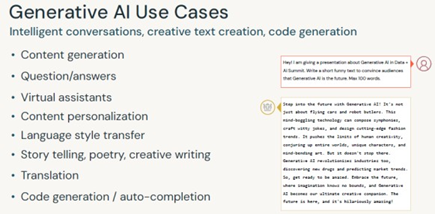
A significant application of generative
AI is found in text-based agents and text generation, which Gartner acknowledges as having a moderate to significant degree of business
value and being easily
achievable with the latest tools. Now, let us
delve into a few additional scenarios where generative AI can be employed. A virtual
assistant capable of answering questions
and automating dialogue systems, personalized content
generation for social media storytelling, music creation, poetry. automated customer support and
chatbots, content creation
for marketing and advertising campaigns, recommendation systems for e- commerce
platforms, and data analysis and forecasting
for financial institutions. other notable use
cases include translation code generation auto
completion. It is not only limited to futuristic.
Another potential business use case for generative AI models is in the field of content creation. These models have the ability to autonomously generate and opportunities to delve into
and test generative AI.
Cutting-Edge Deep Learning Models: The latest developments in deep learning models consist of generative adversarial networks (GANS), Transformer architectures, and reinforcement learning from Human feedback (RLHF). These sophisticated models possess the remarkable capability to process information with enhanced efficiency and closely resemble human responses. Additionally, thanks to considerable advancements in processing power, these models are now capable of achieving even more extraordinary outcomes3.
There has been a notable increase in the level of interest surrounding AI, specifically in the field of generative AI. It is imperative to acknowledge this surge at this point in time. While the concept of generative AI has been around for some time and has been applied in certain contexts, we have recently achieved a substantial breakthrough in its accuracy. The efficiency and accessibility of these models have reached a critical stage. As a result, previously imagined scenarios can now become real, and even individuals without technical expertise can effortlessly leverage the capabilities of these models. With the rise in the quantity of Open Source and customizable models, generative AI is becoming more attainable to a wider audience, thereby broadening the scope of potential applications and opportunities2.
concepts like flying cars and robot
assistants, but it can also produce
symphonies, generate jokes, and design cutting-edge fashion trends. Additionally, there are other notable applications such as translation, code generation, and auto
completion.
high-quality written, visual, and audio content, which can revolutionize industries such as marketing and entertainment. use case of generative AI involves generating Audio Visual and 3D assets unlocking Limitless creative and design possibilities for various industries. This capability can transform industries such as architecture, gaming, and virtual reality by efficiently creating realistic and immersive experiences. One potential use case of generative AI in these industries is the automated generation of virtual environments and characters, reducing the time and effort required for game development. This not only streamlines the game development process but also opens up opportunities for creating more interactive and engaging gaming experiences for players. Another potential use case of generative AI in gaming is the creation of dynamic and adaptive game narratives, allowing for personalized storytelling and enhanced player immersion. This technology can revolutionize the gaming industry by providing players with unique and tailored experiences, increasing player engagement and satisfaction. Furthermore, generative AI can be utilized in the development of AI-controlled non-player characters (NPCs) that exhibit more realistic and human-like behavior, adding depth and complexity to the gameplay. These AI-controlled NPCs can enhance the overall gaming experience by providing more challenging and realistic interactions for players, ultimately leading to a more immersive and enjoyable gameplay. possibilities for instance generative AI can be used to create unique virtual characters or personalized images based on textual prompts in the realm of audio it can compose music in various genres and generate realistic sounds for virtual reality simulations or even even mimic a singer's voice in video generation it can recreate scenes that are difficult or expensive to produce or reconstruct scenes without re-shooting them.

With the advancement of generative AI models, synthetic data generation is becoming an
essential tool for those involved in
the big data and AI space. It
offers significant advantages, such as increasing the size and diversity of data sets, protecting data privacy, and reducing the dependence on
real data. By incorporating synthetic data, businesses can effectively
address the limitations of relying solely on
real data, thereby expanding their datasets and enhancing the precision of their machine learning models. Moreover, synthetic data is
instrumental in carrying out crucial tasks like object detection, image recognition, and speech synthesis.
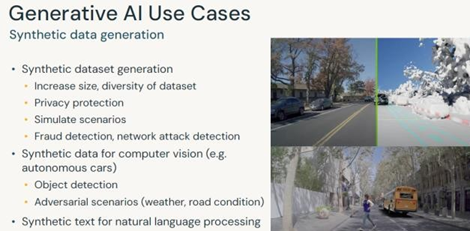
The detection and tracking of adversarial scenarios, as well as the conduct of natural language processing, are subjects that we shall briefly delve into. Let us now examine the advantageous aspects of generating synthetic data, which include the augmentation of data set size and diversity, privacy safeguarding for real-world data, and the simulation of scenarios for the purpose of testing and experimentation. Additionally, synthetic data generation aids in fraud detection and network attack detection, enhances computer vision applications such as autonomous cars, and improves the field of natural language processing. While creating synthetic data for tabular and textual purposes is feasible, generating synthetic data for computer vision remains a challenge. Despite the current technological limitations, the implementation of generative design can offer significant value to businesses.
The application of AI in design encompasses a wide range of areas
such as drug discovery, product and material
design, chip design,
as well as architectural
design and urban planning. Looking ahead,
the progress in generative AI promises to bring remarkable advancements in this field, presenting groundbreaking possibilities4.

2. Large Language Model (LLM)
2.1. What is LLM
LLMs, also known as large language
models, are highly sought after in
the field of generative AI. In this
section, we will delve into understanding the
structure of LLMs and explore
some significant business applications. LLMs are not just
a passing trend; they are
transforming the AI landscape. This technological shift is truly groundbreaking and occurs
only once in a generation. To gain a better understanding,
let's examine the specifics of LLMs. First,
it is essential to comprehend generative AI,
which we discussed
in the previous section. Generative AI is a branch of artificial
intelligence focused on content
creation. Within generative AI, we
have LLMs and Foundation models. Both of these
models are trained on extensive datasets and
are developed using deep learning neural networks like the Transformer architecture. Starting with LLMs, they are extensively trained on large datasets to enhance their language processing capabilities. In essence, LLMs employ the power of generative AI and vast datasets to excel
in language tasks. Foundation
models, on the other hand, are larger ML models that undergo pre-training and fine-tuning processes
to further enhance
their language understanding and generation abilities5.

2.2. How do LLM's work
LLMs usually comprise
three primary elements:
the encoder, decoder,
and Transformer model.
The encoding component of the language model receives a substantial amount of text and transforms it into tokens, which are smaller chunks that make up the sentence. Each token is assigned a numerical value. In addition, the tokens are converted into token embeddings, which group similar tokens together. Once the token embeddings are generated, they are trained using a pre-trained Transformer model that is specific to the architecture of the LLM. In certain cases, there may be a step where human feedback guides the model in generating output for a particular task. Finally, the decoder component converts the output tokens back into meaningful words for understanding. While the specific architecture of LLMs may vary, the components mentioned here are commonly found in today's LLMs. Currently, there are numerous LLMs developed by different companies, with some being open-source and others proprietary. An important aspect of language models is their size, which is indicated by the number of parameters, and this has significantly increased in recent years. Among these models is Dolly, an open-source LLM created by Databricks6,7.

Firstly, let us discuss content creation and augmentation with LLMs. These models are highly effective in generating coherent and contextually relevant text for various purposes, such as stories and dialogues. They function as AI assistants that effortlessly help produce engaging content. Next, we have summarization, which is self-explanatory. If there is a need to summarize lengthy documents, courses, or articles, LLMs are the ideal tool for the job. They can quickly distill key information into concise summaries. Furthermore, LLMs excel at generating questions and answers based on extensive text input. By providing them with a wealth of information, they can generate relevant questions and their corresponding answers. But that is not all. LLMs possess the ability to perform language translation, explain grammatical rules in plain text, analyze sentiment or customer feedback, detect spam, identify named entities, assess the tone and content level of text, and even generate code. They offer a versatile range of capabilities for various language-related tasks. When it comes to customer engagement, personalization and customer segmentation play a crucial role. For instance, LLMs can be leveraged to provide personalized product recommendations based on a customer's past purchases or suggest tailored content based on their interests.
another valuable application by using LLM's you can extract insights from customer feedback as shown in the example in this slide you can identify the top five reasons for customer complaints enabling you to address those issues promptly and enhance customer satisfaction
another interesting use case is virtual assistance which hold tremendous potential for the future imagine a scenario where Voice assistance can provide seamless customer support without the need for human involvement these Advanced virtual assistants can understand customer queries provide accurate information and offer personalized assistance all through natural language interactions

LLMs offer an extra benefit of improving customer support through the automated answering of inquiries and providing prompt solutions. If we examine the content presented on the slide, we can find a testimonial from a dissatisfied customer expressing their dissatisfaction with the company's product. They mention that the product was poorly constructed and subsequently deteriorated. The customer is seeking a speedy resolution, and it is certainly not desirable for any business to have an unhappy customer. Instead of having to involve a human representative, we can send an automated message utilizing the customer's information to assist in resolving the issue.

Let us explore the realm of content creation. LLMS prove to be highly effective for a wide range of creative endeavors. They provide an effortless means to generate short stories, create scripts, update documentation pages or user manuals, and even facilitate content translation. Regardless of whether you are a writer, marketer, or content creator, LLMS offers an impeccable solution to enhance your creative workflow.

LLMs play an integral role in the generation of code and the improvement of developer efficiency. They provide essential support in efficiently solving problems by generating code snippets. A notable example of this is GitHub's co-pilot, which can generate boilerplate code based on plain text or offer autocomplete suggestions for functions. Moreover, LLMs contribute to a range of other

tasks that enhance
developer productivity, such as error
detection, code debugging, code conversion between programming languages, code documentation writing, and serving
as virtual coding
assistants for learning
purposes. These capabilities empower developers and
significantly contribute to their productivity8,9.
3. Conclusion
The examination of generative AI models
reveals a landscape filled with promise,
revolutionizing business operations across various sectors.
The advancement of neural
networks and deep learning structures has resulted in powerful resources
capable of generating creative content, imitating
human behavior, and synthesizing realistic
data. The potential
applications of generative AI in business
are extensive and remarkable. This technology can transform marketing
strategies, streamline content
creation, optimize product
design processes, and enhance customer engagement. The practical
examples highlighted in this study
demonstrate the valuable advantages that businesses
can achieve by integrating generative AI into their operations. However,
delving into the realm of generative AI presents its own set of challenges. Ethical concerns, protection of data privacy,
and addressing biases
in AI models must be approached with caution. As organizations embrace
generative AI, it is crucial
to strike a delicate
balance between fostering innovation and deploying
these technologies responsibly to ensure their
positive impact on society. With anticipation
for upcoming advancements, future prospects in generative AI hold great potential. Progress
in understanding models,
enhancement procedures, and ethical frameworks is expected to
facilitate the utilization of these technologies in a more advanced and conscientious manner.
Enterprises should stay vigilant, keeping
up with these advancements and adapting their approaches to fully
leverage the vast capabilities of generative AI. In essence, generative AI models bring about a fundamental change in how businesses perceive
creativity, content creation,
and problem-solving. By understanding and addressing the challenges associated with these models, businesses
can access unparalleled
possibilities for expansion, efficiency, and
breakthroughs in the constantly evolving field
of artificial intelligence.
References:
- Bandi A, Adapa
PVSR, Kuchi YEVPK. The power of generative AI: A review of requirements,
models, input–output formats, evaluation metrics, and challenges. Future
Internet 2023;15: 260.
- Harshvardhan
GM, Gourisaria MK, Pandey M. A comprehensive survey and analysis of generative models in machine learning. Computer Science
Rev 2020;38.
- Waqas A, Bui
MM, Glassy EF, El Naqa I. Revolutionizing digital pathology with the power of
generative artificial intelligence and foundation models. Laboratory,
2023.
- Fui-Hoon
Nah F, Zheng R, Cai J, Siau K, Chen L. Generative AI and ChatGPT: Applications, challenges, and AI-human
collaboration. J Infor Tech Case Appl Res 2023;25: 277-304.
- Chang Y, Wang X, Wang
J, et al. A survey on evaluation of large language models. arXiv
2023.
- Ozdemir S. Quick Start Guide to Large Language Models: Strategies and Best Practices for Using
ChatGPT and Other LLMs. Addison-Wesley Professional 2023.
- Mandvikar S. Augmenting Intelligent Document Processing (IDP) Workflows with Contemporary Large Language Models (LLMs).
Int J Comp Trend and Tech 2023;71: 80-91.
- S. Ozdemir, Quick Start Guide to Large Language Models: Strategies and Best Practices for Using ChatGPT and Other LLMs. Addison-Wesley
Professional 2023.
- Jablonka KM, Ai Q, Al-Feghali A, et al. 14 examples of how LLMs can transform materials science and chemistry: a reflection on a large language model hackathon. Digit Discov 2023;9: 1233-1250.