Integrating MDM with GDS: A Comprehensive Approach for Travel Industry Optimization
Abstract
In the contemporary travel
industry, data integrity and accessibility are paramount for enhancing
operational efficiency and customer satisfaction. This paper elucidates the
integration of Master Data Management (MDM) with Global Distribution Systems
(GDS) to address prevalent challenges such as data silos, inconsistencies and
inefficiencies. By creating a unified architecture that harmonizes MDM
practices with GDS functionalities, travel organizations can optimize their
data landscapes, ensuring data accuracy, streamlining operational workflows and
facilitating improved decision-making processes. This comprehensive approach is
essential for leveraging data as a strategic asset, ultimately leading to
enhanced customer experiences and increased organizational profitability.
Keywords: Master Data
Management, Global Distribution Systems, Travel Industry, Data Integration,
Data Optimization, Customer Experience.
1. Introduction
The travel industry is
characterized by its reliance on diverse data sources, including customer
information, supplier details and product offerings. The interplay between
Master Data Management (MDM) and Global Distribution Systems (GDS) is critical
in ensuring that this data is accurate, consistent and readily accessible. MDM
provides a framework for managing critical data entities, while GDS serves as
the transactional backbone, facilitating the distribution and reservation of
travel products.
Despite the foundational
role of GDS, many organizations encounter significant challenges stemming from
fragmented data ecosystems. These challenges manifest as:
●Data Silos: Isolated data repositories inhibit holistic
data utilization.
●Inconsistent Data: Variability in data entry processes
leads to inaccuracies across systems.
●Operational Inefficiencies: Manual interventions and
redundant processes consume valuable resources.
This paper proposes a
detailed methodology for integrating MDM with GDS, focusing on the creation of
a centralized data governance framework that enhances data quality and
operational efficiency.
1.1 The Role of MDM in
Travel
MDM is a comprehensive
approach that consolidates and manages critical data assets across an
organization. In the context of the travel industry, MDM focuses on the
following key data domains:
1.Customer Profiles: A consolidated view of customer
preferences, demographics and booking history, enabling personalized marketing
and service delivery.
2.Supplier Information: A centralized repository of supplier
data, including airlines, hotels and service providers, to ensure consistency
and reliability in transactions.
3.Product Catalogs: Accurate and uniform representations of
travel products, services and pricing to facilitate effective distribution
through GDS.
1.2 Integration Challenges
1.Data Silos: Many travel organizations operate with disparate
systems that do not communicate effectively, resulting in isolated data sets
that prevent comprehensive analysis.
2.Inconsistent Data: Different formats, definitions, and entry
protocols across systems lead to discrepancies that can compromise
decision-making.
3.Operational Inefficiencies: The lack of automation in data
management processes results in manual errors, increased processing time, and
reduced agility.
1.3 Integrating MDM with
GDS
Integrating MDM with GDS
creates a cohesive data ecosystem that enhances operational capabilities. This
integration facilitates a seamless flow of accurate and up-to-date information
between MDM and GDS, empowering organizations to:
1.Enhance Data Quality: MDM ensures that data is consistent
and accurate before it is ingested into GDS.
2.Streamline Processes: Automated data synchronization reduces
manual intervention and accelerates transaction processing.
3.Improve Customer Experiences: Access to reliable data
enables personalized interactions and timely service delivery.
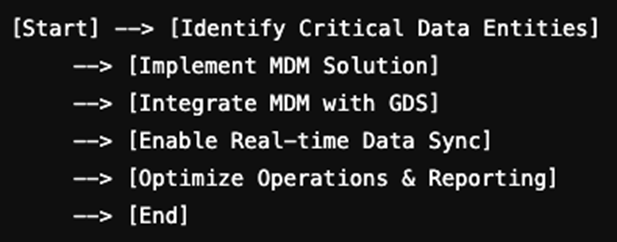
Flowchart: MDM and GDS
Integration Process.
1.4 Technical
Implementation
To achieve successful
integration between MDM and GDS, organizations should consider the following
technical steps:
1.Establish a Unified Data Model: Define a common data schema
that aligns the data structures of MDM and GDS. This model should include key
entities such as customers, suppliers and products, along with their
relationships.
2.Utilize APIs for Integration: Implement Application
Programming Interfaces (APIs) to facilitate real-time data exchanges between
MDM and GDS. This allows for immediate updates and ensures that both systems
reflect the latest data.
3.Implement Data Governance Practices: Establish data
governance policies to oversee data quality, compliance, and security. This
includes defining roles and responsibilities for data stewardship and
implementing data validation processes.
Pseudocode Example: Data
Synchronization between MDM and GDS
# Define function to
synchronize MDM data with GDS
def sync_data(mdm_data,
gds_data):
for record in mdm_data:
if record not in gds_data:
gds_data.append(record)
log_change(record, action="Added to
GDS")
return gds_data
# Fetch data from MDM and
GDS systems
mdm_data =
fetch_mdm_data()
gds_data =
fetch_gds_data()
# Synchronize GDS with MDM
data
gds_data =
sync_data(mdm_data, gds_data)
# Function to log changes
for audit purposes
def log_change(record,
action):
with open('data_sync_log.txt', 'a') as
log_file:
log_file.write(f"{action}:
{record}\n")
Data Flow Diagram
Data Flow Diagram illustrating the integration between MDM and GDS
Explanation of the
Diagram:
●MDM (Master Data Management): Central repository managing
critical data entities.
●Data Validation: Ensures that data from MDM is accurate
before further processing.
●Data Extraction: Pulls relevant data from MDM for
synchronization with GDS.
●API Integration: Facilitates the connection between MDM and
GDS for real-time data exchange.
●Data Synchronization: Updates GDS with validated data from
MDM.
●GDS (Global Distribution Systems): The transactional
backbone for distributing travel-related products and services.
This diagram represents
the flow of data between MDM and GDS, highlighting the processes involved in
data extraction, transformation, and loading (ETL).
2. Conclusion
The integration of Master
Data Management with Global Distribution Systems presents a transformative
opportunity for the travel industry. By establishing a unified framework that
addresses data quality and operational efficiency, organizations can optimize
their data landscape. This strategic integration not only enhances
decision-making capabilities but also elevates customer experiences through
personalized service offerings. As the travel industry continues to evolve,
leveraging integrated data solutions will be paramount for maintaining
competitiveness and achieving long-term success.
3. References
- Smith,
“Master Data Management: A Guide to Data Integration,” Journal of Data
Management 2022;5(3):145-160
- Jones
and C. Lee, “The Future of Travel: Leveraging GDS for Enhanced Customer
Experience,” Travel Technology Journal 2023;10(1):25-40
- Johnson, “Data Governance in the Travel Industry,” International Journal of Information Systems 2023;15(2):80-92.
- Williams,
“Integrating Data Management with Business Strategy,” Strategic Information
Systems 2023;22(4):123-138.