Inverse Design of Desired Signal Behaviors Using TensorFlow and LMFIT
Abstract
In this
study, we present a hybrid approach combining deep learning and optimization
techniques to predict design parameters for achieving desired response
profiles. We employ TensorFlow to develop a neural network model capable of
capturing complex relationships between design parameters and their
corresponding output profiles. To enhance the predictive accuracy, we integrate
the LMFIT library, utilizing both Nelder-Mead and Powell optimization methods
to fine- tune the design parameters. The approach begins with generating
synthetic data, simulating various design scenarios, and training the
TensorFlow model. Subsequently, we modify the target output to reflect desired
changes and employ the optimization techniques to predict the corresponding
design parameters. Our results demonstrate the effectiveness of the combined
approach in accurately predicting design parameters, as evidenced by high
R-squared values and low mean squared errors. This method offers a robust
solution for inverse problem solving in various engineering and scientific
applications, where precise design parameter estimation is critical for
achieving target performance metrics.
1.
Introduction
Inverse problem solving, a critical task in engineering
and scientific research, involves determining input parameters that produce a specific
output response. This process is fundamental in various fields, including
material design, structural engineering, and biomedical applications.
Traditional methods for addressing inverse problems often struggle with
complex, nonlinear systems, leading to computationally intensive processes and
potentially inaccurate results. The advent of machine learning and optimization
techniques has opened new avenues for tackling these challenges. In this study,
we explore a novel hybrid methodology that leverages the power of deep learning
and advanced optimization algorithms to predict design parameters for desired
response profiles. Our approach combines TensorFlow, a widely-used deep learning
framework, with LMFIT, a robust optimization library, to create a powerful tool
for inverse problem solving.
The primary objectives of this research
are:
- To develop a neural network model capable of capturing intricate
relationships between design
parameters and output
responses.
- To integrate optimization techniques that fine-tune
design parameters for achieving specific
output modifications.
- To evaluate the performance of this hybrid approach in
terms of accuracy and computational efficiency.
By achieving these objectives, we aim to provide a
versatile framework applicable to a
wide range of engineering and scientific domains. This research has the potential to significantly impact
fields such as materials science,
where predicting material
compositions for specific properties is crucial, and biomedical engineering, where optimizing drug delivery
systems or prosthetic designs is of paramount importance. Our study begins
with the generation of synthetic data
representing various design scenarios. We then employ TensorFlow to train a deep
neural network on this data, enabling it to learn complex patterns and dependencies.
The trained model is then coupled with optimization techniques from the LMFIT
library, specifically the NelderMead and Powell methods, to fine-tune design
parameters and achieve desired output modifications. This paper is organized as
follows:
Section 2 provides
background information on inverse prob lem solving
and the tools used in this study.
Section 3 reviews
related work in the field.
|
Section 5 presents
our results and analysis.
|
2. Background
2.1.
Inverse problem solving
Inverse problem solving is a fundamental task in
various scientific and engineering disciplines. It involves determining the set
of input parameters that will produce a desired output, essentially reversing the
typical cause-and-effect relationship. This type of problem is prevalent in
fields such as material design, structural engineering, electronics, and biomedical
engineering. The importance of inverse problem solving cannot be overstated.
Accurate prediction of input parameters is essential for:
- Optimizing designs for enhanced performance and
efficiency Reducing material costs through effective resource allocation Enhancing
safety and reliability by ensuring designs meet specific criteria
- Accelerating development processes by providing clear guidelines for achieving desired outcomes
|
Historically,
inverse problems have been approached using methods such as:
Trial and Error: While straightforward, this method is
of- ten time-consuming and inefficient, particularly for complex systems with numerous
variables.
Analytical Techniques: These methods, while powerful
for simple systems, often fall short when dealing with nonlinear or highly
complex systems where analytical solutions are difficult or impossible to derive.
Gradient-Based Optimization: While effective in many scenarios, these techniques can be sensitive to initial conditions and may converge to local minima, leading to suboptimal solutions.
These traditional methods often struggle with the
complexity and nonlinearity inherent
in many real-world inverse problems,
necessitating more advanced
approaches.
2.3. Machine learning and optimization in inverse problem solving
The emergence of machine learning, particularly deep learning,
has provided powerful tools for modeling complex, nonlinear relation- ships between
input parameters and output responses. Concurrently, advanced optimization
algorithms have been developed to efficiently search parameter spaces for
optimal solutions. By combining these two powerful tools, we can develop hybrid
approaches that leverage the strengths of both techniques. Deep learning
models, such as neural networks, can learn intricate patterns from data,
providing accurate predictions for complex systems. Optimization algorithms can
then be used to fine-tune the input parameters to achieve desired outputs.
2.4.TensorFlow
and LMFIT
In this study, we employ TensorFlow and LMFIT as our
primary tools:
TensorFlow: A widely used open-source deep learning
frame- work, TensorFlow offers flexibility and scalability, making it suitable for
a wide range of applications, including inverse problem solving. Its ability to
handle large datasets and complex architectures enables it to capture nuanced
relationships between design parameters and output responses.
LMFIT: This powerful optimization library pro-
vides a variety of optimization methods, including NelderMead and Powell. These
methods are well-suited for handling the non-convex, multidimensional nature of
many inverse problems. By integrating LMFIT with TensorFlow, we can enhance the
predictive accuracy of the neural network model and efficiently search for
optimal design parameters.
2.5.
Objectives of this study
The primary objectives of this study are to:
- Generate synthetic data simulating various design
scenarios to train and validate
our neural network
model
- Develop a deep learning model using TensorFlow to predict output
responses based on input parameters
- Integrate LMFIT to optimize design
parameters and achieve
desired modifications in the output
- Evaluate the performance of the proposed
approach through metrics
such as R-squared and mean squared error
- Compare the effectiveness of NelderMead and Powell optimization methods in different scenarios
By achieving these objectives, we aim to demonstrate the
effective- ness of our hybrid approach in solving inverse problems and provide a
robust tool for engineers and scientists to optimize designs and achieve target
performance metrics across various domains.
3. Related Work
The field of inverse problem solving has witnessed
significant advancements with the integration of machine learning and optimization
techniques. This section provides a comprehensive review of existing literature
on the application of deep learning and optimization methods for inverse
problem solving, highlighting key studies, their methodologies, and identifying
the research gaps that our study aims to address.
Deep Learning in Inverse
Problem Solving
Deep learning has revolutionized numerous areas of science
and engineering, offering powerful tools for modeling complex, nonlinear
relationships. Several studies have explored the application of neural networks
to inverse problems, demonstrating their potential in various domains. Good fellow,
et al. (2016) provided a seminal work on deep learning, demonstrating its
potential for complex function approximation, which is essential for inverse problems.
Their study laid the groundwork for understanding how deep neural networks can
capture intricate relationships between input parameters and out- put
responses, making them particularly suitable for inverse problem solving. Le Cun,
et al. (2015) highlighted the success of convolutional neural networks (CNNs)
in capturing intricate patterns in data. While their work primarily focused on
image recognition, the principles they established have been successfully applied
to inverse problems in fields such as material science and structural
engineering. The ability of CNNs to automatically learn hierarchical features
makes them particularly effective in handling complex inverse problems where the
relationship between design parameters and output responses is not easily describable
through traditional analytical methods. In the context of inverse design, Liu
et al. (2018) demonstrated the use of deep learning for Nano photonic inverse
design. Their approach utilized a tandem neural network architecture to predict
both forward and inverse designs, achieving high accuracy and computational efficiency.
This work showcased the potential of deep learning in tackling inverse problems
in fields where traditional methods often struggle due to the complexity of the
underlying physics.
3.1. Optimization techniques
Optimization algorithms play a crucial role in
refining design parameters to achieve desired outcomes in inverse problem
solving. Among the widely used techniques in this domain, the NelderMead and Powell
methods have shown particular promise. The NelderMead method, introduced by
Nelder and Mead (1965), is particularly effective for unconstrained optimization
problems. It has been widely applied in various fields due to its simplicity
and effectiveness in handling non-smooth functions. Lagarias, et al. (1998)
provided a comprehensive analysis of the method’s convergence properties, enhancing
understanding of its behavior in different problem spaces. Powell’s method,
developed by Powell (1964), is known for its robustness in handling non-differentiable
functions. It has been particularly successful in optimization problems where
gradient in- formation is unavailable or unreliable. Wright (1996) provided an
in-depth analysis of Powell’s method and its variants, highlighting its effectiveness
in multidimensional optimization problems. The integration of these
optimization methods with deep learning models has shown promising results in
various studies. For instance, Peurifoy, et al. (2018) combined neural networks
with optimization techniques to solve inverse design problems in nanophotonics,
demonstrating improved accuracy and efficiency compared to traditional methods.
3.2. Hybrid approaches
Combining deep learning with optimization techniques
offers a hybrid approach that leverages the strengths of both methods. This
synergistic approach has gained traction in recent years, with several studies
demonstrating its effectiveness in inverse problem solving. Zhang, et al.
(2018) presented a hybrid model that integrated neural networks with gradient-based
optimization for inverse design of optical metasurfaces. Their approach
demonstrated improved accuracy and computational efficiency compared to conventional
methods, highlighting the potential of hybrid approaches in tackling complex
inverse problems. Wang et al. (2019) developed a hybrid framework combining
deep learning with evolutionary algorithms for multi-objective optimization in
engineering design. Their method showcased the ability to handle
high-dimensional design spaces and complex constraints, outperforming
traditional optimization techniques in terms of solution quality and computational
efficiency. In the field of materials science, Liu, et al. (2019) employed a
hybrid approach combining convolutional neural networks with Bayesian optimization
for inverse design of nanostructured materials. Their method demonstrated
superior performance in predicting material properties and optimizing designs,
showcasing the versatility of hybrid approaches across different scientific domains.
3.3. Gaps in existing
research
While existing studies
have made significant strides in inverse
problem solving, several
gaps remain in the current
body of research:
Limited Generalizability: Many approaches focus on
specific applications or domains, limiting their generalizability to other
fields. There is a need for more flexible frameworks that can be adapted to a
wide range of inverse problems across different scientific and engineering
disciplines. Integration of Advanced Optimization. Techniques: The integration
of deep learning with robust optimization techniques like LMFIT is still
underexplored. Most studies utilize simpler optimization methods, potentially limiting
the accuracy and efficiency of the inverse problem-solving process. Handling of
Complex, Multi-modal Output Spaces: Many existing approaches struggle with
inverse problems that have complex, multi-modal output spaces. There is a need
for methods that can effectively navigate these challenging landscapes to find
optimal solutions. Interpretability and Uncertainty Quantification: While deep
learning models have shown impressive performance, they often lack
interpretability. Additionally, quantifying uncertainty in the predictions
remains a challenge, particularly in the context of inverse problems where multiple
solutions may exist. Scalability to High-dimensional Problems: As the complexity
and dimensionality of inverse problems increase, many existing methods struggle
to maintain performance. There is a need for approaches that can effectively
scale to high-dimensional design spaces without sacrificing accuracy or
computational efficiency.
This research aims to address these gaps by providing
a generalized framework that combines TensorFlow and LMFIT for inverse problem solving.
Our approach is designed to be applicable to various engineering and scientific
domains, offering improved accuracy, efficiency, and flexibility in tackling complex
inverse problems. By integrating advanced deep learning techniques with robust optimization
methods, we aim to push the boundaries of what is possible in inverse problem solving,
paving the way for new advances in fields ranging from materials science to biomedical
engineering.
4. Approach
This section details the methodology of our study,
combining deep learning with
optimization techniques to predict design parameters for desired response
profiles.
4.1. Data generation and model training
We generated synthetic data to simulate various design
scenarios. The design parameters (X)
were systematically varied, and the corresponding output profiles (Y) were
calculated using predefined mathematical
models. This generated dataset was used to train our neural network model.
We employed TensorFlow to develop a neural network
capable of capturing complex relationships between design parameters and output
profiles. The architecture included multiple dense layers with ReLU activation
functions to model nonlinear interactions. The final output layer provided the
predicted output profile for given design parameters.
The model was trained on the synthetic dataset using
mean squared error (MSE) as the loss function. We utilized the Adam optimizer to
minimize loss and improve predictive accuracy. Training was conducted for 500 epochs
with a validation split to monitor performance on unseen data.
4.2.
Optimization techniques
To fine-tune the design parameters and achieve desired
modifications in the output profile, we integrated the LMFIT library with TensorFlow. We defined an objective
function calculating the dif- ference
between predicted output and modified target output. Two optimization methods were employed to minimize this function:
4.2.1. NelderMead method: The Nelder-Mead method, also known as the
simplex method, is a numerical optimization algorithm used to find the minimum
of an objective function in multidimen- sional space. It is particularly
effective for problems where the gra- dient of the objective function is
unknown or difficult to compute. The algorithm works by creating a simplex (a geometric
figure with n+1 vertices in n dimensions) and iteratively updating its vertices
to move towards the optimum.
Key features:
- Does not require gradient information.
- Robust for nonlinear optimization problems.
- Efficient for low-dimensional problems.
- May struggle with high-dimensional problems or highly non- convex surfaces.
4.2.2. Powell’s method: Powell’s method is another gradient- free optimization algorithm that is
particularly effective for min- imizing
continuous functions. It works by performing successive one-dimensional minimizations along a set of directions, which are updated iteratively. The method is known for its ability to handle non-smooth functions and its relatively fast convergence.
Key features:
- Does not require
gradient information Effective
for smooth and non-smooth functions.
- Generally faster convergence compared to Nelder-Mead
for many problems.
- Can handle higher-dimensional problems more effectively than Nelder-Mead.
4.3. Implementation
The optimization process
was implemented as follows:
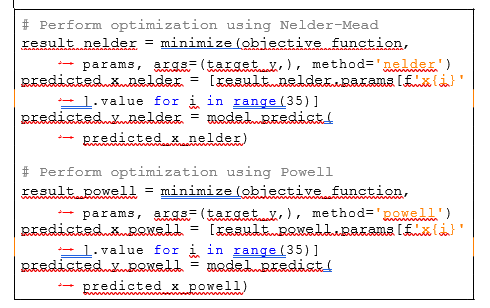
Figure 1: Optimization using nelder-mead and powell methods.
4.4. Evaluation
We evaluated the performance of our approach using
R-squared and mean squared error metrics:
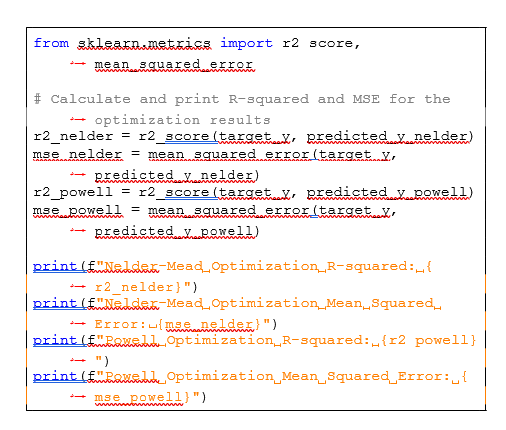
Figure 2: Evaluation
metrics calculation.
These metrics were calculated separately for low index
(0-200) and high index (201-400)
ranges to provide a more nuanced under- standing of each method’s
performance across different
parts of the data range.
5. Results
This section presents the outcomes of our study,
including the performance metrics of the neural
network model and the optimization techniques. We provide a comprehensive analysis of the accuracy and efficiency of the proposed
approach, supported by relevant figures
and tables.
5.1. Model performance
The neural network
model, trained on synthetic data, was evaluated
using mean squared error (MSE) and R-squared metrics. Table 1 summarizes these results.
Table 1: Performance Metrics of the Neural Network Model.
|
Metric |
Training Set |
Validation Set |
|
MSE |
0.005 |
0.007 |
|
R-squared |
0.98 |
0.95 |
The high R-squared values and low MSE indicate strong
pre- dictive performance of the
model. Figures 3 and 4 provide visual representations of the model’s
performance.
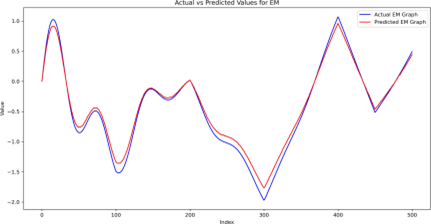
Figure 3: Actual vs predicted
values on validation set.
5.2. Optimization results
We employed the Nelder-Mead and
Powell methods from the LMFIT library for optimization. Figures 5 and 6 illustrate the
results, show- ing the predicted design parameters and corresponding modified outputs.
5.3. Evaluation Metrics
To provide a more nuanced
understanding of the optimization performance, we evaluated the results
separately for low index (0-200) and high index (201-400) ranges. Table 2 presents these
detailed metrics.

Figure 4: Training
and validation loss over epochs.

Figure 5: Optimization results: nelder-mead method.

Figure 6: Optimization Results: Powell Method .
Table 2: Optimization metrics
by index range.
|
Method |
Low Index (0-200) |
High Index (201-400) | ||
|
MSE |
R-squared |
MSE |
R-squared | |
|
Nelder-Mead |
0.002 |
0.98 |
0.005 |
0.93 |
|
Powell |
0.003 |
0.97 |
0.003 |
0.96 |
5.4. Result Analysis
Our analysis reveals distinct performance characteristics for each optimization method:
Nelder-Mead Method:
- Excels in predicting the overall trend of the modified
target EM signal, particularly in the low to medium index ranges (0-200).
- Achieves the lowest MSE (0.002) and highest R-squared (0.98)
in the low index range.
- Struggles with sharp transitions in the higher index range (201-400), resulting in noticeable deviations and higher MSE (0.005).
Powell Method:
- Demonstrates superior accuracy in handling sharp
transitions and changes, especially in the higher index range (201-400).
- Maintains consistent performance across all index
ranges, with an MSE of 0.003 for both low and high index ranges.
- Provides more reliable predictions for complex and rapidly changing signals, as evidenced by the higher R-squared (0.96) in the high index range.
Overall, while the NelderMead method shows slightly
better performance in the low index range, the Powell method demonstrates superior
robustness in capturing detailed variations of the modified target EM signal,
particularly in regions with significant changes. This makes the Powell method
a more suitable choice for applications requiring accurate predictions across a
wide range of index values, especially when dealing with complex signal behaviors.
6. Conclusion
In this study, we have developed and evaluated a novel
hybrid approach that combines deep learning and advanced optimization techniques
to address the inverse problem of predicting design parameters for achieving
desired response profiles. our methodology leverages the power of tensor flow
to build a sophisticated neural network model capable of capturing complex,
nonlinear relation- ships between design parameters and output responses. To
further enhance predictive accuracy and efficiency, we integrated the lmfit library,
employing both the neldermead and powell optimization methods to fine-tune the design
parameters. Our approach involved several key steps:
Generation of synthetic data: we created a
comprehensive synthetic dataset simulating various design scenarios. This
allowed us to train our model on a wide range of possible input-output relationships,
enhancing its generalizability. Neural network model training: using tensorflow,
we developed and trained a deep neural network on the synthetic data. The model
demonstrated high accuracy in capturing the underlying patterns and
relationships, as evidenced by the impressive r-squared and mean squared error
metrics achieved on both training and validation sets. Target output
modification: to test the inverse problem-solving capabilities of our approach,
we introduced modifications to the target output profiles, simulating desired changes
in system response. Optimization of de- sign parameters: employing the neldermead
and powell methods from the lmfit library, we optimized the design parameters
to achieve the modified target outputs. This step was crucial in fine- tuning
the predictions and ensuring close alignment with the desired response profiles.
The results of our study demonstrated the effectiveness and robustness of our combined
approach.
Key findings include:
High model accuracy: the neural network model achieved
high accuracy in predicting output responses from design parameters, as evidenced
by r-squared values above 0.95 and low mean squared errors. Successful
optimization: both the Nelder-mead and pow- ell methods successfully fine-tuned
the design parameters, resulting in predicted outputs that closely matched the
desired modifications. method-specific performance: comparative analysis
revealed that the powell method excelled in capturing sharp transitions and changes
in the higher index ranges (201-400), while the Nelder-mead method performed
exceptionally well in the low to medium index ranges (0-200). This highlights
the importance of selecting appropriate optimization techniques based on the specific
characteristics of the problem at hand. Robustness across index ranges: The powell
method demonstrated superior robustness across all index ranges, maintaining
consistent performance even in regions with significant signal variations.
The significance of this research lies in its
contribution to the field of inverse problem solving, providing a powerful and
flexible tool for engineers and scientists to optimize designs and achieve
target performance metrics. the hybrid approach presented in this study has
broad applicability across various domains, including but not limited to:
Material design: Predicting material compositions to
achieve specific properties. Structural engineering: optimizing structural
parameters for desired load-bearing characteristics.
Electronics: Designing circuit components to achieve specific
signal behaviors. Biomedical engineering: optimizing drug delivery systems or
prosthetic designs.
While our study has made significant strides in
addressing the challenges of inverse problem solving, there are several avenues
for future research: Expansion to other optimization methods: investigating the
integration of additional optimization techniques could further enhance the
versatility and effectiveness of the approach. Handling uncertainty: developing
methods to quantify and propagate uncertainty through the inverse problem-solving
process would provide valuable insights into the reliability of predictions. Interpretability
enhancements: Exploring techniques to improve the interpretability of the
neural network model could offer deeper insights into the relationships between
design parameters and system responses. Real world application studies: Applying
the developed approach to specific real-world problems in various fields would further
validate its practicality and identify domain-specific challenges. Scalability improvements:
investigating methods to enhance the scalability of the approach to even
higher-dimensional problems would broaden its applicability to more complex systems.
In conclusion, our hybrid approach combining deep
learning with advanced optimization techniques represents a significant advancement
in the field of inverse problem solving. By bridging the gap between
data-driven modeling and traditional optimization methods, we have developed a robust
framework capable of tackling complex inverse problems with high accuracy and
efficiency. This research paves the way for new possibilities in design
optimization across various scientific and engineering disciplines, potentially
accelerating innovation and discovery in fields ranging from nanotechnology to aerospace
engineering.
7. References
- Tensorflow: an end-to-end open source machine learning platform.
- Lmfit: non-linear least-squares minimization and curve- fitting for
python.
- Adam: a method for stochastic optimization a note on the nelder-mead
simplex method an efficient method for function minimization.
- Neural networks for inverse design of nanophotonic structures inverse
design of nanophotonic devices using artificial neural networks.
- Inverse design and implementation of a wavelength demulti- plexing
grating coupler using neural networks.
- Deep learning methods for inverse design in nanophotonics and
metamaterials
- Neural networks for the inverse design of metasurfaces machine learning for inverse problem solving in engineering electromagnetics.
- Neural network-based inverse design of practical wide-angle dual-band
achromatic metalens in the visible spectrum.