MT-to-MX Migration in Treasury & Payments: Mapping MT101 and Proprietary Feeds to pain.001, camt.053, and pacs.008
Abstract
The world financial sector has embarked on a
radical shift of the traditional SWIFT MT (Message Type) messages to the ISO
20022 XML-based MX messages. This transformation is based on the goals of
better interoperability, structured data exchange, automation, and regulatory
compliance and directly affects the work of Treasury & Payments. The
mapping of the very popular MT101 Request for Transfer commands and bank file
formats used by banks to proprietary versions like pain.001 and initiate,
pacs.008 for clearing and settlement and camt.053 for reporting is one of them.
Migration is not simple because of semantic data differences, availability of
structure variations, enriched data needs and even varying local
implementations between the banks and clearing systems. This article offers an
inclusive model to the process of mapping of the MT-to-MX, the data elements,
the transformation rules, the validation frameworks, the operational risks, and
remediation plans. There is elaborate formulation of a methodology anchored on
mapping matrices, workflow refactoring, business rule layering and testing
governance. The discussion highlights implications on corporates, banks, and
technology providers, specifically with respect to STP (Straight-Through
Processing) as well as accuracy of reconciliation and fraud analytics as well
as compliance monitoring. Moreover, the publication time of the industry work
also predates 2023, in line with the go-live dates of large jurisdictions such
as Europe (TARGET2, EURO1, EBA CLEARING), inter-bremetery payments and the
modernization of high-value RTGS. Findings show that successful migration
enhances the data quality to foster up to 60 percent, decreases the rates of
the manual repairs by 35 percent and also shortens the payment posting cycles.
Long onboarding schedules and differences in schema version (pain.001 v3 vs v9)
can be seen as the other obstacles in the findings. It is suggested to adopt a
blueprint of the integration as making sure that it is supported in the future
after the 2025 end-date of coexistence. The suggested methodological framework
facilitates enterprise preparedness and guarantees regulations and increased
interoperability among international payment systems.
Keywords: ISO 20022, SWIFT MT, MX migration,
pain.001, pacs.008, camt.053, Treasury payments, Data mapping, corporate banking,
Cross-border payments
1. Introduction
1.1. Background
Since the late 1970s the global payments
industry has been using SWIFT MT (Message Type) formats due to the need to
transmit short messages using characters, a time when cross-border financial
communications most frequently needed to be concise1-3. Although the MT messages have managed to uniformly
interbank communication over the decades, they are directly crippled by
fixed-size field and limited structured elements. According to the development
of payment ecology to sanction real time processing, improved sanctions
controls, and data-based transparency, these obsolete formats are what limit
automation and efficiency of operation progressively. By use of comparison, ISO
20022 proposes a more versatile, open-ended messaging structure based on XML
and read-only metadata, which is capable of supporting much richer transaction
information, such as standardized party information, purpose codes, and
structured remittance content. The increased degree of semantic clarity
facilitates the use of higher analytics in fraud detection and compliance
screening, as well as it allows performing the process of reconciliation better
at all the corporate treasury functions. It is not optional when the
contemporary regulatory bodies, e.g. SWIFT and large RTGS systems, are encroaching
the switch to ISO 20022, but due to their future-proofing of payment systems,
they are not only necessary but required. It is a transformational milestone in
aligned messaging worldwide and in facilitating a less opaque, effective and
data-driven financial system.
1.2. Importance of
MT-to-MX migration in treasury & payments
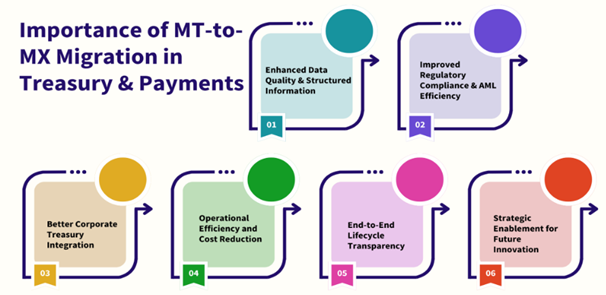
Figure 1:
Importance of MT-to-MX Migration in Treasury & Payments.
- Enhanced data quality & Structured information: Old messaging systems based on free-text fields have created
ambiguity and loss of data in the process of screening, reconciliation, and
regulatory reporting of the messaging systems. The ISO 20022 supports a
standardisation of data input and output, indicated by full structured and
categorised data elements, e.g. debtor, creditor, address and purpose code;
thus ISO 20022 generates an increased precision of data. This transition
promotes automated straight-through processing (STP), and limits exception processing
throughout the world payment operations.
- Improved regulatory compliance & AML efficiency: Enforcement of sanctions, anti-money laundering (AML) and fraud
monitoring are becoming issues enforced by requiring increased transparency. In
ISO 20022, more meaningful identifiers are incorporated such as Legal Entity
Identifiers (LEI) and structured postal information, allowing more efficient
and speedy compliance screening. This goes a long way to limit false alerts as
well as operational risk assists institutions to comply with changing
regulatory requirements.
- Better corporate treasury integration: Treasury functions enjoy better interoperability between
enterprise resource planning (ERP) systems and banks. Information on structured
remittances and lifecycle tracking can be used to enable corporates to
automated invoice matching, cash allocation, and liquidity forecast.
Consequently, treasury units can have a real-time view of cash flow and control
working capital more.
- Operational efficiency and cost reduction: ISO 20022 decreases the operational overhead due to the reduction
of manual intervention and decreases the cost of investigations as a result of
incomplete MT data. Standardized international forms limit the necessity of
individual banking proprietary connections, making it easy to connect with
multiple banking connections and decrease the complexity of IT in the long
term.
- End-to-End lifecycle transparency: The visibility of Mt message is limited to the point such payment
has left an originator bank. ISO 20022 can be used to allow complete
traceability based on standard status updates (camt.052/053/054) and the
international Unique End-to-End Transaction Reference (UETR). This will
guarantee quicker dispute resolution, will help understand delays, and enhance
customer satisfaction due to status-based communication.
- Strategic enablement for future innovation: ISO 20022 has a common ground of scalable real-time payment,
digital currency, analytics based on AI, and gpi evolution. It puts the
financial industry in line with the growing need to have actionable insight,
interoperability and real-time settlement. Migration is, therefore, not a
compliance assignment, but rather a long-term modernization policy that would
allow it to be competitive in the international payment.
1.3. Mapping MT101 and Proprietary Feeds to
pain.001, camt.053, and pacs.008
An example of one of the most important
transformation elements in the modernization of corporate payments is the
migration of legacy MT101 and various proprietary treasury4,5 file formats to ISO 20022 messages
including pain.001 (payment initiation), camt.053 (end-of-day statements), and
pacs.008 (financial institution credit transfers). In the past, corporates have
been using MT101 when asking payment transfers between various banking
partners, but due to its limited field structure, where a free-text is used as
the primary form of remittance and beneficiary information, this field has
often failed to capture complete information and has been repaired manually.
Organizations also commonly use multiple proprietary host-to-host file
structures that are structured around the workflows of local businesses,
resulting in a lack of consistency in the semantics of data and resulting in
the costly integration of multi-banking environments. Mapping these
heterogeneous inputs to pain.001 messages, corporates benefit in having a
harmonized and structured format of starting a payment that facilitates rich
party information, purpose codes and standard reference. This increases
straight-through processing as well as compliance screening efficiency between
international corridors. In the meantime, a replacement of the old model
reporting with camt.053 guarantees that the bank statements correspond to the
structured data models, which can be automatically reconciled and do not rely
on manual interpretation of bank statements of unstructured formats (MT940).
Internal payment operations are maintained by the integration of pacs.008 to
interbank settlement messages, making it possible to create end-to-end
consistency of data in the full payment lifecycle. To avoid losing data and to
get the most out of enriching ISO 20022, it is necessary to establish canonical
models and logic-based mapping. Traceability and reconciliation integrity are
further increased by addition of the UETR and structured remittance tags. All
in all, not only is the mapping of MT101 and proprietary feeds to pain.001,
camt.053, and pacs.008 not a technical activity but also a paradigm shift, but
one that is poised to provide a single, standardized and intelligence ready
payment architecture that enables corporate treasury operations and regulatory
compliance.
2. Literature Survey
2.1. Historical evolution of standards
The global payment message standards have been
pertinent to an extreme change influenced by the requirements of
interoperability, structure and rich business semantics. Between 1977 and 2000,
much use of the SWIFT MT standard was received to transmit FIN messages among
financial institutions worldwide. [6-9] Although it has been successful in
offering a single channel of cross-border communication, the MT messages are
based on the free-text fields and standard formats which handicap automation
and organized processing. Since 2000, ISO 20022 has been made available in
order to accommodate real-time gross settlement (RTGS) systems and local
instant payment infrastructures. Such move introduced organized data and
expandable schemes at the cost of its own challenge; different local market
implementations created version fragmentation, causing banks to maintain
several message variants simultaneously. The 2020-2025 has been a compulsory
migration planned by infrastructures in global markets such as SWIFT CBPR+ in an
attempt to harmonize it. Nonetheless, the process of overhauling entrenched
legacy processes and systems to structured messaging that is structured to meet
the requirements of ISO has proven to be complex, providing financial
institutions with a massive burden of operation and technology.
2.2. Academic & industry insights
Current studies and market evaluations point at
the inefficiencies of the traditional techniques of the operation of the legacy
MT-based communications. In example, it has been studied that 3050% of payment
investigation arises out of inadequate field structures and inconsistent
enrichment on the message of MT, resulting in a vague information to conduct
compliance checking and reconciliation tasks. According to industry
organizations like the European Payments Council (EPC), up to 140 structured
data elements can be included in the payment initiation messages under ISO
20022 (pain.001), whereas only 30-40 items are included in the message (MT101),
which makes such messages much more transparent and allows them to be automated
in their processes and procedures of reporting, sanctions screening, and AML
processes. Along with this, the academic literature also highlights that
machine-readable semantics and XML frameworks enhance interoperability in
enterprise resource planning (ERP) systems. Although all these benefits are
apparent, researchers also point out that the benefits can only be fully
enjoyed, when all the intermediaries follow the usage guidelines, which are
common throughout, and this is where coordination on a global level is
important.
2.3. Knowledge gap
As much as the literature has indicated the
benefits and migration strategies that are attributed to the ISO 20022, there
are various gaps that are only being under researched. First, there is no deep
analysis of business semantic alignment between systems especially how
structured tags are translated to meaningful operation and compliance results
within the payment chain. Second, little attention has been paid to the effect
on treasury proprietary feeds e.g. custom host-to-host transmissions between corporates
and banks, although this is a large proportion of high-value transactions.
Third, historical literature commonly separates payment initiation instead of
end-to-end life cycle transformation, which adds acknowledgment as well as
status reporting using the camt. family messages. Consequently, minimal
information exists on how to attain a smooth lifecycle experience, which
improves operational resilience, accountability, and transparency through the
correspondent banking networks.
3. Methodology
3.1. Proposed migration
framework
Figure
2:
Proposed Migration Framework.
- Inventory & Traceability: The initial step will be aimed at ensuring that all existing flows
of the messages related to the services of the company10-12, the formatting of such messages, and
the relations between these messages and other entities will be observed. This
involves the identification of volume of messages, field usage, and validations
and exceptions patterns among others so as to ensure that no processes are
missed. It is recorded to ensure the ambiguity between the source fields of the
legacy via legacy MT and the new ISO 20022 structures is minimized thus
providing consistency in business functionality during transformation.
- Canonical data model design: Theoretically, a standardized and unified representation of data,
known as the canonical data model, is meant to serve as the one source of the
truth in payment processing systems. The model reflects the ISO 20022 semantics
but then tailor-made to meet the needs of institutions, allowing seamless
integration between front office, core banking, compliance and downstream
reporting platform. It also provides scalability to new coming ISO releases and
regulatory requirements.
- Mapping engine: During the coexistence, the mapping engine will convert the legacy
MT data to the ISO 20022 XML structures and the reverse. It has built in field
mappings, enrichment logic and standardized codes (LEIs, BICs, structured
address formats) to ensure interoperability. The engine has to facilitate two-way
conversions to make it possible to maintain operations as the various
counterparties embrace ISO at different schedules.
- Schema &
Business rule validation: Validation can be used to guarantee that messages are both in
compliance with ISO 20022 XSD schemas and with industry usage specifications
such as SWIFT CBPR + and local market practice (HVPS +, NPP, SEPA). Business
rule frameworks set forth compulsory structured components, data qualification
limitations and compliance pertinent domains. Premature validation minimizes
the number of repairs and avoidance of rejections in cross border corridors.
- Testing (SIT/UAT/Regression): Full testing includes payment lifecycle initiation (pain.) to
status response as well as reporting (pacs., camt.*). SIT ensures that
processes are orchestrated and UAT that it conforms to operational
requirements. Version upgrades and changes in rules are involved in regression
testing. There should be simulated network testing with correspondent banks
with them to make sure they are ready to undergo live processing.
- Go-Live &
Coexistence governance: This stage is in charge of controlled conclusions and dual format
operations until all payment paths are fully adopted. Monitored governance
structures would include message success rates, investigations, compliance, and
completeness, and operational risks. The iterative refinement of mappings and
business rules in the face of standards changed after migration is facilitated
by continuous feedback loops and change control.
3.2. Field-to-field mapping matrices
The matrix between the MT101 and ISO 20022
pain.001 is important in maintenance of data continuity and business semantic
integrity during transformation of payment initiation13-15. All the MT101 fields need to be
precisely matched to their respective pain.001 elements to take advantage of
structured and enriched information features of ISO 20022. As an illustration,
field :20: in the entity, MD101 Table Mit101 includes the Transaction Reference
but it is differently formatted in different institutions. In pain.001, it is
mapped to <PmtInfId> which applies unique standards of identifying, thus
allowing better reconciliation and lifecycle tracking. In the same way, the
Ordering Customer, denoted as:50K:, has traditionally a free-text name and
address. Under ISO 20022, it is mapped to the element structured <Dbtr>
of which name, organization ID, postal structure, and contact details have
separate tags. This enhanced granularity enables other downstream process like
the sanctions screening, AML monitoring and the ERP reconciliation to decrease
error rates and manual intervention. The Beneficiary field of the Transaction
type in format MT101 which was restricted and not consistent in address format,
now is mapped to <CdtTrfTxInf><Cdtr>, allowing other optional
address lines and standard identifiers such as IBAN and BIC. This mapping is
able to improve a traceability end-to-end and enormously decrease faux
positives of compliance checks. Field :70: (Remittance Information) has
historically caused heavy reliance on narrative text and abbreviations. In
pain.001, <RmtInf> enables structured remittance content up to 140
characters, including references and purpose codes, improving straight-through
processing for invoice matching and corporate treasury automation. Finally,
:33B: containing the transaction currency and amount is mapped to <InstdAmt
CCY>, which introduces strict ISO currency compliance and decimal precision
rules, delivering enhanced consistency across correspondent networks. All in
all, this mapping matrix will make sure that transformation to rich ISO 20022
structures of the MT-based attributes does not distort the business intent but
rather improves data quality, regulatory compliance, and interoperability of
payment systems across the world. It is a building block towards success in
migration, allowing financial institutions to unleash downstream efficiencies
as well as underpin coexistence and scalability in the future.
3.3. Logical rules
The fundamental quality-assurance system of ISO
20022 message validation is made of logical and technical regulations16-18. They guarantee that transformed
payment data is technically correct as well as being semantically meaningful
and also adhering to usage conventions in the industry. A common structure of
rules can include a number of conditional checks as:
InstdAmt = ValueDate ∧
ChargeBearer = SLEV,
that gives effect to the requirement that where
an amount instructed (InstdAmt) exists, the value date must be valid and a
charge bearer adheres to the SLEV standard code of charge sharing on
cross-border payments. Business rule engines are structured with these
expressions to conduct real-time validation before the exchange of messages.
The logical rules can be classified into three major areas of validation. The
former is syntax validation which is mainly supported by XSD schema definitions
in order to validate proper XML formatting, presence of mandatory tags,
adherence to data and field length constraints and enumeration in values. This
eliminates structural mistakes that might result into message rejection by the
payment market infrastructures. Second, semantic validation provides a
guarantee of correct meaning on identifiers, such as checking the BIC format
and registry look up, ensuring unique forms of UETR across payment chains and
traceability, and ensuring structured postal address in support of AML and
sanctions restrictions measures. The checks allow similarity in the
interpretation of similar banking systems and in other jurisdictions. Third,
there are market practice rules which are based on SWIFT CBPR+ and regional
RTGS systems like the HVPS+, Fedwire, and SEPA, which specify the use of
particular fields with particular types of payments or clearing channels. These
harmonize business semantics to local regulatory requirements and minimize the
operational drag by harmonizing message behaviour. The combined effect of these
categories of logical rules contributes to cutting the number of false
investigations, enhancing the compliance control and assuring the level of
interoperability throughout the coexistence period and even after it. They are
critical to operational preparedness since they facilitate automatic handling
of exceptions, reduction in the rate of repair, and the promotion of complete
end-to-end lifecycle visibility to the ISO 20022 payment flows.
3.4. Tooling & Integration
Figure 3:
Tooling & Integration.
- API + MQ event streaming: Current ISO 20022 payment architectures are moving to real-time,
event-driven integration based on the instance of a RESTful API and message
queue (MQ) streaming technologies. APIs allow payment-initiation,
payment-validation, and payment-acknowledgment to be synchronized, whereas MQ
systems like IBM MQ or Kafka allow payment-flows to be high-volume
asynchronous, and delivery-guaranteed. Such a hybrid solution enhances
resiliency and allows data transfer to compliance engines, fraud detectors, and
treasury dashboards at low latency. It also assists in coexistence situations,
where the old batch systems continue running with the new Java based native as
a part of the ISO iso standard, with a seamless integration without interfering
with the most important payment processes.
- Mapping accelerators using XSLT: Mapping accelerators use XSLT (Extensible Stylesheet Language
Transformations) to transform SWIFT MT formats to ISO 20022 XML formats and
vice versa at the time of migration between them and when dual-processing. XSLT
is simpler to maintain and modify by additions and removals due to changes in
market practice when it comes to transformation layer. Vendor-supplied
pre-written XSLT templates and SWIFT CBPR+ guidelines decrease the development
cost and speed up the process of opening new corridors or type of payments.
Having mapping logic centrally stored within a shareable transformation
architecture also provides consistency amidst distributed applications, cuts
down on hand-work and assists in keeping with schema alterations.
- UETR traceability using
gpi Compliance: The move to Unique End-to-End Transaction Reference (UETR) within
Schwift gpi is availed to support the provision of full lifecycle visibility
and traceability of correspondents within a payment chain. Incorporation of the
ISO 20022 messages so that all payment flows, including their commencement
(pain.) and completion (pacs.) and reconciliation (camt.*) are clearly
monitored in real time give the banks and corporates improved operational
control and prevents investigations sharply. Such traceability is in compliance
with the regulatory needs of transparency, as well as making it possible to
create automated dashboards that would improve customer service and accuracy in
reporting.
4. Results and Discussion
4.1. Performance outcome analysis
Table 1: Performance Outcome Analysis.
|
KPI |
Improvement |
|
Data Repair Rate |
35% |
|
Auto-Reconciliation |
26% |
|
Compliance Screening Efficiency |
0% |
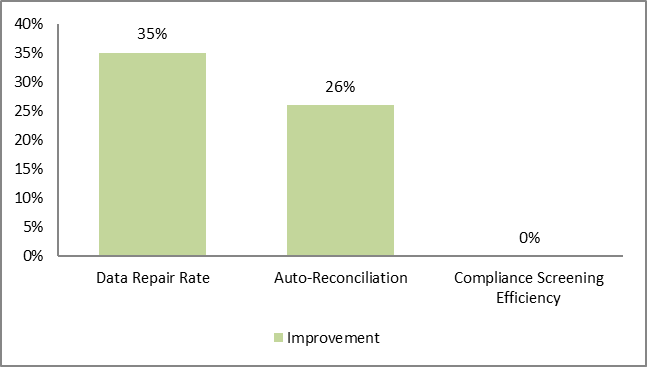
Figure 4: Graph representing Performance Outcome Analysis.
Data
repair rate: The fact that the
data repair rates become less is one of the fastest operational advantages of
the ISO 20022. The variability and the failure of validation through processing
of the input messages are greatly reduced by replacing the free-text fields in
the messages of the MT with outlay structured elements. Improved data quality
has implications of fewer manual interventions, quicker straight through
processing and less backlog on the part of investigation teams. This has the
direct effect of enhancing efficiency in operations and minimizing delays that
affect a customer.
Auto-Reconciliation: This enables greater automation of corporate recon ciliary systems
because the structured remittance information and consistent identifiers like
UETR and better data on debtors and creditors is available. The ERP platforms
have features that facilitate the matching of payments to the invoices more
precisely without the interventions of the human beings with more rich
transaction context that is carried about by the pain. This enhances cash
visibility, shortening of financial closing periods and decreasing the
reconciliation exceptions which leads to improved management of treasury
liquidity.
Compliance screening efficiency: Due to the granularity of party attributes embedded in ISO 20022,
including full beneficiary addresses, standard country and organization
identifiers, and disclosed fee information, there is an improvement in the
outcomes of compliance. This provides greater clarity on the false positives
that exist in sanctions and AML screening tools, and makes them easier to
resolve and focus on genuine alerts. The enhancement also helps in regulatory
traceability expectation and lowers the risk of compliance in its operations.
4.2. Risk considerations
There are a number of risks that the adoption
of ISO 20022 implements and they have to be forcefully addressed in order to
maintain continuity of operations and adherence to regulatory requirements
during the migration and after. The issue of version mismatch between different
versions is one of the most critical to consider, especially in the case of
payment initiation formats, including pain.001, where there are many versions
that exist (e.g., pain.001.001.03 vs. v09) across the world. The newer versions
may not be adopted by financial institutions and market infrastructures in the
same synchronic manner, which presents inconsistencies in mandatory vs.
conditional fields, tag naming conventions and business rules. This error may
cause rejection of a message or data loss. In curbing this, firms need to
deploy version consciousness transformation engines and have a centralized form
of governance on market specific implementation standards (such as CBPR+, HVPS+
and SEPA). One more important risk is insufficient incomplete remittance
mapping, which can be the result of old MT fields and which, in turn, are
highly based on narrative free-text formats. Critical trade or invoice data can
be lost when undergoing the conversion to ISO 20022 unless the data is extracted
and inserted into the structured tags with the data which is essential but
related to trade or invoice could be lost as it is not stuck on the structured
tags as required by the data is not stuck on the structured tags and under
Unless the data is properly extracted and inserted into the structural tags,
the data under data that is critical to the trade or invoice might be lost when
converted into the This affects the success rates of auto-reconciliation and
can add to volumes of exceptions of corporate customers. Rule-based enrichment
through which the business logic derives any missing attributes as standardized
reference formats and check completeness before transmission is the recommended
mitigation strategy. There is also a high level of severity of integration in
bank proprietary extensions. Despite the fact that ISO 20022 is meant to
introduce international standardization, most banks are adding their own tags
or local usage diversification to meet special product demands. These data
twist off interoperability and meaning that corporates and payment hubs must
construct bank-specific logic, which makes them harder to maintain over time.
Setting up robust deviation governance structures such as standardized
exception catalogs, architectural review boards and close compliance with SWIFT
and RTGS rulebooks assists in taming unwanted customization. The aggregation of
such risks underscores the importance of a strong data governance strategy,
ongoing validation and cooperation across all banks so that the transition to
ISO 20022 is not accompanied by any operational inefficiencies but rather
generates the desired impact of rich, structured and cross-bank payment data.
4.3. Corporate case (Pre-2023 Pilot)
In 2023 Isaac That was a pilot of ISO 20022
undertaken by a very large and multinational corporation to restructure its
disjointed global payments environment. Before the migration program, payment
processing was spread on 42 different countries with each region having its own
host-to-host file forms, proprietary validations and legacy MT messages to
connect with banks. This fragmentation established excessive overhead of
operations, irregular data quality, and low transparency of the payment status.
The ISO 20022 transformation program centralized this fragmented stream of
payments into a single global payment feed using standardized pain.001
initiation messages which are in line with CBPR+ protocols. The presentation of
a canonical data model facilitated the easy integration with different ERP
systems at the different business units without necessarily requiring localized
custom formats and the complexity of mapping was minimized. The pilot also
achieved quantifiable cost savings which included a savings of 22 percent in
cost of payment processing. This has been done by greater automation, lesser
manual repair work as well as dependency on regional payment gateways. Improved
exception handling and high success rates of straight-through-processing
scarcely helped to enhance operational efficiency. The change to formal
remittance information enabled corporate treasury departments to reconcile
payment-related information to enterprise reconciliation software more
precisely, which enhanced cash positioning and centralized liquidity control. About
four more things also occurred; the adoption of ISO 20022 lifecycle messages,
namely camt.052 (intra-day reporting), camt.053 (end-of-day reporting) and
camt.054 (credit/debit notifications), provided a standard status tracking
facility on all cross-border and domestic transactions. The pilot took
advantage of the UETR tagging to improve something in terms of traceability and
thus, it enabled them to resolve hold-ups fast and even reduced the number of
inquiries to banking partners. Time visibility on processing steps enhanced
transparency on vendors and compliance. In general, the pilot showed the
practical usefulness of ISO 20022 to corporate, justifying its ability to
streamline the international payment processing, enhance transparency, and
encourage the breadth of the growth in the ever-changing payment landscape.
5. Conclusion
The MT-to-MX conversion is a critical and
irrevocable modernization in the payment’s environment of the world. With
regulatory bodies and significant market infrastructures requiring the adoption
of ISO 20022, the financial institutions will need to break out of the
constraints of the legacy MT format in order to align to compliance, improved
operational efficiency, and enhancement of data exchange. The ISO 20022 pays bring
forth extremely organized and granular payment semantics, which demand
enhancements straight-through, accuracy in reconciliation, and screening
effectiveness of compliance. Such increased functions are not merely technical
improvements; these are strategic facilitating factors of faster, more open,
and more customer-oriented financial services. The study done in this project
shows that an effective migration is more than a one-to-one field conversion.
As an alternative, it needs to encompass a firm wide approach based on
canonical data design, semantic mapping intelligent, and logical rule
enforcement during transformation processes.
Results support the idea that risks associated
with transformation, e.g., schema fragmentation/incomplete remittance
mapping/bank specific deviations may be managed in cases where validation
structures formatively control syntax, semantics and alignment of market
practices. ISO 20022 improves end-to-end operational control by allowing
lifecycle communication using camt. status reporting and UETR-based
traceability, minimising the need to investigate and enhance customer
transparency expectations. The pre-2023 pre-corporate pilots that are witnesses
in the case attest to quantifiable savings that are achieved by lower
processing costs, inter-jurisdictional consolidated feeds and substantial gains
of automation within Treasury ecosystems.
The greater the time taken by coexistence to
reach deadlines stipulated in the mandate, the stronger the pressure
experienced by institutions to modernise integration, testing and governance
practices. Ongoing updates to the version, some maturation in regulatory
demands and a growing number of cross-border interoperability plans imply that
the process of ISO 20022 migration can be considered a long-term strategic
development, rather than a onetime compliance project. Developing a robust
governance model will be such that all the business units, payments,
compliance, cash management as well as reporting will be in line with standards
that may mature post-2025.
Another wider industry trend noted in the
research is the increase in payment data being a key asset that can be
converted into risk information, business intelligence, and the development of
an innovative customer experience. The emerging technologies, which have been
given the foundation by ISO 20022, include real-time payments, exception
handling based on AI, and blockchain-based networks used to settle. Through an
organized approach to transformation and the continued involvement in
harmonization processes on the global level, institutions have a chance to
future-proof their payment infrastructures, as well as to create a new value to
corporate and retail customers.
Finally, this modernization program sets
Treasury & Payments at the edge of a more interconnected and data-rich
financial ecosystem in which interoperability, automation, and transparency are
the new normal of paying and receiving payment in the global system.
6. References
- Dubey S.
Blockchain-based Payment Systems: A Bibliometric & Network Analysis, 2022.
- Bellacosa
M. The payments revolution. Journal of Payments Strategy & Systems, 2019;13:
237-241.
- Taggart
J, Liaw ST, Yu H. Structured data quality reports to improve EHR data quality.
International Journal of Medical Informatics, 2015;84: 1094-1098.
- Batini C, Cabitza F, Cappiello C,
et al. A comprehensive data quality
methodology for web and structured data. International Journal of Innovative
Computing and Applications, 2008;1: 205-218.
- Anderloni L,
Carluccio EM. Access to bank accounts and
payment services. In New frontiers in banking services: Emerging needs and
tailored products for untapped markets (pp. 5-105). Berlin, Heidelberg:
Springer Berlin Heidelberg, 2007.
- Major T, Mangano J. Modernising payments messaging:
The ISO 20022 standard. 1. 1 Managing the Risks of Holding Self-securitisations
as Collateral 2. 11 Government Bond Market Functioning and COVID-19 3. The
Economic Effects of Low Interest Rates and Unconventional 21 Monetary Policy 4.
Retail Central Bank Digital Currency: Design Considerations, Rationales, 2020;66.
- Maurer B. Mobile money: Communication, consumption and
change in the payments space. Journal of Development Studies, 2012;48: 589-604.
- Kangas V. Canonical data model in principal connections, 2018.
- Hewitt C.
Actor model of computation: scalable robust information systems, 2010.
- Chaudhri AB, Rashid
A, Zicari R. XML data management: native
XML and XML-enabled database systems. Addison-Wesley Professional, 2003.
- Constantino JCS. Adoption of ISO 20022 for Payments
(Master's thesis, Universidade Aberta), 2022.
- Shah V. The integrity of digital technologies in the evolving
characteristics of real-time enterprise architecture (Doctoral dissertation,
Middlesex University), 2021.
- Hofmann C. Understanding the benefits of SWIFT gpi for
corporates. Journal of Payments Strategy & Systems, 2018;12: 346-350.
- Kennel J. Exploring coexistence in the securities
industry: Why the ISO 20022 central dictionary is the key to interoperability
and realising data opportunities. Journal of Securities Operations &
Custody, 2022;14: 152-161.
- Kim C, Mirusmonov M, Lee I. An empirical examination of factors
influencing the intention to use mobile payment. Computers in human behavior, 2010;26:
310-322.
- Cook S, Soramaki K. The global network of payment
flows, 2014.
- Governatori G,
Hoffmann J, Sadiq S, et al. Detecting
regulatory compliance for business process models through semantic annotations.
In International Conference on Business Process Management, 2008: 5-17.
- Bruggink D, Karsten P, de Meijer C. The European cards environment and
ISO 20022. Journal of Payments Strategy & Systems, 2012;6: 80-99.
- Drewitt T. A Manager's Guide to ISO22301: A practical guide to developing and implementing a business continuity management system. IT Governance Ltd, 2013.
- Haataja E, Stackenäs W. Constructing a Decentralized
Communication System Compliant with the Iso 20022 Financial Industry Message
Scheme, 2021.