Next-Gen Fintech: Exploring the Potential of 5G and the Role of Network Engineering
Comparative Study of Fine Needle
Aspiration Cytology and Histopathology Results of Salivary Gland Swelling in St.
Paul’s Hospital Millennium Medical College, Addis Ababa, Ethiopia
Mohammed Sefa Arusi Dari1*, Zeyneb Saleh Hassen2 and Zelalem Tadesse Wondimu3
¹Department
of Otolaryngology Head and Neck Surgery, Addis Ababa University, Addis Ababa,
Ethiopia
2General Practitioner, St. Paul Hospital
Millennium Medical College, Addis Ababa, Ethiopia
3Department of Internal Medicine, Wolkite
University, Wolkite, Ethiopia
*Corresponding author: Mohammed Sefa Arusi Dari, Department of Otolaryngology
Head and Neck Surgery, Addis Ababa University, Addis Ababa, Ethiopia, E-mail: [email protected]
Received: February 01, 2025, Accepted:
February 17, 2025, Published: March 19, 2025
Citation: Mohammed Sefa Arusi Dari. Comparative Study
of Fine Needle Aspiration Cytology and Histopathology Results of Salivary Gland
Swelling in St. Paul’s Hospital Millennium Medical College, Addis Ababa,
Ethiopia. World J Surg Surgical Case Rep. 2025;1(1): 1-17.
Copyright: ©2025 Mohammed
Sefa Arusi Dari. This is an
open-access article distributed under the terms of the Creative Commons
Attribution License, which permits unrestricted use, distribution, and
reproduction in any medium, provided the original author and source are
credited.
Abstract
Background: Fine-Needle Aspiration Cytology (FNAC) is a
widely accepted, safe, and cost-effective diagnostic tool for evaluating
salivary gland swellings. It helps differentiate between benign, inflammatory,
and malignant lesions, aiding in surgical planning and management.
Objective: This study aimed to compare FNAC results with
histopathology findings to assess the diagnostic accuracy of FNAC in evaluating
salivary gland swellings at St. Paul’s Hospital Millennium Medical College,
Addis Ababa, Ethiopia.
Methods: A four-year hospital-based cross-sectional
study was conducted on patients with salivary gland swellings who underwent
both FNAC and histopathology at St. Paul’s Hospital Millennium Medical College
from January 1, 2019, to August 30, 2022. Data were collected using a
standardized questionnaire and analyzed using SPSS version 27. Sensitivity,
specificity, Positive Predictive Value (PPV), Negative Predictive Value (NPV),
and accuracy were calculated using histopathology as the gold standard.
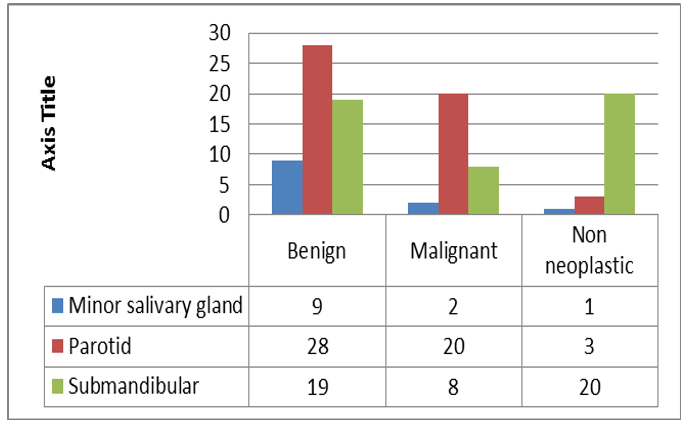
Results: Of the 475 FNACs performed, 110 cases had
correlating histopathology results. The parotid gland was the most commonly
affected site (46.4%), followed by the submandibular gland (42.7%) and minor
salivary glands (10.9%). FNAC demonstrated high sensitivity, specificity, and
accuracy: 100%, 98.83%, and 99.09% for non-neoplastic lesions; 96.4%, 92.6%,
and 94.5% for benign neoplasms; and 83.3%, 95.5%, and 94.54% for malignant
neoplasms, respectively.
Conclusion: FNAC is a highly sensitive and specific
diagnostic tool for evaluating salivary gland swellings. It is reliable for
preoperative planning and can help avoid unnecessary surgical interventions.
Keywords: Salivary gland, Fine needle aspiration
cytology, Histopathology, Diagnostic accuracy