Personalized Career Pathway: A Hybrid Machine Learning Approach for Dynamic Recommendations
Abstract
This
paper presents a conceptual framework for a hybrid machine learning-driven
career pathway recommendation system designed to provide personalized, dynamic
and real-time job transition insights. The proposed system leverages
skill-centric approaches using content-based and collaborative filtering to
match users with relevant job opportunities and suggest targeted upskilling
pathways. Real-time adaptability is integrated to ensure that the
recommendations remain current, reflecting changes in user profiles and market
demands. Furthermore, temporal analysis is employed to predict career
progression patterns, enabling users to make informed decisions about future
transitions and milestones. By combining these approaches, the framework aims
to offer a comprehensive solution for personalized career guidance, addressing
key challenges such as data sparsity, real-time updates and evolving career
trajectories. This paper outlines the design and potential applications of the
framework while discussing the benefits, challenges and future research
directions.
Keywords:
Artificial intelligence (AI), Career pathway recommendation, Collaborative filtering,
Temporal analysis
1.
Introduction
A.
Background and motivation
In
today’s rapidly evolving job market, career pathways are no longer linear.
Individuals frequently shift roles, industries and skill sets, making career
planning a complex process. The increasing diversity in career options, coupled
with the dynamic nature of job requirements, calls for more sophisticated
systems that can guide users toward optimal career decisions.
Traditional
job recommendation systems, which primarily rely on static models, often fail
to adapt to these dynamic changes and offer limited insight into long-term
career growth.

Figure
1:
Life Cycle of Career Transition11.
Moreover,
such systems typically provide recommendations based on current job openings,
without accounting for the user’s long-term career trajectory or potential
skill development. Consequently, users may miss out on opportunities that align
better with their future goals or emerging industry trends. Therefore, there is
a growing need for intelligent systems capable of personalized and
forward-looking career guidance.
A
hybrid machine learning framework that integrates multiple approaches can
effectively address this need. By combining skill-based filtering, real-time
adaptability and temporal analysis, the proposed framework can offer tailored,
dynamic recommendations that evolve alongside a user’s career journey. This
holistic approach not only improves immediate job matching but also enables
users to plan their future transitions more strategically by identifying
potential growth pathways and skill gaps.
B.
Objectives
The
primary objectives of this research are as follows:
- To
propose a hybrid machine learning framework that leverages skill-based
filtering, collaborative filtering and temporal analysis to offer personalized
career recommendations.
- To
integrate real-time adaptability by designing a system capable of updating
recommendations dynamically in response to changes in user profiles and job
market conditions.
- To
incorporate temporal analysis for predicting future career roles and
milestones, enabling users to make informed decisions about their long-term
career progression.
- To
address the challenge of upskilling by recommending targeted learning resources
based on identified skill gaps and industry trends.
This
framework aims to bridge the gap between current job recommendation systems and
the need for dynamic, future-oriented career guidance. By doing so, it seeks to
empower individuals in navigating complex career landscapes while ensuring
continuous professional growth.
2.
Related Work
The
field of job recommendation systems has evolved significantly over the years,
driven by the need to streamline job search processes and improve the quality
of candidate-job matches.
Traditional
approaches have focused on static models, while more recent research has
explored dynamic and personalized solutions that adapt to changing user
profiles and job market conditions. This section reviews existing literature in
three key areas: job recommendation systems, skill-based filtering and temporal
analysis for career pathways.
A.
Job recommendation systems
Recommendation
systems play a crucial role in simplifying job search by automating the process
of matching candidates with relevant job opportunities. Existing approaches can
be broadly categorized into content-based filtering, collaborative filtering
and hybrid models.
Content-based
filtering involves recommending jobs based on user profiles and job
descriptions using algorithms like TF-IDF, cosine similarity and topic modeling1. Collaborative filtering, on the other
hand, predicts user preferences by analyzing similarities between users or
items, which has been successfully applied in systems designed for online job
portals2.
Hybrid
models combine these two approaches to overcome challenges like cold start and
data sparsity. For instance, Mulay et al. proposed a hybrid job recommendation
system that integrates content-based and collaborative filtering to improve
recommendation accuracy3. Despite
their advantages, most existing systems struggle to provide real-time updates
or account for the dynamic nature of career pathways, limiting their
applicability for long-term career planning4.
B.
Skill-based filtering
Skill
extraction and analysis are critical components in personalized career
recommendation systems. Various Natural Language Processing (NLP) techniques,
including TF-IDF and cosine similarity, have been used to identify and match
skills from resumes and job descriptions5.
These techniques help in constructing skill-based user profiles that are
crucial for offering personalized recommendations6.
Skill-based
filtering has gained importance due to its ability to recommend personalized
upskilling pathways. Research by Patel and Vishwakarma highlights the
integration of skill profiles with collaborative filtering to enhance
recommendation quality7.
Furthermore, Kumar et al. demonstrated the utility of hybrid filtering
techniques in technical job recommendation systems, emphasizing skill-matching
as a core component8. By focusing
on users' skill gaps and future requirements, skill-based systems are well-suited
for guiding users toward long-term career growth.
C.
Temporal analysis in career pathways
Temporal
analysis plays a pivotal role in understanding career trajectories and
predicting future job roles. Techniques such as Recurrent Neural Networks
(RNNs) and Long Short-Term Memory networks (LSTMs) have been employed to model
sequential patterns in user behavior. For example, Parthasarathy and Shanmugam
developed a hybrid system that uses temporal data to predict user preferences
dynamically9.
Temporal
models have significant advantages in career pathway systems by enabling
proactive recommendations based on anticipated user transitions. The use of
such models can help identify potential career milestones and suggest timely
interventions, such as targeted learning opportunities10. These models enhance the ability of
recommendation systems to provide forward-looking guidance, making them
particularly useful in dynamic job markets.
While
existing approaches in job recommendation systems, skill-based filtering and
temporal analysis have advanced the field significantly, most current systems
lack a unified framework that combines these aspects into a holistic solution.
This paper proposes a hybrid machine learning framework that integrates
skill-centric filtering, real-time adaptability and temporal analysis to
address the limitations of existing systems. The next section outlines the
design of the proposed framework, detailing how these components are integrated
to deliver personalized, dynamic and forward-looking career recommendations.
3.
Hybrid Framework for Personalized Career Pathway Recommendations
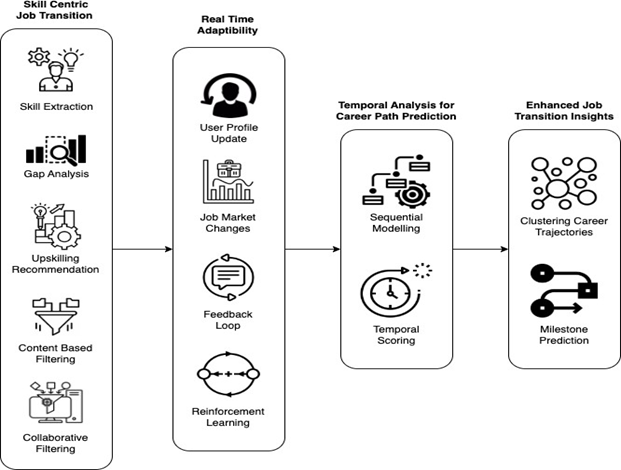
Figure 2: Hybrid Framework
for Personalized Career Pathway Recommendations.
The proposed framework presents a hybrid machine learning-driven solution for personalized career pathway recommendations. It integrates multiple components, including skill-centric filtering, real-time adaptability and temporal analysis, to deliver dynamic and forward-looking guidance. By combining these elements, the framework ensures that users receive not only immediate job recommendations but also proactive suggestions for long-term career planning.
A. Skill-centric job transition framework
- Skill
Extraction and gap analysis: The core of the framework lies in
skill-based analysis, which involves identifying key skills from user profiles
and job descriptions. Natural Language Processing (NLP) techniques such as Term
Frequency-Inverse Document Frequency (TF-IDF) and cosine similarity are
employed to extract and compare relevant skills.
- Skill
extraction: Job descriptions are parsed to derive required
skills, while user profiles are analyzed to determine the existing skill set.
- Gap
analysis:
The system identifies skill gaps by comparing the user’s current skill set with
the skills required for desired roles.
- Upskilling
recommendations: Based on the detected gaps, a dynamic upskilling
engine suggests relevant courses, certifications or training programs, helping
users to bridge skill gaps and enhance employability.
- Content-based
and collaborative filtering
To ensure personalized and diverse recommendations, the framework combines content-based and collaborative filtering methods: - Content-Based
Filtering:
This method recommends jobs by matching the user’s skill set with job
requirements, ensuring that the suggested roles align with the user’s expertise
and interests.
- Collaborative
Filtering:
By analyzing the behavior of similar users, such as the jobs they applied for
or accepted, the system generates additional recommendations, addressing
scenarios where explicit content matching may fall short.
B.
Real-Time Adaptability
- Real-Time
Data Handling: The job market and user preferences evolve rapidly,
necessitating real-time adaptability in the recommendation system. The proposed
framework trigger updates whenever significant changes occur, such as:
- User
Profile Updates: When users add new skills, certifications or job
preferences, the system immediately recalculates recommendations.
- Job
Market Changes: New job postings or changes to existing ones are
incorporated into the recommendation engine in real time.
This
real-time data handling ensures low-latency updates, keeping the
recommendations relevant and current.
- Feedback
loop for continuous improvement: User interactions with the system,
such as viewing, applying for or accepting jobs, are tracked to continuously
improve the recommendation quality. The system incorporates a feedback loop
where:
- User
Actions:
Data on user engagement is fed back into the system to fine-tune future
recommendations.
- Reinforcement
Learning:
Advanced reinforcement learning techniques can be employed to optimize the
recommendation engine over time, ensuring that it adapts to user preferences
and behavior.
C.
Temporal analysis for career path prediction
- Sequential
modeling: Career
progression often follows sequential patterns, making temporal analysis crucial
for predicting future roles. The framework proposes the use of sequential
models, such as Long Short-Term Memory (LSTM) networks or Recurrent Neural
Networks (RNNs), to capture these patterns.
- Key
Features:
The models analyze temporal patterns, including average tenure in roles and the
frequency of transitions, to understand user behavior over time.
- Prediction: Based
on these patterns, the system predicts potential future roles, helping users
make informed career decisions.
- Temporal
scoring mechanism: In addition to sequential modeling, a
temporal scoring mechanism is introduced to prioritize potential job
transitions.
- Scoring: Each
transition is assigned a score based on factors such as time-to-goal (the
expected time required to achieve a desired role) and career growth potential.
- Milestone
Identification: The system identifies key career milestones, such as
readiness for promotion or eligibility for leadership roles, enabling users to
take timely actions.
D.
Enhanced job transition insights
- Clustering
career trajectories: Clustering techniques are used to group
users with similar career trajectories, offering deeper insights into common
patterns of career progression.
- Clustering
algorithms: Users are clustered based on factors like job roles,
industries and skill sets.
- Insights: These
clusters provide valuable insights into successful career paths, which can be
leveraged to recommend potential pathways for users with similar backgrounds.
- Milestone
prediction: In addition to clustering, the framework predicts
significant career milestones for users.
- Promotion
readiness:
The system identifies when a user is likely ready for a promotion based on
historical patterns and current skill levels.
- Leadership
eligibility: Recommendations for leadership or managerial roles
are provided when users meet predefined criteria.
- Next
steps:
Based on predicted milestones, the system suggests optimal next steps,
including targeted upskilling or role transitions, ensuring users stay on track
toward long-term career goals.
This
framework integrates skill-centric analysis, real-time adaptability and
temporal insights to deliver a comprehensive and personalized approach to
career guidance. By dynamically addressing skill gaps, adapting to evolving job
markets and predicting future career milestones, it empowers users to make
informed decisions and proactively shape their career trajectories.
This
holistic approach enhances the relevance and effectiveness of job
recommendations, ultimately supporting continuous professional growth and
long-term career success.
4.
Discussion
A.
Benefits of the proposed framework
The
proposed framework offers several key benefits that enhance its utility in
personalized career guidance:
- Enhanced
personalization: By leveraging skill-based filtering and dynamic
upskilling suggestions, the framework ensures that job recommendations are
highly tailored to an individual’s unique profile. This personalized approach
not only improves the relevance of job matches but also helps users proactively
address skill gaps.
- Real-time
adaptability: The integration of real-time data handling mechanisms
allows the framework to continuously update recommendations based on the latest
user inputs and market conditions. This ensures that users receive up-to-date
career advice in a fast-paced and constantly evolving job market.
- Temporal
insights for career planning: Temporal analysis enables the framework
to identify patterns in career trajectories, predict future roles and suggest
optimal transitions. This forward-looking capability helps users make strategic
career decisions, such as when to seek promotions or pursue leadership roles.
B.
Challenges and considerations
While
the proposed framework presents numerous advantages, there are also challenges
and considerations that must be addressed to ensure effective implementation:
- Data
sparsity and quality issues: Personalized recommendations rely heavily
on high-quality data. In cases where user profiles or job descriptions lack
sufficient information, the performance of content-based and collaborative
filtering models may be limited. Ensuring accurate and complete data collection
is crucial for optimal results.
- Infrastructure
for real-time updates: Implementing real-time adaptability
requires a well-designed, low-latency infrastructure. Event-driven
architectures and message queues must be efficiently managed to handle rapid
data changes without compromising performance.
- Fine-tuning
temporal models: Temporal models such as LSTMs and RNNs require
careful tuning to capture career progression patterns accurately. Differences
in industries, job roles and individual career paths may necessitate
domain-specific adjustments to ensure that predictions remain reliable across
diverse user segments.
C.
Potential use cases: The versatility of the proposed framework
allows it to be applied across various domains where personalized career
guidance is needed. Key potential use cases include:
- Career
guidance platforms: Platforms offering personalized career
transition and progression advice can leverage the framework to enhance their
recommendation systems. These platforms can benefit from real-time adaptability
and skill-centric guidance to improve user satisfaction and engagement.
- Educational
platforms:
Learning platforms focused on professional development can use the framework to
recommend courses, certifications and learning paths that align with users’
career goals. This ensures that learners are equipped with the right skills to
pursue their desired career transitions.
By
addressing these challenges and leveraging its diverse applications, the
proposed framework has the potential to transform how individuals and
organizations approach career planning and development.
5.
Conclusion and Future Work
This
paper proposes a conceptual framework for a hybrid machine learning-based
career pathway recommendation system aimed at providing personalized and
dynamic career guidance. The framework integrates skill-based filtering,
real-time adaptability and temporal analysis to address critical challenges in
career planning, such as identifying skill gaps, predicting future roles and
offering timely upskilling suggestions. By incorporating real-time data
handling, the system ensures that recommendations remain relevant in rapidly
evolving job markets, enabling users to make well-informed career decisions.
The
skill-centric approach ensures that users receive highly personalized
recommendations by matching their current skill sets with job requirements and
suggesting targeted upskilling pathways. Temporal analysis further enhances
this by offering insights into long-term career trajectories and predicting
future milestones. Together, these components create a comprehensive framework
that can proactively guide users in navigating their career paths.
Despite
its promising design, this framework remains conceptual and requires further
research and development for real-world application. Future work could focus on
implementing and validating the framework using real-world datasets from
different industries. This would help in identifying practical challenges,
refining the framework’s performance and ensuring its adaptability across
diverse user segments.
Additionally,
exploring advanced deep learning models, such as transformers, for enhanced
skill extraction and temporal prediction could significantly improve the
precision and robustness of the recommendations. Expanding the framework’s
scope to support cross-industry career transitions and developing mechanisms
for mapping transferable skills across domains would further enhance its
applicability.
Ultimately,
by addressing these areas in future research, the proposed framework can evolve
into a powerful tool for personalized career planning. It holds the potential
to transform how individuals approach career transitions and lifelong learning,
ensuring continuous professional growth in an ever-changing job market.
6.
References
- Yang S, Korayem M,
AlJadda K, Grainger T and Natarajan S. “Combining content-based and
collaborative filtering for job recommendation system: A cost-sensitive
statistical relational learning approach,” Knowl. Based Syst, 2017;136:37-45.
- Zhang Y, Yang C
and Niu Z. “A research of job recommendation system based on collaborative
filtering,” in Proc. 7th Int. Symp. Comput. Intell. Design, 2014;1:533-538.
- Mulay A, Sutar S,
Patel J, Chhabria A and Mumbaikar S. “Job recommendation system using hybrid
filtering,” ITM Web Conf, 2022.
- Mishra R and Rathi
S. “Efficient and scalable job recommender system using collaborative filtering,”
in Lecture Notes in Electrical Engineering, vol 601. Springer, Singapore, 2020;842-856.
- Afoudi Y, Lazaar M
and Al Achhab M. “Hybrid recommendation system combined content-based filtering
and collaborative prediction using artificial neural network,” Simul. Model.
Pract. Theory, 2021;113:102375.
- Chen W, Zhang X, Wang H and Xu H. “Hybrid deep collaborative
filtering for job recommendation,” in Proc. IEEE Int. Conf. Comput. Intell.
Appl, 2017;275-280.
- Patel R and
Vishwakarma S. “An efficient approach for job recommendation system based on
collaborative filtering,” in ICT Systems and Sustainability. Advances in
Intelligent Systems and Computing, 2020;1077:169-176.
- Kumar N, Gupta M, Sharma D and Ofori I. “Technical job recommendation system using APIs and web crawling,” Comput. Intell. Neurosci, 2022;2022:7797548.
- Parthasarathy G
and Shanmugam SD. “Hybrid recommendation system based on collaborative and
content-based filtering,” Cybern. Syst., 2022;54:432-453.
- Choudhary S, Koul S, Mishra S, Thakur A and Jain R. “Collaborative job prediction based on naïve Bayes classifier using python platform,” in Proc. Int. Conf. Comput. Syst. Inf. Technol. Sustain. Solutions, 2016;302-306.
- https://www.seasonsofchange.com/career-change-tips .