The Future of Enterprise ERP Modernization with AI: From Monolithic Systems to Generative, Composable, and Autonomous Platforms
Abstract
Enterprise Resource Planning (ERP) systems have long served as the
backbone of enterprise integration, bringing together finance, supply chain,
HR, and operations into unified platforms. From the early 2000s, when
on-premises suites like Oracle E-Business Suite, SAP ECC, and PeopleSoft
dominated the landscape, ERP steadily advanced through phases of
service-oriented architectures and the widespread adoption of cloud-based
models that emphasized scalability, accessibility, and reduced total cost of
ownership. By February 2025, the trajectory has shifted further toward
AI-native ERP platforms, where generative AI copilots streamline user
interactions, process mining enables continuous optimization, and composable
architectures allow organizations to reconfigure capabilities with agility.
This evolution reflects not only technological innovation but also a
transformation in enterprise operating models, positioning AI as a strategic
enabler that redefines how organizations plan, execute, and adapt. This paper
synthesizes more than two decades of ERP evolution and examines how artificial
intelligence (AI) is shaping the future of modernization, with architectural
diagrams illustrating the patterns and design shifts driving this next era.
Keywords: Enterprise ERP modernization; AI copilots; generative AI; process
mining; composable ERP; cloud ERP; Oracle Fusion; SAP Joule; Microsoft Dynamics
365; Workday Illuminate; ERP migration; digital transformation
1. Introduction
Since the early 2000s, ERP
modernization has consistently been shaped by business and technology
imperatives: reducing operational costs, breaking down functional silos, and
enabling digital transformation at scale. Legacy ERP systems such as Oracle
E-Business Suite, SAP ECC, and PeopleSoft were built for stability and
governance, providing standardized workflows and compliance frameworks. While
these systems delivered consistency and reliability, they were also rigid,
often requiring long customization cycles that hindered business agility.
Organizations found themselves locked into complex, monolithic platforms that
could not easily adapt to rapidly changing market conditions.
The 2010s ushered in the
era of cloud ERP, with solutions like Oracle Fusion, SAP S/4HANA Cloud,
Microsoft Dynamics 365, and Workday reshaping expectations. These
service-centric and SaaS-based platforms emphasized flexibility, faster
deployment, and lower infrastructure overhead. Cloud ERP also democratized
access, giving enterprises the ability to scale globally and integrate
seamlessly with SaaS ecosystems. By 2020, hybrid deployment models-where
critical workloads remained on-premises but analytics and extensions ran in the
cloud-had become mainstream. Self-service analytics tools further empowered
business units, reducing reliance on IT teams for routine reporting and
analysis.
By 2025, ERP modernization has entered a new phase defined by artificial intelligence at the core of
enterprise operations. The rise of AI copilots, chatbots, and generative
assistants has fundamentally changed the way users interact with ERP systems-moving
from transactional data entry to conversational, context-aware engagement.
Predictive analytics and anomaly detection are now embedded directly into
finance, supply chain, and HR processes, enabling proactive decision-making
rather than reactive analysis. Process mining and automation tools continuously
optimize workflows, identifying inefficiencies and recommending corrective
actions in near real time.
This transition marks a deeper cultural and architectural shift.
Whereas past modernization waves focused primarily on cost reduction or
platform migration, the AI-driven era positions ERP as a dynamic, learning system capable of
evolving alongside the business. Copilots reduce complexity for end users,
predictive intelligence strengthens decision quality, and composable
architectures enable enterprises to reconfigure ERP capabilities as modular
building blocks. Together, these innovations ensure that ERP is no longer just
a back-office system of record-it is a strategic
engine of adaptability and competitive differentiation in the age of
digital transformation.
2. ERP and AI Convergence
The integration of AI into ERP has three major dimensions:

Figure 1: ERP AI Chatbot &
Copilot Integration.
As in (Figure 1) ERP platforms are embedding conversational
AI, copilots, and chatbots that leverage natural language understanding (NLU)
and dialogue management to guide users. Instead of navigating complex ERP
menus, employees can query systems in plain language to retrieve reports,
initiate workflows, or validate transactions. These copilots enhance
productivity by reducing friction, automating repetitive tasks, and enabling
new users to engage effectively with ERP platforms without extensive training.
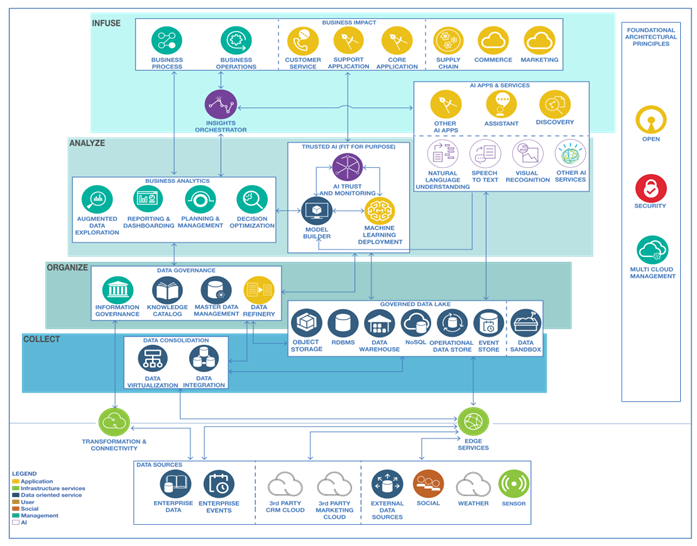
Figure 2: Analytics
Architecture for ERP Modernization.
As shown on (Figure 2), AI-powered ERP modernization extends
far beyond operational automation. As shown in the analytics reference
architecture, ERP is now deeply integrated with broader enterprise data
ecosystems that collect, organize, and analyze structured and unstructured
sources. AI techniques such as predictive modeling, anomaly detection, and
process mining enable organizations to transition from descriptive reporting to
proactive insights. This analytics-driven layer transforms ERP into a
decision-support hub, where raw transactions are continuously refined into
strategic intelligence that informs planning, budgeting, and operational
adjustments.

Figure 3: Generative AI
Architecture for ERP.
(Figure 3) highlights how the third dimension is the rise of generative AI integration within ERP,
supported by architectures combining large language models (LLMs), retrieval
pipelines, fine-tuned models, and secure APIs. As illustrated in Fig. 3, this
enables ERP systems to generate human-readable narratives, contextual
recommendations, and explainable forecasts, bridging the gap between data
complexity and executive decision-making. Coupled with composable ERP
principles, generative AI allows enterprises to modularize ERP capabilities.
3. ERP Modernization Patterns
The figure illustrates a general
ERP system design, with a central ERP engine connected to financials,
HR, inventory, reporting, supply chain, and customer-facing applications. In
the context of AI-driven ERP
modernization, this classical architecture is being re-imagined along
four critical dimensions (Figure 4):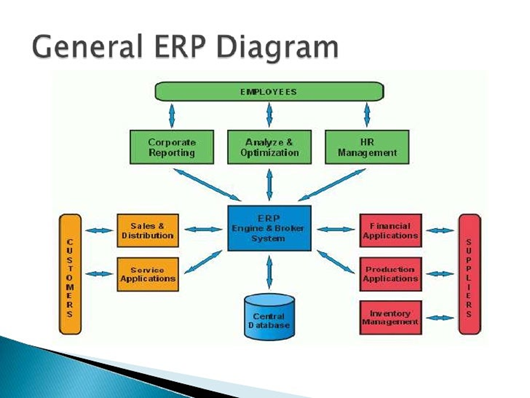
Figure 4: Oracle ERP System
Architecture.
- Composable
architectures: Traditional
ERP engines (as shown at the center of Fig. 4) are evolving into Packaged
Business Capabilities (PBCs) and microservices. Instead of monolithic upgrades,
organizations can now adopt AI-driven modules for forecasting, anomaly
detection, or demand planning incrementally. This modularity allows ERP to be
tailored to industry needs while enabling faster innovation cycles.
- Hybrid ERP models: Whereas the figure highlights
a single central database, in practice, modern ERP increasingly spans hybrid
environments. Core financials and compliance-sensitive workloads may remain
on-premises, while AI copilots, advanced analytics, and decision-intelligence
services are delivered from the cloud. This hybrid orchestration ensures
compliance, scalability, and resilience while unlocking AI-driven productivity.
- Process mining
& Automation: Beyond
transactional integration, process mining tools like Celonis now plug directly
into ERP data flows to discover inefficiencies in areas such as HR onboarding,
procurement, or sales order fulfillment. This continuous process intelligence
layer transforms the static “ERP broker” shown in Fig. 4 into a self-optimizing
engine that automates repetitive steps and recommends improvements in real
time.
- Change management
& Adoption: Finally,
ERP modernization is not solely a technical shift. Employees, represented at
the top of (Figure 4), must adapt to AI copilots, predictive
dashboards, and conversational interfaces that reshape their roles. Successful
modernization therefore requires structured training, governance frameworks,
and ethical AI guidelines that build trust, transparency, and compliance into
the decision-support fabric.
In essence, AI is
transforming ERP from a centralized system of record into a distributed,
intelligent system of decisions. While the figure reflects the
foundational model, modernization redefines each component into a dynamic,
AI-augmented service, enabling enterprises to balance governance, agility, and innovation in the AI era.
4. Case Examples (2023-2025)
- Case - Oracle Fusion ERP (2024-2025): Oracle has positioned Fusion ERP at the
forefront of AI-enabled enterprise platforms by embedding generative AI assistants directly into
financial, supply chain, and HR modules. These copilots are designed to draft
narrative reports, summarize large volumes of transactional data, and provide
scenario-based recommendations for planners and decision-makers. In financials,
the assistant can automatically generate variance analyses and audit
narratives; in supply chain management (SCM), it offers predictive demand
forecasting and supplier risk assessments; and in HR, it supports workforce
planning by analyzing attrition patterns and skill gaps. Oracle’s integration
of AI within ERP reflects its broader vision of “autonomous enterprise
systems,” where core processes self-optimize in near real time.
- Case - SAP Joule (2024): SAP introduced Joule, a conversational AI copilot that spans procurement, supply
chain, and HR processes. Unlike traditional assistants, Joule emphasizes natural language grounding, enabling
users to ask questions in plain language and receive contextually relevant
responses sourced from ERP data and external systems. For procurement, Joule
can flag vendor risks, automate purchase requisitions, and recommend sourcing
alternatives. In HR, it surfaces insights on employee performance, diversity,
and retention, while in supply chain management it generates optimization
scenarios that balance costs, lead times, and sustainability goals. Joule
reflects SAP’s long-term vision of embedding AI within its “Business Technology
Platform,” positioning ERP not just as a transactional backbone but as a
decision-intelligence hub.
- Case - Microsoft dynamics 365 Copilot (2024): Microsoft reframed ERP modernization through
its Dynamics 365 Copilot,
marketed as an agentic ERP layer
that provides contextualized recommendations across sales, finance, and
operations. Unlike earlier rule-based ERP assistants, Dynamics Copilot
leverages Microsoft’s integration with Azure OpenAI Service to generate
insights from structured ERP data and unstructured documents, such as contracts
or emails. The system not only automates repetitive tasks like drafting
customer communications or financial summaries, but also delivers predictive
guidance for inventory planning, invoice reconciliation, and field service
scheduling. Microsoft emphasizes collaborative
intelligence, where the copilot augments rather than replaces
decision-making, empowering business analysts and citizen developers alike.
- Case - workday illuminate (2024): Workday’s Illuminate introduced AI-driven insights across HR and finance
workflows, marking a significant step in embedding machine learning and
generative AI into the employee experience. Illuminate provides context-aware recommendations such as
personalized career development plans, proactive alerts for payroll anomalies,
and scenario modeling for financial planning. Its strength lies in human-centered AI design, ensuring
that HR leaders and finance managers can interpret insights in an explainable
and transparent manner. Illuminate further integrates with Workday’s Adaptive
Planning suite, enabling predictive scenario testing that helps enterprises
balance workforce agility with financial resilience.
5. Conclusion
ERP has undergone a profound transformation over the past two
decades, evolving in response to shifting business demands, advances in
enterprise architecture, and disruptive technologies. In the 2000s, ERP
platforms were characterized by rigid,
centralized monoliths, where standardization and governance were
prioritized but innovation was constrained. These legacy systems required heavy
customization and lengthy upgrade cycles, often slowing organizations’ ability
to adapt. The 2010s introduced a new paradigm with cloud-enabled ERP platforms, such as Oracle Fusion, SAP S/4HANA
Cloud, Microsoft Dynamics 365, and Workday, which emphasized agility,
subscription-based scalability, and integration with broader SaaS ecosystems.
This cloud-first approach allowed enterprises to break free from infrastructure
constraints, reduce TCO, and embrace hybrid deployment models that blended
on-premises resilience with cloud-driven innovation.
By 2025, ERP has entered its AI-native era, reshaping itself into composable ecosystems that are modular, intelligent, and adaptive.
As Figures 1-4 illustrate, this transformation has several dimensions.
Conversational AI copilots
enable users to interact with ERP systems through natural language, drastically
lowering the barrier to entry and empowering employees across functions. Predictive and generative intelligence
turn ERP from a system of record into a system of foresight, providing scenario
modeling, anomaly detection, and AI-generated narratives for decision-making. Composable modularity allows ERP
functions to be delivered as Packaged Business Capabilities (PBCs) that can be
combined, extended, or replaced with ease, ensuring enterprises are no longer
tied to inflexible upgrade cycles. Finally, secure cloud-hybrid architectures integrate AI services with
robust governance, ensuring that enterprises can innovate while maintaining
compliance, data sovereignty, and resilience.
This new model signals that the future of ERP is not confined to automation of transactions, but rather
the continuous, AI-driven optimization
of processes across finance, supply chain, HR, and customer operations.
ERP modernization is becoming the foundation for enterprise adaptability, enabling organizations to sense, predict,
and act in near real time. Far from being back-office infrastructure, ERP is
evolving into the core enabler of
digital transformation, ensuring that enterprises remain competitive, intelligent,
and resilient in the decade ahead.
6.
References
- https://hbr.org/1998/07/putting-the-enterprise-into-the-enterprise-system
- Klaus H, Rosemann M, Gable GG. What is ERP? Information Systems Frontiers, 2000;2:
141-162.
- Al-Mashari
M. Enterprise resource planning (ERP) systems: A research agenda. Industrial Management & Data Systems,
2001;101: 22-27.
- Akkermans H, van Helden K. Vicious and virtuous
cycles in ERP implementation: A case study of interrelations between critical
success factors. European Journal of
Information Systems, 2002;11: 35-46.
- https://www.worldcat.org/oclc/42912112
- Jacobs FR, Weston FC. Enterprise resource
planning (ERP)-A brief history. Journal
of Operations Management, 2007;25: 357-363.
- Peslak AR. Enterprise resource planning
success: An exploratory study of the financial executive perspective. Industrial Management & Data Systems,
2006;106: 1288-1303.
- Hitt LM, Wu DJ, Zhou X. Investment in
enterprise resource planning: Business impact and productivity measures. Journal of Management Information Systems,
2002;19: 71-98.
- Seddon PB, Calvert C, Yang S. A multi-project
model of key factors affecting organizational benefits from ERP systems. MIS Quarterly, 2010;34: 305-328.
- https://www.oracle.com/news/announcement/oracle-introduces-generative-ai-in-fusion-applications-2023-09-19
- https://news.sap.com/2023/09/sap-introduces-joule-ai-copilot
- https://blogs.microsoft.com/blog/2023/03/06/introducing-microsoft-dynamics-365-copilot
- https://blog.workday.com/en-us/2023/workday-unveils-illuminate-ai-for-hr-and-finance.html
- https://www.gartner.com/en/documents/market-guide-for-erp-platforms
- https://www.forrester.com/report/the-future-of-erp
- https://sre.google/books
- https://www.celonis.com/whitepapers
- https://www.idc.com/getdoc.jsp?containerId=IDC_P37377
- https://www.gartner.com/en/articles/top-technology-trends-composable-applications
- https://itrevolution.com/accelerate