The Future of Finance: AI-Driven Innovations in CRM, Cybersecurity, and Banking Ecosystems
Abstract
Artificial
Intelligence (AI) is currently on the path of transforming the financial sector
with AI-based Customer Relationship Management (CRM), cybersecurity and
financial banking ecosystem. Predictive analytics, personalized
recommendations, and automated support from AI-powered CRM systems give
customers faster and better customer engagement, which enhances customer
retention and makes operations more efficient. Machine learning and real-time
anomaly detection are changing threat detection, fraud prevention, and risk
assessment to use in cybersecurity, as well as using AI to mitigate cyber
threats with unheard-of accuracy. At the same time, AI is disrupting the way
banking ecosystems are being redefined to offer hyper-personalization of
financial services, optimization of credit risk models, and even more efficient
regulatory compliance. In this paper, we first examine how AI impacts these
critical areas and how financial institutions employ AI to innovate, protect
security, and improve the customer experience.
Furthermore,
it also speaks about the problems of AI adoption, such as ethical concerns and
data privacy problems, among others. With the ongoing development of AI,
financial institutions pay attention to the admission of the process between
innovation and compliance and disclose loyalty and trust. The integration of AI
will be key to the strategic future of finance and a more secure,
customer-centric, and resilient financial landscape.
Keywords: AI in
finance, Customer Relationship Management (CRM), Financial cybersecurity,
Banking ecosystems, Machine learning, Fraud detection, Predictive analytics,
Risk assessment, Regulatory compliance, Digital transformation
1.Introduction
Digital
transformation in the financial sector focuses on Artificial Intelligence (AI)
to transform conventional operations. From Customer Relationship Management
(CRM) to areas like the banking ecosystem, cybersecurity, and so on, AI-driven
innovations are redefining what it means to engage with customers, secure
transactions, and optimize financial services by financial institutions1-4. With the
approach of AI adoption by financial institutions, they need to address the
issues of data privacy, compliance, and ethical adoption of AI.
1.1.
AI in Financial Services: A Paradigm Shift
Artificial
Intelligence (AI) is revolutionizing the traditional financial sector, and
digital transformation is at the forefront. AI transforms banking ecosystems by
transforming how financial institutions interact with customers, securing
transactions and providing financial services. Faced with financial
institutions embracing AI, one must also grapple with data privacy, regulatory
compliance, and ethical AI adoption.
1.2.
Enhancing Cybersecurity with AI
With
financial transactions transacted more digitally, stupidity on attacks has
evolved to be more complex. The AI-enabled cybersecurity solutions leverage
advanced analytics, real-time monitoring, and predictive modeling to identify
and stop fraud, data breaches, or cyberattacks. Financial institutions can use
AI-enabled security frameworks to analyze large datasets and anomalies and
combat these risks before they cause damage. Trust and trusted sensitive
financial information are maintained by the application of AI in cybersecurity.
1.3.
AI’s Role in Modern Banking Ecosystems
AI-driven
financial innovation is shaping the future of banking ecosystems, such as
AI-powered hyper-personalized financial services, automated credit risk
assessments and real-time fraud detection. However, customer experience
continues to be revolutionized by AI-powered chatbots, robo advisers and
predictive analytics, as it maximizes operational efficiency. Furthermore, AI
is automating regulatory compliance to uphold financial regulations and reduce
the cost of complying with them.
2. AI in
Financial Customer Relationship Management (CRM)
Artificial
Intelligence (AI) is making its way into the financial sector to change
customer relationship management (CRM) and make institutions provide seamless,
personalized, and informative services. AI in CRM systems uses advanced data
analytics, machine learning, and automation to enhance customer interactions,
optimize engagement strategies, and improve overall customer satisfaction5-8. The innovations resulting from these
financial services not only streamline the process but also allow financial
institutions to create stronger relationships with their customers,
consequently supporting a higher level of customer loyalty and overall
financial growth.
2.1.
Role of AI in Enhancing Customer Experience
2.1.1.
AI-Powered Chatbots and Virtual Assistants
AI-powered
chatbots and virtual assistants are becoming basic in financial CRM. These AI
systems interact with customers in a human-like manner by using NLP machine
learning algorithms. 24/7 on hand, they answer queries, process transactions,
and advise customers through account management tasks. With this availability,
the customers’ experience is greatly improved since there is an immediate
response outside regular business hours.
AI-driven
virtual assistants allow financial institutions to become more independent of
human agent services so that they can devote their time and effort to more
complicated questions. Chatbots answer routine questions but continue to learn
from customer interactions using machine learning to improve responses. It
saves time and leads towards reduced operational costs over time. This means
faster, more accurate customer service, and they will be satisfied.
2.1.2.
Personalized Financial Services
With
AI, we can perform hyper-personalization in financial services, utilizing
signals from transaction histories, spending patterns, financial goals, etc.
This makes it possible for financial institutions to make financial product
recommendations investment advice, and tailor financial plans for each user.
Customer needs are predicted as AI-driven models then offer customized
solutions such as customer content banking, personalized savings plans, loan
offers, or retirement strategies to enhance engagement and satisfaction.
Moreover,
AI models can also react swiftly and dynamically to the evolution of financial
behavior to engender more profound customer loyalty. Financial institutions
also use sentiment analysis to better understand the customer’s emotions and
adjust services for more targeted, empathetic customer interactions. Switching
from providing generic offerings to servicing the customer with personalized
financial solutions enhances customer experience, fosters relationships, and
promotes future loyalty.
2.2.
Predictive Analytics for Customer Retention
2.2.1.
AI-Based Churn Prediction Models
Financial
institutions, retention of customers is essential, and AI based churn
prediction models are great means of first identifying customers at risk of
exiting. When an AI system analyzes a transaction history, the service usage
patterns, as well as the customer demographics, it can predict which customers
are more likely to disengage. These models serve as a source of such
observations as suppressed account activity or delayed payments early warning
signs for financial institutions.
Financial
institutions have always known customers will become disengaged, it is only
once customers are at risk that financial institutions can take proactive
steps, such as personalized incentives or tailored services, to reengage.
Suppose, for example, a bank cuts interest rates to the customer who seems to
be most unhappy. In this way, these interventions help reducing churn and
increasing customer satisfaction which in turn leads to long term loyalty.
Moreover, AI models continuously learn from churn instances that have already
occurred and invariably get better at their predictions.
2.2.2.
Sentiment Analysis for Customer Feedback
Sentiment
analysis using AI is another layer to look at customer behavior. Such AI tools
look at how customers talk with them (via surveys, reviews, etc.), see if
customers are satisfied or unhappy, and base their sentiment on that. With
real-time sentiment analysis, financial institutions can understand what the
customers are saying about them, allowing them to react to negative feedback in
a timely manner and capitalize on positive experiences.
By
categorizing feedback as positive, negative, or neutral, AI systems give
institutions the ability to proactively fix problems before they become larger
issues so that a normal customer experience can be achieved. Institutions can
also use sentiment analysis to personalize communication and engagement
strategies, rewarding satisfied customers with what they want or addressing
complaints with what the customer wants. More than that, this improves customer
retention as the customer feels heard and valued.
2.3.
Automation in Financial Advisory Services
2.3.1.
Robo-Advisors and AI-Driven Investment Strategies
None
of the applications of AI in financial advisory services are more significant
than Robo-advisors. These AI-powered platforms provide automated financial
planning and investment advisory recommendations that are cheaper than those of
human advisors9-11. Robo advisers use data like
risk tolerance, financial goals and market trends to create customized
investment strategies they fiddle with in real-time as the market's condition.
As
machine learning algorithms are used, the robo-advisors optimize asset
allocation, portfolios, and investment opportunities according to what will
help an individual’s financial objectives. Available with a clean interface,
investment options are available so that those who otherwise could not afford
to use the traditional financial advisor rob advisors democratize access to
financial services. Robo-advisors are expected to get even more powerful and
sophisticated tools like sentiment analysis and alternative data sources to
tweak investment strategies as AI evolves.
2.3.2.
AI-Driven Credit Scoring and Risk Assessment
Machine
learning algorithms are being used also to improve the efficacy of credit
scoring and risk assessment by making the individual’s creditworthiness more
accurate. Historical financial data such as debts and credit history make up
much of how traditional credit scoring models operate, and do so without taking
into account where a borrower may be in terms of their current financial
situation. AI based systems incorporate any of the nontraditional data sources
like transaction history, social behaviour or real time activity of a financial
nature to create an even richer profile of risk.
Using
AI driven systems these systems enhance financial inclusion by providing
underserved population without good history of credit. They also enhance fraud
detection by analyzing patterns and anomalies in real time and flagging
possible fraudulent activities. With AI driven credit models, as customers’
behaviour changes, the credit models can adapt also to make risk assessments
dynamically and accurately, which is essential within the area of financial
risk control as well as guaranteeing regulatory compliance.
3. AI in
Financial Cybersecurity
Cyber
threats have become increasingly rampant with the increase in digital financial
transactions. New vulnerabilities have been created due to the rapid growth of
online banking, mobile payments, and digital financial services that
cybercriminals are looking to exploit10-14. To secure customer data,
protect against fraud, and meet regulatory compliance standards, financial
institutions must embrace advanced security measures. In recent years, AI has
become indispensable in deploying cybersecurity, offering real-time threat
detection, fraud prevention, and automated risk mitigation.
3.1.
Threats in the Digital Banking Landscape
3.1.1.
Cyber Threats in Financial Services
Financial
data and transactions are of high value, and the financial sector is,
therefore, a prime target for cybercriminals. Cyber threats prevalent in
digital banking can be classified as follows:
·Cybercrime: Those who commit this
act do so due to many security weaknesses such as unauthorized transactions,
identity theft and money laundering. Existing rule-based fraud detection
systems are unable to match the rate of evolving fraud techniques.
·Phishing Attacks: These attackers send
deceptive emails, messages, or bogus websites to worm sensitive information
from the user, such as login credentials or credit card details. Attacks in
financial fraud, specifically phishing, are among the most common.
·Malicious software: encrypts a financial
institution's data and asks for ransom payments to regain access. Banking
operations can be crippled, and there is the risk of significant financial and
reputational damage.
·Insider Threats: Employees or
contractors with access to financial systems who may intentionally or
unintentionally expose the data, thus resulting in a security breach, are
termed insider threats. It is possible for AI to watch employee activities
remotely and detect any anomalies that might argue about insider threats.
·Account Takeover Attacks: Cybercriminals
take over a user’s account in a banking institution and generate fraudulent
transactions such as stealing identity.
3.1.2.
AI in Fraud Detection and Prevention
Real-time
fraud detection and adaptive security mechanisms are AI's forte, and they play
a main role in helping the financial sector strengthen its cybersecurity. The
current method of traditional fraud detection relies on rule-based systems,
which are having trouble identifying new threats. However, unlike human-driven
fraud prevention, AI-implemented fraud prevention employs a machine-learning
algorithm to analyze massive data, detect anomalies, and predict fraudulent
activities ahead of time.
·Real-Time Fraud Detection: AI systems
scan through millions of transactions per second to detect suspicious patterns
associated with fraud. These systems flag potentially fraudulent activities
based on transaction amount, transaction frequency, location, and device used.
Unlike other fraud detection models, AI keeps learning from new fraud patterns
daily and becomes better at detecting them.
·Behavioral Biometrics and Anomaly Detection: Security is
improved by determining whether there has been a breach of sanctioned
characteristics of a user in their progress, such as the speed of where a user
typed, where they moved their mouse, and how they generally logged in. The
system can ask for extra authentication or shut down some activity if an
account behaves unusually: those logins from distant, unfamiliar locations,
this sudden gift of lots of money.
·AI-Driven Phishing Detection: AI systems
with content analysis, URL and metadata analysis capabilities are used to
detect phishing attempts. These models take NLP and image recognition to create
models for actually detecting fake login pages, anti-impersonation and
suspicious email patterns. In the area of phishing scams, financial
institutions deploy AI-powered email filters and website monitoring tools to
prevent themselves from being scammed.
·Risk-Based Authentication: AI brings
in security by introducing risk-based authentication (RBA), where the security
implemented on a user depends on his or her risk profile. For instance, a
low-risk user may log in using just a password, while a very high-risk attempt
(such as from an unknown device) may trigger Multi-Factor Authentication (MFA)
or further user verifications.
3.2.
AI-Powered Fraud Detection Systems
Financial
institutions prioritise fraud detection as a high priority as cybercriminals
get smarter. Normally, traditional fraud detection systems rely on predefined
rules and patterns and are, thus, limited in their ability to detect the
emergence of novel and sophisticated fraud strategies. However, with machine
learning, anomaly detection, and behavioral biometrics, AI-based fraud
detection systems have the ability to deliver dynamic and real-time solutions.
For
instance, Machine learning models are trained on huge chunks of the transaction
data, which on the basis of which the model learns what are the pattern of
normal and abnormal activities. And especially since they are so effective at
detecting anomalies of the sort (such as high value transactions from strange
locations), which may indicate fraud. AI systems are different from rule-based
systems since they learn from new data, so they are more accurate in
identifying attempts of fraud without increasing the number of false positives.
One
other powerful tool used in AI driven fraud detection is behavioral biometrics.
That is focused on analyzing the user’s own unique pattern of interacting with
such devices with, say: typing speed, mouse movements, etc. The system can flag
an unusual action such as logging in from a strange location or running an
unusual transaction. At the same time that is does this, it also prevents
identity theft and account takeovers, while keeping user experience intact.
Together,
these AI driven systems enable the financial institutions to detect the frauds
in real time, thus minimizing the losses to the financial institutions as well
as to minimize the customer trust by keeping the customers busy within their
‘legitimate’ activities. AI’s ability to learn and adapt lends itself to be a
valuable tool in dealing with financial cybersecurity as it grows.
3.3.
AI in Regulatory Compliance and Risk Management
Financial
risk mitigation using regulatory compliance for suppressing money laundering,
fraud and other financial crimes. They will have stringent monitoring and
reporting obligation of financial transactions as per regulations such as KYC
(Know Your Customer), AML (Anti Money Laundering) and GDPR (General Data
Protection Regulation). In most cases, compliance processes involve high
volumes and complexity of data largely leaving financial institutions prone to
make mistakes alongside inefficiency. In fact, AI is automating these areas by
means of automation and real time data analysis, and then through predictive
modeling.
AI
powered solutions make the KYC and AML processes more usable through the
automata of identity verification, watching transactions for malpractices
activities, and risk profiling assessment. AI for KYC help with advanced
artificial intelligence recognition and document scan technology to carry on
the identification of customers with the least human involvement to cut down on
the onboarding time and make the data way more precise. Continuous monitoring
is also available to financial institutions so that they can have the ability
to keep their customer profiles current with real time behaviour as opposed to
periodic reviews. AI takes advantage of machine learning to apply the analysis
of transaction data in detecting hidden patterns of money laundering activities
in money transfers or crossborder transactions for AML.
As
for regulatory technology (RegTech), the use of AI is also prominent in the
sense that it automates the analysis of legal and regulatory texts. Natural
language processing (NLP) tools allow financial institutions methods to read
complex documents without interpreting them manually, helping financial
institutions stay updated about the changes in the regulations. Additionally,
AI fueled predictive models can foresee considerable risk before they become
real, helping financial institutions to act on compliance risk competently
thereby eliminating penalties.
In
aggregate, AI is reimagining the fundamentals of what financial institutions
can do in terms of regulatory compliance and risk management as more efficient,
accurate and scaled. Similarly, AI is set to assume an increasingly important
role in ensuring compliance in increasingly complex regulatory environments,
allowing firms to calibrate and maneuver around regulatory challenges while
ensuring security and maintaining trust in customers.
4. AI-Driven
Banking Ecosystems
The
revolution of AI facilitates automation, financial forecasting, and data-driven
decision-making in banking ecosystems. Banks are moving to digital-first models
as AI-driven technologies streamline operations, enhance customer experience,
and encourage innovation through open banking frameworks. The combination of
leveraging AI through API15
banks can leverage driven financial systems to provide more personalized, more
efficient and safer services.

Figure
1.
AI-Driven Banking Ecosystem Framework
The
core components for leveraging AI in financial services allow this to inform
the creation of AI banks of the future. It identifies 4 main objectives that
converge to a goal: profitability, omnichannel experience, personalization at
scale, speed, and innovation. These are the goals of AI in making financial
institutions change how they relate with customers, within operational
efficiency, and in all-around decision-making at the centers. It breaks down
AI-driven banking into many layers that address the important aspects of modern
financial services.
The
operating model and core technology, which are at the foundation of this
framework, are the backbone for AI-driven transformation. A technical thruway
in this layer draws attention to the critical role a tech-forward approach
would play in combining AI with data management, modern API architecture,
leveraging cybersecurity controls, and intelligent infrastructure. The
operational efficiency of banking institutions is further strengthened by
AI-powered automation and cloud-based solutions. Moreover, the model helps to
enable agile working, if not promote it, remote collaboration and
transformation through hiring and reskilling strategies.
The
framework moves toward AI-powered decision-making, where advanced analytics and
AI capabilities are important. Businesses deploy AI-driven tools like natural
language processing, computer vision, facial recognition, and robotics to
improve customer acquisition, credit evaluation, fraud detection, collections
and personalized recommendations. Using these technologies enables banks to
foresee customer needs and automate real-time risk assessments and systems for
fighting fraud.
At
the top level, the framework looks into more intelligent banking solutions to
restructure customer engagement. This involves targeted financial services,
smart financial channels and uncomplicated customer experiences across multiple
channels, including mobiles, smart banking devices, partner ecosystems, etc.
Digital marketing using AI-driven analytics, automated customer service
support, and cross-selling strategies helps banks provide hyper-personalized
financial experience without losing operational efficiency.
Ultimately,
helping customers thrive in a bank efficiently in today’s uncertain world,
which relies on technology to overcome and adapt to global norms, and also
build a bank with a holistic technology-first approach to improve customer’s
experience and second to secure its bank in cybersecurity and compliance and
sound decision making. By implementing AI at multiple levels, financial
institutions can initiate sustainable growth, optimize resources and achieve
high profitability with an acceptable level of competition in the evolving
digital banking environment.
4.1.
Smart Banking and Automation
4.1.1.
AI-Powered Process Automation in Banks
Loan
approvals, customer service, risk assessment, and any kind of compliance check
have always been manual processes done by banks16-19.AI
is transforming these operations thanks to process automation incorporating AI,
which lowers costs and improves efficiency. When RPA and AI are used together,
banks can make routine work, like verification of documents, transaction
processing and fraud detection, a thing of the past.
Customer
service was one of the key areas where AI-driven automation is in action. These
virtual assistants and AI-powered chatbots enable all-time customer support by
answering inquiries, making transactions and resolving any issue without human
intervention. Natural Language Processing (NLP) and machine learning help these
virtual assistants understand the customer’s query and responds to them better
and better.
AI
also helps in automating underwriting process in case of loans and credit
approvals. Whereas traditional loan approval methods and systems are based on
clearly defined criteria, the AI assisted loans models utilise a variety of
data, including current real time financial behaviour, transaction history and
alternative sources of creditworthiness. The resulting bias reduction,
accelerated approvals, and expanded credit access to underserved populations
all add up to improving peoples’ access to credit.
AI
powered automation is another major application of automation in banks that
deal with regulatory compliance as well. AI driven tools take hygiene of your
data to a whole new level as they analyse really massive dataset to uncover any
suspicious activity from AML like as well as Know Your Customer (KYC). But
these systems reduce human exposure to error and in turn promote greater
accuracy in compliance reports for avoiding bank regulatory penalties.
4.1.2.
AI-Driven Financial Forecasting
In
banking, financial forecasting is crucial in assisting institutions in
anticipating what will happen on the market, the behavior of customers, etc.
Using AI powered predictive analytics, these models analyse historical data,
macroeconomic indicators as well as real time financial transactions to create
extremely predicated forecasts. Such as, AI based forecasting tools assist in
predicting loan defaults, figuring out investment chances, along with liquidity
administration. They are continuously learning from new data and are improving
their predictions and decreasing financial risk. Banks can also use AI to
detect early signs of economic downturns as they use global financial patterns,
interest rates, consumer spending behavior, etc. to detect the early signs of
this and take proactive measures.
Moreover,
AI derived sentiment analysis allows banks to understand market sentiment from
analyzing news articles, social media trends, users’ feedback. Sentiment driven
insights can help banks better understand risks and make more informed
investment decisions by integrating the sentiment driven insights with the
financial forecasting. Beyond risk management, AI driven financial forecasting
also helps in customer’s personalized financial planning. AI helps banks
recommend tailored financial solutions based on individual spending habits,
saving goals and investment preferences. It helps bank in customer engagement
and loyalty resulting in longer lasting relationships between the bank and its
clients.
4.2.
AI and Open Banking
4.2.1.
Role of AI in API-Driven Banking Ecosystems
The
financial industry is being changed by open banking that allows third-party
providers to access banking data via Application Programming Interfaces (APIs).
Open banking has a huge role played by AI in financial data analysis, making it
more secure and allowing for scalable personal financial services.
Automated
financial management is one of the main advantages of AI in API-driven banking.
AI tools aggregate the data from a number of banks, as well as other financial
institutions, through which you get a single window or view of your finances.
AI-driven budgeting assistants let customers keep an eye on expenses, save more
money and receive real-time financial insights.
Open
banking ecosystems are additionally secured by AI that detects anomalies in API
interactions. Third-party applications work according to the defined security
standard. Machine learning algorithms are run on transaction patterns and
analysed to detect fraudulent activities. AI-based identity verification
systems also secure authentication processes by reducing the risk of
unauthorized access.
Additionally,
chatbots enabled through open banking platforms are powered by AI for easy and
smooth customer interaction. Built on chatbots, these financial advice chatbots
are automated payments so that one chatbot can handle payments from one
financial institution to another and can be used to handle all financial
transactions across various financial institutions.
4.2.2.
AI-Powered Data Analytics for Financial Decision-Making
The
openness of banking generates loads of data, a great vibe that AI can leverage
to help make smarter financial decisions. The use of predictive analytics using
next-gen and AI leads banks and financial institutions to get deeper insights
into the behavior of their customers, credit risks, and the investment trends
taking place, such as how a customer's spending history can give AI the means
to tailor financial products like loan offers, dynamic interest rates or
recommendations on how to invest. Personalization to this level boosts customer
satisfaction and makes financial inclusion more possible. AI's help to banks in
assessing the creditworthiness of individuals and businesses by alternative
data sources continues to be risk assessment models powered by AI that can
evaluate the individuals and businesses ' creditworthiness based on transaction
history, bill payment, and digital footprint, among others. In this approach,
banks can lend to customers without a proper traditional credit history that
has shown responsible financial behavior. Similarly, AI-driven data analytics
helps enhance corporate banking by giving real-time insights into cash flow
management, debt forecasting, and investment optimization. Financial models
powered by AI achieve revenue forecasting, cost-saving identification, and the
automation of financial plans for businesses.
Furthermore,
in the open banking space, AI helps regulate compliance by analyzing the
transactional data to detect money laundering, fraud, and tax evasion. With
AI-driving RegTech solutions, financial institutions can ensure compliance with
changing regulations is met, and the cumbersome work that often comes with
manual audits and reporting can be tamed.
Table
1.
AI Applications in Open Banking
|
AI
Application |
Functionality |
Impact
on Open Banking |
|
Automated
Financial Management |
Aggregates
data from multiple accounts and provides real-time insights |
Enhances
financial planning and transparency |
|
AI-Powered
Security & Fraud Detection |
Monitors
API interactions for anomalies and unauthorized access |
Strengthens
security and prevents financial fraud |
|
Predictive
Analytics for Credit Scoring |
Assesses
creditworthiness using alternative financial data |
Expands
access to credit for underserved populations |
|
AI-Driven
Investment Recommendations |
Analyzes
spending habits and market trends to provide investment insights |
Enables
personalized financial decision-making |
4.3.
The Impact of AI on Traditional vs. Digital Banks
Artificial
Intelligence (AI) is transforming the banking industry from conventional banks
to digital ones, also known as neobanks. Moving forward, AI is a core piece of
neobanks, and traditional banks will adopt it to keep up with the pace20-24. AI plays different roles in these
banking models and dictates how they run, interact with the customer, and
manage risk.
4.3.1.
AI-Driven Innovation in Neobanks
Digital
or neuro banks don’t have physical branches; they operate through technology to
provide banking services. However, their business is based on AI, with AI being
the main driver, making it possible to provide hyper-personalized financial
services, real-time decision-making, and cost-efficient operations.
AI-powered
customer service is one of the major releases in neobanks, having chatbots and
virtual assistants. These AI-based systems make customer inquiries,
transactions, and financial advice without human intervention. Unlike
traditional banks, the neobanks intelligently combine AI to have a unified
channel, working on mobile apps and web platforms, making the entire banking
experience seamless and 24/7. Personalized financial management also picks up
in neobanks with the help of AI. AI analytics then monitors users’ spending
habits, classifies their transactions, and offers highly personalized insights
into budgeting, savings and investment opportunities. Many neobanks integrate
AI-powered recommendation engines that provide the best financial products according
to an individual's financial behaviour to fulfill their mission.
The
biggest advantage of AI in the realm of neobanks is that it can perform
automated risk assessment and lending decisions. In particular, traditional
banks typically consider credit scores and hand assessments to determine
loanability. However, NEOBANKS use AI driven credit scoring models that do not
base their scoring on just the history of payments, but also on social
behavior, the history of transaction, spending patterns in real time. That
means the neobanks are able to lend to people who don’t have traditional
credit, for instance gig workers and freelancers.
Fraud
and cybersecurity are of paramount importance in the neobanks: they are AI
driven. Transactions are monitored by these machine learning models in real
time, finding suspicious activities long before they can be done. Other types
of biometrics, such as behavioral biometrics (keystroke patterns, device
recognition) continue the security path by detecting any attempts of
unauthorized access.
Table
2.
AI Applications in Neobanks
|
AI
Application in Neobanks |
Functionality |
Impact |
|
AI-Powered
Chatbots |
Automated
customer support and financial assistance |
24/7
seamless banking experience |
|
Personalized
Financial Insights |
AI-driven
budgeting, spending analysis, and investment suggestions |
Improved
customer engagement and financial literacy |
|
AI-Based
Credit Scoring |
Alternative
data-based risk assessment |
Expanded
credit access for underserved individuals |
|
AI-Driven
Fraud Detection |
Machine
learning models for anomaly detection |
Enhanced
security and fraud prevention |
4.3.2.
AI Adoption in Traditional Banking Institutions
Traditional
banks have a pretty satisfactory base of the infrastructure but they lag in
digital transformation as they have an old system of the legacy tied to the
regulatory bound and the complex operative structure. While the rate of
adoption of AI in traditional banks is being sped up as they look to become
more efficient, better service their customers, and maintain their relevance to
the digital first challengers.
Process
automation is one of the key areas on which the traditional banks are using AI.
Manual banking tasks like verifying a document, approving a loan and producing
a compliance report are being automated using AI Powered Robotic Process
Automation (RPA). Faster processing speed as well as lowering the operational
costs helps traditional banks fight off neobanks in winning the race for
efficiency.
AI
powered predictive analytics is also integrating into traditional banks to be
used in risk management and also investment strategies. The machine learning
models are to predict Loan Defaults, Market Fluctuations, and Customer Churn
with analysis of historical data. Using AI driven insights, the banks run on
traditional are able to provide better and more competitive loan products,
better road to manage the asset, better road to diversify the portfolio.
The
area of AI adoption in traditional banking also involves realizing more
personalized customer engagement. Banks can serve customers with financial
products tailored to the customer's behaviour using AI-driven recommendation
engines. Whereas neo banks by nature are digital-first, when traditional banks
implement AI tools, it is for hybrids, which involve combining mobile banking
with traditional platforms with in-branch AI services. Traditional banks also
take the mantle of fraud prevention and cyber security issuances by building
AI-powered transaction monitoring systems. Unlike rule-based fraud detection
methods based on static rules, AI models analyse real-time transactional,
device behaviour and geolocational patterns to uncover data related to fraudulent
activity. Combining biometric authentication (face recognition, fingerprint
scanning) with AI-based risk analysis, traditional banks protect security
without irritating the client.
Table
3.
AI Integration in Neobanks vs. Traditional Banks
|
AI
Integration |
Neobanks |
Traditional
Banks |
|
Customer
Service |
AI-driven
chatbots and virtual assistants |
AI-enhanced
support alongside human agents |
|
Financial
Management |
AI-powered
budgeting and financial insights |
Personalized
financial planning tools |
|
Lending
& Credit Scoring |
AI-based
alternative credit assessments |
AI-assisted
traditional credit evaluations |
|
Fraud
Detection |
Machine
learning models for real-time anomaly detection |
AI-powered
transaction monitoring with biometric authentication |
4.4.
AI-Powered Decision Making
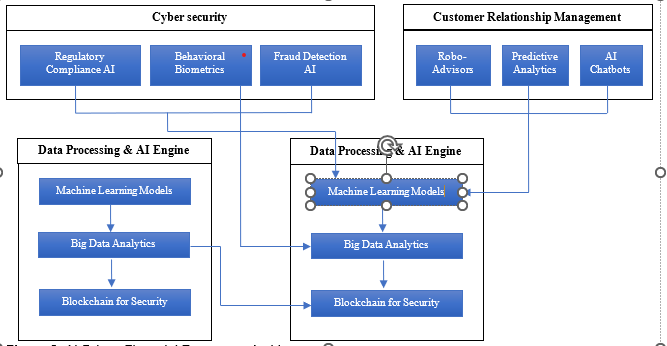
Figure
2.
AI-Driven Financial Ecosystem Architecture
A
high-level architecture for an AID-driven financial ecosystem and how the
components of cybersecurity, customer relationship management (CRM), banking
ecosystem, etc., interact. The backbone of this framework is a data processing
AI engine that powers different types of AI-powered capabilities through
machine learning models, data science, and blockchain security. It offers these
elements by providing automation, predictive analytics, and secure transactions
within this financial industry. The cybersecurity module consists of AI-based
fraud detection, regulatory compliance, and behavioral biometrics to improve
security against financial threats.
The
CRM module is on the customer-facing side and uses AI-based chatbots,
robo-advisors, and predictive analytics to enhance engagement and customer
decision-making. Smart banking and open banking APIs with banking AI financial
forecasting perfectly integrate the banking ecosystem and digital banking
experiences. This demonstrates the nature of interconnectedness of
these/components together and how AI-driven technologies help personalize, be
secure, and run efficient operations within modern financial institutes,
forming the emergence of AI banks.
5.
Challenges and Ethical Considerations in AI-Driven Finance
Artificial
intelligence (AI) is transforming the financial sector, but so are its
associated challenges and ethics. From a data privacy perspective, a financial
institution25-27 regulator, or
consumer must control the data they collect, process and monetize. While AI
boosts efficiency, decision-making, and customer experience, fairness in using
AI for financial decision-making, transparency of AI usage, and building trust
in AI-driven financial ecosystems must be resolved.
5.1.
Data Privacy and Ethical Concerns
As
AI increasingly integrates into finance, it means collecting and analyzing
sensitive customer data, including transaction history, personal identity
information, and financial behaviors. AI-driven insights that strengthen
financial services also involve serious data privacy and ethical issues
concerning security, consent, and transparency.
Cybercriminals
target financial institutions due to highly lucrative prospects in the
exploitation of vulnerabilities in AI powered systems. As the AI driven banking
becomes more and more popular, therefore, cyberattacks like data breaches,
phishing, and ransomware become more and easier to perform. You need to ensure
that you are keeping your AI models protected from cyber threats so as to
ensure the security of the customer’s data.
Also,
there is the customer consent and transparency issue. However, as black boxes,
many of the AI systems can be explained to customers or regulators. Such
practice raises issues about how customer data is used and shared, as well as
monetized. The fact that AI algorithms constantly process customer data,
without adequate disclosure, makes it possible that such data will be misused
or exploited without the knowledge of the customers. Like any other financial
institution, they also have to abide by the stringent data protection
regulations, which include, the General Data Protection Regulation (GDPR) in
Europe and the California Consumer Privacy Act. Translated into regulations,
this means that financial institutions must be transparent and get consent from
the customers for the way their personal data is being processed and users must
have control over their personal information.
5.2.
Bias in AI-Driven Financial Decision-Making
The
financial systems are AI-driven to help decision-making on lending, credit
scoring, fraud detection and investment management. Despite that, AI models are
vulnerable to bias, and the consequences can be unfair, discriminatory outcomes
for minority or underrepresented groups.
One
of the major contributors to bias in AI finance is biased training data.
Historical data will inform the AI models, and if past financial decisions were
affected by discriminatory practices, AI systems will be imbued with the same
biases. The above is just an example of the risk. Suppose the AI-based credit
scoring system is trained using data that favors the high-income candidate from
certain demographics. In that case, it will be biased disproportionately in
rejecting loan applications from the minority or low-income group.
This
also creates an algorithmic bias in automated decision-making. Gender, race,
age, or location may be taken into account in subtle ways by AI models that
they have no wish to discriminate, and it will be hard to navigate around the
implicit bias embedded in machine learning. For example, biased mortgage
approval algorithms can result in disparities in getting home loans and fewer
financial inclusions in these disadvantaged communities.
The
impact of AI bias in finance can be severe, leading to:
• Unfair lending decisions in favor of
certain demographics against other demographics.
• Exclusion from financial services for
individuals with limited financial history.
• Regulatory scrutiny and legal actions
against financial institutions for discriminatory practices.
Financial
institutions must take proactive steps to detect, mitigate, and prevent AI bias
through:
• Ensuring fairness in the AI models by
using diverse and representative data for training.
•Addressing the trust issues in
decision-making processes through Explanable AI (XAI).
• Regular catching and testing for
unintentional discrimination using regular AI.
5.3.
Regulatory and Compliance Challenges
Regulatory
constraints for financial institutions are brought to bear in the face of the
rapid adoption of AI in finance. Though regulators around the world are trying
to put AI governance on a stable footing, gaps in legal frameworks in place
create risks for both the banks and customers.
AI
accountability is one of the most important challenges related to regulation.
There is no transparency in many of AI driven financial decisions, and
regulators find it hard to determine who might be liable for such erroneous or
unfair decisions.
Another
issue at hand is the fragmentation of the global regulators. Complying can be
tricky for multinational banks in light of various AI regulations of different
countries. This differs from the risk-based AI governance approach undertaken
by the European Union in its AI Act, while other jurisdictions, such as the
U.S. and China, have their regulatory approaches. Cross-border financial
institutions need to navigate complex compliance requirements.
Moreover,
AI-driven finance must comply with existing financial regulations, such as:
•AI models need to detect fraud
without violating privacy rights while meeting Anti Money Laundering (AML) And
Know Your Customer (KYC)
• AI-driven credit decisions must
ensure fair lending laws, which prevents AI from being discriminatory.
•Consumer protection regulations via
AI are launched in the consumer protection area; they will have to meet certain
transparency conditions in the pricing, disclosure of risks, and investment
strategies.
6. Future
Trends and Research Directions
AI’s
advances in the financial industry are becoming increasingly complex. Several
of these key trends and research directions are expected to be realized in the
future of AI in finance, Decentralized Finance (DeFi), quantum computing, and
emerging technologies that aim to fundamentally repurpose the finance services
industry.
6.1.
AI Advancements in Decentralized Finance (DeFi)
Blockchain
ecosystem's addition of Decentralized Finance (DeFi) is in the realm of
emerging services that provide financial services with no need for any
traditional intermediaries, such as banks or brokers. DeFi works to move to a
financial system with transparency, inclusiveness, and efficiency by using
smart contracts and blockchain technology. DeFi platforms are on their way to
becoming mainstream. As AI serves as an agent of change, it is in a very good
position to make AI a major player in driving the development of the platforms
and solving some of the critical problems: scalability, security and user
experience.
AI-powered
smart contract optimization is one of the major advances in AI in DeFi.
Decentralized networks power smart contracts. Smart contracts are
self-executing agreements on these networks; they are the core of DeFi
protocols. By automating the way the contracts are executed and predicting
issues, CAD can improve smart contract functionality with AI. Machine learning
models in AI learn to find the patterns in smart contract behavior to increase
accuracy and efficiency in contract execution and minimize error and
exploitation.
AI
can be applied in liquidity management to analyze massive amounts of market
data and envision liquidity shortages or bottlenecks occurring in DeFi
protocols. A decentralized exchange that leverages AI-driven predictive
analytics can make the Automated Market Maker (AMM) model as efficient as
possible to ensure better price stability and liquidity, which are the very
characteristics that can trip up many DeFi ecosystems as being inherently
skewed towards volatility.
DeFi
is also seeing its share of AI bubble security. Such vulnerabilities in the
DeFi protocols have given rise to smart contract hacking and other activities.
Now, with AI-powered systems, deploying them to fill a blank for real-time
monitoring and analysis of blockchain activity to look for suspicious behaviors
is possible. Machine learning models can catch anomalies in transaction
patterns and alert for a potential case of fraud or hacking beforehand. This is
extremely important for DeFi pools to grow and become a trusted and secure
presence in a highly decentralized environment.
6.2.
AI’s Role in Quantum Computing for Finance
Quantum
computing is a paradigm change in computational power, capable of solving
problems beyond the reach of classical computers. Although nascent quantum
computing is in its infancy, when combined with AI, its applications can be
found in areas of optimization, risk management and financial modelling,
towards a market adaptation that promises a revolution in the finance sector.
Portfolio
optimization is one of the most exciting portfolio applications of quantum
computing. Large-scale and complex portfolios easily overwhelm traditional
optimization techniques due to the large number of variables. Solving problems
of optimization using quantum algorithms, such as quantum annealing and
variation quantum algorithms, can be done very quickly, a fraction of the time
it would take by classical methods. By utilizing quantum computing and AI,
financial institutions can design real-time, dynamic inventory strategies
considering a wider spectrum of variables and market conditions. Such a
strategy could yield better returns and improved portfolio risk-adjusted
performance.
Quantum
computing teamed up with AI could transform risk management with the power to
more accurately model and predict complex financial eventualities. Can quantum
algorithms fasten Monte Carlo simulations that are usually deployed to assess
risk by spectator thousands of virtual market scenarios? Quantum-enhanced
simulations could enable much faster and more accurate risk simulation that
could be used by financial institutions to better make decisions in the face of
uncertainty.
AI-driven
quantum computing will also be used for cryptographic security. With most, if
not all, the encryption algorithms used to protect the flow of money today, any
luck of the draw that a quantum computer breaks one of them is good luck.
However, quantum-enhanced AI might be able to help develop new cryptographic
techniques, like post-quantum cryptography, that will stand up to quantum
computing attacks. This will be important as financial systems increasingly
need to guard against quantum machines with computational power.
6.3.
Emerging AI-Powered Financial Innovations
A
host of innovative financial technologies are now being developed thanks to AI
and are likely to define the future of finance. Many of these new AI-powered
innovations are improving the customer experience, making smarter financial
decisions, and providing a more personalized financial experience.
Among
the innovations to appear are AI personal finance management tools. Machine
Learning And Natural Language Processing (NLP) power these platforms, which
offer tailored financial advice, budget tracking, and savings recommendations.
Personal finance assistants based on AI bring in users to spend, save, and
invest intelligently according to their financial goals. These tools give you
traditional financial advice and, if you need it, based on an individual's
spending patterns and economic time.
Furthermore,
AI is used in behavioral finance, studying how psychology affects financial
decision-making. Sentiment analysis tools that use AI are employed to analyze
public sentiment, news, and social media trends and answer whether the markets
will go up, down, or somewhere in between. The financial sector is using AI to
discover consumer behavior. It can then use that to tailor marketing approaches
and develop new products that fulfill the customers' needs.
AI-enhanced
digital banking is another emerging innovation. Banks use AI to enable seamless
and frictionless experiences with everything from personalized digital wallets
to robo-advisors. Natural language command-powered voice-activated banking
services are gaining momentum, and customers can perform banking tasks using
the commands. AI is also powering payment systems, with AI-driven payment
systems offering higher levels of security and speed through technologies like
biometric authentication and blockchain-based payment rails.
7.
Conclusion
Artificial
Intelligence (AI) is transforming the financial industry by creating the path
for more efficient and competent operations, better customer experience, and,
ultimately, innovation. The areas of application of AI in Customer Relationship
Management (CRM), security services, and the banking ecosystem are in their
ways of development, which provide financial institutions with opportunities to
continue to be competitive and meet the needs of the ever-increasing consumer
demand. Financial services increasingly rely on AI to achieve better returns,
eliminate waste and errors, improve customer retention, detect fraudulent
behavior and manage risks.
The
rapid adoption of AI in finance presents several challenges, such as data
privacy concerns, bias in decision-making, regulatory compliance, etc. If
financial institutions are to follow the trend of integrating AI, addressing
the above challenges via ethical guidelines, transparent AI practices, and
sound regulatory frameworks will be the day's need to ensure AI's positive
contribution to the financial ecosystem. However, the future of AI in finance
seems promising. It should further advance with decentralized finance (DeFi),
quantum computing and more emerging AI-powered innovations, bringing new and
unique value to the financial services delivery market. As AI research
continues, develops, and collaborates, the role of AI in the next generation of
financial technologies will continue to grow centrally.
6.
References
- Birch DG,
Rutter K. Where are the customers’ bots? The AI paradigm shift in retail
banking. Journal of Digital Banking 2023;8:132-140.
- Kangra
K. A Paradigm Shift. Artificial Intelligence Technology in Healthcare: Security
and Privacy Issues 2024;1.
- Nadella
GS, Gonaygunta H. Enhancing Cybersecurity with Artificial Intelligence:
Predictive Techniques and Challenges in the Age of IoT. International Journal
of Science and Engineering Applications 2024;13:30-33.
- Roshanaei
M, Khan MR, Sylvester NN. Enhancing cybersecurity through AI and ML:
Strategies, challenges, and future directions. Journal of Information Security
2024;15:320-339.
- Vegesna VV.
Enhancing Cybersecurity Through AI-Powered Solutions: A Comprehensive Research
Analysis. International Meridian Journal, 2023;5:1-8.
- Jonas D, Yusuf NA,
Zahra ARA. Enhancing security frameworks with artificial intelligence in
cybersecurity. International Transactions on Education Technology 2023;2:83-91.
- Akhtar
ZB, Rawol AT. Enhancing Cybersecurity through AI-Powered Security Mechanisms.
IT Journal Research and Development 2024;9:50-67.
- Adewusi
AO, Chiekezie NR, Eyo-Udo NL. The role of AI in enhancing cybersecurity for
smart farms. World Journal of Advanced Research and Reviews 2022;15:501-512.
- Li
F, Xu G. AI-driven customer relationship management for sustainable enterprise
performance. Sustainable Energy Technologies and Assessments 2022;52:102103.
- Galitsky
B. Artificial intelligence for customer relationship management. Springer
International Publishing, Cham 2020.
- Shaik
IAK, Mohanasundaram T, KM R, Palande SA, Drave VA. An Impact of Artificial
Intelligence on customer relationship management (CRM) in the retail banking
sector. European Chemical Bulletin 2023;12:470-478.
- Daqar
MAA, Smoudy AK. The role of artificial intelligence in enhancing customer
experience. International Review of Management and Marketin 2019;9:22.
- Ameen
N, Tarhini A, Reppel A, Anand A. Customer experiences in the age of artificial
intelligence. Computers in human behavior 2021;114:106548.
- Flaherty
B, Heavin C. Positioning predictive analytics for customer retention. Journal
of Decision Systems, 2015;24:3-18.
- Building
the AI bank of the future, McKinsey & company.
- Jung
D, Dorner V, Glaser F, Morana S. Robo-advisory: digitalization and automation
of financial advisory. Business & Information Systems Engineering
2018;60:81-86.
- George AS.
Robo-Revolution: Exploring the Rise of Automated Financial Advising Systems and
Their Impacts on Management Practices. Partners Universal Multidisciplinary
Research Journal 2024;1:1-16.
- Batchu RK. Artificial
Intelligence in Credit Risk Assessment: Enhancing Accuracy and Efficiency.
International Transactions in Artificial Intelligence 2023;7:1-24.
- Mishra S. Exploring the impact
of AI-based cyber security financial sector management. Applied Sciences
2023;13:5875.
- Udeh
EO, Amajuoyi P, Adeusi KB, Scott AO. The integration of artificial intelligence
in cybersecurity measures for sustainable finance platforms: An analysis.
Computer Science & IT Research Journal 2024;5:1221-1246.
- Thapaliya S.
Examining the Influence of AI-Driven Cybersecurity in Financial Sector
Management. The Batuk 2024;10:129-144.
- Bao Y,
Hilary G, Ke B. Artificial intelligence and fraud detection. Innovative
Technology at the Interface of Finance and Operations 2022;I:223-247.
- Kumar
N, Agarwal P, Gupta G, Tiwari S, Tripathi P. AI-Driven financial forecasting:
the power of soft computing. In Intelligent Optimization Techniques for
Business Analytics 2024;146-170.
- Agarwal
A, Singhal C, Thomas R. AI-powered decision-making for the bank of the future.
McKinsey & Company 2021.
- Lazo
M, Ebardo R. Artificial intelligence adoption in the banking industry: Current
state and future prospect. Journal of Innovation Management 2023;11:54-74.
- Basly
S. Artificial Intelligence and the Future of Decentralized Finance. In
Decentralized Finance: The Impact of Blockchain-Based Financial Innovations on
Entrepreneurship (pp. 175-183). Cham: Springer International Publishing 2024.
- Iyer R, Bakshi A. Artificial Intelligence and Quantum Computing Techniques for Stock Market Predictions. Deep Learning Tools for Predicting Stock Market Movements 2024;123-146.