The Impact of Autonomous Vehicles on P&C Insurance: Preparing for the Next Frontier of Risk and Liability
Abstract
The arrival of autonomous vehicles
(AVs) promises to revolutionize transportation with significant implications in
the property and casualty (P&C) insurance business. Traditional paradigms
for risk assessment and liability in auto insurance are under attack as
self-driving technology evolves. This paper examines the emerging risks and
opportunities that AVs have introduced to the P&C insurance world. On the
key considerations side, product and manufacturer liability for human operator
injuries, the increase in automation of insurance underwriting using advanced
technologies like AI and machine learning and potentially decreased accident
frequency but an increased severity in accidents caused by more advanced
vehicle systems is all on the table. The paper also considers regulatory
frameworks that guide the adoption of AV and their implications for Insurance
should the different modes of operation of AV and human-driven vehicles begin
to converge. It addresses how telematics and data analytics play into a fault
and pricing premium decision in a market where AVs are dominant. The paper discusses
adapting to the evolving risk environment and looks at regional Collaboration
between insurers, policymakers and automakers. Insurers can prepare for the
future in which AVs rewrite mobility, assure against uncertainty and capture
opportunity in the era of transformational change through understanding these
dynamics. The alarming findings add weight to the call to proactively develop
insurance products and other risk management apparatuses to fit into the
complexities of autonomous technologies.
Keywords: Autonomous vehicles,
Property and casualty, Risk assessment, Telematics, Regulatory frameworks
1.
Introduction
1.1. The rise of autonomous vehicles
One of
the 21st century's most transformative innovations is autonomous vehicles
(AVs). AVs are aggressively approaching widespread adoption via leveraging
advanced technologies such as artificial intelligence (AI), machine learning
and sensor integration1-3. Their
potential benefits encompass improving road safety, decreasing traffic
congestion and many others. However, their adoption also brings a new frontier
of challenges, particularly for industries like property and casualty (P&C)
insurance, whose risk and liability paradigms are rooted in how humans behave.
1.2. Disrupting traditional insurance models
Traditionally,
this builds on determining how drivers behave, how frequently accidents occur
and how much damage is incurred per accident. However, with AVs, human error
(one of the principal causes of accidents) is eliminated and the spotlight
shifts to software dependability, sensor performance and cyber vulnerabilities.
This shift raises critical questions: In an AV accident, who is liable: the
manufacturer, the software developer or the vehicle owner? Such changes,
however, require rethinking risk assessment, underwriting treatment and premium
structures.
1.3. Regulatory and technological challenges
AVs'
regulatory environment is still evolving, as there are still many differences
in the standards between jurisdictions. They determine how insurers consider
liability and coverage themselves. Integrating telematics, real-time data
analytics and AI tools creates a new complexity in fault determination and
pricing premiums. Connected vehicles could be vulnerable to hacking,
complicating insurers' profiles even more.
1.4. Preparing for the next frontier
AVs are a
challenge and an opportunity for the P&C insurance industry. Insurers must
get used to it in an ecosystem where technology-driven risks and liabilities
replace the traditional metrics. However, insurers, automakers, regulators and
tech developers must work together to traverse this transition successfully.
This paper aims to understand these dynamics and learn some lessons for the
insurance industry to prepare the insurance sector for the widespread adoption
of AVs and embrace the next frontier of mobility.
2.
Autonomous Vehicles: Evolution and Technology
The story
of autonomous vehicles has gradually changed, but it is a transformational
story fuelled by technology and efforts to achieve safer, more efficient
transportation systems. -based on understanding the evolution and technological
foundation supporting AVs4-7, we can
project their impact on industries like property and casualty (P&C)
insurance.
2.1. Levels of vehicle automation
The six
SAE levels of automation are from level 0 (no automation) to level 5 (full
automation). They represent the industry standard of the level of automation in
a vehicle, which has governed discussions around advancing technologies,
regulatory frameworks and insurance implications.

Figure 1: SAE Automation Levels for Autonomous
Vehicles.
· Level 0: The human driver takes
over driving tasks individually, as and when needed. Currently, automobiles in
this category comprise a large part of the market, for which risk is attributed
only to human error and traditional underwriting insurance models prevail. This
stage has historically been the basis for actuarial calculations and liability
frameworks in the insurance industry.
· Level 1: Features Vehicles at
this level offer things like adaptive cruise control or lane-keeping assistance
and driver assistance. Automation only reduces to specific tasks, causing the
driver to remain fully engaged. From an insurance point of view, although minor
changes in underwriting models, liability remains where it has been on the
driver.
· Level 2: Combines steering and
acceleration control, with the driver monitoring the environment, intervening
as required hardware and Partial Automation. With the advent of Level 2
vehicles, the distinction between driver and system responsibility becomes
increasingly vague and thus, insurers must think about dual fault scenarios.
This phase lays a foundation for hybrid liability frameworks.
· Level 3: Level 3 Automation.
This level of automation allows the vehicle to perform most driving tasks, but
the driver must always allow the vehicle to intervene when conditions warrant
it. That transition point highly impacts insurance models because the liability
shifts more towards the manufacturer or the software provider in case of system
failure. At this stage, regulatory debates intensify and safety standards and
accountability are debated.
· Level 4: High Automation or
Condition-based (e.g. geofenced) - Vehicles at this level can perform all
driving functions under specific conditions. However, human intervention is
still allowed. As driver fault continues to fade, the models adapt to changes
in product liability and advanced AI systems. Adjusting software reliability
and environmental constraints are some of the factors incorporated in risk
assessment.
· Level 5: The most advanced are
those that operate with full Automation vehicles that are fully autonomous and
can achieve this level of autonomy under all conditions without human
involvement. It is highly likely that liability, at least at this stage, will
fall almost entirely upon manufacturers and software providers. Instead,
insurers will focus on handling cyber liability, product liability and systemic
coverage for hacking or software errors.
2.2. Key technological advancements
Many
suites of cutting-edge technologies are critical for the functionality and
reliability of AVs. Artificial intelligence (AI) is the central piece which
powers decision-making, allowing vehicles to analyse camera, lidar, radar and
ultrasonic sensor data. Together, these components produce a seamless,
360-degree view of the vehicle's surroundings, detecting obstacles,
acknowledging potential movements and realizing real-time decisions.
From a
data sharing and sensing standpoint, the Internet of Things (IoT) is key to AVs
because it allows them to communicate with external systems, e.g. traffic
management infrastructure and other vehicles, to create a more interconnected,
intelligent transportation ecosystem. Moreover, machine learning algorithms
enable data to be collected in the operation as a source of a never-ending data
stream to improve driving performance continuously. Beyond that, V2X systems or
vehicles to everything, add dimension to safety: they allow vehicles and
infrastructure to communicate.
2.3. Predicted adoption timelines and market
penetration
Phase
adoption is expected due to the initial market penetration chiefly facilitated
by fleet operations, i.e. ride-sharing and logistics. Industry forecasts
indicate that market revenues will be led and driven by partially automated
vehicles (Levels 2 and 3), but adoption of Levels 4 and 5 will be significant
by the mid-2030s. A mix of technological readiness, regulatory alignment and
public trust will determine these timelines.
Adoption
will vary globally, with developed nations most likely to adopt first because
of the more mature infrastructure and better regulatory support. However, as AV
technology is more expensive and requires more building work for
infrastructure, emerging markets could experience delays. Increased adoption
will force industries to readjust from traditional vehicles to AVs as
generations pass, changing the landscape's risk and liability.
3.
Changes in Risk and Liability Frameworks
The rise
of autonomous vehicles (AVs) is turning conventional risk analysis and risk
management on its head. It then looks at how risk and liability frameworks have
evolved as vehicles8-12 have shifted
from human to technology-operated.
3.1. Traditional insurance risk models
This
traditional auto insurance is based on a risk-taking assessment that predicts
what is most likely to occur based on human drivers. Those factors include
driving history, age, location and the type of vehicle. It has always been
assumed that the causes of road accidents are human error beyond the 90 per
cent mark that exists globally; however, this is not always the truth.
Liability, therefore, usually rests with the driver, making the personal auto
insurance product the predominant offering in the market. Traditional models
have straightforward claims processes based on determining fault through driver
behaviour and environmental conditions. However, the arrival of the AVs
disrupts these models and moves the risk from the human drivers to the vehicle systems
and manufacturers.
3.2. Shifting liability: Driver vs.
Manufacturer vs. Software Provider
As more
and more driving tasks are transferred to AVs, there is a movement of liability
from people to organizations involved in designing, manufacturing and operating
the vehicles. Although less so in levels 2 and 3, a driver is still responsible
for monitoring and taking action if necessary. However, accountability becomes
more complex as vehicles move toward full autonomy (Levels 4 and 5).
In an AV
accident, the question arises: Does the fault result from a hardware error, a
software error or surrounding interference? Suppose, for instance, an AV
mistakenly misses an obstacle detectable by existing sensors because of a
sensor failure. The liability might lie with the manufacturer or vendor of that
sensor. Also, if a developer causes a software bug to crash, he can be held
responsible. Transforming driver liability into product liability disrupts such
frameworks and questions conventional insurance, prompting reinsurers to
consider products including manufacturer liability insurance and software
defect coverage.
3.3. Cybersecurity risks associated with
autonomous vehicles
AVs have
their Achilles heels: they rely on connectivity and the latest technology and
are susceptible to specific cybersecurity threats. The AV system can be the
target of cyberattacks that disrupt operations, steal sensitive data or allow a
cyber attacker to take remote control of the vehicle. In an interactive world
of cyber, such risks introduce an entirely new dimension of liability for the
insurer: the liability for the potential impact of a cyber incident on safety
and operational integrity.
A
coordinated hacking event targeting a fleet of AVs could inflict high harm. In
that context, liability may not lie with the vehicle owner, the software
provider or the network operator. To manage these risks, insurers must
incorporate cyber liability into their risk models and develop products
tailored for the loss they will see from attacks on AV systems.
The
development of the AV risk and liability framework shows the need for new
innovative insurance solutions. Standards around definition, the mitigation of
risks and a smooth transition to a future of autonomous vehicles will all
depend on the Collaboration of insurers, automakers and regulators.
4.
Implications for Property and Casualty Insurance
Panels
for Autonomous Vehicles (AVs) integration into the transportation landscape
will mark the beginning of the end of property and casualty (P&C) insurance
industry as we know it13-16. Insurers
must adapt to change the complexities introduced by AV technology, from
underwriting and claims management to the creation of new insurance products.
The image
depicts a conceptual architecture of a system of autonomous vehicle ecosystems,
P&C insurance frameworks, external factors such as regulations and
collaborations. Counting these domains apart clearly into blocks helps to see
how information runs and what dependencies are in the key components.
The
Autonomous Vehicles Ecosystem comprises the technological components defining
autonomous vehicles, including sensors, AI algorithms, decision systems,
communication systems and cybersecurity measures. Together, these components
permit autonomous vehicles to perform safely and efficiently. These
advancements in the field directly affect the shift in risk and liability,
resulting in new challenges for the insurance industry. P&C Insurance
Framework captures how the insurance industry is bearing these changes. This
framework is divided into three components: insurance products, data-driven
systems and risk models. New data sources are required as input for these risk
models, including underwriting, actuarial and claims management and the models
must adapt to new risks associated with autonomous technologies. Given the
risks inherent in autonomous vehicle operations, both insurance products have
cyber and product liability policies. Data-driven systems, particularly
telematics and analytics platforms, are key to collecting insights that power
the predictive analytics that feed into the risk model and product development.
The Legal and
regulatory block describes certain external forces that impact the autonomous
vehicles ecosystem and its framework of P&C insurance. The risk environment
is defined by compliance standards, liability framework and international
regulations that set up how insurers and manufacturers divide the
responsibilities (Figure 2). A sample is a safety system design wherein
liability is transferred from the drivers to the manufacturers and software
providers; this requires rethinking conventional insurance policies.
Figure
2:
Conceptual Architecture of Autonomous Vehicles and P&C Insurance
Interactions.
The final
block on the Collaboration highlights the necessity of automakers working with
technology companies and the government. The key to ensuring that these
technological developments map to regulatory requirements and to producing
insurance products that engineer the special risks of autonomous vehicles lies
with these collaborations. It depicts how such relationships encourage
innovation while paring risks and preserving consumer trust.
4.1. Changes in underwriting and pricing
Underwriting
has to pivot from human driver risk to technological and system risk in the AV
era. Security regulators and insurers must pay particular attention to the
reliability of AV hardware (sensors, cameras) and software (AI algorithms) and
how cyber-safe the insurance company and its manufacturers and suppliers are.
In
addition, pricing models will undergo major changes. Telematics, real-time
vehicle monitoring and data-driven insight will become more important than
traditional factors, such as driving history and behaviour. Further, it can
also mean accident frequency will decrease because of safer driving by AVs, but
because of the high cost of repairing advanced systems, claims costs may rise (Table
1).
Table
1:
Comparison of Traditional and AV Underwriting Factors.
|
Category |
Traditional
Vehicles |
Autonomous
Vehicles |
|
Risk Basis |
Driver behaviour, age, driving history |
Hardware/software reliability, cyber risks |
|
Claims Frequency |
High (human error) |
Low (technology-driven safety) |
|
Claims Severity |
Moderate |
High (cost of advanced technology) |
|
Pricing Data Sources |
Historical driver data |
Real-time telematics, manufacturer data |
4.2. Claims management in the era of autonomous
vehicles
As AVs
introduce new liability and fault determination challenges, the claims
management process becomes more difficult. Instead of blaming driver
negligence, insurers must investigate technological failures, software logs and
data from vehicle sensors. This necessitates Collaboration with manufacturers
and technology providers to access the proprietary data for claims resolution (Table
2).
Insurers
need to account for the further likelihood of disputes among several
participants, such as the vehicle owner, automaker and software developer.
Efficient claims processing will require advanced forensic capabilities and
specialized expertise in AV system design.
Table
2:
Traditional vs. AV Claims Management Processes.
|
Aspect |
Traditional
Vehicles |
Autonomous
Vehicles |
|
Fault Determination |
Based on driver behaviour |
Analysis of system logs and failures |
|
Primary Liability |
Driver |
Manufacturer, software developer or owner |
|
Claims Investigation Tools |
Police report, witness statements |
Telematics data, sensor logs, cyber forensics |
4.3. New insurance products and coverages
Because
of the transition to AVs, insurers must develop new products to tackle new
risks. Key new coverages include:
· Cyber liability insurance: It protects against
losses caused by cyberattacks on AV systems, such as data breaches, ransomware
and remote hijacks.
· Product liability insurance: Carriers of
manufacturers and software developers of AV components or algorithms that have
resulted in accidents due to defects.
· Technology error and omissions (E&O) insurance: Prepares products and
services offering appropriate error addresses against AV software and services,
generating liability claims.
· Fleet insurance for AVs: Designed to serve as tailored products
to companies operating AV fleets, which cover all coverage for all of their AV
system malfunctions and all of their liability risks (Table 3).
Table
3:
Examples of New Insurance Products for Avs.
|
Product |
Description |
Target
Audience |
|
Cyber Liability Insurance |
Covers risks from cyberattacks and data breaches |
Vehicle owners, fleet operators |
|
Product Liability Insurance |
Protects against claims from defective AV components |
Manufacturers, suppliers, developers |
|
Fleet Insurance |
Comprehensive coverage for AV fleets |
Ride-sharing companies, logistics firms |
|
Technology E&O Insurance |
Addresses liability for software or system errors |
Software developers, tech companies |
5.
Regulatory and Legal Considerations
Wherever
Autonomous Vehicles (AVs) are adopted, they drive significant changes in legal
and regulatory frameworks. Defining liability, guaranteeing public safety and
making17-20 certain insurance
implications associated with AV technologies are all critical to these changes.
5.1. Evolving legal frameworks for autonomous
vehicles
The
development of AV technology is leading governments to make new legal
frameworks that can govern how the technology's tests, deployments and
operations are conducted. Definition of manufacturers' roles and
responsibilities the definition of software developers' and owners' roles and
responsibilities are also defined as the key focus areas. Usually, such
regulations also prescribe system safety requirements, data transparency and
data cybersecurity.
For
example, in the United States, the National Highway Traffic Safety
Administration (NHTSA) has directed the AV developer to perform safety
assessments and report on safety as defined. Like the EU, the European Union
has established regulations regarding the legal approval of automated driving
systems, requiring such safety tests and data-sharing protocols.
Liability
issues are also being addressed by the legal framework, which will be put in
liability in the case of an accident taking place with an AV. Early legislative
efforts sound like a product liability trend in which manufacturers or software
providers might be responsible for system failures.
5.2.
International perspectives and regulatory disparities
Countries
differ widely in their approaches to regulating AVs and these vary
tremendously, ranging from what technological priorities countries are
pursuing, what legal traditions underpin some approaches to others and what
infrastructure readiness has prepared individual countries for.
· United states: There is little regulation, with federal
guidelines, essentially a broad framework and then states adopting their own
rules. California and Arizona are the leaders when it comes to regulating AV
testing.
· European union: Centralized safety and approval processes
dictating uniformity across member states is the EU's way of doing things.
· China: China has taken a government-led approach by implementing
a pro-AV development program and aggressive policies to increase AV testing in
innovative city environments.
· Emerging markets: Infrastructure limitations and resource
constraints create regulatory challenges to speed adoption in Latin America and
Africa.
5.3.
Impact of legislation on P&C insurance
The rules
of the P&C insurance industry are set into motion by legislation as the AV
environment unfolds. Insurers need regulatory clarity as to who is liable
before designing appropriate products. For example, if product liability laws
change, the focus of personal auto insurance could switch to policies that
cover manufacturers and software manufacturers, etc (Table 4).
Such
embedding of mandates for data sharing in regulations also affects claims
management. Insurers may require telematics data, crash reports and system logs
to determine faults in AV accidents. However, This data privacy is hampered by
laws preventing insurers from accessing it, such as the General Data Protection
Regulation (GDPR) in Europe, making the claims process difficult.
Table
4:
Legislative Impact on P&C Insurance.
|
Legislative Aspect |
Insurance Implications |
|
Liability
Frameworks |
Shift toward
product and cyber liability coverage |
|
Data Privacy
Laws |
Challenges in
accessing crash data for claims investigation |
|
Safety
Standards |
Influence on
underwriting based on compliance with safety regulations |
|
Cybersecurity
Requirements |
Increased
demand for cyber liability insurance |
6. Challenges and
Opportunities for Insurers
The
arrival of autonomous vehicles (AV) presents both challenging and new
opportunities for insurers. Change from human-driven to technology-driven
vehicles rewrites risk, liability and operational frameworks, thus requiring an
innovative path forward in Insurance.
6.1.
Data collection and privacy concerns
Autonomous
vehicle operations and the underwriting of insurance hinge on data. AVs are
likewise laden with sensors, cameras and telematics systems, which give
administrators data about vehicle performance, surrounding environments and
incidents. This data is extremely useful for insurers in assuring them of their
risks, the liability of the case and how they should price their policies.
However,
there are major privacy concerns associated with data collection. The General
Data Protection Regulation (GDPR) in Europe and the California Consumer Privacy
Act (CCPA), for example, dictate how much data can be processed, stored and
even shared. They must balance these regulations while staying transparent and
protecting customer information. A big challenge is striking the right balance
between using data for underwriting purposes and keeping with the letter of
privacy regulations.
6.2.
Role of telematics and data-driven insurance models
In the AV
era of telematics, telematics is the cornerstone of data-driven insurance
models. Telematics, in this regard, collects real-time data on vehicle
performance and conditions to help uncover system reliability and see
operational patterns. It creates an opportunity for insurers to develop
usage-based Insurance (UBI) policies that calculate premiums based on actual
vehicle use and performance metrics and away from the static factors of vehicle
type and owner demographics.
Before an
incident, Telematics can also support claims management by providing objective
evidence from AV systems, such as speed, braking patterns and sensor inputs.
This data also improves accuracy in determining the fault and decreases
disputes throughout the claims process.
6.3.
Collaborations with automakers and technology companies
The
technology of AV is complex and requires the Collaboration of insurers,
automakers and technology companies. Insurers need to be extremely close to
automakers, learning about AV systems and their exact safety features,
limitations and how they fail. Detailed technical data is essential to
underwriting, pricing and claims management.
Insurers
have partnerships with technology companies, especially using artificial
intelligence and cybersecurity, which can enable insurers to stay on top of
emerging risks in the industry. This can extend to joint initiatives to enhance
AV cybersecurity that reduce the risk of hacking or data breaches, thus making
for safer vehicle operations. In addition, collaborations foster innovation in
the insurance product, such as bundled offers, including automakers offering
insurance coverage as part of the sale or lease agreement with the vehicle.
7. Preparing for the
Future: Strategies for Insurers
Insurers
must adopt forward-looking strategies to thrive in a quickly evolving land space
defined by autonomous vehicles (AVs). This section looks at innovations, risk
modelling and consumer trust around the issue of the future.
7.1.
Investing in innovation and technology
In order
to go from traditional cars to AVs, insurers will need to understand the
technology and innovate. To improve their ability to assess risks with
complicated AV systems, insurers must begin investing in AI, machine learning
and big data analytics. Telematics, blockchain and the Internet of Things can
all be rolled into a live claims process, fraud detection and the ability to
monitor the performance of AV in real-time.
In
addition, insurers must participate with tech companies and automakers to
develop solutions that best meet the special requirements of AV drivers and
operators. Insurance cases are a prime use case for such an integrated platform
where insurers can seamlessly integrate their platforms with AV systems for
instant insurance activation, real-time risk updates and immediate claims
resolution.
7.2.
Risk modelling and predictive analytics
Risk
modelling is essential for understanding and managing the new types of risks
brought by AVs. Insurers can use predictive analytics to gauge the performance
of AV hardware and software and estimate the probability of accidents, as well
as what a system failure could cost an insurer.
Insurers
can use machine learning algorithms to build more accurate risk models using AV
testing, telematics and incident report data. Such models can depend on weather
conditions, other urban or rural factors and cybersecurity complexity. This
also helps insurers provide bespoke policies for particular customers with
regard to which AV types, manufacturers or usage patterns they use.
7.3.
Building consumer trust in autonomous vehicle insurance
The
insurance industry is built on the consumer's trust, a cornerstone that must be
rebuilt as trust builds in managing emerging risks. There must be clear lines
of communication on how AV insurance works, what it covers and how premiums are
calculated. Insurers can handle the complexities of AV liability, data
security, claims, etc. And consumers need to understand this.
In
particular, data privacy issues are extremely well-suited for transparency
objectives. Insurers need to reassure policyholders that their personal and
vehicle data are used responsibly and that they are following legal standards.
It can also help consumers stay confident in their purchase decisions and
appeal to broader customers, offering flexible and easy-to-understand policies
like pay-as-you-drive or bundled coverage when an AV is purchased.
8. The Impact of
Autonomous Vehicles on P&C Insurance: Preparing for the Next Frontier of
Risk and Liability
Great
changes in the property and casualty (P&C) insurance landscape will be
brought about through the rise of autonomous vehicles (AVs). Insurers will have
to adjust to new risks, liabilities and coverage needs arising from this shift
to AV as they rise from experimental technology to mainstream deployment. In
this section, the future of the insurance market is anticipated, especially in
commercial auto insurance, workers' compensation and cyber liability, as well
as the challenges and opportunities that insurers have to be ahead of the
curve.
8.1.
Shifts in insurance premiums and coverage needs
The
adoption of autonomous trucks and vehicles is expected to create notable
changes in several key areas of Insurance:
·Commercial auto insurance: The rise of AVs could
be extremely damaging to this segment by definition, having traditionally been
the most loss-ridden. Reducing the frequency of claims and the number of
accidents could be achieved by eliminating human error, which causes nearly 94%
of traffic accidents. Thus, the premium for commercial autonomous vehicles will
begin to decline. However, these new risks will include software malfunctions,
cyberattacks and product liability issues caused by autonomous systems. So,
these risks will make underwriting more complicated; insurers will need to
create more sophisticated models than just intuiting based on data; for
commercial auto insurers, offering even a shift of 20% of their premiums to
other lines of coverage could result in an annual loss of premiums over $7
billion.
· Workers' compensation: The adoption of AV can greatly reduce
workers' compensation claims related to driving. However, with AVs assuming the
driving task, the number of occupational accidents and fatalities to human
drivers would probably decrease. It could help profitability for workers' comp
insurers. However, as AVs do away with jobs currently protected under workers'
compensation for drivers like truckers and delivery persons, insurers could
lose premium revenue. One estimate for the annual premium loss from this
segment is $3 billion.
8.2.
Trends in US commercial auto combined ratio
The US
commercial auto insurance business trend between 1998 and 2022 is expressed as
a visual fraction. The combined ratio is a metric in the insurance world used
by the industry to measure underwriting profit and is expressed as a percentage
of premiums. A combined ratio below 100% is underwriting profit (above 100%
indicates loss).
It is
apparent from the graph that the return on investment, known as the combined
ratio, for commercial auto insurance has endured underwriting losses over the
years, usually above 100 percent, which usually implies an unsaturated appetite
on the part of the insurance buyers. The tone of this trend speaks to insurers'
plight in this niche market, where the high fly rate of claims from human error
in driving is the root of most accidents. However, the ratio can indicate a few
relatively win-overs in the loss-making sector, such as the early 2000s and
around 2013.
Automated
vehicles will decrease human participation in driving, which is expected to
greatly diminish human error frequency and severity of accidents. Such a change
could result in a better-combined ratio on commercial auto insurance. However,
the image also points to how volatile this metric is. Insurers must guard
against new risks, like software glitches and cyber-attacks, which will temper
the gains they expect.
The graph
offers a compelling basis for the argument that, from a commercial auto point
of view, autonomous vehicles have the potential to fundamentally alter a
long-term trend. Through historical performance context and AV adoption's
expected impact on risk and liability, insurers can better anticipate and
prepare for the paradigm shift in risk and liability.
· Cyber liability insurance: As AVs become more
connected with increasingly high reliance on advanced, sophisticated software,
including an estimated 100 million lines of code in a single vehicle, their
cyber vulnerabilities will increase. Hacking, data breaches and system failures
may disrupt vehicle operations, resulting in accidents and damage to critical
infrastructure. Developing specialized cyber liability products with complete
cyber coverage for AVs' fairly interconnected nature will become necessary to
ensure insurers adapt to this vertical. That will mean insurance coverage for
data breaches, software vulnerabilities and the legal liability stemming from
attacks on AV systems using cyber (Figure 3).
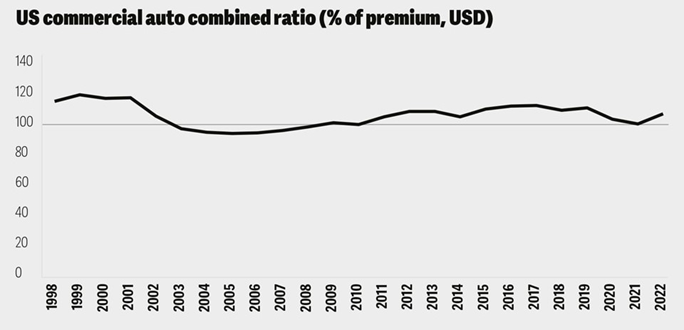
Figure
3: US Commercial
Auto Combined Ratio.
8.3.
Challenges in underwriting and risk assessment
The
transition to AVs presents significant challenges for insurers, particularly in
underwriting and risk assessment:
·Lack of historical data: Autonomous vehicles have little
historical data. Unlike traditional vehicles, which have decades of accident
data from which to underwrite risk models, insurers want to ensure AVs are as
safe as manually driven cars to drive down costs. However, unless they have
access to large troves of data, ensuring them accurately while understanding
the actual risks of being involved in accidents is nearly impossible. This
means that insurers may have to innovate in new ways, using telematics data and
almost real-time monitoring of AVs to learn. The lack of permanence in services
required and the nature of the risks in this business make it, in a sense,
similar to the situation that the cyber insurance industry is undergoing:
insurers are evolving their models as new risks become apparent.
Complex liability issues: Accidents involving AVs will probably
be tough to prove fault in. It could be shared between several parties (vehicle
manufacturer, software provider or a third-party service provider), making the
claims process more intricate. It's not always clear that the person steering
or braking solely caused an accident. Sometimes software bugs, GPS errors and
external factors like potholes could all be contributing to an accident that
makes it difficult to assign fault. To set the right framework for AV, insurers
will have to find new tools and methodologies for investigating and determining
liability for AV-related claims. As AV litigation increases because parties try
to establish clearly defined fault and liability, this complexity may lead to more
litigation in AV-related accidents.
· Regulatory hurdles: Because autonomous vehicles are still a
relatively new technology, they are being adopted into a regulatory environment
that is also evolving. Some states or countries have approved AV testing and
use, but a uniform global regulatory framework has not yet been established. AV
insurers will have to figure out how to travel transportation by machine along
a confusing mosaic of local and state regulations that differ on safety
requirements, testing rules and liability. However, AVs will also need federal or
global regulatory approval to operate in an interstate or international market,
increasing complexity for insurers wanting to operate in different markets.
8.4.
Strategic adaptation for insurers
To
prepare for the impact of autonomous vehicles on the insurance landscape,
insurers should consider several strategic approaches:
· Partnerships with manufacturers: Insurers have to build
relationships with autonomous vehicle manufacturers to know how the technology
works, the safety features and the potential risks. Manufacturers like Tesla or
Waymo will partner with insurers to gain access to technical data, vehicle
performance insights and system reliability metrics to underwrite, risk model
and manage claims. As with emerging risks we've discussed, companies like
Liberty Mutual are already working with AV manufacturers to be ready to meet
the risks coming down the pike. Through these collaborations, insurers can
leverage the unique AV needs to work with them to develop policy.
· Innovative coverage solutions: However, the new risks
and liabilities of AVs require insurers to create innovative and flexible
coverage solutions. For example, customizable policies that can suit the
different needs of the diverse set of players in the AV ecosystem (vehicle
manufacturers, fleet operators and software developers) will be important.
Bundled or customizable policies for autonomous vehicles, for example, which
might combine aspects of the risks posed by product defects with the risks
associated with cyberattacks, are already being explored by companies such as
AXA XL. These hybrid policies enable insurers to provide both traditional
vehicle risks and new AV-specific exposures.
· Proactive risk management: Insurers should fund
research and development in AV-specific risk management strategies. Insurers
can best address new risks by introducing products pre-emptively to better
anticipate and address emerging risks. Participating with the broader AV
ecosystem will put insurers at the forefront of adapting to address new ones
and give them a competitive advantage. It will allow insurers to be proactive
and leaders in the industry, ensuring innovation as we continue to see AV
adoption grow.
9. Conclusion
The
entrance of Autonomous Vehicles (AVs) into the property and casualty (P&C)
insurance industry is a transformative change that adds challenges and
opportunities. The Keys to adapting to AVs' evolving risk landscape are as AVs
evolve from cutting-edge to mainstream vehicles. However, by eliminating human
error, traditional vehicle-related claims will likely decrease in frequency and
reduce rates, whereas new risks will emerge, including cyber threats, software
malfunctions and product liability. These risks demand an overhaul of the
insurers' underwriting, pricing and claims management strategies through
advanced technologies and fresh data sources.
Finally,
complexity will mount for the insurers to face liability issues tied to
AV-related accidents where the fault will be increasingly hard to pin down.
However, the claims process itself will be more complicated, with multiple
parties possibly sharing the responsibility, including manufacturers, software
providers and even third-party service operators. In addition, the AV's
regulatory environment is still being developed and the insurers are currently
facing different national and regional regulations to adapt to. Insurers must
stay ahead of regulatory change to be competitive and mitigate risk.
However,
despite these challenges, P&C insurance has never been more promising
regarding the future of Insurance in an AV-driven world. Investing in
innovation and technology will enable insurers to build enhanced risk
assessment models utilizing telematics data and to build more targeted coverage
solutions that will assist AV stakeholder's needs. Insurers can then use
insights from collaborations with automakers and technology companies to offer
new, different, more tailored insurance products designed for that evolving AV
landscape. Additionally, insurers who can facilitate the building of consumer
trust in the new options for coverage will have a considerable advantage across
AVs' increasing presence.
Ultimately,
autonomous vehicles will greatly change the insurance industry and innovations,
flexibility and proactive risk management will be required. Those insurers who
lean in and make investments in these new technologies and strategies will not
only ride the AV curve but emerge as leaders in a fast-changing landscape. A
successful future will be one of toggling emerging risks and opportunities,
accommodating the insurers' needs and the future of consumers and ensuring the
resilience of the insurance sector to change.
10. Author Contribution Statement
Sateesh Reddy Adavelli,
Solution Architect, USA
Led the
conceptual framework development for the paper, focusing on AV impact across
insurance models. He was the primary contributor to the risk and liability
frameworks section, drawing on his extensive experience in insurance
architecture. Sateesh developed the conceptual architecture diagram showing AV
and P&C insurance interactions and provided valuable insights on
international regulatory disparities. He was instrumental in formulating
strategic recommendations for insurers and ensuring cohesive integration of all
sections.
Ravi Teja Madhala,
Sr Software Developer Analyst, USA
Brought technical
depth to the paper through his analysis of AV technologies and their
implementation timelines. Ravi's expertise in cybersecurity formed the backbone
of the sections addressing cyber risks in autonomous vehicles. He conducted
research and developed the comparative analysis between traditional and AV
underwriting factors, compiled the US Commercial Auto Combined Ratio data and
provided critical insights on telematics and data-driven insurance models. His
contributions were especially valuable in identifying technical challenges in
AV risk assessment.
Nivedita Rahul,
Business Architecture Manager, USA
Provided crucial business perspective through her analysis of P&C insurance implications. Nivedita led the research on emerging insurance products and coverages for AVs and developed the claims management transition framework. Her expertise in data privacy and regulatory compliance strengthened multiple sections of the paper. She analyzed business impacts for insurers and contributed significant insights on consumer trust development in AV insurance products. Nivedita's business strategy expertise helped shape the paper's recommendations for industry preparation.
All three authors
collaborated throughout the research and writing process, bringing together
their complementary expertise in insurance architecture, technical
implementation and business strategy to create a comprehensive analysis of how
autonomous vehicles will transform the property and casualty insurance
landscape.
11. References
- Tarr JA, Tarr AA. Autonomous Vehicles: Liability and
Insurance. In The Global Insurance Market and Change. Informa Law from
Routledge, 2024: 157-181.
- Faisal A, Kamruzzaman M, Yigitcanlar T, Currie G.
Understanding autonomous vehicles. Journal of transport and land use, 2019;12: 45-72.
- Kewal T,
Saxena C. Digital Disruption in Insurance Value. Innovative Computing and
Communications: Proceedings of ICICC 2024, Volume, 2024;5: 173.
- Weiser PJ. Regulatory challenges and models of
regulation. J on Telecomm High Tech L, 2003;2.
- Leenes R, Palmerini E,
Koops BJ, et al. Regulatory challenges of
robotics: some guidelines for addressing legal and ethical issues. Law,
Innovation and Technology, 2017;9: 1-44.
- Brawley A, Kwok D, Lesarge J, Nickerson E. Promoting
Competition in P&C Insurance, 2021.
- Woo
S, Youtie J, Ott I, Scheu F. Understanding the long-term emergence of
autonomous vehicle technologies. Technological Forecasting and Social Change, 2021;170:
120852.
- Schoettle B, Sivak M. Motorists' preferences for
different levels of vehicle automation. University of Michigan, Ann Arbor,
Transportation Research Institute, 2015.
- Cascetta E, Carteni
A, Di Francesco L. Do autonomous vehicles
drive like humans? A Turing approach and an application to SAE automation Level
2 cars. Transportation research part C: emerging technologies, 2022;134: 103499.
- Stayton E, Stilgoe J. It's time to rethink levels of
automation for self-driving vehicles [opinion]. IEEE Technology and Society
Magazine, 2020;39: 13-19.
- Rustad ML. Product Liability for Software Defects in
Driverless Cars. S Cal Interdisc LJ 2022;32: 171.
- Sun X, Yu FR, Zhang P. A survey on cyber-security of connected and
autonomous vehicles (CAVs). IEEE Transactions on Intelligent Transportation
Systems, 2021;23: 6240-6259.
- Taeihagh A, Lim HSM. Governing autonomous vehicles:
emerging responses for safety, liability, privacy, cybersecurity and industry
risks. Transport reviews, 2019;39: 103-128.
- Kim K, Kim JS, Jeong S, et al. Cybersecurity for
autonomous vehicles: Review of attacks and defence. Computers &Security, 2021;103:
102150.
- Esho
N, Kirievsky A, Ward D, Zurbruegg R. Law and the determinants of property‐casualty insurance.
Journal of Risk and Insurance, 2004;71: 265-283.
- Hanweck GA, Hogan AM. The structure of the
property/casualty insurance industry. Journal of Economics and Business, 1996;48:
141-155.
- Pütz F. The impact of connected automated vehicles on
the insurance sector: a comprehensive analysis of legal and risk factors
(Doctoral dissertation, University of Limerick), 2019.
- Garikapati D, Shetiya SS. Autonomous Vehicles: Evolution of Artificial
Intelligence and Learning Algorithms, 2024.
- Ryan C. Driverless cars: Preparing for the impact on the automobile insurance industry, 2017.
- Channon M, Marson J. THE liability for cybersecurity
breaches of connected and autonomous vehicles. Computer Law & Security
Review, 2021;43: 105628.