Web Assembly (Wasm): An Innovation to Client-Side Improvement
1. Abstract
Web
Assembly is a new target compilation for web applications. It is a groundbreaking
technology that allows the browser to run native languages like C, C++, Python,
and Rust. The Code in different native languages is highly computed and
optimized code which does not affect the performance of the Web Application.
This research paper comprehends the web assembly integration to elevate the
front-end code of Web applications. The usage of web assembly in web applications
has a plethora of benefits including speed, security, portability, and
independence of the environment where it is used. The Web assembly takes the
complex computation to its module to offload the client side of a web
application for better high-powered computing.
WebAssembly is a new language like the assembly language which is near
to machine language and easy to compute for the hardware, it gives the standard
binary format code, making it fast to load and decode enabling different
programming languages to use without affecting the speed. The maturation of the
web platform has boomed the sophisticated and challenging application which
includes Computer Vision, Machine learning web apps which include large datasets,
Augmented and virtual reality, and Rendering of Geographic Apps. JavaScript is a
very optimized and dynamic type language, but it all demands other than
JavaScript, so then web assembly comes into action on the way to accelerate the
web in different domains.
2. Keywords: Web Assembly,
high-powered computing, frontend performance, interactive frontend, Wasm
integration
3. Introduction
The
Web started from a simple document page to exchange information on the network.
However, it has become popular due to its accessibility and different operating
systems and hardware. Historically JavaScript is only a web programming
language that is natively run on the browser1.
The web is widespread throughout the different sectors of business, which
introduce many other languages like C, C++, Python, and Rust but issues arise with
speed and performance.
Although
JavaScript offers the modern virtual machine and it has become a compilation
target for other languages as well and even C, and C++ but inconsistent
performance and some other pitfalls. Then Wasm comes into the action. The emergence of the addresses the problem of
safe, secure and portable low-level code on the web. Wasm is a short form of
the web assembly.
The
Wasm elevates the frontend code of the web application by passing the complex
computation to its module and making the client side lightweight so that the user
gets low latency in response.
Web
Assembly is a low-level (machine code), statically typed language and does not
require any garbage collection. Web Assembly is the alternative way to the V8
engine of JavaScript to extract the difficulty and enhance the performance
which serves as a universal compiler that can run on a browser.
Web
assembly plays a key role in elevating the frontend code of the web app by
integrating the wasm. The significant increase in performance, and web assembly
usage is increasing as interactive web is going to be sophisticated. The simple
strategy is to offload the computationally intensive task to the web assembly
module to decrease the load on the client side. Developers can reduce the
burden on the browser JavaScript engine, which results in fast loading time and
interactive user experiences. Another main factor of using web assembly is
binary format is more compact than JavaScript source code, which leads to
smaller file size and quicker downloads at the client side which elevates the
frontend code.
Web
assembly provides an extra layer of security. Wasm codes run in sandboxed
environments, which are isolated from the rest of the system, reducing the risk
of security vulnerabilities. This feature enables the developer to run the
untrusted code on web applications securely.
4. Literature
Review
The
primary goal of developing the web assembly is to be faster than JavaScript. The
result shows that when the C program is compiled with the web assembly rather
than JavaScript, it runs 34% faster in Google Chrome1. Web assembly is continuously gaining popularity
in Web Applications like Figma (User interface and experience tool) where C++
and Rust language are used and optimize the performance of the Figma
application without using the hardware of the computer. The front end of the
web application is very smooth and handy. Many other tech companies like eBay,
Norton, and Google are using web assembly in their service to improve
performances that were previously written in JavaScript2. TensorFlow.js machine learning application for
instance is based on WebAssembly and is widely used in applications of Google3.
Web
Assembly is supported in all major browsers and adopted by many programming languages
for the backend like C, C++, Go, and Rust4,5.
Code written in this programming can be executed in a web browser using web
assembly efficiently. The long list of languages can be compiled directly to
web assembly. Also, these can have virtual machines in WebAssembly6. This enables many developers to deal with the
robust and old system which includes old technologies and languages.
Web
Assembly is widely used in the field of graphics rendering and mathematical
simulation because web apps at the client side are optimized and the backend is
coped up with wasm. Mozilla demonstrated a 20x performance improvement in
parsing the JSON data using Web Assembly when compared to JavaScript7. Web Assembly can used to throttle the machine
learning algorithms, enabling real-time inference directly in the browser,
according to Google Results8.
Web
assembly significantly improves on the state of the art of efficient
computation on the web. Web assembly attains popularity due to the well-furnished
distribution of its implementation. Web Assembly has global report support for
roughly 80% of all users (including mobile devices).
5. Benefits
of Web Assembly
The
Web Assembly offers diverse benefits and therefore it would be difficult to
achieve efficient outcomes from the system without the use of Wasm. The list of
benefits is therefore given below:
It
is efficient to execute the Code as .wasm has a smaller size.
The
sandbox environment offers secure access from the user’s system.
The
developers are provided with a variety of programming languages and they can
choose according to their expertise.
It
is hardware and platform (Operating system) Independent
It
is compatible with a diverse range of browsers and any code written in
languages like C, Cpp, JS, or Rust can run on any browser with the latest
updates without requiring further modifications.
With
the use of Wasm, it is simple to validate and compile the code.
It
has the potential to expand further in the future providing more benefits to
developers and end users.
1. Problem Statement
Web
assembly is assembly language that is used for the web. Web assembly has
unreadable code for humans because of its machine-level language, which is a challenge
for the developer to debug the code. Inspection of the code is more challenging
than the JavaScript.
Wasm
can compute different complex tasks efficiently, but it has limited access to
Document Object Model (DOM) and Browser API. So developer has to bridge the
Wasm and JavaScript to interact with the browser environments. Larger file size of the wasm may decrease the
speed of the page load time in a slow internet connection. But it can be coped
up by understanding the tools and techniques of wasm.
2. Solutions
Elevating the frontend code of the wasm can be achieved by understanding the architecture which is given in (Figure 1) below. The background knowledge of tools and technology used by Wasm paves the path to achieving optimization on the client side.

Figure 1: Architecture of Web Assembly for web-based systems
1. Appropriate
Tools
Choose
appropriate tools and techniques for compiling and optimizing code for the Web
Assembly. Several tools such as Emscripten and Rust Language can help
developers compile code to Web assembly and optimize it for performance. Web
Assembly code extension is .wasm which is low-level code that is only machine-understood
code.
2. Integration
Once
the compiler generates the web assembly code, a developer can integrate the web
assembly using JavaScript. The web assembly module is loaded using JavaScript
API, allowing the developer to selectively reduce the burden of the frontend
code by sending the complex task to web assembly code.
3. Memory
Management
The
developer can use best practices to minimize memory usage and avoid unnecessary
computation. The language the developer used like Rust, C, or any other, uses
advanced methods, libraries, and environments. Optimize code in the programming
language you are using so that it contains less number of lines when web
assembly is generated it contains a small size of file, which improves the
performance.
4. Compatibility
Compatibility
across different operating systems and hardware can be tested in a variety of
environments. BrowserStack is a simulator that allows developers different
browser configurations, allowing them to identify and fix computability issues
in the early stage of development as well.
The simulators are helpful for quick testing as they provide automated testing for the systems. For, a detailed view of how different frameworks help to test systems based on various programming languages, the following picture in (Figure 2) may help in understanding. The BrowserStack provides access to multiple platforms like Selenium, Playwright, and more for automated testing of the system.
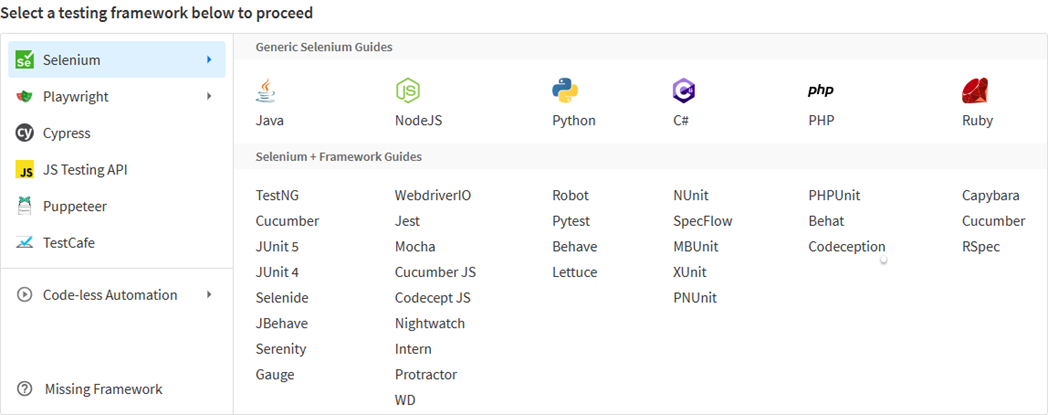
Figure 2: An overview of Testing Frameworks with programming
languages
6. Research
Impact
Given
the detailed analysis of WebAssembly and how it affects the performance of
front-end systems specifically for the web, the writing allows to equip the
developers with this useful technology to reflect efficiency in their systems
as well as the process of development. Certain difficulties for the browser can
only be solved with the use of WebAssembly and solutions are suggested
following that for the developers to overcome the hindrances existing to use
Wasm.
7. Future
Developments
Web
assembly has huge potential; in this paper, we have discussed many applications
already using web assembly in the field of machine learning, and pattern
recognition9. It will be used in Web-based
games and video applications where computer vision is involved which is
hardware hardware-intensive task. Web assembly is very practical in the field of
Metaverse because it is very necessary to put less burden on the front end and
keep resource-intensive tasks using the Web Assembly. Internet of thing is
becoming daily use by different companies and individuals, it involves
communication with hardware through an internet connection when applications
are increasing day by day, web assembly is the solution to reduce the frontend
burden and tackle it in web assembly where low-level code is involved helpful
for the IOT device communication10.
8. Conclusion
In
Conclusion, WebAssembly (Wasm) is a binary instruction format which is a
powerful tool for developers as it is equipped with numerous advantages. The
deployment of programming languages code over the web for client and server
applications is easy with the use of this format. The interaction between
programs and their platforms becomes easy. It offers benefits in terms of
performance, diversity, code sharing, security, and cross-browser
compatibility. However, there are certain difficulties associated with the use
of Wasm but these are addressed in this article with appropriate solutions.
9. References
- Haas A, Rossberg
A, Schuff DL, et al. Bringing the web up to speed with Web Assembly.
Proceedings of the 38th ACM SIGPLAN Conference on Programming Language Design
and Implementation, 2017.
- Yan Y, Tu T, Zhao L, Zhou Y, Wang W. Understanding the
performance of WebAssembly applications. Proceedings of the 21st ACM Internet
Measurement Conference, 2021.
- Smilkov D, Thorat
N, Yuan A. Introducing the WebAssembly backend for TensorFlow.js, TensorFlow, 2020.
- https://github.com/gopherjs/gopherjs
- A. Zakai, Emscripten:
an LLVM-to-JavaScript compiler. in Companion to the 26th Annual ACM SIGPLAN
Conference on Object-Oriented Programming, Systems, Languages, and
Applications, 2011.
- https://github.com/appcypher/awesome-wasm-langs
- https://www.smashingmagazine.com/2019/04/webassembly-speed-web-app/
- https://www.w3.org/2020/06/machine-learning-workshop/talks/a_proposed_web_standard_to_load_and_run_ml_models_on_the_web.html
- https://webassembly.org/docs/use-cases/
- Ray PP. An Overview of WebAssembly for IoT: Background, tools, state-of-the-art, challenges, and future directions. Future Internet, 2023;15: 275.