Morphological and Cytological Studies on Two Species of Tomato (Solanum lycopersicum L. and Solanum pimpinellifolium L. (Solanaceae)
Keywords: Morphological, Cytological, Solanum lycopersicum, Solanum pimpinellifolium, Crop improvement, taxonomic relationship
1.
Introduction
The tomato
belongs to the Solanaceae family under the genus Solanum. It is one of the most
important fruit crops in the world. It is regarded second in importance only to
the potato in several nations1. The
species of Solanum are indigenous to Ecuador, Peru, and the Galapagos Islands;
however, most evidence indicates that Mexico was the primary site of
domestication2,3. The tomato is
incredibly flexible; it can be found in thousands of cuisines across Europe,
from pizza to bloody marys, and from ketchup to chowder4. In Nigeria, tomatoes are a vital ingredient
in the cuisine of both affluent and impoverished individuals. Tomato stew is
particularly enjoyed on Sundays and during festive occasions. Tomatoes also have therapeutic and nutritional qualities. It is
necessary to offset the acids produced when meat and other fatty acids are
digested5. This roughage is
advantageous since it improves digestion and helps with constipation6. Tomatoes provide carbohydrates, fats,
proteins, vitamins, and minerals, which can enhance the brightness of the eyes
more effectively than cosmetics when consumed7,8.
It can be processed and packaged for both industrial and economic uses.
Furthermore, it can also be employed for gardening purposes5.
Solanum lycopersicum and Solanum
pimpinellifolium are two of the several tomato (Solanum) species that are the
focus of this study. According to research, fruit size QTLs are the main
determinant of tomato production, however locule and soluble solids may have
additional influence on the overall expression of tomato output9.
S. lycopersicum is a species characterized by medium to large fruit
size, commonly grown in contemporary agriculture, and usually yields 2 to 4
locules. Nevertheless, it possesses a small to moderate lycopene content, shows
low resistance to diseases, and displays a light red hue along with minimal
levels of soluble solids in the fruit3.
It is a herbaceous plant that can be classified as either an annual or a
short-lived perennial; it generally grows upright, possesses weak stems, and
frequently displays sprawling or vining traits. The stem is soft and covered in
hair, adorned with glandular trichomes, green in hue, and weak in structure,
although it becomes woody at the base as the plant matures. The leaves are
pinnately compound, arranged alternately, featuring irregularly lobed edges, a
hairy surface, and release a strong tomato aroma when crushed. The root system
comprises a taproot with numerous lateral roots; when grown in the field, the
roots develop a fibrous and extensive nature. The flowers are small, ranging
from 1 to 2 cm, yellow in color, pentamerous (consisting of five petals and
five sepals), actinomorphic, and grow in clusters referred to as racemes; they
are bisexual and primarily self-pollinating, although cross-pollination may
also take place. The fruit is a fleshy berry that can be round, oblong, or
pear-shaped. Depending on the cultivar, its smooth skin is green when it is
young and turns red, orange, pink, yellow, or purple when it is mature. The
kidney-shaped, tiny, flat seeds are covered in fine hairs and vary in colour
from pale yellow to brown10.
S. pimpinellifolium, conversely, is a wild species distinguished by its
small fruits that possess 2 locules. It is noted for its exceptional resistance
to diseases, high concentrations of soluble solids in its fruit, increased
lycopene levels, and a rich red hue11,12.
These characteristics hold immense importance for the tomato sector. Lycopene,
the compound chiefly accountable for the red hue of tomato fruit, serves as a
vital marker of fruit quality and is an essential element in the manufacturing
of premium processed tomato products6,13.
The characteristics of soluble solids and lycopene have garnered significant
attention from tomato geneticists and breeders, resulting in considerable
initiatives directed towards improving these traits in new cultivars11,13. This is a herbaceous plant that can be
categorized as either an annual or a short-lived perennial; it initially grows
erect but ultimately becomes sprawling or viny, extending to lengths of about 3
meters. The stem is slender and green, with a thickness of 8 to 11 millimeters
at the base, and is sparsely adorned with various types of glandular and
non-glandular trichomes. The leaves are imparipinnate, measuring between 4 to
12 centimeters in length, and consist of 2 to 4 pairs of lateral leaflets along
with a terminal leaflet. The fruits are quite diminutive, roughly 1 centimeter
in diameter, vibrant red, and spherical in shape, featuring two seed chambers.
At first, they have a hairy texture but gradually become smooth; they are
consumable yet not grown on a commercial scale. The seeds are small, ranging
from 2 to 3 millimeters, light brown in hue, and have fine, silky hair-like
extensions14.
The morphological
traits of plants are easily observable and accessible, which makes them the
most frequently employed in taxonomic studies15.
The data obtained from external morphology acts as the essential language for
the characterization, identification, classification, and relationships of
plants16. It is now broadly
recognized by taxonomists that morphological characteristics should not be the
only criteria taken into account in the systematic classification of plants17.
Cytology has demonstrated significant advantages in resolving specific
taxonomical challenges by providing additional characteristics17,18. The number of chromosomes and their
homology predominantly affect the pairing behavior observed during meiosis,
which in turn partially governs the fertility levels of hybrids, consequently
influencing breeding behaviors and variation patterns within populations. The
chromosomal count acts as a crucial and commonly employed taxonomic feature,
and it is, in fact, almost the only biosystematic evidence that is consistently
recorded in standard floras and the like19.
Although the
importance of these two species is well acknowledged, there have been few
comparative studies aimed at systematically assessing their morphological and
cytological characteristics together. This gap in knowledge hinders the
effective application of S. pimpinellifolium in tomato breeding programs, as
breeders require a thorough understanding of its cytogenetic compatibility and
morphological traits in relation to the cultivated tomato. Therefore, a
comprehensive analysis concentrating on the morphology and cytology of S.
lycopersicum and S. pimpinellifolium is crucial to furnish essential
information that can support genetic enhancement initiatives, conservation
strategies, and sustainable tomato farming. The aim of this study was to
evaluate the morphological and cytological studies on two species of tomato
(Solanum Lycopersicon and Solanum pimpinellifolium (Solanaceae).
2. Materials and Methods
2.1. Area of study
Seeds of the
species were germinated in polythene bags behind the Botany laboratory
premises, Awka, and subsequently taken to the laboratory for cytological and
morphological examination at maturity.
2.2. Collection
and identification of plant materials
S. lycopersicum
and S. Pimpinellifolium were bought from Oshe market Onitsha, Anambra State.
Plants identification was done by plant taxonomist at Botany department, Nnamdi
Azikiwe University, Awka. The voucher specimens were deposited at the Botany
department herbarium, Nnamdi Azikiwe University, Awka.
2.3. Morphological studies
Observations
regarding vegetative and reproductive characteristics, including plant habit,
leaf structure, flower morphology, fruit size, shape, and seed traits, were
conducted using samples obtained from mature plants. These attributes were
measured, documented, and analyzed to identify similarities and differences
between the two species.
2.4. Cytological studies
The materials
listed below were employed for the study of
·
Mitosis and meiosis: S. lycopersicum and S.
Pimpinellifolium root tips, immature flower buds, photomicroscope, reagents and
stains used were Carnoy's fluid, 1:3(v/v) glacial acetic acid and 95% ethanol,
70% ethanol, 18% hydrochloric acid, F.L.P. orcein, distilled water and 0.002m,
8-hydroxy-quinoline.
·
Procedure for mitotic chromosome studies: The root tip
squash technique was employed for the studies of mitotic chromosomes.
The roots of
newly germinated plant species under investigation were gathered and subjected
to a pretreatment of 5 hours with 8-hydroxyquinoline, followed by fixation in
Carnoy’s fluid (1:3 (V/V) glacial acetic acid and 95% ethanol) for a duration
of 24 hours. Subsequently, the roots underwent hydrolysis using 18% HCl for 5
minutes to facilitate the loosening of the cementing substance between cells,
thereby allowing the cells to spread during the squashing process. The
hydrolyzed roots were then rinsed in 70% alcohol to avert the crystallization
of the stain caused by the acid. A mounted needle was utilized to excise the
apical 1mm segment of the root tip onto a clean slide. A single drop of FLP
(formic, lactic, and propionic acids) orcein was applied to the specimen. A
thin cover slip was then placed over the specimen and gently squashed by
briskly tapping the cover slip with the blunt end of a biro. This tapping
continued until the material was adequately spread and became nearly invisible.
To enhance the spreading of the cells, the slide was positioned between a large
fold of filter paper on a smooth yet firm surface, and thumb pressure was
cautiously applied on top of the cover slip. Excess stain was absorbed with
filter paper, and the slide was subsequently placed under the microscope for
chromosome observation. This procedure is as outlined by20.
2.5. Procedure
for meiotic studies
For meiotic
investigations, the young flower buds of the two species being examined were
gathered between 8 am and 12 noon and subsequently fixed in Carnoy’s fluid,
which is composed of glacial acetic acid and 95% ethanol in a 1:3 ratio for a
duration of 24 hours. The Pollen mother cells (PMC) were then extracted from
the anthers in a drop of acetic orcein stain, covered with a cover slip, and
gently squashed by tapping the cover slip briskly with the blunt end of a biro.
This tapping was continued until the material was adequately spread and became
nearly invisible. To enhance the spreading of the cells, the slide was
positioned between a large fold of filter paper on a smooth yet firm table
surface, and thumb pressure was applied carefully on top of the cover slip.
Excess stain was removed using filter paper, and the slide was then mounted on
the microscope for chromosome observation. This procedure is as outlined by20.
2.6. Statistical
analysis
Analysis of variance was
used to examine quantitative morphological data. The significance of the
Duncan's multiple range test was employed to examine treatment differences. Results were presented in Mean ± Standard Deviation.
3. Results
3.1. Morphological
result
3.1.1.
Root morphology: S. lycopersicum and S. pimpinellifolium
exhibit a taproot system characterized by numerous lateral roots. The roots of
S. lycopersicum are moderately thick and possess fewer lateral branches, in
contrast to the thinner and more extensively branched roots of S.
pimpinellifolium. The root system of S. lycopersicum is shallow to moderately
deep, featuring noticeable adventitious roots at the base of the stem, while S.
pimpinellifolium has a deeper and more spreading root system with a dense
arrangement of lateral roots. In terms of root hair distribution, S.
lycopersicum shows a moderate presence, whereas S. pimpinellifolium displays an
abundance of root hairs (Plate 1-2).
3.1.2. Stem
morphology: Both S. lycopersicum and S. pimpinellifolium have branching, upright,
herbaceous stems. S. pimpinellifolium had a narrower, tougher, and slenderer
stem than S. lycopersicum, which was comparatively thicker, softer, and more
succulent. While both species displayed pubescent stems, S. pimpinellifolium
had denser trichomes than S. lycopersicum. S. pimpinellifolium had a greener,
slightly tougher stem with longer internodes than S. lycopersicum, which had a
green stem with a weakly woody base (Figures 1-2).
3.2. Leaf morphology and phyllotaxy
Solanum
lycopersicum and Solanum pimpinellifolium exhibit alternate phyllotaxy, with
leaves appearing singly at each node. Both species possess compound and
pinnately lobed leaves. Nevertheless, the leaves of S. lycopersicum are larger,
broader, and more expanded compared to those of S. pimpinellifolium, which are
smaller and narrower. The average leaf length of S. lycopersicum varies from 15
to 25 cm, with a width ranging from 8 to 15 cm, while the leaves of S.
pimpinellifolium measure between 5 and 12 cm in length and 3 to 6 cm in width.
Both species
exhibited petiolate leaves; however, S. lycopersicum had a longer petiole,
averaging between 4 and 7 cm, whereas S. pimpinellifolium had a shorter
petiole, measuring from 2 to 4 cm. The leaf margins of both species were
irregularly lobed, with S. pimpinellifolium displaying deeper and more
pronounced lobing. The surfaces of the leaves were pubescent in both species;
nonetheless, the trichomes were more plentiful in S. pimpinellifolium compared
to S. lycopersicum. In both species, the leaf apex was acute to acuminate,
while the leaf base was unequal and slightly decurrent on the petiole. Both
species exhibited petiolate leaves; however, S. lycopersicum had a longer
petiole, averaging between 4 and 7 cm, whereas S. pimpinellifolium had a
shorter petiole, measuring from 2 to 4 cm. The leaf margins of both species
were irregularly lobed, with S. pimpinellifolium displaying deeper and more
pronounced lobing. The surfaces of the leaves were pubescent in both species;
nonetheless, the trichomes were more plentiful in S. pimpinellifolium compared
to S. lycopersicum. In both species, the leaf apex was acute to acuminate,
while the leaf base was unequal and slightly decurrent on the petiole (Figures 3-4).
3.3. Morphology
of inflorescence and flower
Both Solanum
lycopersicum and Solanum pimpinellifolium exhibit cymose inflorescences. The
inflorescence of S. lycopersicum is typically simple or exhibits weak
branching, in contrast to the more extensively branched inflorescence of S.
pimpinellifolium, which supports a higher quantity of flowers. On average, S.
lycopersicum has 4 to 8 flowers per inflorescence, while S. pimpinellifolium
inflorescences contain between 10 and 20 flowers. The flowers of both species
were small, pedicellate, and actinomorphic. However, the flowers of S.
lycopersicum were comparatively larger, measuring approximately 1.5-2.5 cm in
diameter, whereas those of S. pimpinellifolium were smaller, with a diameter
ranging from 0.8 to 1.2 cm. In both species, the flowers exhibited bisexual and
pentamerous characteristics. Both species featured five green sepals that
formed a persistent calyx. The corolla in both species was yellow and comprised
five petals that were fused at the base; however, the corolla lobes were
broader in S. lycopersicum and narrower in S. pimpinellifolium. The androecium
included five stamens in both species, with yellow anthers arranged in a cone
around the style. The pistil was singular, characterized by a superior ovary, a
slender style, and a terminal stigma in both species (Figures 5-6).
3.4. Morphology
of fruit and seed
S. lycopersicum
and S. pimpinellifolium yield fleshy berry fruits. The fruits of S.
lycopersicum are larger, typically globose to slightly oblong, and smooth,
whereas those of S. pimpinellifolium are smaller, round, and more consistent in
shape. The average diameter of S. lycopersicum fruits ranges from 4 to 8 cm,
while the fruits of S. pimpinellifolium measure approximately 0.8 to 1.5 cm in
diameter. At maturity, the fruit color is red for both species, although the
fruits of S. pimpinellifolium exhibit a brighter red hue.
Both species
produce many-seeded fruits; however, S. lycopersicum has fewer seeds per fruit
in comparison to S. pimpinellifolium. The average seed count per fruit varies
from 100 to 300 in S. lycopersicum and from 200 to 500 in S. pimpinellifolium.
The seeds of both species are small, flat, and ovate. The seeds of S.
lycopersicum are slightly larger, measuring about 2.5 to 3.5 mm in length,
while those of S. pimpinellifolium are smaller, with lengths ranging from 1.5
to 2.5 mm. The seed color is cream to light brown in both species, and the seed
surface is slightly pubescent (Figures 7-10).
3.5. Habit
S. lycopersicum and S.
pimpinellifolium are erect, branching herbaceous plants. S. lycopersicum is taller and more
robust, while S. pimpinellifolium
is shorter, slender and more delicate (Figures 1-2).
3.6. Habitat
S. lycopersicum commonly occurs in
cultivated fields and gardens under managed conditions, while S. pimpinellifolium
grows naturally in open, disturbed soils and marginal areas. S. pimpinellifolium
shows greater adaptability to dry and nutrient-poor soils compared to S.
lycopersicum (Figures 1-2).
Figure 1: S.
lycopersicum Plant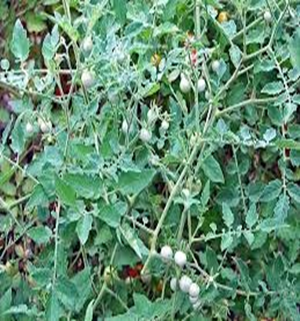
Figure 2: S.
pimpinellifolium Plant.

Figure 3:
S. lycopersicum showing its leaves.
Figure 4: S. pimpinellifolium showing its leaves
Figure 5:
S. lycopersicum showing its Inflorescence.

Figure 6: S. pimpinellifolium showing
its Inflorescence.