Service Quality in Digital and Phygital Learning Environments: Evidence from West African Higher Education
Graphical Abstract
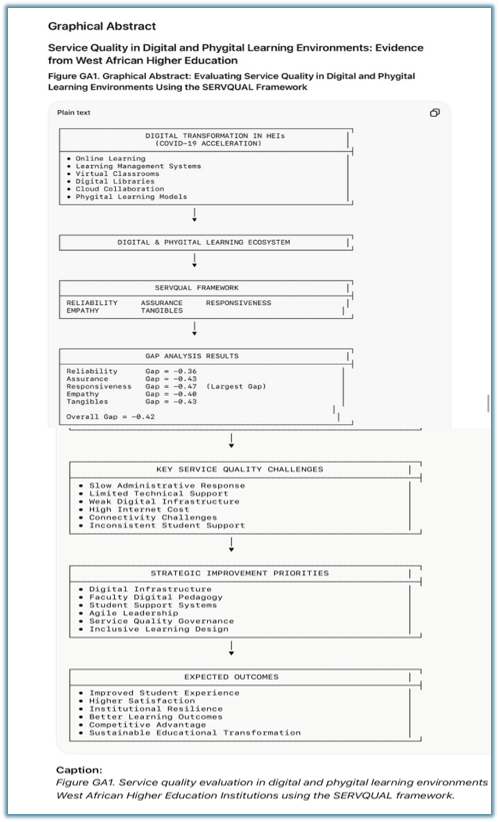
Abstract
The
rapid digitalisation of higher education, accelerated by the COVID-19 pandemic,
has redefined how service quality is conceptualised, delivered and evaluated
within universities. In West Africa, where Higher Education Institutions (HEIs)
operate under significant infrastructural, technological and resource
constraints, the transition to digital and blended “phygital” learning
environments has created both opportunities and challenges for maintaining
quality standards.
This study evaluates service quality in digital and phygital learning environments within HEIs in West Africa using the SERVQUAL framework. The study focuses on five core dimensions: reliability, assurance, responsiveness, empathy and tangibles. Employing a mixed-method, survey-based design, data were collected from 424 stakeholders, including students, faculty members, administrators and alumni. A gap analysis approach was used to compare stakeholder expectations with perceived experiences across the five SERVQUAL dimensions.
The findings reveal negative service quality gaps across all dimensions, with the most significant gaps occurring in responsiveness, assurance and tangibles. These gaps reflect institutional limitations in timely support, digital confidence, infrastructure, connectivity and technology-enabled service delivery. However, the findings also show moderate progress in reliability, access to learning materials and continuity of academic delivery. Overall, the results indicate that digital transformation has improved some aspects of higher education service delivery while exposing deeper weaknesses in institutional support systems.
The study argues that service quality in digital higher education is not merely a function of technological deployment. It requires integrated investment in digital infrastructure, pedagogy, faculty development, student support systems, institutional governance and managerial capability. The paper contributes to educational management literature by offering context-specific insights into service quality measurement in emerging economies and provides recommendations for improving student experience, institutional resilience and competitiveness.
Keywords: Service Quality, SERVQUAL, Digital Learning, Phygital Learning, Higher Education Institutions, West Africa, Educational Management, Student Experience, Digital Transformation
1. Introduction
Service
quality has become a central concern in higher education management,
particularly in an increasingly competitive, globalised and technology-mediated
educational environment. Traditionally, universities were evaluated primarily
on academic reputation, research output, faculty strength and graduate
employability. However, contemporary higher education increasingly recognises
students, faculty, alumni and other stakeholders as active participants whose
experiences, expectations and satisfaction shape institutional sustainability.
The rapid digitalisation of higher education has expanded the meaning of service quality. In traditional learning environments, service quality was often associated with lecture delivery, physical facilities, administrative support and interpersonal engagement. In digital and phygital learning environments, however, service quality now includes platform reliability, online responsiveness, digital accessibility, virtual engagement, technical support, learner autonomy and the quality of blended learning design.
The COVID-19 pandemic accelerated this transformation. HEIs across the world were compelled to migrate rapidly from physical classrooms to online and blended learning systems. For West African institutions, this shift was particularly challenging because many institutions already faced infrastructural deficits, limited digital readiness, uneven access to devices, poor internet connectivity and inadequate digital pedagogy capacity.
Yet the crisis also created an opportunity. It forced institutions to rethink service delivery, adopt digital tools, redesign learning processes and explore blended models that combine physical and digital learning. This blended approach, often described as “phygital learning”, has become increasingly relevant for HEIs seeking flexibility, resilience and wider access.
This paper examines service quality in digital and phygital learning environments in West African HEIs. It applies the SERVQUAL model to assess gaps between stakeholder expectations and perceived experiences. The central argument is that service quality in digital higher education is multidimensional and must be managed through the integration of technology, pedagogy, institutional support and agile leadership.
2. Literature Review
2.1. Service quality in higher education
Service
quality is widely recognised as a major determinant of student satisfaction,
institutional reputation and competitive advantage. Parasuraman, Zeithaml and
Berry developed the SERVQUAL model to measure service quality as the gap
between customer expectations and perceptions. The model identifies five
dimensions: reliability, assurance, responsiveness, empathy and tangibles1.
In higher education, reliability may refer to consistency in teaching, assessment and administrative processes. Assurance relates to the competence, credibility and confidence demonstrated by faculty and institutional staff. Responsiveness concerns the speed and effectiveness of support services. Empathy reflects personalised attention and care for learners. Tangibles include physical facilities, technological infrastructure, digital tools and learning resources.
Although SERVQUAL was originally developed for general service industries, it has been widely adapted to higher education because universities increasingly operate in environments where stakeholder satisfaction, service experience and institutional responsiveness matter significantly.
2.2. Digital transformation and service
delivery
Digital
transformation has altered the delivery of higher education services. Learning
management systems, virtual classrooms, online assessment platforms, electronic
libraries, cloud-based collaboration tools and artificial intelligence-enabled
learning systems have expanded the reach and flexibility of education.
However, digital transformation does not automatically improve service quality. Matt, Hess and Benlian argue that digital transformation requires coherent strategies that align technology with organisational structures and stakeholder needs2. Vial similarly emphasises that digital transformation involves organisational change triggered by digital technologies, not merely the adoption of digital tools3.
In higher education, this means that online platforms must be supported by redesigned pedagogy, responsive administration, digital competence, student support and quality assurance systems. Without these elements, digital learning can reproduce or even worsen existing service quality weaknesses.
2.3. Phygital learning and the student
experience
Phygital
learning refers to the deliberate integration of physical and digital learning
experiences. It seeks to combine the strengths of face-to-face interaction with
the flexibility, scalability and accessibility of digital platforms.
Chaturvedi, Purohit and Verma argue that blended and online learning became
essential during the COVID-19 crisis, but their effectiveness depends on
learner engagement, technological access and institutional readiness4.
In West Africa, phygital learning offers significant potential. It can reduce geographical barriers, support working professionals, enhance lifelong learning and increase access to quality education. However, it also creates complexity. Institutions must coordinate multiple delivery channels, maintain consistency across physical and virtual environments and ensure that students receive timely academic, administrative and technical support.
2.4. Service quality challenges in
emerging economies
Service
quality in emerging economies is shaped by structural and institutional
factors. In West Africa, HEIs often operate in environments marked by
unreliable electricity, limited broadband penetration, high internet costs,
inadequate digital infrastructure and constrained funding. These challenges
affect the capacity of institutions to deliver reliable and responsive digital
learning experiences.
The World Bank notes that educational technology in Sub-Saharan Africa has potential to improve access and quality, but its impact depends on infrastructure, teacher capacity, governance and equity5. Therefore, the measurement of service quality in West African digital higher education must be context-sensitive.
3. Theoretical Framework
This
study is anchored in the SERVQUAL framework developed by Parasuraman, Zeithaml
and Berry1. The model is
appropriate because it evaluates service quality through the gap between
stakeholder expectations and actual perceived experiences.
For the purpose of this study, the SERVQUAL dimensions were adapted to digital and phygital learning environments as follows:
Reliability refers to the consistency of digital learning delivery, availability of learning materials, stability of academic schedules and dependability of online systems.
Assurance refers to the confidence stakeholders have in faculty competence, digital pedagogy, institutional credibility and the ability of staff to support technology-enabled learning.
Responsiveness refers to the timeliness of feedback, speed of administrative response, availability of technical support and the capacity of institutions to address student needs quickly.
Empathy refers to personalised attention, learner support, flexibility, inclusiveness and the institution’s sensitivity to student circumstances.
Tangibles
refer to physical and digital infrastructure, learning platforms, internet
access, devices, digital libraries and the visible resources that support
phygital learning (Figure 1).
Figure 1: Conceptual Framework of Service Quality in Digital and Phygital Learning
4. Methodology
The
study adopted a mixed-method research design to evaluate service quality in
digital and phygital learning environments within HEIs in West Africa.
Data were collected using structured questionnaires and open-ended questions. The structured component was based on the SERVQUAL dimensions of reliability, assurance, responsiveness, empathy and tangibles. The open-ended component captured qualitative insights from stakeholders regarding their lived experiences of digital and phygital learning
The sample consisted of 424 valid respondents drawn from HEIs in West Africa. Respondents included students, faculty members, administrative staff and alumni. This broad stakeholder composition enabled the study to capture diverse perspectives on service quality.
The study employed descriptive statistics and gap analysis to compare expectations and perceived experiences across the SERVQUAL dimensions. Qualitative responses were analysed thematically to identify recurring challenges, opportunities and institutional improvement priorities (Tables 1 and 2).
Table
1: Demographic Profile of Respondents.
|
Stakeholder Group |
Frequency |
Percentage |
|
Students |
170 |
40.1 |
|
Faculty |
102 |
24.1 |
|
Administrations |
76 |
17.9 |
|
Alumini |
76 |
17.9 |
|
Total |
424 |
100 |
Table 2: SERVQUAL Framework Adaption for Digital and Phygital Learning
|
Dimension |
Traditional Interpretation |
Digital Learning Interpretation |
|
Reliability |
Consistent Service |
Platform Stability |
|
Assurance |
Staff Competence |
Digital Pedagogy Confidence |
|
Responsiveness |
Timely Response |
Online Support Speed |
|
Empathy |
Personal Attention |
Learner-Centred Support |
|
Tangibles |
Physical Facilities |
Digital Infrastructure |
5. Results
5.1. Overall service quality gap
The
study found that stakeholder expectations were higher than their perceived
experiences across all SERVQUAL dimensions. The aggregate expectation mean was
4.14, while the aggregate current experience mean was 3.73, producing an
overall service quality gap of -0.42 (Figures 2 and 3)
This
negative gap indicates that although stakeholders recognised improvements in
digital service delivery, current institutional performance did not fully meet
expectations. The finding confirms that digital transformation has created
progress but has not yet fully resolved service quality limitations in West
African HEIs (Tables 3 and 4).

Figure 2: SERVQUAL Gap Analysis Model.
Figure 3: Radar Chart of SERVQUAL Gaps.
Table 3: Expectations and Experience Scores.
|
Dimension |
Expectation Mean |
Experience Mean |
Gap |
|
Reliability |
4.11 |
3.74 |
-0.36 |
|
Assurance |
4.19 |
3.77 |
-0.43 |
|
Responsiveness |
4.13 |
3.66 |
-0.47 |
|
Empathy |
4.22 |
3.83 |
-0.4 |
|
Tangibles |
4.02 |
3.59 |
-0.43 |
|
Overall |
4.14 |
3.73 |
-0.42 |
Table 4: Ranking of Service Quality Gaps.
|
Rank |
Dimension |
Gap |
|
1 |
Responsiveness |
-0.47 |
|
2 |
Assurance |
-0.43 |
|
3 |
Tangibles |
-0.43 |
|
4 |
Empathy |
-0.4 |
|
5 |
Reliability |
-0.36 |
5.2. Responsiveness
Responsiveness
recorded an expectation mean of 4.13 and a current experience mean of 3.66,
producing the largest gap of -0.47.
This finding indicates that responsiveness is the most significant service quality weakness in the sampled HEIs. Stakeholders reported concerns relating to delayed feedback, slow administrative response, inadequate technical support and limited real-time assistance in digital learning environments.
In phygital learning systems, responsiveness is critical because students rely on timely communication, platform support, assessment feedback and administrative guidance. A lack of responsiveness can reduce student satisfaction, weaken engagement and undermine confidence in digital learning.
5.3. Assurance
Assurance
recorded an expectation mean of 4.19 and a current experience mean of 3.77,
producing a gap of -0.43.
This gap suggests that stakeholders expected higher levels of competence, confidence and credibility in digital learning delivery than they experienced. While many faculty members adapted to online platforms, the findings indicate the need for stronger digital pedagogy skills, better instructional design, improved assessment practices and more consistent learner support.
Assurance in digital education depends not only on academic expertise but also on the ability of faculty and administrators to operate confidently within technology-enabled environments.
5.4. Tangibles
Tangibles
recorded an expectation mean of 4.02 and a current experience mean of 3.59,
producing a gap of -0.43.
This finding highlights infrastructure-related limitations in digital and phygital learning environments. Tangibles include digital platforms, internet connectivity, devices, virtual learning infrastructure, digital libraries and physical facilities that support blended learning.
The gap in tangibles reflects the broader infrastructural challenges affecting higher education in West Africa. Without reliable infrastructure, even well-designed digital learning strategies may fail to deliver the expected quality of experience.
5.5. Empathy
Empathy
recorded an expectation mean of 4.22 and a current experience mean of 3.83,
producing a gap of -0.40.
Although empathy performed moderately well, the negative gap shows that stakeholders expected more personalised attention and support than they received. Digital environments can sometimes reduce human connection, especially when institutions lack structured learner support mechanisms.
In West African HEIs, empathy is particularly important because students may face unequal access to technology, financial constraints, unstable connectivity and competing work or family responsibilities. Institutions must therefore design digital learning systems that are flexible, inclusive and sensitive to learner realities.
5.6. Reliability
Reliability
recorded an expectation mean of 4.11 and a current experience mean of 3.74,
producing a gap of -0.36. This was the smallest gap among the five dimensions.
The relatively better performance in reliability suggests that digital platforms improved consistency in access to learning materials, lecture delivery and academic continuity. During and after the COVID-19 disruption, many institutions became more capable of sustaining learning activities through online platforms and blended delivery models.
However, the negative gap indicates that reliability remains below stakeholder expectations. Inconsistent internet access, platform instability and uneven faculty adoption continue to affect the dependability of digital and phygital learning (Table 5).
Table
5: Key Challenges Identified by Respondents.
|
Challenge |
Frequency |
Percentage |
|
Internet Cost |
391 |
92.2 |
|
Conmectivity |
383 |
90.3 |
|
Infrastructure |
361 |
85.1 |
|
Technical Support |
315 |
74.3 |
|
Digital Skill Gaps |
251 |
59.2 |
6. Discussion
The
findings demonstrate that service quality in digital and phygital learning
environments remains a major challenge for HEIs in West Africa. Although
digital transformation has improved access, continuity and flexibility, it has
also exposed weaknesses in responsiveness, assurance and infrastructure.
The largest gap in responsiveness suggests that institutions must prioritise student support systems. Digital learning environments require fast, accessible and reliable communication channels. Students must be able to receive timely responses to academic, administrative and technical concerns.
The gap in assurance indicates the need for continuous faculty development. Digital teaching requires more than transferring classroom lectures to online platforms. It requires digital pedagogy, learner engagement strategies, online assessment design and confidence in the use of educational technologies.
The gap in tangibles confirms that infrastructure remains a central constraint. Institutions cannot deliver high-quality phygital learning without investment in platforms, connectivity, devices, digital libraries and technical support.
The relatively smaller gap in reliability suggests that digital transformation has improved continuity of learning. However, sustaining this improvement requires institutional commitment, quality assurance systems and continuous improvement6-10.
Overall, the results support the view that service quality in digital higher education is not simply a technological issue. It is an institutional capability issue. It requires coordination across leadership, infrastructure, pedagogy, staff development, student support and governance (Figure 4).

Figure 4: Digital and Phygital Learning Service Quality Ecosystem.
7. Managerial Implications
7.1. Invest in digital infrastructure
HEIs must prioritise investment in reliable learning management systems, internet connectivity, cybersecurity, digital libraries, cloud infrastructure and technical support systems. Tangible infrastructure forms the foundation for dependable digital and phygital learning.
7.2. Strengthen faculty digital pedagogy
Institutions
should provide continuous professional development for faculty members in
online teaching, digital assessment, learner engagement, instructional design
and the ethical use of educational technologies.
7.3. Improve responsiveness and student
support
Institutions
should establish responsive helpdesks, digital support centres, student
advisory systems and clear communication channels. Responsiveness should be
treated as a core service quality metric.
7.4. Build empathy into digital learning
design
Digital
learning systems should be designed around student realities. Flexible
deadlines, inclusive access policies, mentoring systems and personalised
academic support can improve empathy and engagement.
7.5. Integrate service quality into
strategic management
Service
quality assessment should not be treated as a one-time exercise. HEIs should
institutionalise regular SERVQUAL-based evaluations and use the findings to
improve operations, governance and student experience (Figure 5) and (Table
6).

Figure 5: Service Quality Improvement Framework for West African HEIs.
Table 6: Managerial Action Matrix.
|
Service Gap |
Startegic Response |
Expected Outcomes |
|
Responsiveness |
Digital Helpdesk |
Faster Support |
|
Assurance |
Faculty Devolpment |
Improved Confidence |
|
Tangibies |
Infrastructure Investment |
Better Experience |
|
Empathy |
Student Success Centers |
Greater Satisfaction |
|
Reliability |
LMS Enhancement |
Consistent Delivery |
8. Contribution to Knowledge
This
study contributes to the literature in four major ways.
First, it applies the SERVQUAL framework to digital and phygital learning environments in West African HEIs, a context that remains underrepresented in global educational management research.
Second, it provides empirical evidence that service quality gaps persist even when digital transformation improves access and continuity.
Third, it identifies responsiveness, assurance and tangibles as the most critical areas requiring institutional improvement.
Fourth, it demonstrates that service quality in digital higher education should be understood as a strategic management issue rather than a purely technological concern.
Table
7: Service Quality Maturity Model for
Digital HEIs.
|
Level |
Maturity Stage |
Characteristics |
|
1 |
Reactive |
Basic Digital Service |
|
2 |
Emerging |
LMS Adoption |
|
3 |
Structured |
Integrated Digital Learning |
|
4 |
Optimised |
Phygital Learning Excellence |
|
5 |
Transformational |
Student-Centred Digital Ecosystem |
9. Conclusion
Service
quality remains a critical determinant of institutional success in higher
education, particularly in digitally mediated environments. As HEIs in West
Africa continue to adopt digital and phygital learning models, they must ensure
that technology-enabled education meets stakeholder expectations.
The findings show that digital transformation has improved aspects of reliability, access and continuity. However, significant gaps remain in responsiveness, assurance and tangibles. These gaps reflect deeper challenges in institutional capacity, infrastructure, digital pedagogy and student support.
Improving service quality requires a holistic approach that integrates technology, pedagogy, leadership, governance and support systems. HEIs that address these dimensions will be better positioned to improve student experience, strengthen institutional competitiveness and contribute to the long-term transformation of higher education in West Africa.
10. Limitations and Future Research
This
study is limited by its regional focus and cross-sectional design. While the
findings provide important insights into West African HEIs, future research
could examine country-specific differences, institutional types and
longitudinal trends.
Further studies may also explore the relationship between service quality and student retention, academic performance, digital engagement and institutional reputation. Comparative studies between West African HEIs and institutions in other emerging regions would also enrich the literature.
11. References
1.
Parasuraman
A, Zeithaml VA, Berry LL. SERVQUAL: A multiple-item scale for measuring
consumer perceptions of service quality. Journal
of Retailing, 1988;64(1): 12-40.
2.
Matt
C, Hess T, Benlian A. Digital transformation strategies. Business & Information Systems
Engineering, 2015;57(5): 339-343.
3.
Vial
G. Understanding digital transformation: A review and a research agenda. Journal of Strategic Information Systems,
2019;28(2): 118-144.
4.
Chaturvedi
K, Purohit H, Verma M. Effective teaching practices for success during COVID-19
pandemic: Towards phygital learning. Frontiers
in Education, 2021;6: 1-9.
5.
World
Bank. Education Technology in
Sub-Saharan Africa. Washington, DC: World Bank, 2023.
6.
Abad-Segura E,
González-Zamar MD, Infante-Moro JC, et al. Sustainable management of digital
transformation in higher education. Sustainability,
2020;12(5): 2107.
7.
Baale
JO. The Application of Agile Digital
Transformation Strategy in Higher Education Institutions in West Africa,
Business School Netherlands, 2022.
8.
Baale
L. Digital Transformation of Education
in Africa: Bridging the Gaps and Building the Future. The Nigerian
Journal of Pharmacy, 2024;58(2): 149-180.
9.
Dwivedi
YK, et al. Artificial intelligence and digital transformation in education:
Opportunities, challenges and implications. International Journal of Information Management, 2023;71: 1-15.
10.
Hodges
C, Moore S, Lockee B, et al. The difference between emergency remote teaching
and online learning. EDUCAUSE Review,
2020.